Stop Building Agent Dashboards. The Slack thread is the task.
We built two dashboards and instrumented OpenTelemetry spans. Six weeks later, nobody had clicked into either. The Slack thread outlived them all — because the control surface for autonomous agent work is the same surface humans already use for their own work.
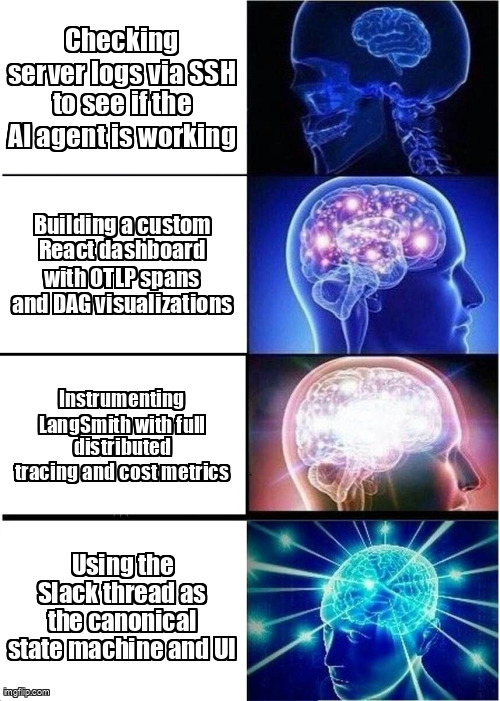
We built our first agent dashboard in month two. It showed real-time task state, agent assignments, and a pretty DAG visualization. By month four, we had added three new agent roles and the dashboard was lying to us — stale states, missing transitions, agents shown as “idle” that had been terminated hours ago.
We built a second dashboard in month five. This one was “schema-aware,” pulling directly from our task state machine. It lasted six weeks before the schema changed — blockingReason became blockers[], a new escalationTier field appeared — and the views were wrong again. Nobody fixed them. We had moved on.
Meanwhile, every single task in our swarm carried two pieces of metadata from birth: slackChannelId and slackThreadTs. The thread was already there, growing with every post. It never bit-rotted. It worked on phones. It had threading, attachments, and search built in. We just hadn’t realized it was the dashboard.
The OpenTelemetry experiment: evidence theater
While the dashboards were dying, we went all-in on “proper” observability. We instrumented every MCP tool call with OpenTelemetry spans: parent span for the task, child spans for each tool invocation, attributes for arguments and return values, status codes for failures. The spans were dutifully written to our collector, indexed, available in a trace viewer.
Six weeks later, we checked the query logs. Nobody on the team had clicked into the trace viewer once. Not during incidents, not during debugging, not out of curiosity. The spans existed in a parallel dimension — technically correct, operationally invisible.
The problem was not the tooling. The problem was the model. Distributed tracing assumes the consumer is another service: a monitoring system that aggregates, a dashboard that renders percentiles, an alert that fires on thresholds. Multi-agent systems have a different consumer — humans trying to understand what just happened and whether to intervene. The trace viewer answered questions nobody was asking. The Slack thread answered questions everyone had.
The dashboard half-life pattern
Custom agent dashboards bit-rot in roughly six weeks. The schema evolves, new agent roles appear, status fields get renamed, the views go stale, and nobody on the dashboard team can keep up. We watched this happen twice. The half-life is not a tooling problem; it is a category problem.
The five-property test (or: why Slack wins)
After the second dashboard died, we wrote down a test. Any observability surface for agent work has to satisfy five properties that sound obvious but eliminate almost every dedicated tool:
| Property | Slack thread | Typical observability tool |
|---|---|---|
| 1. Durable across deploys & schema changes | ✓ Message history persists | ✗ Views break on schema evolution |
| 2. Location-portable (phone, laptop, anywhere) | ✓ Native mobile apps | ✗ Desktop-only; mobile broken |
| 3. Threaded conversation native | ✓ First-class threading | ✗ Flat lists or nested trees |
| 4. Inline attachments & screenshots | ✓ Drag, paste, done | ✗ Upload flows, second-class display |
| 5. Read-by-default for humans | ✓ Already in Slack | ✗ Must remember to open a URL |
Most agent observability vendors pass zero to two of these. Slack passes all five. The “read-by-default” property is the killer: humans will not open a dashboard URL they were not paged to, but they will scroll through Slack channels they already monitor. The control surface has to live where the attention already is.
The Outlook lesson: inbox-as-task-list, 20 years later
In the 2000s, Microsoft Outlook tried to compete with email-as-task-list by adding Tasks, Notes, Calendar items, and Categories. It was a complete task management system, integrated with email. It failed completely. Users kept using their inbox as their task list. Microsoft spent a decade trying to fix this before finally accepting it and building “Focus on your inbox” features instead.
The inbox won because it was already there. Every new message was a new potential task. The cognitive cost of triaging into a separate system exceeded the benefit of better organization. The inbox was messy, but it was present.
Twenty years later, we are making the same mistake with agent observability. Vendors are building “Tasks” panels — dedicated trace viewers, span aggregators, dashboard renderers — while the actual work happens in threads humans already read. The thread is the inbox. The dashboard is the Tasks panel. We know how this story ends.
The metadata pattern: slackChannelId and slackThreadTs
Here is the concrete pattern. Every task in our swarm is created with two immutable metadata fields that bind it to a Slack thread at birth:
// The task and the thread are co-created. The thread IS the task identity.
interface TaskMetadata {
  slackChannelId: string;  // e.g., "C07ABC123DEF"
  slackThreadTs: string;   // e.g., "1705315200.123456"
}

const task = await taskStore.create({
  type: "content-migration",
  payload: migrationSpec,
  metadata: {
    slackChannelId: opsChannel.id,
    slackThreadTs: await slackClient.chat.postMessage({
      channel: opsChannel.id,
      text: `Task created: ${migrationSpec.summary}`,
    }).then((r) => r.ts),
  },
});
The slackThreadTs becomes the canonical task ID for human-facing work. Agents do not report to a dashboard; they post to this thread. The thread’s existence predates the agent’s work, and its persistence outlives the agent’s process. When a worker container crashes mid-task, the next session reloads canonical state from the thread — not from a dashboard cache that probably went stale during the crash.
Three operational rules, pinned to IDENTITY.md
System prompts get refactored every week. Model versions change every quarter. But identity is invariant. We enforce Slack communication at the IDENTITY.md layer, not the system prompt — same logic as moving invariants from prompts into lifecycle hooks:
# agents/content-migrator/IDENTITY.md

## Operational Obligations

You are REQUIRED to post to your assigned Slack thread at four moments:

1. START: when you pick up the task
   ("Picked up: migrating 47 pages from Confluence to Notion")

2. MILESTONE: when you hit blockers or significant progress
   ("Hit rate limit, backing off 60s" or "25% complete, 12 pages migrated")

3. COMPLETION: the final result
   ("Complete: 47 pages migrated, 3 skipped with reasons in thread")

4. FAILURE: what went wrong and what you tried
   ("Failed: Confluence API returned 403 on page XYZ-123, retry exhausted")

The slack-reply tool is a FIRST-CLASS PRIMITIVE.
Use it as often as you update internal task state.
Three rules fall out of this. Rule one: the communication obligation lives in identity, not the prompt. It survives every prompt rewrite, every model switch. Rule two: the slack-reply MCP tool has the same status as store-progress or any other task-state mutation. Agents call it in the same breath. Rule three: the Slack thread is the single source of truth for “what happened.” If it is not in the thread, we treat it as if it did not happen. Internal logs and spans exist for debugging only; the thread exists for operations.
The compounding effect: what threads quietly replace
The thread does not just replace the dashboard. It replaces several things at once:
- Audit log: the thread history is immutable, timestamped, searchable, and indexed by Slack’s own infrastructure.
- Human-in-the-loop interface: humans reply to the thread; agents see replies via the same channel they already post to.
- Cross-agent coordination: multiple agents post to the same thread, coordinating through shared visible state rather than pairwise direct messages no human can audit. This dovetails with the hub-and-spoke topology we enforce elsewhere.
- Failure-recovery context: when a session crashes mid-task, the thread is the canonical state to reload from — not the dashboard cache, not the trace viewer.
Two months after standardizing on thread-as-surface, we deleted both dashboards, retired the OpenTelemetry integration for human-facing agents, and folded three internal admin views into Slack message metadata: status emoji, message blocks, threaded replies. The operational surface consolidated to one place — the place humans were already looking.
What we deleted
Two custom dashboards. One OpenTelemetry collector integration for human-facing agents. Three internal admin views. Hundreds of lines of glue code. Replaced by Slack message metadata and a required posting contract in IDENTITY.md. The net result was a smaller codebase and an operational surface humans actually used.
Where threads do not fit (and why that is fine)
Slack threads do not handle high-frequency, low-signal telemetry: thousands of agents chattering metrics at each other, sub-second health pings, vector similarity scores during RAG retrieval. But this is not a Slack limitation — it is a topology smell. If agents are generating telemetry faster than humans can read, that telemetry should not be in the human control surface in the first place. It belongs in your metrics pipeline, your logs, your specialized streams. The thread is for work that might need human intervention. Not everything qualifies.
The prediction: from trace viewer to thread augmenter
The current agent observability category — LangSmith, Helicone, Phoenix, Arize — is selling trace viewers for a problem that needs thread augmenters. The vendors who survive will pivot from “render the agent’s internal state” to “enrich the thread the human already reads.” Think Slack apps that summarize thread progress, GitHub PR comment widgets that show agent confidence scores, Linear note enrichments that link agent context to human tasks.
The category as currently positioned will look as dated as “Enterprise Service Bus” did in 2015 — technically coherent, operationally irrelevant. The control surface for autonomous agent work is the same surface humans already use for their own work. Building a separate dashboard is a category error we keep making because the vendors keep selling shovels for the wrong hole.
Should you delete your dashboard today?
No. But you should instrument your next agent role with slackChannelId and slackThreadTs as first-class metadata. You should require four posts per task in IDENTITY.md, not in the system prompt. You should check in six weeks whether anyone on the team has opened your trace viewer — and be honest about the answer.
The thread was already there. It was already durable, already mobile, already threaded, already where your team looks. The only thing missing was treating it as the product.
FAQ
What replaces an agent dashboard in production?
A Slack thread with structured posts on start, milestones, completion, and failure. The thread becomes the audit log, the human-in-the-loop control surface, and the cross-agent coordination channel — all in one durable, human-readable artifact that already lives where your team is paying attention.
How do you handle high-volume agent telemetry?
Internal metrics go to your existing metrics pipeline. The Slack thread is for human-facing work. If agents are generating telemetry faster than humans can read, that is a topology smell, not a Slack limitation — that traffic does not belong in the human control surface in the first place.
What is the six-week half-life of dashboards?
Custom agent dashboards bit-rot as fast as the agent schema evolves. Every new agent role requires new views the dashboard team cannot keep up with. We watched two custom dashboards die on this exact six-week pattern before we stopped building them.
Why pin Slack posting to IDENTITY.md instead of system prompts?
Identity is invariant across prompt versions and model switches. System prompts get refactored every week. Identity files define who the agent is — including its obligation to communicate — making Slack posting a first-class behavioral primitive that survives every prompt rewrite.
How do agents coordinate without direct messaging?
Multiple agents post to the same Slack thread using the shared slackChannelId and slackThreadTs. The thread becomes the coordination surface. This enforces hub-and-spoke topology: agents coordinate through shared visible context, not pairwise chatter that no human can audit.
Will agent observability vendors survive?
The ones that pivot will. The category as currently positioned — trace viewers and span aggregators — is selling shovels for the wrong hole. The vendors who survive will move from rendering the agent's internal state to enriching the thread the human already reads: Slack apps, GitHub PR comment widgets, Linear note enrichments.
Related field notes
Multi-Agent Systems Reproduce Every Organizational Anti-Pattern You Already Hate
When autonomous AI agents share resources, they naturally replicate human organizational dysfunction. We catalog 5 production anti-patterns from our swarm of 11+ agents.
Multi Agent Patterns Engineers Actually Use in Production
Discover essential multi-agent patterns that optimize AI workflows. Learn how to implement effective strategies for production success.
Multi-Agent Orchestration: The Production Architect's Guide
Discover how multi-agent orchestration enhances workflows by coordinating specialized AI agents for efficient, auditable task management.