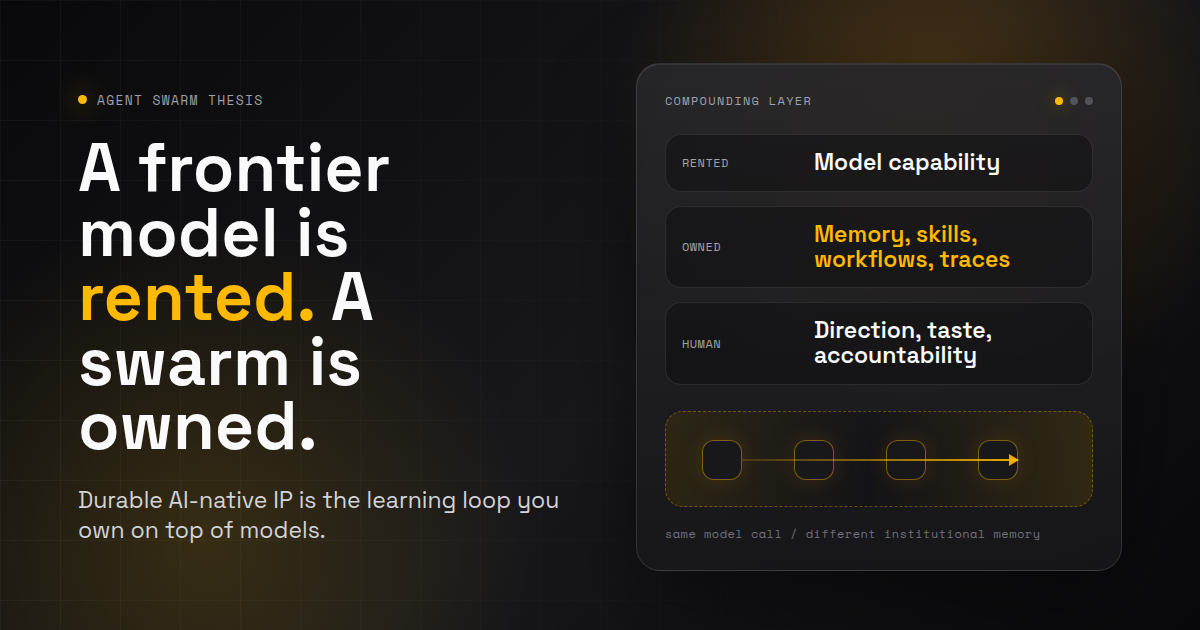
A frontier model is rented. A swarm is owned.
The durable IP of an AI-native company is not the model it calls. It is the learning loop it owns on top of models.
The mistake is to treat the frontier model as the moat.
It is not. The model is rented. You call it through an API, pay per token, and swap it when the next provider gets cheaper, faster, or better at your workload. The model matters enormously, but it is not where durable company-specific intelligence compounds.
The durable IP is the learning loop you own on top of models: the memory of prior work, the traces of how decisions were made, the skills that encode procedures, the workflows that keep humans in control, and the agent profiles that evolve from repeated exposure to one company's context.
Human capital is judgment, taste, relationships, and accountability. Token capital is the AI capability a firm owns and improves over time. In practice, token capital looks less like a model checkpoint and more like a swarm that has been working with you for six months.
Token capital is the swarm itself
A fresh swarm and a six-month-old swarm can call the same frontier model. They are not worth the same.
The fresh swarm has raw capability. The veteran swarm has memory. It knows which PR feedback Taras cares about, which smoke tests have lied before, which customer names require care, which scripts are reliable, which workflows should be delegated, and which apparent shortcuts turn into review debt. It has SOUL files, identity files, installed skills, task journals, shared memories, and a long tail of scars that make the next task faster and safer.
That is token capital. Not tokens as a billing unit. Tokens as accumulated machine labor that has become company-specific capability. The longer the swarm works inside a firm, the less it resembles a generic assistant and the more it resembles a company veteran.
What compounds in a real swarm
| Layer | What it stores | Why it becomes IP |
|---|---|---|
| Memory | Decisions, incidents, preferences | Queryable institutional context |
| Skills | Procedures and operating playbooks | Repeatable behavior, not tribal memory |
| Profiles | Role, taste, boundaries, scars | Agent identity that survives sessions |
| Traces | Every task, tool call, and result | Private data for evals and improvement |
Swap the generalist model. Keep the company veteran.
The literal test of sovereignty is simple: can you switch the underlying model without losing the expertise your system has acquired?
Agent Swarm is designed around that test. Workers can run Claude, Codex, opencode, or pi underneath. The model supplies general intelligence. The swarm supplies continuity. The institutional knowledge lives outside the weights, where the company can inspect it, govern it, move it, and improve it.
That separation matters because model advantage is unstable. A provider can leapfrog another provider in a quarter. Pricing can change in a week. A context window can expand, a tool API can regress, a safety policy can shift, or a new open model can become good enough for a class of work. If your intelligence is fused to one provider, every provider shift becomes institutional amnesia.
A sovereign swarm treats the model like compute: critical, expensive, and replaceable. The company veteran is the layer above it.
Own the learning loop, or rent your own context back
Satya Nadella put a useful name on the broader pattern when he wrote on June 14, 2026 that a frontier without an ecosystem is not stable. The important part for operators is not the tweet itself. It is the direction of value: durable firm advantage comes from the owned learning loop around models, not from merely accessing the model.
The fear is obvious. If all your work runs through a few frontier model providers, and every trace of that work becomes training exhaust for someone else's system, you are not building token capital. You are renting capability and donating context.
The structural answer is self-hosted swarms. Aurica is the proof point: a customer deployment where the swarm runs inside the customer's own infrastructure. Their traces, task journals, memory, and operational context stay inside their boundary. The models can still be external or mixed. The learning loop is theirs.
This is the AI-Native vs. AI-First distinction in operational form. AI-First says, "use AI everywhere." AI-Native asks what new operating system the company needs when AI work becomes persistent, inspectable, delegated, and compounding.
Memory search today. Private evals next. Private RL after that.
The first owned layer is already shipping: queryable institutional memory. Every completed task can become a future answer. Every mistake can become a warning. Every reviewer preference can become a retrieval hit before the next PR is opened.
But memory search is only the first turn of the loop. The next layer is private evals: not "does this model score well on a public benchmark," but "does this swarm get better at our workflows, with our constraints, on our definition of done?" That is where desplega.ai fits. Evals against real outcomes are how a company measures whether its token capital is compounding or merely producing plausible work.
After memory and evals comes the obvious frontier: private reinforcement learning on real internal traces. A swarm already journals the raw material: prompt, tool call, diff, review, failure, recovery, and final outcome. The question is not whether those traces are valuable. The question is who gets to learn from them.
If the traces leave your boundary, your company teaches someone else's system. If the traces stay with the swarm, your company teaches its own.
Without human direction, compute runs in circles
None of this removes the human. It makes the human more important.
A swarm without direction is just parallel compute with confidence. It can generate, test, retry, summarize, and branch forever. That is not agency. Agency requires someone to decide what matters, what tradeoff is acceptable, which risks are real, and when the work is done.
This is why Agent Swarm has a Lead model. The human directs. The Lead decomposes and coordinates. Workers execute. Reviewers challenge. The Slack thread stays attached to the task. The journal remains auditable. Progress is stored. Completion is explicit.
The swarm compounds because humans keep it pointed at valuable work. The human gains leverage because the swarm remembers what happened last time.
The moat is not access. It is accumulation.
Access to frontier models will keep spreading. That is good. It means every company can rent more intelligence than it could afford to build.
But renting intelligence is not the same as owning the learning loop. The companies that win will not be the ones that merely connect every employee to the latest model. They will be the ones that turn repeated work into durable institutional machinery: memory that can be queried, agents that can evolve, workflows that can be audited, traces that can train private quality systems, and human direction that keeps the machine honest.
A frontier model is rented. A swarm is owned.
/ references
Sources and further reading
FAQ
Does owning a swarm mean owning a frontier model?
No. The point is the opposite: the frontier model can remain rented and swappable while the company's durable intelligence lives in its swarm memory, workflows, traces, skills, and evolved agent profiles.
Why is a six-month-old swarm worth more than a fresh one?
Because it has accumulated task history, searchable memories, operating procedures, failure patterns, reviewer preferences, and domain-specific agent identities. A fresh swarm has access to the same model. It does not have the same institutional experience.
Where do evals fit into this thesis?
Private evals turn the swarm's work traces into a quality system. Public benchmarks tell you whether a model is generally capable; private evals tell you whether your company veteran is improving at your actual workflows.
Related field notes
The Write-Only Radar: Our Curation Agent Proposed the Same Story for 21 Days
When every node stays green while producing duplicate work, your data model is lying to you.
Orchestrator Loops Are a Trap: Why Process-Level Orchestration Wins
Why recursive Agent/Task tool calls collapse in production and how Agent Swarm uses independent Claude Code processes with external runners instead.
Nobody Prompt-Injected Our Agents — They Escalated Their Own Privileges
How the OWASP Top 10 for Agentic Applications maps to real threats in autonomous swarms. Spoiler: the danger is inside.