AI Access Control for Agent Swarms: A Governance-First Blueprint
Discover how AI access control can transform multi-agent swarms with unique identities and policy-driven security, ensuring robust governance.

AI access control for multi-agent swarms works only when it's identity-first, policy-as-code, and enforced at every single interaction boundary rather than checked once at login. That means every agent gets a unique non-human identity, every credential is short-lived and invocation-bound, and every tool call passes through a policy decision point before execution.
Concretely, that requires:
- Non-human identities (NHIs) per agent, not shared service accounts
- Short-lived, invocation-bound credentials issued from a token vault
- A policy decision point (PDP) separated from the policy enforcement point (PEP) that actually gates execution
- Per-tool scoping instead of blanket API access
- Cryptographically signed, append-only audit records for every decision
Standards like the NIST AI RMF, the OWASP LLM Top 10, and the emerging Agent Control Specification (ACS) all converge on this same architecture. None of them treat access control as a static permissions table you set once and forget.
Key Takeaways
AI access control for agent swarms succeeds when identity, policy, and enforcement are separated and applied at every single tool call, not once at session start.
| Point | Details |
|---|---|
| Identity comes first | Give every agent a unique non-human identity and short-lived, invocation-bound credentials. |
| Separate decision from enforcement | Run policy evaluation through a PDP and enforce verdicts through a non-bypassable execution gate. |
| Default to deny | Start every tool scope blocked and grant read or write access explicitly, with approvals on writes. |
| Log every verdict | Keep a cryptographically signed, append-only audit trail for post-incident reconstruction. |
| Roll out in phases | agent-swarm.dev applies this pattern through a lead agent and isolated, per-worker containers instead of one shared credential set. |
Table of Contents
- What Makes Multi-Agent Workflows a Different Access Control Problem?
- What Are the Governance-First Principles Behind AI Access Control?
- How Do You Architect the Components of AI Access Control?
- How Do You Enforce Access Control at Runtime?
- What Should Be on a Pre-Production Access Control Checklist?
- What Does a Realistic Rollout Timeline Look Like?
- What Do Engineering Teams Get Wrong About Agent Access Control?
- Where Does agent-swarm.dev Fit This Blueprint?
- What Should You Read Next on Agent Governance?
- Sources
- FAQ
What Makes Multi-Agent Workflows a Different Access Control Problem?
Static role-based access control was built for humans logging into one system at a time. Agent swarms break that model in ways that aren't obvious until something goes wrong in production.
The core failure pattern is the confused deputy problem: Agent A has legitimate access to a resource, Agent B doesn't, and Agent B convinces Agent A to act on its behalf. Multiply that across a swarm with five or ten specialized workers, and you get transitive delegation chains nobody explicitly authorized. Research on authorization propagation in multi-agent AI systems identifies this as a distinct workflow-level problem, not a permissions bug: aggregation inference lets an agent piece together restricted data from several allowed sources, and temporal validity gaps let a credential issued for one task get reused for another after context has shifted.
None of this requires malice. A worker agent retrying a failed step, an orchestrator caching a credential longer than intended, or a planner delegating a subtask to the wrong specialized worker can each quietly punch through a static permissions boundary.
What Are the Governance-First Principles Behind AI Access Control?
Governance-first design starts with identity and ends with proof. Between those two points sits the actual enforcement logic deciding what an agent can touch, right now, for this specific action.
- Identity-first: every agent gets a unique NHI, and every session gets a short-lived credential rather than a long-lived API key. Identity-first orchestration also calls for request-level signed context objects that bind identity, tenant, and session to each individual tool call.
- Policy-as-code with deterministic verdicts: the PDP evaluates a request and returns ALLOW, BLOCK, or ESCALATE, and that logic lives in version-controlled policy, not scattered if-statements inside agent code.
- Separation of decision and enforcement: the PDP decides; a distinct, non-bypassable execution gate enforces. An agent that reasons its way around a soft check still hits a hard wall at the LATTICE architecture's execution boundary.
- Default-deny allowlists: every tool starts blocked; access gets granted explicitly, scoped to read or write, with write actions routed through approval flows.
- Budgets, step limits, and a kill switch: runaway loops and cost spikes get capped structurally, not caught after the invoice arrives.
- Continuous evaluation: authorization runs as always-on infrastructure at every boundary, not a gate you pass once at workflow start.
Pro Tip: Don't try to scope your entire tool catalog on day one. Pick one high-risk tool class (database writes, outbound email, payment APIs), lock it down with a default-deny policy, run it through policy simulation against real traffic logs, then expand scope by category.
How Do You Architect the Components of AI Access Control?
A working system needs eight components wired together in a specific order, and skipping one usually means the missing piece gets bolted on later under worse conditions.
- NHI and certificate management — issues and rotates the unique identity for every agent
- Dynamic credential issuance / token vault — mints short-lived, invocation-bound tokens on demand
- Policy manifest (ACS-style) — the version-controlled source of truth for what's allowed
- Policy decision point (PDP) — evaluates each request against the manifest
- Policy enforcement point (PEP) / execution gate — the non-bypassable checkpoint that actually blocks or allows the action
- Tool gateway — enforces per-tool scoping so a "read customer records" grant can't silently become "write"
- Cryptographic audit/tracing store — append-only, signed record of every verdict
- Runtime sandbox — changeset-based containment for anything the gate allows
The dataflow runs in one direction: a request enters, gets wrapped in a signed context object carrying identity, tenant, and intent, and hits the PDP. The ACS specification defines named intervention points for this: agent_startup, pre_model_call, pre_tool_call, post_tool_call, and output, each receiving a full JSON snapshot of state. The PDP returns a signed verdict, the execution gate enforces it, and only then does the tool actually run.
| Component | Primary function |
|---|---|
| Token vault | Issues short-lived, invocation-bound credentials |
| PDP | Evaluates policy, returns signed ALLOW/BLOCK/ESCALATE |
| Execution gate (PEP) | Enforces the verdict; cannot be bypassed by the agent |
| Audit store | Records every decision as a signed, append-only trace |
Log the full context object, the policy version evaluated, the verdict, and a timestamp at each intervention point. That's what lets you reconstruct exactly which policy version approved a specific action six weeks after an incident.
How Do You Enforce Access Control at Runtime?
Policy verdicts mean nothing if an agent's container can still write to disk, open an arbitrary socket, or persist changes after a BLOCK verdict. Runtime enforcement closes that gap with kernel-level and container-level primitives.
- Linux namespaces and cgroups isolate the process; seccomp filters and Landlock (or another LSM) restrict which syscalls an agent's process can even attempt
- eBPF hooks intercept
exec,connect, andopencalls in real time, which lets you block unauthorized network or filesystem actions at the kernel level rather than trusting the application layer - Changeset governance treats every agent action as a proposed diff against an ephemeral overlay filesystem layer, evaluated by an OPA/Rego policy before it commits, with automatic rollback on denial. PuzzlePod implements exactly this pattern with commit/rollback semantics and seccomp
USER_NOTIFmediation - Secrets get injected at call time via vault references, never baked into environment variables, and credentials carry execution-count limits so a token dies after its bound number of uses, not just its TTL
A pre_tool_call check illustrates the flow: the agent requests a database write, the signed context object (containing identity, intent, and scope) reaches the PDP, the PDP returns a signed verdict, and the execution gate either passes the call through to the tool gateway or blocks it and logs the denial. Nothing downstream of the gate ever sees a request the PDP rejected.
- Agent issues tool call with signed context object
- PDP evaluates against current policy manifest
- PDP returns signed verdict (ALLOW / BLOCK / ESCALATE)
- Execution gate enforces; on ALLOW, changeset commits; on BLOCK, rollback and audit log
Fail-closed is the default posture throughout: if the PDP times out or the policy manifest fails to load, the gate blocks by default rather than passing the request through.
What Should Be on a Pre-Production Access Control Checklist?
Before an agent swarm touches production data, run through this sequence:
- Confirm every agent has a unique ID, no shared credentials anywhere in the swarm
- Verify the tool allowlist defaults to deny, with explicit per-tool read/write scopes
- Route every write action through an approval flow, manual at first
- Set step limits and spend budgets per task and per agent
- Enable audit logging and confirm traces are cryptographically signed
- Test the emergency kill switch under load, not just in isolation
A minimal policy manifest for a single tool scope looks like this in shape, not syntax: an agent identifier, an allowed tool name, a permission (read or write), a time bound, and a maximum execution count. The exact durations and limits should be determined according to organizational policies and risk tolerance. Express intent as a policy input alongside those fields; the Intent-Bound Access Control approach treats "why" an action is requested as first-class data, which makes delegation chains auditable instead of opaque.
Before rollout, run policy simulation against replayed production traffic to catch false denials, generate conformance snapshots so policy changes get reviewed like code, and seed staging with adversarial canary tasks designed to trigger confused-deputy behavior on purpose.
What Does a Realistic Rollout Timeline Look Like?
Governance-first access control fails when teams try to enforce everything at once. A phased approach works better:
- Discovery and inventory — map every tool, credential, and agent currently in use, unscoped
- Staging pilot — pick one workload, apply full policy-as-code enforcement, run in simulation mode
- Incremental expansion — onboard tool categories one at a time, moving from ESCALATE to ALLOW as confidence builds
- Organization-wide enforcement — default-deny becomes the baseline for every new agent and tool by default
Track policy-decision latency, denied-versus-allowed rates, credential rotation compliance, and revocation SLA (how fast a compromised credential actually stops working). Mean-time-to-contain an incident is the metric that matters most once you're live.
- Latency versus coverage: every additional check adds milliseconds; budget for it before launch
- Strictness versus developer velocity: stage ESCALATE before flipping to hard BLOCK so teams don't get blindsided
- Simulation-first reduces the risk of fail-closed defaults breaking legitimate workflows on day one
Docker's guidance on runtime security for AI agents makes the same case from the developer side: enforce the same policies in local dev and CI that you enforce in staging, or the gap becomes where incidents originate.
What Do Engineering Teams Get Wrong About Agent Access Control?
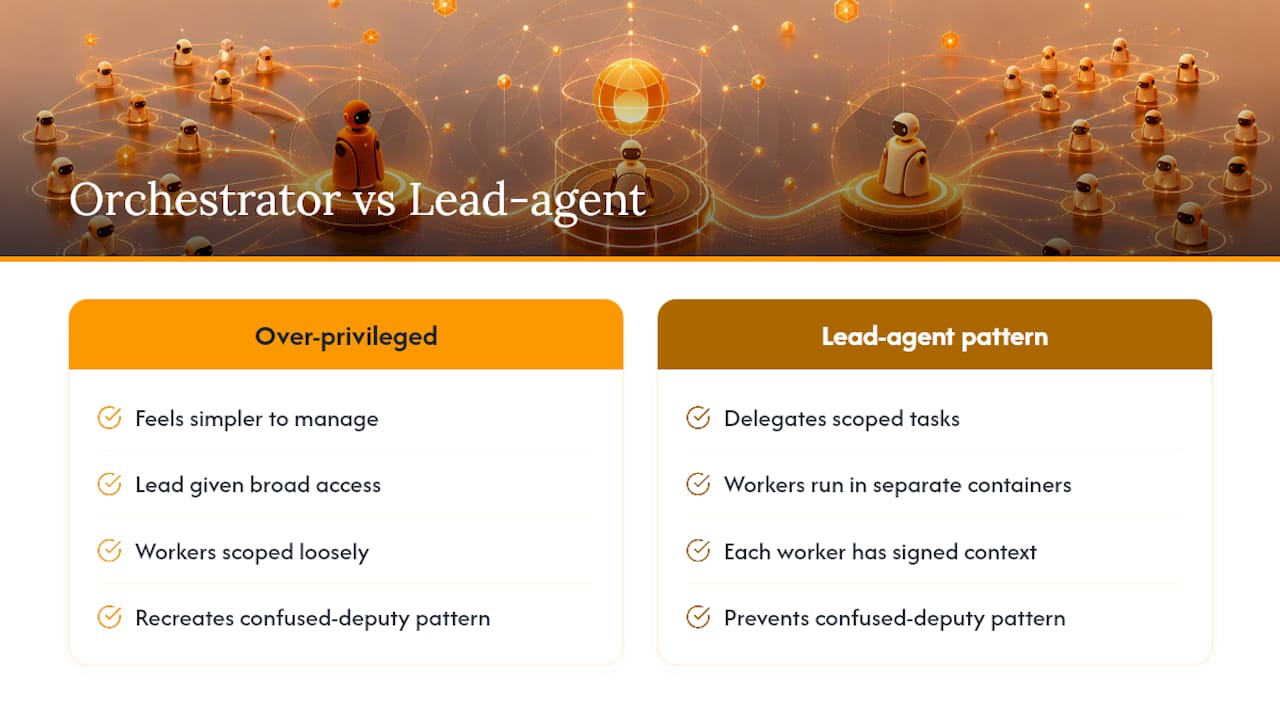
The mistake we see most often is over-privileging the orchestrator because it feels simpler than scoping each worker individually. Teams give the lead agent broad access "just in case" and scope workers loosely, which recreates the exact confused-deputy pattern the architecture is supposed to prevent.
agent-swarm.dev's lead-agent-and-isolated-workers pattern exists specifically to avoid that: the lead agent delegates scoped tasks to workers running in separate containers, each carrying its own signed context object rather than inheriting the lead's full permission set. If you want to see the pattern applied to real tasks rather than diagrams, the session examples show delegation and scoping decisions as they actually happened.
Where Does agent-swarm.dev Fit This Blueprint?
agent-swarm.dev is built around the same governance-first pattern this article describes: a lead agent breaks objectives into scoped tasks, hands them to specialized workers (running Claude Code, Codex, OpenCode, and others) inside isolated containers, and every worker operates with its own identity and boundaries instead of inheriting the lead agent's full access. Shared memory compounds across runs without requiring every worker to hold every credential.
If you're deciding between building this governance layer from scratch or adopting an operating system that already ships with per-agent isolation and audit logging built in, the comparison of Agent-swarm walks through when each approach makes sense for a given team size and risk tolerance. The fastest way to see the pattern working is to run one of the live example sessions and watch a task get delegated, scoped, and audited end to end.
What Should You Read Next on Agent Governance?
- LATTICE's governance-first architecture — the research behind non-bypassable execution gates and cryptographic audit trails
- Authorization propagation in multi-agent systems — why transitive delegation breaks classical RBAC/ABAC models
- Agent Control Specification (ACS) policy engine — the spec defining intervention points like
pre_tool_call - PuzzlePod's changeset governance daemon — a working implementation of commit/rollback runtime enforcement
- Okta's identity-first orchestration guidance — practical detail on NHIs and signed context objects
- Docker's runtime security guidance for AI agents — closing the dev-to-production enforcement gap
- How AI data agents actually work — engineering background on orchestration and delegation patterns
- Agent-swarm — real delegation and scoping decisions in production-like runs
Sources
- LATTICE: Governance-first architecture with per-action enforcement and cryptographic auditability (Frontiers in AI)
- Authorization propagation in multi-agent AI systems: identity governance as infrastructure (arXiv)
- How AI agent orchestration works and identity-first orchestration (Okta)
- PuzzlePod: runtime governance daemon for agent containers (GitHub)
FAQ
What Is the Difference Between RBAC and Policy-as-Code for AI Agents?
RBAC assigns fixed roles to agents, while policy-as-code evaluates each request dynamically against version-controlled rules, allowing decisions to factor in intent, time bounds, and execution counts that static roles can't capture.
Does AI Access Control Need a Separate PDP and PEP?
Yes. Separating the policy decision point from the enforcement point means an agent can't reason its way past a check; the execution gate enforces the verdict regardless of what the agent's own logic concludes.
What Is Intent-Bound Access Control (IBAC)?
IBAC treats the stated reason for a request as a policy input alongside identity and scope, which makes delegation chains auditable and helps flag requests where the stated intent doesn't match the action requested.
How Does agent-swarm.dev Handle Agent Permissions?
agent-swarm.dev assigns each worker agent its own identity and scoped task inside an isolated container, so the lead agent's broader access never transfers wholesale to a specialized worker.
How Often Should Agent Credentials Rotate?
High-privilege credentials should rotate on short TTLs, with some identity and access guidance recommending windows as tight as one hour for the highest-risk actions.
Recommended
Related field notes
A TLA+ Playbook for Your Scheduler, Queue or Retry Loop
Five steps, one prompt each: model a concurrent subsystem in TLA+, calibrate it on bugs you already fixed, turn every counterexample into a failing test, and keep the spec true with a daily swarm workflow. Our run found ten bugs in a day.
We Rebuilt Linear's “Loops updates” Clip as a Swarm Video in Eight Rounds
Three video models read Linear's motion-design teaser; the two Gemini models called the 3D scene 2D until 7.5s. A frame-by-frame check caught it. The replica is 858 frames of Remotion and three.js, reviewed eight times.
SEO con agentes IA: guía práctica para automatizar sin perder el control
Aprende a automatizar tareas SEO con agentes de IA sin perder el control: define reglas, supervisa aprobaciones y gana tiempo para estrategia.