A Blueprint for Production-Grade Content Pipeline Automation
Transform your workflow with effective content pipeline automation. Learn how to implement a durable, efficient system that boosts productivity.

Use a supervisor/coordinator pattern with isolated worker agents, a deterministic state machine, and non-skippable human approval gates. That's the architecture. Content pipeline automation, in the engineering sense that matters here, means a multi-agent AI work system that breaks a goal into discrete tasks, hands each one to a scoped worker agent running in its own sandbox, and keeps a durable record of every decision along the way. It is not auto-generated blog copy. It is how you get a recurring engineering, growth, or ops workflow off a human's plate without losing auditability.
The pilot is simple.
- Pick one pipeline you already own and that is not on the critical path.
- Wire intake from GitHub, Linear, or Slack, whichever already carries the request.
- Run a single-team pilot with full tracing turned on before you touch anything customer-facing.
Everything below explains why this shape wins, where teams get it wrong, and how to build it without inventing your own failure modes.
Key Takeaways
Content pipeline automation succeeds when a supervisor/coordinator pattern, isolated worker agents, a deterministic state machine, and non-skippable human gates work together as one system.
| Point | Details |
|---|---|
| Start with supervisor pattern | Centralize decomposition and routing through one coordinator; keep workers stateless and scoped. |
| Isolate every workspace | Use git worktrees or containers per run to stop state leaks and cross-run contamination. |
| Make gates non-skippable | Enforce approval at plan, ship, and release stages as hard invariants, not optional flags. |
| Track five pilot metrics | Measure cycle time, approval latency, failed-run rate, sandbox failure rate, and human intervention count. |
| agent-swarm maps the checklist | Lead agent decomposition, isolated containers, shared memory, and run traces align with this architecture. |
Table of Contents
- What Architecture Pattern Fits Content Pipeline Automation?
- How Do You Prevent Context Leaks and Lost State?
- What Do You Need to Build a Minimum Viable Pipeline?
- Which Tools Handle Durability, Sandboxing, and Cost Control?
- How Do You Keep an Agent Pipeline Reliable in Production?
- How Does agent-swarm.dev Fit This Checklist?
- Why Most Multi-Agent Advice Skips the Hard Part
- Run Your Content Pipeline Automation Without the Guesswork
- Sources
- FAQ
What Architecture Pattern Fits Content Pipeline Automation?
Five patterns show up repeatedly in production multi-agent systems, and they are not interchangeable. Supervisor/coordinator centralizes decomposition: one agent plans, routes, and consolidates, while workers stay stateless and scoped to a single task. Sequential pipeline chains agents in a fixed order, simple but brittle if any stage stalls. Event-driven reacts to triggers asynchronously, good for scale, harder to trace. Mesh lets agents talk peer-to-peer, flexible but nearly impossible to audit at scale. Hub-and-spoke resembles supervisor but with lighter central control and looser guarantees.
For content pipelines that need auditability and deterministic handoffs, supervisor/coordinator is the most common production pattern, and for good reason:
- Latency: supervisor adds a small routing hop but avoids the coordination storms mesh produces under load.
- Complexity: keeping workers stateless simplifies testing dramatically versus event-driven fan-out.
- Observability: every decision passes through one coordinator, so a single trace shows the whole run.
- Auditability: reviewers can inspect one decision log instead of reconstructing peer-to-peer chatter.
Picture an incoming GitHub issue: a supervisor decomposes it into planner, implementer, reviewer, QA, and release stages, dispatching each to a scoped worker and consolidating the output into one pull request.
Pro Tip: Don't split your first pipeline into more than three or four agent roles. Over-splitting up front creates coordination overhead you don't need until failures actually force a split.
How Do You Prevent Context Leaks and Lost State?
Most agent pipeline failures trace back to one of three things: context bleeding between agents, memory nobody versioned, or a workspace that got contaminated by a previous run. Fix these before you scale anything.
- Scope context tightly. Each worker gets only the slice of data its task requires, passed as structured JSON output rather than free-form text, with summarization checkpoints compressing large intermediate results before handoff.
- Default to scratchpads, not shared memory. Per-run scratchpads avoid cross-contamination. Reach for a shared memory store only when agents genuinely need persistent context across runs, and cap recall size, version it, so a bad memory write doesn't silently corrupt every future run.
- Isolate every workspace. Git worktrees or feature-branch containers keep one run from touching another's files. Script-workflow patterns that clone into isolated temporary directories per run reduce cross-run contamination measurably, and they leave a reproducible trace behind.
- Run build and test in an ephemeral sandbox before any commit. No exceptions, no shortcuts for "quick" changes.
- Enforce a deterministic state machine with named states. Approval gates at plan, ship, and release should be non-skippable, not optional flags a tired engineer can bypass at 2 a.m.
Hard invariants matter more than clever prompting: block the commit unless the sandbox run exits 0, bound every long-running call with a timeout, and escalate to a human the moment a task returns partial data instead of guessing at the rest.
These aren't nice-to-haves. Production-ready orchestrators enforce non-skippable human gates at exactly these three points and record every agent decision for later audit. Skip the gate, and you've built a system that fails silently instead of failing loud.
What Do You Need to Build a Minimum Viable Pipeline?
Assemble these components before you run anything real:
- Orchestration coordinator that owns decomposition and routing.
- Worker agents, scoped narrowly, running the actual model calls (Claude Code, Codex, OpenCode, or similar).
- Sandbox runtime for isolated builds and tests, one per run.
- Durable state store that survives a crash without losing task progress.
- Queue or workflow engine to sequence work and handle retries.
- Observability stack capturing traces, logs, and decision history.
Wire integrations in this order, since intake breaks first if you skip it: GitHub App via MCP, CI webhook listeners, Slack or Linear for intake and notifications, a secrets manager, and artifact storage for build outputs.
The minimum viable run flow looks like this: intake, plan, plan approval, build in isolation, QA, PR open, ship approval, demo deploy, as shown in this step-by-step AI productivity improvements for teams guide. This mirrors how orchestrators that decompose issues into optimal sub-tasks produce one reviewable PR per issue, keeping review friction low even as task count grows. Attach a trace ID at every step, no exceptions, so a failed run at step six doesn't force you to guess what happened at step two.
During the pilot, capture five metrics: cycle time, approval latency, failed-run rate, sandbox failure rate, and human intervention count.
Pro Tip: Track human intervention count from day one. A pipeline that needs constant manual rescue isn't automated, it's just delayed manual work with extra steps.
Which Tools Handle Durability, Sandboxing, and Cost Control?
Reach for a durable workflow engine, not a plain task queue, whenever a run includes long-running LLM calls that might take minutes and can't afford to restart from zero on a crash. Temporal-style durable execution checkpoints each activity and resumes from the last successful tool call, which matters a lot more than it sounds once you've watched a six-minute agent run die at minute five. Wrap long LLM calls as durable activities with heartbeats so the system can detect a stall and retry safely without losing progress already made.
For sandboxing, three approaches cover most cases:
- Docker-per-run for build and test isolation.
- Ephemeral demo deploys for human verification before ship.
- Git worktree isolation when full container overhead isn't justified.
Cost control lives in the coordinator: enforce per-task budgets, heartbeat checks on long calls, and an agent trust score that throttles or flags workers with elevated failure rates.
A workable infra mapping: Postgres with pgvector for memory, a Temporal-style engine or Redis/Celery for simpler queues, Docker or Kubernetes for sandboxes, and MCP bindings for model integrations.
How Do You Keep an Agent Pipeline Reliable in Production?
Expose run traces and every agent decision through a queryable endpoint, and stamp a correlation ID on every artifact and notification the pipeline produces. High-trust production swarms record detailed run traces and provide live demo URLs or ephemeral deploys specifically so a human can verify output without re-running anything.
Recovery needs three patterns working together:
- Checkpoint and resume so a crash mid-run doesn't discard completed work.
- Sandbox verification before commit, every time, no exceptions for hotfixes.
- Strangler-fig migrations when you're replacing existing cron jobs or queues, running old and new systems in parallel until the new one proves itself.
Runtime patterns matter more than most teams expect here. Running agents in tmux or container sessions preserves stdout and survives backend crashes, and atomic agent acquisition using database row locking prevents two workers from grabbing the same task and double-dispatching it.
Set monitoring on agent error rates, queue depth, human-gate latency, sandbox failure rate, and cost anomalies, with defined SLOs and an escalation path for each. Security gates belong in the same runbook: secret detection, dependency audits, and a hard block on critical findings until a human signs off. None of this is optional once real revenue or customer data touches the pipeline.

How Does agent-swarm.dev Fit This Checklist?
agent-swarm maps to nearly every item above by design. Its lead agent handles decomposition and routing, the supervisor role described earlier, while specialized workers run in isolated containers using Claude Code, Codex, OpenCode, or similar backends. Shared memory and contextual knowledge compound across runs instead of resetting each time, and integrations across Slack, Linear, GitHub, and hundreds of other platforms handle intake and notification without custom glue code.
- The task state machine documents the seven-state lifecycle agent-swarm uses to recover from crashes without losing progress.
- Real session examples show run traces and demo deploys in practice, not just in theory.
- The script-workflow deep dive covers per-run isolation and reproducible QA recipes directly.
A sensible pilot: pick one team-owned pipeline, enable a self-hosted deployment or request access via the Cloud waitlist, turn on tracing and the hard invariants described earlier, and run it for a fixed number of cycles while measuring cycle time and intervention count against your current manual process.
Why Most Multi-Agent Advice Skips the Hard Part
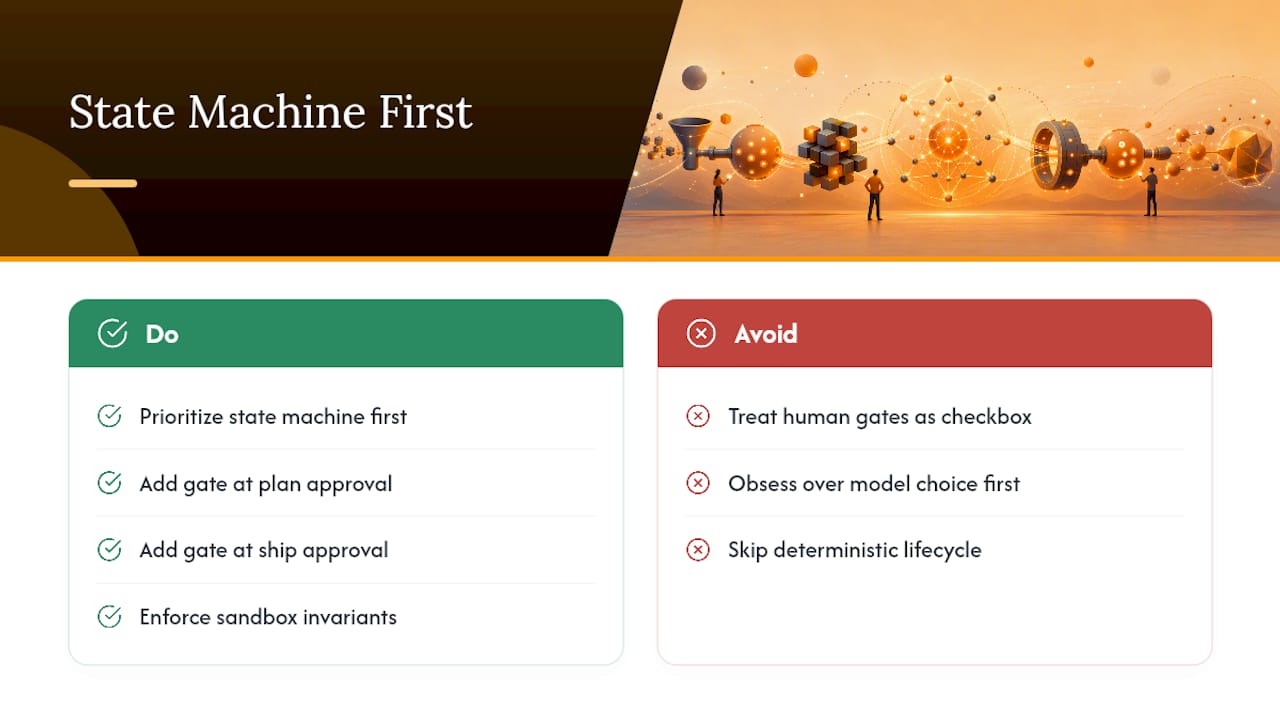
The conventional advice treats human-in-the-loop gates as a compliance checkbox, something you add later for enterprise buyers. That's backward. The gate at plan approval is what keeps a bad decomposition from burning three hours of compute on the wrong task. The gate at ship approval is what stops a passing sandbox test from becoming a production incident. These aren't friction, they're the difference between a pipeline you trust and one you babysit.
If you take one thing from this, prioritize the state machine before the model selection. Teams obsess over which LLM to route to which worker and skip the deterministic lifecycle that makes the whole system recoverable. Get the state machine and the sandbox invariants right first. The model choice is replaceable. A pipeline that loses state on crash is not a pipeline, it's a liability with good demos.
Run Your Content Pipeline Automation Without the Guesswork
agent-swarm gives engineering teams the supervisor/coordinator architecture this article recommends, already built, already running in production for teams that needed to stop babysitting recurring workflows. Instead of assembling a task state machine, container isolation, and audit trails from scratch, you get a lead agent that decomposes objectives, isolated worker containers running Claude Code, Codex, or OpenCode, and shared memory that compounds across runs instead of resetting.
If you're weighing build-versus-buy on orchestration, the comparison against accumulation-style tools lays out exactly where a coordinated swarm beats ad hoc agent stacking. Teams that want proof before committing engineering time can review the Capchase case study for measurable outcomes from a real deployment. The fastest path in is the Cloud waitlist — Cloud starts at €30 per month for up to 4 workers — or self-host for free if you'd rather run it on your own infrastructure first. Pick one pipeline, wire up intake, and start the trial this week.
Sources
- Architecting Multi-Agent AI Swarms: A System Design Deep Dive - Ajit Singh
- Outgrowing Cron Jobs and Queues: Migrate to Temporal
- usephalanx/phalanx
FAQ
What Is the Best Architecture for Content Pipeline Automation?
A supervisor/coordinator pattern with isolated worker agents is the most common production choice because it centralizes decomposition while keeping audit trails deterministic.
How Do I Stop Agents From Losing Context Between Tasks?
Use scoped context with structured JSON outputs, summarization checkpoints, and per-run scratchpads instead of unbounded shared memory that grows without limits.
When Should I Replace Cron Jobs With a Durable Workflow Engine?
Switch once runs include long-running calls that can't afford to restart from zero on failure. Temporal-style checkpointing resumes from the last successful step instead of the beginning.
Does agent-swarm Support Human Approval Gates?
Yes. agent-swarm's task state machine and lead agent decomposition support approval checkpoints at planning and shipping stages, matching the non-skippable gate pattern this article recommends.
What Metrics Should I Track During a Pilot?
Cycle time, approval latency, failed-run rate, sandbox failure rate, and human intervention count give you a clear before-and-after comparison against your current manual process.
Recommended
- Building a DAG Workflow Engine That Waits: Pause, Resume, and Convergence Gates | agent-swarm.dev
- Why We Ditched DAGs for State Machines in Agent Orchestration | agent-swarm.dev
- Your AI Workflow Has Too Many Agents | agent-swarm.dev
- Script Workflows: Durable One-off Runs for Agent Work | agent-swarm.dev
Related field notes
Shared-Context AI Agents: Patterns, Risks, and Setup
What shared-context AI agents are, how shared context differs from memory and private state, the risks, and how to run governed sharing.
We Deleted --resume: A Bounded Preamble Beats Session Resume
Why Agent Swarm dropped claude --resume and codex.resumeThread for a 2,000-token context preamble that survives container restarts and harness re-routing.
Your Agents Write the Titles Your Trackers Read
An IMDEA audit of 9 AI chat services found trackers receiving titles, permalinks and screenshots, not just prompts. Agent swarms multiply those artifacts.