What Does the Cost of AI Agents Actually Look Like in 2026?
Discover the true costs of AI agents in 2026, breaking down initial build and ongoing expenses to help you budget effectively.

Expect anywhere from $3,000 to $500,000+ in Year 1, and the spread isn't random. A simple rule-based agent lands near the bottom; a multi-agent enterprise system with compliance requirements lands near the top. Three variables move the number more than anything else: model and token usage, integration and orchestration complexity, and governance/ops overhead once the thing is live.
Most budgets go wrong because teams price the build and forget the run. Real production breakdowns show Tier 1 agents building for $3K–$8K with $40–$150 in monthly run costs, while Tier 3 multi-agent systems build for costs generally tens of thousands and run with several hundred to over a thousand dollars monthly. That run cost compounds for years. Your Year 1 total, once you fold in infrastructure, monitoring, and maintenance, commonly comes to 1.4 to 1.8 times the headline build quote.
Before you request quotes:
- Pick a tier (simple, mid, or enterprise) based on how many external systems the agent touches, not how "smart" you want it to seem.
- Flag any vendor quote that has no line item for monitoring, retraining, or token overage. That's a red flag, not a discount.
Pro Tip: Ask every vendor to show you the monthly run-cost estimate separately from the build quote. If they can't, they haven't modeled your token usage yet, and neither have you.
Key Takeaways
The cost of AI agents ranges from $3,000 for a simple Tier 1 build to $500,000+ for enterprise multi-agent systems, and token usage plus integration complexity drive Year 1 totals to 1.4 to 1.8 times the initial build quote.
| Point | Details |
|---|---|
| Match tier to complexity | Budget $3K–$8K for simple agents, $18K–$60K+ for enterprise multi-agent systems. |
| Budget run costs separately | Monthly run costs range from $40 to $1,550+, driven by token volume and context window size. |
| Plan for Year 1 multipliers | Expect all-in Year 1 cost to reach 1.4x to 1.8x the headline build price. |
| Control spend before launch | Set hard ceilings and overage alerts; unthrottled agents can hit $300/day. |
| Reduce redundant token spend | Platforms like agent-swarm use shared memory across containerized workers to cut repeated-context costs. |
Table of Contents
- Agent Complexity Tiers and Realistic Cost Ranges
- What Goes Into the Development Cost Breakdown?
- How Much Do Tokens, Hosting, and Orchestration Cost Monthly?
- Which Pricing Model Fits Your Budget and Risk Tolerance?
- The Hidden Costs That Double Your Estimate
- How Does AI Agent Cost Compare to Hiring a Human?
- What Is Agent FinOps and How Does It Cut Costs?
- How Were These Cost Estimates Built?
- What Should Be in Your AI Agent Budget Checklist?
- Where Engineering Leaders Get the Budget Wrong
- Cut Your AI Agent Run Costs With Orchestrated Workers
- Sources
- FAQ
Agent Complexity Tiers and Realistic Cost Ranges
Cost scales with what the agent does, not how many buzzwords describe it. A rule-based script that files support tickets costs nothing like an agent that reconciles invoices across five ERPs. Splitting the market into four practical tiers makes vendor quotes easier to sanity-check.
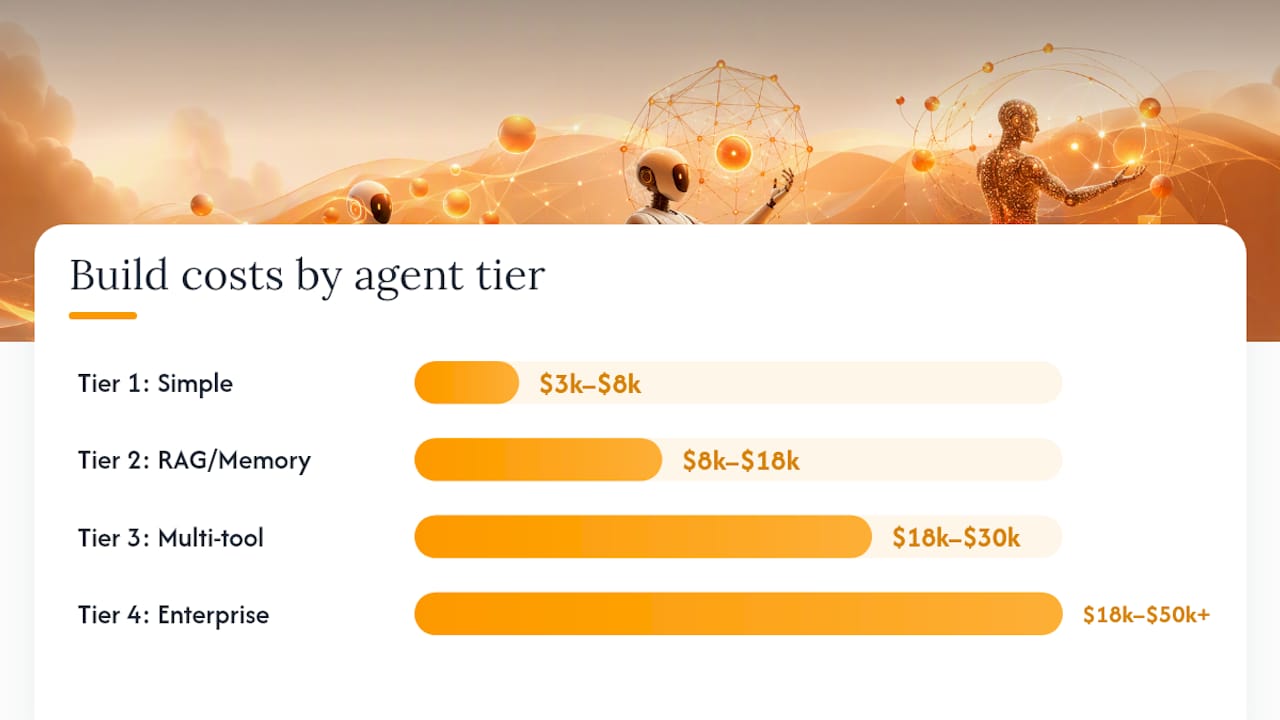
Tier 1: Simple, rule-based or single-tool agents. These handle a narrow task, one API, minimal context. Think auto-categorizing inbound emails or drafting a standard reply. Build costs run $3,000 to $8,000, with monthly run costs of $40 to $150, based on real deployment data from production multi-agent systems.
Tier 2: Single-task with retrieval (RAG) or contextual memory. This agent answers questions against a knowledge base, pulls from a vector database, and maintains conversation state. Build costs land at $8,000 to $18,000, with run costs of $140 to $500 a month.
Tier 3: Mid-complexity, multi-tool agents. These coordinate two or more actions, calling a CRM, then a calendar API, then sending a Slack notification, all in one workflow. Costs escalate quickly here because every integration adds testing surface and failure modes.
Tier 4: Enterprise multi-agent systems. A lead agent breaks down objectives and dispatches work to specialized sub-agents, each with its own tools, memory, and guardrails. Build costs run in the range of tens of thousands or more, with monthly run costs ranging from several hundred to over a thousand dollars. Separate industry analysis puts full enterprise deployments, once compliance and integration scope are factored in, as high as $150,000 to $500,000+.
| Agent Tier | Typical Build Cost | Typical Monthly Run Cost | Example Use Case |
|---|---|---|---|
| Tier 1: Simple/rule-based | $3,000–$8,000 | $40–$150 | Email triage, FAQ auto-reply |
| Tier 2: Single-task with RAG | $8,000–$18,000 | $140–$500 | Internal knowledge assistant |
| Tier 3: Mid, multi-tool | $18,000–$30,000 | $300–$900 | Support agent that books, refunds, and escalates |
| Tier 4: Enterprise multi-agent | $18,000–$50,000+ | $300–$1,500+ | Cross-department workflow orchestration |
Who buys at which tier? Startups usually start at Tier 1 or 2 to prove value fast. Mid-size engineering teams tend to land at Tier 3 once one agent needs to talk to several systems. Enterprises with compliance obligations, financial services, healthcare, regulated manufacturing, almost always end up at Tier 4, because governance and audit trails add cost regardless of how "simple" the core task looks.
What Goes Into the Development Cost Breakdown?
Every AI agent build runs through the same seven phases, whether a vendor itemizes them or buries them in a lump sum. Knowing the phases lets you catch what a quote is missing before you sign anything.
Discovery and scoping. This is where you define what the agent actually does, what "done" means, and which systems it touches. Skimp here and every later phase costs more. Budget 10 to 20 hours for a Tier 2 agent, more for anything touching multiple departments.
Data prep and labeling. If your agent needs to retrieve from internal documents or classify tickets, someone has to clean, chunk, and structure that data first. This phase is routinely underestimated because teams assume their data is "already fine." It rarely is.
Architecture and prompt engineering. Designing the agent's decision logic, choosing the model, and writing/testing prompts or fine-tuning specs. A composited engineering estimate puts a functioning action-taking agent, one that calls multiple APIs with real authentication, at roughly 65 build hours, separate from a simple chatbot.
Integrations. Every API connection (Slack, a CRM, an internal database) adds authentication handling, error retries, and rate-limit logic. This is the single most common source of scope creep. Vendors quoting a fixed integration cost without naming the specific systems are guessing.
QA and adversarial testing. Agents fail in ways traditional software doesn't, hallucinated tool calls, infinite retry loops, prompt injection from user input. Budget dedicated time for adversarial testing, not just happy-path QA.

Deployment. Standing up the hosting environment, wiring monitoring, and configuring access controls.
Training and handoff. Documenting the agent's logic and training your team to maintain and adjust it. This phase is the one most often dropped from vendor quotes entirely, which is why teams get stuck calling the original vendor for every small change.
| Phase | Typical Hours (Mid-Complexity Agent) | Common Omission in Vendor Quotes |
|---|---|---|
| Discovery & scoping | 10–20 hrs | Vague success criteria, no defined "done" |
| Data prep & labeling | 20–40 hrs | Assumes clean data, no cleanup budget |
| Architecture & prompting | 65 hrs baseline (action-taking agent) | Model selection treated as one-time, not iterative |
| Integrations | 20–60 hrs per system | Per-system testing and retry logic |
| QA & adversarial testing | 20–30 hrs | Prompt injection, hallucinated tool calls |
| Deployment | 10–20 hrs | Monitoring and alerting setup |
| Training & handoff | 10–15 hrs | Documentation for internal maintenance |
- Ask for a line-item hour estimate per phase, not a single lump-sum number.
- Confirm who owns data labeling. Vendors sometimes assume you'll supply clean, structured data at no cost to them.
- Request a written definition of "adversarial testing" in the QA phase. Many quotes list QA without specifying it covers agent-specific failure modes.
Pro Tip: Spend an extra week on discovery before signing anything. A tightly scoped discovery phase is the cheapest insurance you'll buy against a mid-project change order.
How Much Do Tokens, Hosting, and Orchestration Cost Monthly?
Run costs are where naive estimates break down, because they scale with usage, not with how much you paid to build the thing. Five line items make up the bulk of it: LLM/token consumption, orchestration and worker runtime, vector database hosting, monitoring and observability, and bandwidth/storage.

Token costs depend on model choice and context window size. Azure OpenAI Service pricing shows the direct trade-off: larger context windows and higher-tier models cost significantly more per million tokens, and an agent that re-sends full conversation history on every call burns through budget fast. Orchestration and worker runtime, the compute that runs your agent's containers or serverless functions, scales with call volume and concurrency. Vector database costs rise with how often the agent retrieves from a knowledge base and how large that index is. Monitoring and observability tools are a small line item individually, but skipping them is how a $150/month agent becomes an $800 surprise. Bandwidth matters more than people expect once agents move large payloads, and cloud egress pricing varies by region and volume.
| Cost Line | Typical Monthly Range | What Pushes It Higher |
|---|---|---|
| Tokens/LLM calls | $40–$1,000+ | Large context windows, high call volume, premium models |
| Orchestration/worker runtime | $20–$300 | Concurrency, always-on vs. on-demand containers |
| Vector database | $10–$150 | Index size, retrieval frequency |
| Monitoring/observability | $10–$60 | Number of agents tracked, alert granularity |
| Bandwidth/storage | $5–$40 | Large file payloads, cross-region traffic |
A low-volume scenario, one Tier 1 agent handling a few hundred requests a month, lands near $40 to $150 total. A mid-volume scenario, a Tier 2 or 3 agent with RAG and a few thousand monthly interactions, tends to run $300 to $700. A high-volume enterprise deployment with multiple concurrent agents can easily clear $1,000 to $1,500+ a month, especially if nobody's watching context window size. Right-sizing container resources, matching CPU and RAM allocation to actual load rather than a fixed default, is one of the more overlooked ways teams claw back a chunk of that number.
Which Pricing Model Fits Your Budget and Risk Tolerance?
Vendors sell AI agent capacity five different ways, and the model you pick shapes how predictable your budget is more than the sticker price does.
Per-token/consumption pricing charges for actual usage. It's cost-efficient at low volume but can spike unpredictably if usage grows or an agent gets stuck in a retry loop. Per-agent or per-worker pricing charges a flat fee per active agent, which is easier to forecast but can penalize you for spinning up agents you barely use. Per-seat/subscription pricing bundles a fixed number of agents or interactions into a monthly fee, good for stable, known workloads. Hourly or Agent-FTE pricing treats an agent like a fractional employee, billed for active work time, which appeals to teams comparing directly against human labor costs.
- If your usage is unpredictable or seasonal, favor consumption pricing with a hard spend cap.
- If you know your volume and want budget certainty, favor subscription or per-worker pricing.
- If you're directly comparing an agent's cost to hiring, Agent-FTE pricing gives the cleanest apples-to-apples math.
- Whatever model you choose, negotiate an overage alert threshold before you sign, not after your first surprise invoice.
- Consumption pricing: efficient at low volume, risky without a spend ceiling.
- Per-worker pricing: predictable, but can overpay for idle capacity.
- Subscription pricing: great for stable workloads, poor fit for bursty ones.
- Agent-FTE pricing: clean ROI comparison, but rarely aligns with actual token costs underneath.
Industry pricing analysis also flags a broader shift from flat subscriptions toward consumption models industry-wide, which means model-change protections in your contract matter more now than they did two years ago. Request volume caps, overage alerts, and a clause requiring notice before the vendor swaps the underlying model your pricing was based on.
The Hidden Costs That Double Your Estimate
Governance, retraining, and failure recovery rarely show up in a vendor's initial quote, and they're exactly why "Year 1 all-in" costs run 1.4 to 1.8 times the headline build price.
Governance and compliance overhead. Audit trails, access controls, and approval workflows for anything touching regulated data add real engineering hours that discovery phases often skip. Model drift and retraining. Agents built on a specific model version degrade or behave differently when the underlying model updates. Budgeting zero dollars for retraining is a common mistake. SRE and ops time. Someone has to watch dashboards, respond to failures, and tune prompts as edge cases surface. This is ongoing headcount cost, not a one-time line item. Data labeling drift. As your business changes, the data your agent retrieves from needs re-labeling and re-indexing.
Without spend controls, the numbers get ugly fast. Reporting on uncontrolled agent deployments shows realistic scenarios where an unthrottled agent runs up $300 a day, more than a comparable employee's daily cost, simply because nobody set a circuit breaker on retry loops or token consumption.
Separately, the World Economic Forum's Future of Jobs Report points to significant workforce shifts tied to automation, reinforcing that the real productivity gains for agencies include retraining your team to work alongside agents as part of the business case, not as an afterthought.
- Governance/compliance: audit logging, access review, approval chains.
- Model drift: re-testing and re-tuning after model version updates.
- SRE/ops time: ongoing monitoring, incident response, prompt adjustments.
- Data relabeling: keeping retrieval sources current as the business changes.
Watch for vendor scopes that quote a single flat number for "maintenance" with no hourly breakdown. That's usually where the real TCO gap hides.
How Does AI Agent Cost Compare to Hiring a Human?
The comparison only works when you price both sides the same way: cost per completed task, not cost per hour worked.
Take a high-frequency, low-value task, say, categorizing and routing 2,000 support tickets a month. A Tier 1 agent handling this might run $40 to $150 a month in operating cost after a $3,000 to $8,000 build. A human doing the same work part-time, even at a modest hourly rate, costs several times that every single month. The agent wins clearly on repetitive, high-volume, low-judgment work.
Now take a low-frequency, high-value task: reviewing complex contracts for risk flags, maybe 20 times a month. A Tier 3 or 4 agent for this could cost $300 to $900 a month to run, on top of a $18,000+ build. A skilled human reviewer doing the same 20 reviews might cost less in raw hours than the build investment implies, at least in year one. The math favors the agent only once volume climbs or the build cost gets amortized across multiple use cases.
- Estimate monthly task volume.
- Price the comparable human hourly rate (fully loaded, including benefits).
- Calculate agent monthly run cost plus amortized build cost (build ÷ 12, minimum).
- Break-even happens when: (human cost per task × monthly volume) > (agent run cost + amortized build cost).
- Recalculate at 2x and 3x expected volume, since agents scale marginal cost far better than headcount does.
- Break-even formula: Agent pays for itself when monthly task volume × human cost per task exceeds monthly agent run cost plus amortized build cost.
- Don't forget to include your own oversight time in the human comparison. Agents still need review cycles.
What Is Agent FinOps and How Does It Cut Costs?
Agent FinOps is the discipline of treating agent spend like cloud spend: variable, monitored, and owned by someone specific. EY's framing treats token costs as the visible tip of a much larger TCO iceberg, and recommends centralizing ownership of that spend rather than letting it sprawl across teams unmonitored.
Core controls worth adopting immediately: set hard spend ceilings per agent, review your model mix quarterly (not every task needs the most expensive model), run regression evaluations on a fixed cadence so you catch drift before customers do, and assign one named owner per agent's budget line.
Orchestration platforms reduce cost through a few concrete mechanisms: caching repeated retrieval calls instead of re-querying the model, reusing warm workers instead of cold-starting containers for every task, running smaller models locally where the task doesn't need frontier-level reasoning, and building kill switches that stop runaway retry loops before they hit $300 a day.
This is where a platform like agent-swarm fits into the budget conversation: it runs specialized workers in isolated containers with shared memory that compounds over time, which cuts the redundant token spend that comes from agents re-learning context on every task. Self-hosting keeps operating cost low for teams with existing infrastructure; the cloud version trades a small monthly fee for faster onboarding.
Pro Tip: Review your model mix every quarter, not once a year. The cheapest model that still passes your evaluation suite should be your default, not your fallback.
- Set a hard monthly spend ceiling per agent before launch, not after the first invoice.
- Assign one named budget owner per agent.
- Run evaluation/regression tests on a fixed schedule to catch model drift early.
- Use caching and worker reuse to cut redundant token spend.
How Were These Cost Estimates Built?
These ranges come from published build breakdowns of real production multi-agent systems, cloud provider pricing pages for token and bandwidth costs, and industry cost analyses covering proof-of-concept through enterprise deployments.
Treat the lower end of each range as an optimistic estimate for a well-scoped project with an experienced team. Treat the higher end as the realistic outcome when integrations multiply or compliance requirements appear mid-project, which happens often.
- Scale every range up if you're in a heavily regulated industry, healthcare, finance, insurance.
- Scale down slightly for a well-defined single-integration use case with an in-house engineering team already familiar with the tooling.
- All figures are presented as vendor-neutral benchmarks, not tied to a specific region or currency; convert to your local pricing where cloud costs apply.
What Should Be in Your AI Agent Budget Checklist?
Before signing any vendor contract or greenlighting an internal build, confirm every one of these line items is explicitly addressed, either in the quote or in your internal budget.
- Discovery, data prep, architecture, integrations, QA, deployment, and handoff, itemized separately.
- Monthly run cost estimate based on your actual expected volume, not a generic average.
- A named owner for ongoing spend monitoring and model-drift review.
- Retraining and re-evaluation cadence written into the contract, not left implicit.
- Overage alerts and a hard spend ceiling configured before launch.
Ask vendors directly: what model are you assuming for token pricing, and what happens to my cost if you change it? Who maintains integrations if an API changes on the other end? What counts as "done" for acceptance testing, and is that written into a measurable SLA?
Where Engineering Leaders Get the Budget Wrong
Most cost overruns trace back to one habit: pricing the demo, not the production system. A working prototype hides retry logic, edge-case handling, and monitoring, the parts that eat 40 percent of real budgets. I'd also flag governance as the most commonly cut corner. It looks skippable until an auditor asks who approved an agent's action six months ago.
The fix isn't a bigger budget. It's a phased rollout: ship Tier 1, measure real usage for 60 days, then scope Tier 2 with actual data instead of guesses.
Cut Your AI Agent Run Costs With Orchestrated Workers
agent-swarm gives engineering teams a direct lever on the run-cost line items this article just walked through: a lead agent breaks objectives into tasks, assigns them to specialized workers running Claude Code, Codex, or OpenCode in isolated containers, and shared memory compounds across tasks instead of re-priming context on every call. That's fewer redundant tokens burned per workflow compared to a swarm of disconnected point agents.
It integrates with Slack, Linear, GitHub, and hundreds of other platforms, so the integration-phase cost from your development budget gets absorbed into existing connectors rather than custom-built from scratch. Self-hosting the open-source core keeps operating expense near zero if you already run your own infrastructure; the cloud plan trades a modest monthly fee for faster setup if you'd rather skip the ops overhead. If you're comparing build-vs-buy on orchestration, the comparison against renting a single AI engineer lays out the ownership trade-offs directly. Start with the 7-day free trial and map your own token usage before committing to a monthly worker count.
Sources
For live, region-specific pricing, consult cloud vendor pages directly, Azure OpenAI Service pricing is a reliable starting point. For strategic and governance guidance, EY's Agentic AI analysis and Gartner's pricing-model research cover the FinOps and procurement angles this article draws from.
- What an AI Agent Actually Costs to Build in 2026 (with real numbers from a working multi-agent system) - Dangerous Media
- AI Agent Development Cost in 2026: Complete Breakdown
- Azure OpenAI Service pricing — Cognitive Services — Microsoft Azure
FAQ
Are AI Agents Expensive?
Not inherently. A simple Tier 1 agent can build for as little as $3,000 with monthly run costs under $150, but costs climb fast with integrations, compliance needs, and uncontrolled token usage.
How Do You Price AI Agents?
Most vendors use consumption/per-token pricing, per-agent or per-worker fees, subscription bundles, or Agent-FTE hourly rates; the right choice depends on how predictable your usage volume is.
Are AI Agents Free to Use?
Open-source frameworks like agent-swarm can be self-hosted at no licensing cost, but you still pay for compute, token usage, and hosting infrastructure, so "free" only applies to the software itself.
What Is the 30% Rule in AI?
There's no single standardized "30% rule" for AI agent costs; definitions vary by source, so treat any claim to that effect with caution and rely on itemized vendor quotes instead.
How Much Does an Enterprise AI Agent System Cost?
Enterprise multi-agent deployments with full integration and compliance scope typically run $150,000 to $500,000 or more, according to industry cost analyses.
Recommended
Related field notes
A TLA+ Playbook for Your Scheduler, Queue or Retry Loop
Five steps, one prompt each: model a concurrent subsystem in TLA+, calibrate it on bugs you already fixed, turn every counterexample into a failing test, and keep the spec true with a daily swarm workflow. Our run found ten bugs in a day.
We Rebuilt Linear's “Loops updates” Clip as a Swarm Video in Eight Rounds
Three video models read Linear's motion-design teaser; the two Gemini models called the 3D scene 2D until 7.5s. A frame-by-frame check caught it. The replica is 858 frames of Remotion and three.js, reviewed eight times.
SEO con agentes IA: guía práctica para automatizar sin perder el control
Aprende a automatizar tareas SEO con agentes de IA sin perder el control: define reglas, supervisa aprobaciones y gana tiempo para estrategia.