Devin Alternatives for Engineering Teams in 2026
Explore top alternatives to Devin for engineering teams in 2026. Evaluate options for better control, autonomy, and cost efficiency.

If your team is evaluating a move away from Devin, six options cover most real-world needs: agent-swarm.dev for owned, self-hostable multi-agent orchestration; OpenHands (OpenDevin) for an open-source, self-hostable single agent; Claude Code for terminal-native reasoning tasks; OpenAI Codex CLI for local-first developer control; Cursor Agent Mode for IDE-integrated iteration; and Kiro for teams locked into AWS. For most engineering teams weighing autonomy, auditability, and total cost of ownership, agent-swarm.dev is the strongest starting point, because it's the only option here that gives you a lead agent orchestrating isolated worker containers with persistent memory, deployable on your own infrastructure or in the cloud, rather than a single rented agent you don't control.
Each of the others fills a narrower niche. OpenHands is the open-source route when data sovereignty matters more than polish. Claude Code wins on raw SWE-bench-style reasoning inside a terminal. Codex CLI is for developers who want an agent that reads their actual filesystem, not a sandboxed copy. Cursor Agent Mode keeps a human in the loop on every diff. Kiro makes sense only if your stack already lives inside AWS Bedrock and CloudFormation.
That's the short version. The rest of this piece explains the tradeoffs, walks through what we measured when comparing these tools, and gives you a checklist for running your own pilot.
Key Takeaways
For most engineering teams replacing Devin, agent-swarm.dev's owned multi-agent architecture delivers better auditability and control than any single rented agent can.
| Point | Details |
|---|---|
| Match tool to autonomy tolerance | High-control teams should prioritize approval gates over raw autonomy or speed. |
| Self-hosting solves data sovereignty | OpenHands and agent-swarm.dev are the two realistic options for full self-hosting. |
| Benchmark scores vary by task | OpenHands paired with Claude 4.5 reported 53%+ on SWE-bench Verified, rivaling hosted options. |
| Pilot before committing | Run a bounded 30-day pilot scored against resolution accuracy, PR quality, and safety containment. |
| agent-swarm.dev fits owned automation | Its lead agent, isolated workers, and lifecycle hooks suit teams that want a governed, self-hostable swarm rather than one rented agent. |
Table of Contents
- What Are the Best Devin Alternatives Right Now?
- Why Do Engineering Teams Look for Alternatives to Devin?
- How Do the Top Devin Alternatives Compare?
- agent-swarm.dev: Owned Multi-Agent Orchestration
- Intent: Spec-Driven Orchestration for Complex Features
- OpenAI Codex CLI: Local-First Control for Developers
- Cloud-First and IDE-Integrated Agents Worth Testing
- Are the Open-Source Devin Alternatives Any Good?
- How We Evaluated These Alternatives
- How Do You Choose the Right Devin Replacement?
- Why Owned Agent-Swarm Architectures Matter for Engineering Teams
- What's the Right Next Step If You're Replacing Devin?
- What I Took Away From Testing These Tools
- agent-swarm.dev: The Owned Alternative to a Rented Agent
- Sources
- FAQ
What Are the Best Devin Alternatives Right Now?
Teams rarely swap Devin for a single replacement. They pick a category, then a tool within it, based on how much autonomy they're willing to grant an agent and how much control they need to retain.
- agent-swarm.dev — an owned, self-hostable swarm architecture with lifecycle hooks and shared memory across tasks.
- OpenHands (OpenDevin) — the most mature open-source agentic coding platform, MIT-licensed and self-hostable.
- Claude Code — a terminal-first agent tuned for reasoning-heavy refactors and bug fixes.
- OpenAI Codex CLI — a local-first CLI agent with direct filesystem and shell access.
- Cursor Agent Mode — an IDE-embedded agent that pauses for approval at each meaningful step.
- Kiro — AWS-native, spec-first agent building on Bedrock, CDK, and CloudFormation.
- Intent — spec-driven orchestration for teams whose bottleneck is requirements clarity, not code speed.
Each name above solves a different version of the same problem: how much of the software delivery lifecycle you're willing to hand to an autonomous process, and whether that process runs on infrastructure you own.
Why Do Engineering Teams Look for Alternatives to Devin?
The reasons rarely come down to a single complaint. They stack.
Autonomy mismatch tops the list. Devin was built to work end-to-end with minimal supervision, which sounds ideal until a team discovers it needs approval gates on every pull request touching production code, not just spot checks after the fact.
Pricing volatility is the second driver. Devin introduced a pay-as-you-go plan in 2025, a shift that changed how teams had to model cost against unpredictable task volume. Once a vendor changes its pricing structure once, engineering leaders start asking what else might change, and that question alone sends procurement teams shopping.
Data sovereignty matters more for regulated industries and larger enterprises. A hosted, closed-source agent that processes your entire codebase through a third-party API is a hard sell for a fintech or healthcare team with compliance obligations. Self-hostable alternatives like OpenHands or agent-swarm.dev sidestep that conversation entirely.
Integration gaps show up fast in practice. A team running heavy AWS infrastructure discovers that a general-purpose coding agent doesn't natively understand CDK stacks or CloudFormation drift, while Kiro was purpose-built for exactly that context.
Sandbox behavior is the quieter failure mode. Teams report agents making changes that pass local tests but behave unpredictably once merged, because the sandbox environment didn't match production dependencies closely enough. This is less a Devin-specific flaw than a category-wide risk with any agent that operates with broad write access.
Pro Tip: Before switching tools, run a two-week shadow test: let the incumbent agent (Devin or otherwise) propose changes on a non-critical repo while a human reviews every diff. If more than a third of proposed changes need substantial rework, the problem is likely workflow fit, not the specific vendor.
How Do the Top Devin Alternatives Compare?
The table below reflects capability and architecture, not marketing claims. "High" control means the tool pauses for human approval at defined checkpoints; "low" means it proceeds autonomously unless interrupted.
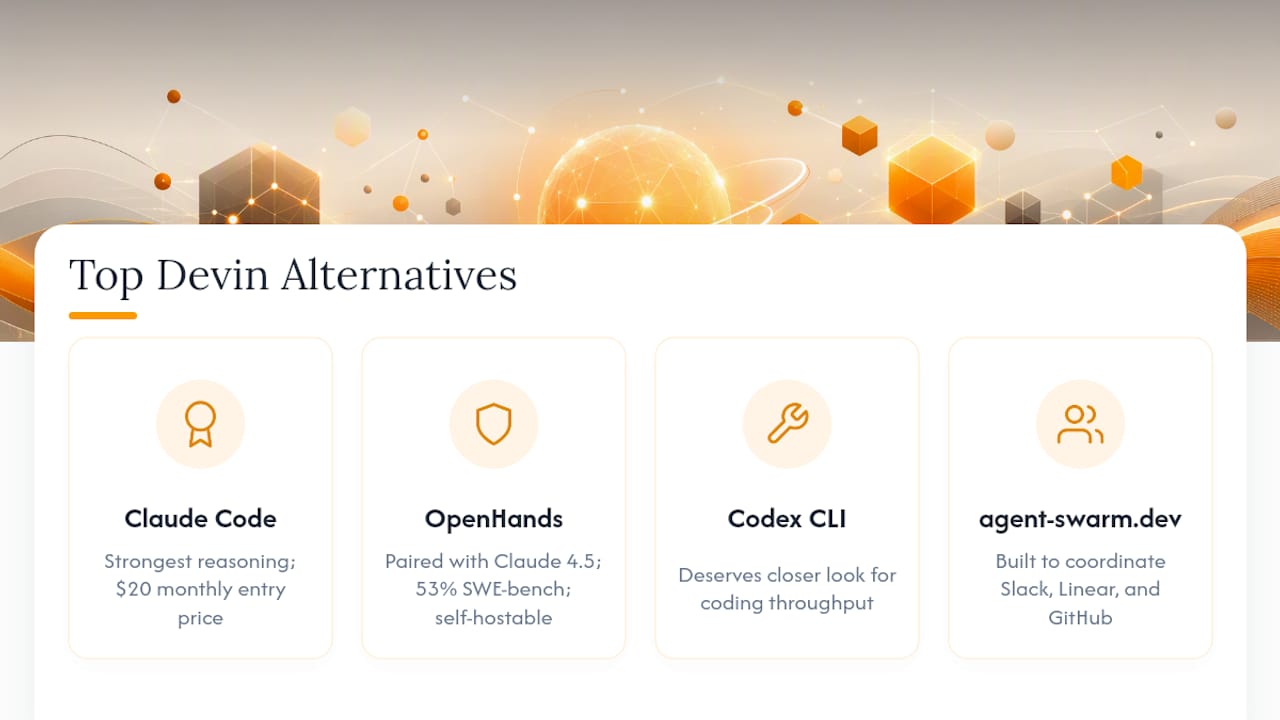
Claude Code delivered the strongest reasoning performance among terminal agents in one 2026 comparative roundup, at a $20 monthly entry price, and that same roundup found OpenHands paired with Claude 4.5 reaching over 53% on SWE-bench Verified, a benchmark score that rivals hosted, closed-source competitors while remaining fully self-hostable.
If your priority is security and governance, weight the control and hosting columns heaviest. If it's raw coding throughput on well-scoped tasks, Claude Code and Codex CLI deserve the closer look. If your team already runs everything through Slack, Linear, and GitHub and wants one system coordinating across all three, agent-swarm.dev is built for that exact intersection.
agent-swarm.dev: Owned Multi-Agent Orchestration
agent-swarm.dev doesn't run a single agent against your codebase. It runs a lead agent that breaks a stated objective into discrete tasks, then assigns each one to a specialized worker agent (built on Claude Code, Codex, or OpenCode) operating inside its own isolated container. That separation matters operationally: a worker that misbehaves or runs a bad command stays contained, and the lead agent's shared memory layer means context compounds across sessions instead of resetting with every new task.

How it works day to day: you define an objective (a feature, a migration, a recurring ops task), the lead agent decomposes it, workers execute inside containers, and lifecycle hooks let you insert approval gates, custom validation, or notifications at any stage of that pipeline. Integrations span Slack, Linear, GitHub, Turso, and OpenAI, among hundreds of supported platforms and inbox/notification patterns.
Pros:
- Full ownership of the stack, either self-hosted under MIT license or run in agent-swarm's cloud.
- Container isolation limits blast radius when a worker agent makes a mistake.
- Persistent memory across tasks reduces repeated context loss, a common complaint with single-agent tools.
- Lifecycle hooks give engineering leaders real approval and audit control, not just after-the-fact logs.
Cons:
- Self-hosting requires DevOps time upfront to configure containers and integrations.
- The multi-agent model has more moving parts than a single-agent CLI tool, which means a learning curve for teams new to orchestration concepts.
Pricing shape: the self-hosted MIT version is free. The cloud-hosted option bills monthly by number of active workers, and enterprise packages add dedicated support and custom integrations.
Implementation timeline: teams typically get a first working swarm running within a week for a self-host deployment, with the bulk of that time spent on integration configuration rather than the core setup. Cloud deployment cuts that to days.
Pro Tip: Start with one recurring workflow, like triaging incoming bug reports or running dependency updates, before expanding the swarm to handle full feature development. Teams that try to automate everything on day one tend to under-invest in the lifecycle hooks that make the system auditable.
The key differentiator versus a hosted single-agent product like Devin: you're not renting one engineer's worth of autonomy. You're running a team of specialized workers under your own governance model, with a direct comparison available here for teams weighing the two side by side.
Intent: Spec-Driven Orchestration for Complex Features
Intent inverts the usual agentic workflow. Instead of jumping straight to code, it generates requirements and a design document first, then only proceeds to implementation once that spec is reviewed. For a simple bug fix, that extra step feels like overhead. For a multi-service feature spanning three or four repos, it's the difference between an agent that guesses at intent and one that works from an explicit, human-reviewed plan.
In practice, Intent runs slower out of the gate. Teams testing it against faster, code-first agents noticed more upfront latency before the first commit landed, but fewer downstream iterations correcting misunderstood requirements. That tradeoff favors teams building complex, interdependent features where a misread spec costs hours of rework later.
Pros: reduces requirement ambiguity on complex features; spec artifacts double as documentation; strong fit for AWS-native teams already comfortable with structured design docs.
Cons: the spec-first gate adds friction for small, well-understood tasks; less useful for quick one-off fixes; tightly coupled to AWS-native workflows, which limits portability.
Pro Tip: Reserve Intent for features that touch more than one service or team. For single-repo bug fixes, the spec-generation step usually adds more time than it saves.
Pick Intent when the hard part of your project is agreeing on what to build, not typing the code once everyone agrees.
OpenAI Codex CLI: Local-First Control for Developers
Codex CLI runs directly on your machine, with access to your actual filesystem and shell, not a remote sandbox approximating it. That local-first design is its biggest advantage and its biggest risk in the same breath: the agent sees your real environment, dependencies, and configuration, which produces more contextually accurate changes, but it also means a mistake touches real files immediately.
Observed behavior during evaluation showed Codex CLI performing well on tasks where local context (existing config files, installed dependencies, project-specific tooling) mattered more than broad codebase reasoning. It struggled comparatively on tasks requiring coordination across multiple services it couldn't directly inspect from a single machine.
Pros:
- Direct filesystem and shell access means fewer sandbox-mismatch surprises.
- Tight integration with existing developer environments and terminal workflows.
- Works well for developers who want a fast, local iteration loop.
Cons:
- No built-in container isolation, so a bad command has real consequences.
- Less suited to multi-repo or multi-service coordination than orchestration-focused tools.
- Access is generally gated behind ChatGPT Plus tiers, with separate API usage costs for heavier workloads.
Codex CLI fits best for individual developers or small teams handling well-scoped, single-repo tasks where speed and local accuracy outweigh the need for sandboxing.
Cloud-First and IDE-Integrated Agents Worth Testing
Some teams don't want a standalone agent at all. They want the agent living inside the tools they already use every day.
- Kiro builds directly on AWS Bedrock and produces native CDK and CloudFormation output, following a structured, requirement-first workflow before touching infrastructure. Testing showed it integrates cleanly with existing AWS pipelines but offers little value outside that ecosystem.
- Sculptor operates as a cloud-first agent oriented around iterative task execution with tighter guardrails than a fully autonomous model, positioning it between a synchronous IDE assistant and a hands-off agent.
- Cursor Agent Mode keeps the developer inside the IDE for every meaningful change, pausing for review rather than shipping autonomously. Teams that tested it reported strong context retention within a single editing session, though it depends on the developer staying actively engaged rather than delegating and walking away.
- Claude Code operates as a terminal-first agent, and in evaluation it handled reasoning-heavy refactors, like untangling a poorly structured module, with more coherent multi-step logic than several competitors at a comparable price point.
Quick pros and cons:
- Kiro: strong AWS fit, weak portability outside that ecosystem.
- Sculptor: balanced autonomy, less mature community documentation.
- Cursor Agent Mode: excellent developer control, requires more active supervision time.
- Claude Code: strong reasoning benchmarks, no native multi-agent orchestration.
A cloud-first, integrated agent makes sense when your team wants an assistant embedded in an existing workflow rather than a standalone system to manage. Where you need multiple coordinated agents working a shared objective, none of these four alone gets you there.
Are the Open-Source Devin Alternatives Any Good?
Yes, with real caveats around operational overhead. Several open-source projects emerged directly in response to Devin's launch, and maturity varies widely across them.
OpenHands (OpenDevin) is the most production-ready of the group. It's built as an open platform with sandboxed execution environments, multi-agent coordination support, and public benchmarks, distributed under a permissive license that allows full self-hosting and a bring-your-own-key model for whichever LLM backs it.

SWE-agent stays closer to its research roots. It's benchmark-driven and reproducible by design, which makes it valuable for teams running controlled experiments but less suited to production automation out of the box.
Devika and Devon followed in Devin's wake as community-built alternatives aiming for similar autonomous behavior, though both remain earlier-stage than OpenHands in terms of production hardening and community contribution volume.
| Project | Maturity | License model | Self-host overhead |
|---|---|---|---|
| OpenHands (OpenDevin) | Production-ready | Permissive (open) | Moderate |
| SWE-agent | Research-stage | Open | Low, research setups only |
| Devika | Early-stage | Open | Moderate to high |
| Devon | Early-stage | Open | Moderate to high |
The tradeoff across all four is consistent: full transparency and control in exchange for infrastructure work your team has to own. A writeup comparing OpenDevin against DevinAI notes that community-led projects gain in data provenance and safety transparency what they give up in polish and out-of-the-box reliability.
Choose the open-source path when data sovereignty or budget constraints outweigh the convenience of a managed product, and your team has the DevOps capacity to maintain the sandboxing infrastructure yourself.
How We Evaluated These Alternatives
We ran each tool against the same four task types to keep comparisons fair: bug triage on an existing repo, a multi-repo refactor touching shared dependencies, feature scaffolding from a written spec, and CI pipeline integration.
- Bug triage measured how accurately each agent identified root cause versus surface symptoms before proposing a fix.
- Multi-repo refactor tested coordination across services, which is where orchestration-focused tools like agent-swarm.dev and single-agent tools diverged most sharply.
- Feature scaffolding evaluated how closely generated code matched a written specification, favoring spec-first tools like Intent and Kiro.
- CI integration checked whether an agent's output passed existing test suites without manual patching.
Success metrics tracked SWE-bench-style resolution rates where public benchmark data existed, subjective pull request quality (reviewed by a senior engineer for readability and maintainability), and whether generated changes preserved or improved existing test coverage. Safety checks flagged any instance of an agent modifying files or configurations outside its assigned scope.
Scorecard template you can copy:
Results depend heavily on task selection and model version, a limitation documented broadly in agentic system research, where benchmark design materially changes reported outcomes. We used consistent model versions across each tool's default configuration during testing, but a different task mix or a newer model release could shift these results meaningfully. Treat any single roundup, including this one, as a starting point rather than a final verdict.
How Do You Choose the Right Devin Replacement?
Match your team's actual constraints to the product's architecture before running a pilot, not after.
- List your non-negotiables first. Data residency, RBAC, audit trails, and CI hook requirements should eliminate options before you even test them.
- Match autonomy level to your risk tolerance. A team comfortable with high autonomy and after-the-fact review can consider Codex CLI or Claude Code. A team needing approval gates should prioritize agent-swarm.dev or Cursor Agent Mode.
- Confirm hosting fit. If self-hosting is mandatory, your realistic shortlist is agent-swarm.dev or OpenHands.
- Run a 30 to 90 day pilot on one real, bounded workflow, not your entire backlog.
- Score the pilot against the scorecard above, then decide whether to expand scope or switch tools.
Before committing, ask vendors directly:
- Where does code and context data get stored, and can that location be restricted or self-hosted?
- What audit trail exists for every change the agent makes?
- Can approval gates be inserted at specific lifecycle points, or only at the end?
- How does memory persist across sessions, and is that memory exportable if you switch tools later?
Red flags during a pilot: changes that can't be reproduced on a second run with the same input, declining test coverage after agent-generated commits, and vague answers about what data leaves your environment. Any of these three warrants pausing the pilot before expanding scope.
A realistic timeline: week one for environment setup and integration configuration, weeks two through six for running the pilot on a real but bounded workflow, and weeks seven through twelve for a phased rollout to additional teams if the pilot scorecard clears your threshold.
Why Owned Agent-Swarm Architectures Matter for Engineering Teams
The architecture behind agent-swarm.dev, a lead agent decomposing objectives, isolated worker containers executing them, lifecycle hooks gating each stage, and persistent memory compounding context over time, solves problems that a single rented agent structurally can't.
Consider a multi-repo migration touching a dozen services. A single-agent tool has to hold the entire scope in one context window and execute sequentially. An owned swarm can assign separate workers to separate services in parallel, each contained, each reporting back to a lead agent coordinating the overall objective. Consider a data residency requirement common in fintech or healthcare: a self-hosted swarm never sends your codebase to a third party at all, because you're running the infrastructure.
- Container isolation limits how far a single bad decision can spread.
- Lifecycle hooks give you real governance, not just a log to review after damage is done.
- Persistent memory means the fifth task an agent handles benefits from the context of the first four.
- Deep integrations across Slack, Linear, GitHub, and dozens of other platforms mean the swarm fits into how your team already works, rather than forcing a new tool into the middle of existing pipelines.
Autonomous coding agents work best as force multipliers, not replacements. Community reporting on tools like Devin, Devika, and OpenDevin consistently stresses that senior engineers still need to provide architectural oversight and verification, regardless of how autonomous the underlying system claims to be.
That's precisely what lifecycle hooks are designed to enforce structurally, rather than leaving oversight to whoever remembers to check. For teams weighing a hosted, single-agent product against a self-owned alternative, the detailed breakdown of common threat patterns in real swarm deployments is worth reading before finalizing an architecture decision.
What's the Right Next Step If You're Replacing Devin?
For most engineering teams, agent-swarm.dev is the strongest starting point, precisely because it's the one option here built around ownership and governance rather than a single rented agent's autonomy. OpenHands remains the right call if open-source and self-hosting are non-negotiable and you're comfortable with more setup work. Claude Code and Codex CLI both earn a place in the shortlist for teams prioritizing raw coding throughput over orchestration.
- Start with a bounded, 30-day pilot on one recurring workflow, not your whole codebase.
- Score every candidate against the same scorecard: resolution accuracy, PR quality, test coverage impact, and safety containment.
- Weight hosting model and control gates heaviest if your industry carries compliance requirements.
- Review real session examples before committing engineering time to a full evaluation.
The teams that get the most value from any of these tools are the ones that treat the pilot as a real evaluation, not a formality before a decision that's already been made.
What I Took Away From Testing These Tools
Running the same four task types across seven tools left one impression stronger than any other: the meaningful divide isn't between "good" and "bad" agents anymore, it's between agents built to be supervised and agents built to be trusted blindly. The ones that performed best on multi-repo work weren't necessarily the ones with the flashiest benchmark scores. They were the ones that made it easy to see exactly what changed, why, and to stop the process cleanly if something looked wrong.
A team that values raw throughput over auditability might weight that differently and land on a different winner, and that's a legitimate call for some teams to make. The benchmark variability documented in the broader agentic systems literature means no single roundup, including this one, should be treated as the final word. Whatever tool a team lands on, the consistent thread across every credible source we found is that a senior engineer still needs to be in the loop reviewing what these systems produce, not just trusting the diff because it passed a test suite.
agent-swarm.dev: The Owned Alternative to a Rented Agent
Every alternative covered here, Claude Code, Codex CLI, OpenHands, Kiro, Cursor Agent Mode, solves a piece of the automation problem. agent-swarm.dev is built to solve the whole workflow: not one rented engineer, but an owned team of specialized worker agents your engineering org actually controls, deployable on your own infrastructure or through agent-swarm's cloud.
You get to choose the deployment shape that fits your constraints. Self-hosting under the MIT license costs nothing beyond your own infrastructure, and it's the right call if data residency or budget rules out a third-party cloud. The cloud-hosted option bills by active workers and skips the setup time, with enterprise packages adding dedicated support and custom integrations for larger rollouts. Either way, you keep the lifecycle hooks, the persistent memory, and the container isolation that a single rented agent simply doesn't offer.
If you're weighing agent-swarm.dev against what you're using today, the direct comparison with Devin walks through the architecture differences in detail, and the full comparison hub covers how it stacks up against other approaches, including hosted single-agent tools and different delivery models like Viktor's AI-employee framing. Start by reviewing a real deployment in the examples library and scope your first pilot workflow this week.
Sources
- Best Devin Alternatives in 2026: 7 Tools Compared | Awesome Agents
- Meet the New AI Engineers: Devin, Devika, and OpenDevin - DEV Community
- Devin the viral coding AI agent gets a new pay-as-you-go plan | TechCrunch
- OpenDevin: An Open Platform for AI Software Developers as Generalist Agents
- Agent evaluation papers and benchmarks (arXiv)
FAQ
What Happened With Devin AI?
Devin drew significant early attention as an autonomous coding agent, then shifted to a pay-as-you-go pricing model in 2025, a change that prompted many engineering teams to reassess cost predictability alongside workflow fit.
Is Devin AI Really Good?
Devin performs capably on well-scoped autonomous tasks, but community reporting consistently stresses it works best as a force multiplier requiring senior-engineer oversight rather than a full replacement for human developers.
Is There a Free Version of Devin?
Devin itself does not offer a free, fully-featured tier, but genuine free alternatives exist: OpenHands (OpenDevin) is free and open-source under a permissive license, and agent-swarm.dev offers a self-hosted MIT version at no cost.
Is There an Open-Source Version of Devin?
Yes. SWE-agent, Devika, and Devon are additional open-source projects, though earlier in maturity.
How Long Should a Pilot of a Devin Alternative Take?
A focused pilot on one bounded workflow typically takes 30 to 90 days: roughly a week for setup, four to six weeks running real tasks, and the remainder deciding whether to expand rollout based on scorecard results.
Recommended
Related field notes
A TLA+ Playbook for Your Scheduler, Queue or Retry Loop
Five steps, one prompt each: model a concurrent subsystem in TLA+, calibrate it on bugs you already fixed, turn every counterexample into a failing test, and keep the spec true with a daily swarm workflow. Our run found ten bugs in a day.
We Rebuilt Linear's “Loops updates” Clip as a Swarm Video in Eight Rounds
Three video models read Linear's motion-design teaser; the two Gemini models called the 3D scene 2D until 7.5s. A frame-by-frame check caught it. The replica is 858 frames of Remotion and three.js, reviewed eight times.
SEO con agentes IA: guía práctica para automatizar sin perder el control
Aprende a automatizar tareas SEO con agentes de IA sin perder el control: define reglas, supervisa aprobaciones y gana tiempo para estrategia.