Open Source AI Orchestration: Best OSS Picks for 2026
Discover the best open source AI orchestration tools for 2026. Choose the right engine for robust production or rapid prototyping.
For production-grade multi-agent systems, pick a workflow-first engine that governs agent teams as durable state machines. For rapid prototyping, an agent-first framework gets you moving in an afternoon. That single distinction decides most of your architecture headaches before you write a line of code.
Here's the shortlist, ranked by job, not by hype:
- Durable production workloads: agent-swarm, Conductor, or Orloj, because they treat state as a first-class citizen and support replayability.
- Rapid prototyping: OpenAI Agents SDK or LangGraph, because their low-level primitives let you sketch a handoff in minutes.
- Hybrid architectures: CrewAI's Crews-plus-Flows model, because it lets an autonomous agent team live inside a deterministic execution shell.
The pattern that ties all of this together is durable execution: your orchestrator's ability to persist state, honor Model Context Protocol (MCP) tool contracts, and resume exactly where a worker crashed.
Key Takeaways
Production multi-agent systems need durable persistence and replayability, and teams that skip these two requirements consistently fail once agent tasks run long enough to hit real infrastructure turbulence.
| Point | Details |
|---|---|
| Match paradigm to job | Use workflow-first engines for production durability, agent-first frameworks for rapid prototyping. |
| Prioritize the checklist | Durable persistence, replayability, tracing, and MCP support matter more than raw feature count. |
| Avoid agent proliferation | Add specialist agents only when they improve capability isolation, policy isolation, or trace legibility. |
| Consider hybrid architectures | A workflow engine governing agent-first teams is often the most stable enterprise pattern. |
| Pick agent-swarm for production | Its durable task delegation, persistent memory, and native Slack, GitHub, and Linear integrations fit teams needing recurring workflow automation without building durable execution from scratch. |
Trusted project pages and guides
- Conductor (conductor-oss)
- Orloj
- CrewAI
- Open Multi-Agent
- OpenAI Agents SDK
- LangGraph
- Agent Orchestra
- AI agents in operational decisions
Table of Contents
- Which Open Source AI Orchestration Tool Should You Pick?
- Workflow-Driven vs Agent-First: What's the Real Difference?
- What Makes Orchestration Production Ready?
- How Do the Major Frameworks Compare on Production Fit?
- What Questions Should You Ask Before Choosing an Orchestrator?
- How Do You Get a Multi-Agent Orchestrator Running?
- Why Agent-Swarm Fits Engineering Teams' Production Needs
- How Does agent-swarm Handle ML Platform and CI/CD Integration?
- How Do Latency and Resource Usage Compare at Scale?
- What Security Practices Matter Most for Open Source Orchestration?
- Get Your Multi-Agent Workflows Production Ready
- Sources
- FAQ
Which Open Source AI Orchestration Tool Should You Pick?
Every team asks the same question in a different accent: "Which one won't fall over in production?" The honest answer depends on whether you're optimizing for developer velocity or operational durability, and most teams need both at different project stages.
Here's a working shortlist, roughly ordered by production readiness:
- agent-swarm is the pragmatic production pick for engineering teams that need durable task delegation, persistent memory across sessions, and native Slack, GitHub, and Linear integrations without babysitting a custom durable-execution layer.
- Conductor (originally built at Netflix, now maintained under the Orkes banner) is best for teams that want an event-driven, durable workflow engine with JSON-declarative pipelines and native LLM/MCP integrations designed for high-scale throughput.
- Orloj fits teams that want YAML-declarative infrastructure, Postgres-backed state, and NATS JetStream messaging with policy primitives baked into the manifest itself.
- OpenAI Agents SDK is the fastest on-ramp for provider-agnostic prototyping, with agents, handoffs, guardrails, and tracing as first-class SDK concepts.
- LangGraph suits teams that want low-level, model-agnostic control flow primitives and are comfortable building their own operational scaffolding on top, according to LangChain's own framework documentation.
- Open Multi-Agent works well for model-agnostic teams that need task dependency graphs, a message bus for inter-agent communication, and configurable scheduling strategies like round-robin or capability-match.
- Agent Orchestra is a Python-first, production-oriented option built around supervisor agents, agent pools, rate limiting, and persistent state for teams that live in the Python ecosystem already.
A few maturity signals worth checking before you commit engineering hours: license type (MIT versus a more restrictive variant changes your legal exposure), the primary language SDK (Python-only shops should weight Agent Orchestra and CrewAI more heavily), and whether the project has publicly named production users. Conductor's Netflix pedigree and internet-scale design give it more production mileage than most agent-first newcomers. Orloj's declarative manifest model borrows heavily from Kubernetes conventions, which shortens the learning curve for teams already running container orchestration.
None of these are mutually exclusive. Plenty of teams run agent-swarm or Conductor as the durable backbone while letting a CrewAI crew or an Agents SDK handoff chain handle the creative, less-deterministic middle of a task.
Workflow-Driven vs Agent-First: What's the Real Difference?
Workflow-driven orchestration is deterministic by design: you declare the steps, the engine executes them in order, checkpoints state after each one, and can resume from any failure point without re-running the whole pipeline. Agent-first orchestration flips that: an LLM decides what happens next, in-process, based on context it accumulates as it goes.
The tradeoff is not subtle. Workflow-driven engines like Conductor give you predictability, replayability, and cost control, because every step is declared before it runs. Agent-first frameworks give you adaptability. They can improvise around an edge case nobody anticipated, but that improvisation costs you observability. According to research on 2026 orchestration paradigms, workflow-driven tools tend to ship with hundreds of pre-built integrations, while agent-first frameworks focus on low-level primitives like handoffs and shared memory instead of breadth.
Three patterns show up constantly once you get past the paradigm-level choice:
- Agents-as-Tools: a manager agent calls bounded specialist agents the way you'd call a function, gets a return value, and moves on. OpenAI's own orchestration guidance recommends this pattern for synthesis tasks where the manager needs to combine several outputs into one.
- Handoffs: the manager transfers full ownership and context to a specialist agent, which then owns the rest of the interaction. This suits routing scenarios where a task splits into genuinely distinct segments of work, like escalating a support ticket to a billing specialist.
- Manager/Coordinator (supervisor): a persistent top-level agent monitors several worker agents, reassigns failed tasks, and aggregates results. This is the pattern most enterprise deployments converge on once they have more than three or four specialist agents running.
Picture the difference visually: an Agents-as-Tools call looks like a straight line out and back, manager to specialist to manager. A Handoff looks like a baton pass. Once it's transferred, the original agent is out of the loop entirely, and the trace has to follow the new owner.
Pro Tip: Start with one agent and add specialists only when they materially improve separation of concerns, whether that's capability isolation, policy isolation, or trace legibility. Adding a second agent because it "feels more sophisticated" is how you end up debugging a five-agent system that a single well-prompted agent could have handled. Agent density anti-patterns show up constantly in postmortems, and they almost always trace back to this exact mistake.
What Makes Orchestration Production Ready?
A demo that works once in a notebook and a system that survives a worker crash at 3 a.m. are not the same thing. Here's the priority order for what actually matters once real users depend on your agents:
- Durable persistence and checkpointing. Every meaningful state transition gets written somewhere durable, not held in process memory.
- Replayability. You can re-run a failed task from its last checkpoint, or replay a completed one for debugging, without side effects duplicating.
- Idempotency and retries. A worker that dies mid-task and restarts doesn't double-charge an API or send a duplicate Slack message.
- Observability and tracing. Every agent decision, tool call, and handoff produces a structured trace you can query later, not just a scroll of logs.
- Policy, guardrails, and human-in-the-loop. Sensitive actions require an approval gate before execution, not after.
- MCP and tool calling. Tools are exposed through a standard protocol instead of bespoke, per-agent integration code.
- Model routing and fallback. If your primary model provider has an outage, the system routes to a fallback instead of stalling every in-flight task.
- Secrets and credential isolation. Each worker or container gets scoped credentials, not a shared API key with god-mode access.
- CI/CD integration. Agent definitions and workflow manifests deploy through the same pipeline as the rest of your infrastructure.
Skip any of these and you'll hit specific, painful failure modes. Missing persistence means a six-hour research task dies at hour five when the host reboots, and you start over from zero. Missing structured tracing means a bad output from three steps back is undebuggable, because nobody can reconstruct what the agent actually saw at each decision point. This is exactly the gap covered in our breakdown of the seven-state task lifecycle, which walks through how a task should move through states like pending, running, and recovering without losing its place.
Red flags to walk away from during evaluation:
- No documented replay mechanism, or replay that requires manual state reconstruction.
- No structured trace format, just plain-text logs.
- No policy enforcement layer between an agent's decision and its execution.
- Tool access granted ad hoc per agent, with no central audit trail.
- No model routing or provider fallback configuration.
Background research on production orchestration consistently finds that frameworks lacking native state serialization and resumption fail once agent tasks run long enough to hit real infrastructure turbulence, not because the LLM reasoning was wrong, but because the plumbing wasn't durable.
How Do the Major Frameworks Compare on Production Fit?
Mapping architecture to production readiness saves you from picking a framework based on GitHub stars alone. Here's how the field breaks down.
agent-swarm runs a lead agent that decomposes objectives into tasks and assigns them to specialized workers (Claude Code, Codex, OpenCode, and similar coding agents) inside isolated Docker containers. Shared memory persists and compounds across sessions instead of resetting with every run, which matters enormously for recurring engineering workflows like triage or code review. It integrates natively with Slack, GitHub, Linear, Turso, and OpenAI, and supports both self-hosted MIT deployment and a cloud-hosted option. This puts it closer to the workflow-first end of the spectrum: durable by default, with agent-first flexibility inside each worker's isolated task.
Conductor is the reference implementation of workflow-first orchestration at scale. It separates orchestration from business logic entirely, offers full replayability, and was built originally to handle Netflix-scale event volume. Its JSON-declarative workflows and native LLM/vector-database integrations make it a strong fit for teams that already think in terms of durable state machines rather than in-process agent loops.
Orloj takes the declarative approach further with YAML manifests covering agents, tools, models, and policies as first-class resources. Postgres handles state, NATS JetStream handles messaging, and governance primitives are built into the manifest itself rather than bolted on. Teams already comfortable with Kubernetes-style resource definitions will find the mental model familiar.
OpenAI Agents SDK sits at the agent-first end. It's lightweight, provider-agnostic, and treats handoffs, guardrails, sessions, and tracing as built-in concepts rather than add-ons. It's the fastest path from zero to a working multi-agent prototype, though production hardening (persistence, replay) is left largely to you.
LangGraph offers low-level, composable primitives for building agent runtimes with fully customizable control flow, according to LangChain's documentation. It supports single-agent, multi-agent, and hierarchical patterns, and stays model-agnostic throughout, which suits teams that want maximum architectural control and are willing to build more of the operational layer themselves.
Open Multi-Agent is model-agnostic and built around task dependency graphs, a MessageBus for inter-agent communication, SharedMemory, and configurable scheduling strategies like capability-match. It's a solid agent-first choice when your workload genuinely needs several specialized agents coordinating over shared state rather than a single linear pipeline.
Agent Orchestra leans production-focused within the Python ecosystem: supervisor agents, agent pools, rate limiting, retries, and persistent state with comprehensive logging out of the box. Teams standardized on Python who don't want to adopt a separate YAML or JSON manifest layer will find this the most natural fit among the agent-first options.
CrewAI deserves a specific mention as the hybrid case. Its Crews handle autonomous agent collaboration, while its Flows layer adds event-driven, stateful control for the parts of a pipeline where you need determinism, according to CrewAI's own project documentation. For many enterprise teams, this hybrid shape, a workflow engine governing agent-first teams underneath, turns out to be the most stable architecture available, because it gets LLM adaptability where it helps and deterministic control where state integrity actually matters.
Across all seven, the deployment surface tends to cluster around the same primitives: Postgres or SQLite for state, Docker or Kubernetes for compute isolation, and either NATS or a simple message queue for inter-agent communication. If your team already runs any of that infrastructure, the framework choice becomes less about capability and more about how much operational scaffolding you're willing to build yourself.
What Questions Should You Ask Before Choosing an Orchestrator?
Six questions matter more than the rest. Ask them in this order, because each one can disqualify an option before you invest more evaluation time.
- Does it support durable persistence for long-running tasks? If a worker crashes at hour four of a six-hour job, does it resume or restart from zero?
- Where does your data reside, and can you control that? Self-hosted deployment matters if data residency requirements rule out a fully managed cloud service.
- Does it support MCP or an equivalent standardized tool-calling protocol? Bespoke, per-agent tool integration code becomes unmaintainable past a handful of tools.
- Can you actually debug a failed run? Structured traces, not scrollback logs, are the difference between a ten-minute fix and a lost afternoon.
- Does it support human approval gates for sensitive actions? Deploying to production or sending external communications should have a policy checkpoint, not blind autonomy.
- What does the run-time cost model look like at scale? Token costs compound fast across multi-agent handoffs; know your unit economics before committing.
When you're validating a specific project or vendor, ask pointed operational questions: How do you resume a task after a worker crash? Which persistence backends are supported, and can you self-host them? How are tools authorized and audited at run time? Vague answers to any of these are a signal to keep looking.
Red flags that should stop a production decision outright:
- No replay mechanism, or one that requires manual state reconstruction.
- No documented state backend, just "it depends on your deployment."
- An unclear or restrictive license that complicates commercial use.
- A stalled community: no commits in months, no response to open issues.
How Do You Get a Multi-Agent Orchestrator Running?
Three steps get you from zero to a production-credible prototype without over-engineering the first version.
- Build a quick prototype. Start with a single agent, or one Agent-as-Tool call, before you introduce a second specialist. Prove the core task works.
- Add persistence and replay. Move state out of process memory into SQLite for a prototype or Postgres for anything resembling production, and confirm you can resume a killed task.
- Harden with governance and observability. Add approval gates for sensitive actions, structured tracing per decision, and secrets scoped per worker rather than shared globally.
On the architecture side, pick a state backend early (SQLite for local prototyping, Postgres once multiple workers write concurrently), decide between sequential messaging or a pub/sub layer like NATS depending on how many agents run in parallel, and configure model routing with a fallback provider from day one rather than after your first outage. A minimal manifest, whether YAML or JSON, should declare the agent's tools, its model, its persistence backend, and its policy constraints, which is the same shape Orloj uses natively for its resource definitions.
Why Agent-Swarm Fits Engineering Teams' Production Needs
agent-swarm maps directly onto the production checklist above: a lead agent breaks objectives into tasks, assigns them to isolated Docker workers running Claude Code, Codex, or OpenCode, and persists shared memory so context compounds across sessions rather than resetting each run.
Where it earns its place in daily engineering work:
- Recurring engineering tasks: triage, code review, and repeated maintenance work benefit most, because the memory layer means the swarm gets faster and more accurate the more it runs.
- Cross-tool automation: native integrations with Slack, GitHub, Linear, and OpenAI mean workflows span your actual toolchain instead of living in a sandboxed demo.
- Flexible deployment: self-hosted (MIT-licensed) for teams with data residency constraints, or cloud-hosted for teams that would rather not run the infrastructure themselves.
Documented customer sessions and case studies, including a deployment at Capchase, show this pattern working on real engineering workloads rather than staged demos.
How Does agent-swarm Handle ML Platform and CI/CD Integration?
Integration friction is where most orchestration projects quietly stall. A framework that looks great in a demo repo but requires custom glue code for your model provider, your vector store, and your deployment pipeline will cost you weeks you didn't budget for.
The practical checklist: confirm native support for your model provider (OpenAI, Anthropic, or a local inference endpoint), check whether the framework talks to your vector store of choice without a custom adapter, and verify it can deploy through your existing CI/CD pipeline rather than demanding a parallel deployment process. Conductor and Orloj both ship native LLM and vector database integrations out of the box, which shortens this list considerably. agent-swarm's approach integrates directly with the tools engineering teams already run: GitHub for source control and pull requests, Linear for task tracking, and Slack for human-in-the-loop notifications, so the orchestration layer plugs into an existing pipeline instead of requiring a new one. For data sources, look for native connectors over custom scripts; every custom integration you write is a maintenance burden that outlives the original engineer who wrote it.

How Do Latency and Resource Usage Compare at Scale?
Benchmarking multi-agent orchestration is messier than benchmarking a single API call, because latency compounds across every handoff and every tool call in the chain. A five-step Agents-as-Tools pipeline pays the round-trip latency cost five times, once per specialist call, plus whatever the manager agent takes to synthesize the results.
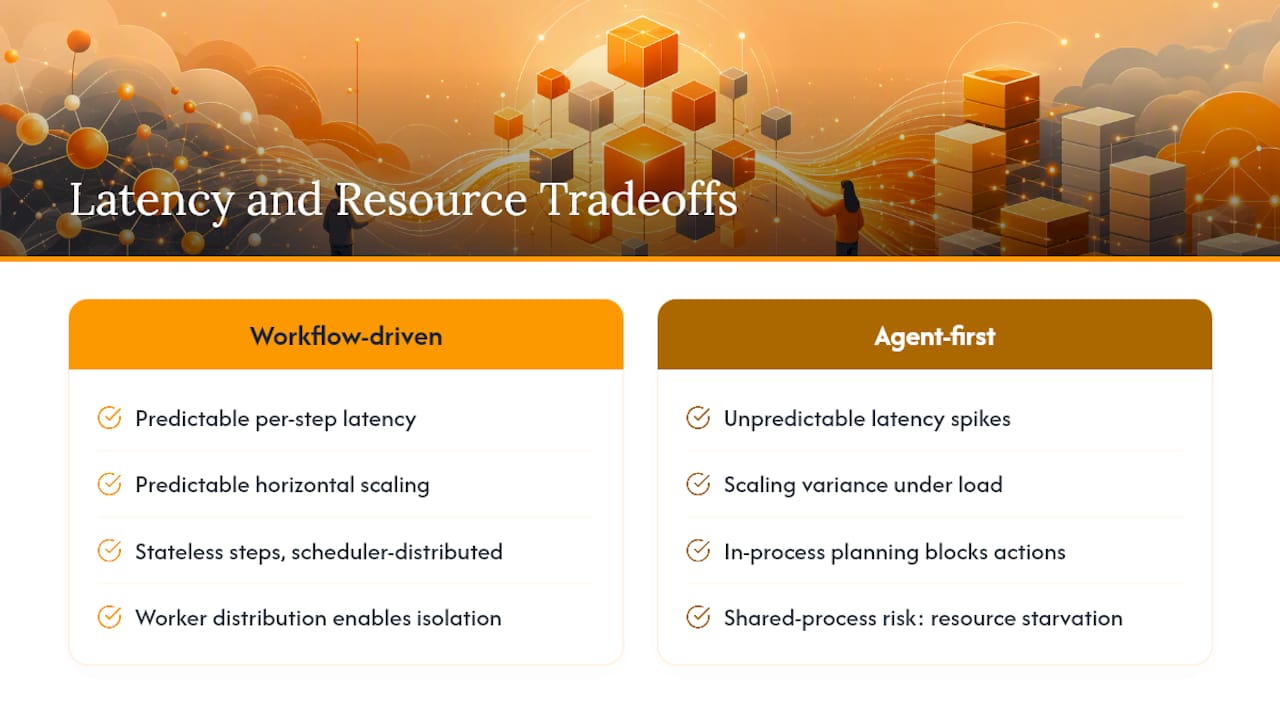
Workflow-driven engines like Conductor tend to handle horizontal scaling more predictably, because each step is a discrete, stateless unit of work that a scheduler can distribute across workers without coordination overhead. Agent-first frameworks can hit unpredictable latency spikes when an LLM's planning step takes longer than expected, since that reasoning happens in-process and blocks the next action. Resource usage follows a similar pattern: containerized workers (the model agent-swarm and Agent Orchestra both use) isolate memory and CPU per task, which prevents one runaway agent from starving the others, a real risk in shared-process agent-first setups running many specialists concurrently. If your workload has predictable, high-volume throughput, weight your evaluation toward workflow-driven engines. If it has bursty, unpredictable reasoning-heavy tasks, agent-first frameworks with good concurrency controls handle the variance better.
What Security Practices Matter Most for Open Source Orchestration?
Multi-agent systems multiply your attack surface, because every tool call, every handoff, and every worker container is a potential point of failure or exploitation. Treat the orchestration layer as infrastructure with security requirements, not just a convenience script.
Non-negotiable practices: scope credentials per worker rather than sharing one API key across every agent, so a compromised container can't act with god-mode access. Isolate execution in containers (Docker is the common baseline across agent-swarm, Agent Orchestra, and most production deployments) so a misbehaving agent can't touch the host system or other workers' data. Require MCP-standardized tool contracts instead of ad hoc integration code, since standardized contracts are easier to audit than bespoke per-agent access patterns. Log every tool call and decision with structured tracing, not just for debugging but for security review after the fact. And put human approval gates in front of any action with real-world consequences (financial transactions, external communications, production deployments) regardless of how confident the agent's reasoning trace looks.
How should an engineering team actually pick an orchestrator?
Start small: one agent, one clear task, and resist the urge to add specialists before you've felt the actual limits of a single agent. Codify anything mission-critical, payment logic, deployment steps, customer-facing actions, in a workflow engine rather than trusting an LLM's in-context judgment every time. Keep LLM planning for what it's genuinely good at: decomposing ambiguous goals into concrete steps, not executing every one of those steps itself.
The adoption path that actually works: prototype fast with an agent-first tool, run it long enough to find your real operational gaps (usually persistence and tracing first), then migrate the critical paths to a durable backend before you scale usage.
Get Your Multi-Agent Workflows Production Ready
agent-swarm turns the durability requirements covered above, checkpointed state, replayable tasks, persistent memory, into infrastructure you don't have to build yourself. A lead agent decomposes your objectives, assigns work to isolated Docker workers running Claude Code, Codex, or OpenCode, and keeps shared context compounding across every session instead of starting cold each run.
You can compare it directly against alternative approaches on the agent-swarm vs. Paperclip breakdown, or see the full landscape at agent-swarm vs the alternatives. Deployment is flexible: self-host the MIT-licensed version if data residency rules that out for you, or run the cloud-hosted option if you'd rather not manage the infrastructure. Check current pricing and join the Cloud waitlist to see how your own recurring engineering tasks run through a durable swarm instead of a brittle prototype script.
Sources
- conductor-oss/conductor
- Orchestration and handoffs | OpenAI API
- Orloj
- crewAIInc/crewAI
- Open Multi-Agent
FAQ
What is the best open source AI orchestration platform?
There's no single best option; it depends on your job. For durable production workloads, agent-swarm, Conductor, and Orloj lead on persistence and replayability. For rapid prototyping, the OpenAI Agents SDK and LangGraph get you moving fastest.
Is n8n free to use for AI workflows?
n8n offers a self-hostable, source-available version at no cost alongside a paid cloud tier, though it's built primarily for general workflow automation rather than durable multi-agent orchestration with native replayability.
Is there a genuinely open source AI orchestration tool?
Yes. Conductor, Orloj, CrewAI, Open Multi-Agent, and Agent Orchestra are all open source, and agent-swarm ships as MIT-licensed for self-hosted deployment alongside its cloud-hosted option.
How do you set up AI orchestration for a multi-agent system?
Start with a single agent or one Agents-as-Tools call, add persistence so tasks survive a worker crash, then layer in observability and human approval gates before scaling to production traffic.
What's the difference between agent orchestration and workflow automation?
Agent orchestration coordinates autonomous LLM-driven decisions across specialized workers, while traditional workflow automation executes a fixed, predetermined sequence of steps; production systems often combine both.
Recommended
Related field notes
Pick Best AI Workflow Automation That Preserves Memory for Engineers
Engineering first guide to AI workflow automation: pilot plan to prove ROI and why agent-swarm.dev fits teams needing persistent memory.
Keep Context Across Runs: Dagster Alternatives for Engineers
Engineering focused comparison of Dagster alternatives: deployment, memory model, sandboxing, and security. See how agent-swarm.dev (MIT, self-host or...
Best Open-Source AI Agent Platforms: Self-Host
Twelve open-source AI agent platforms you can self-host today, ranked by GitHub stars: license, install path, best use case and one real limitation each.