Keep Context Across Runs: Dagster Alternatives for Engineers
Engineering focused comparison of Dagster alternatives: deployment, memory model, sandboxing, and security. See how agent-swarm.dev (MIT, self-host or...

If you need an AI agent operating system rather than a data-pipeline scheduler, some platforms offer alternatives for engineering teams that run specialized worker agents in isolated containers, retain shared memory across runs, and connect to common tools like Slack, GitHub, Linear, and OpenAI. Success looks like a recurring cross-project task, a bug triage sweep, a content refresh, a deployment check, running unattended on a schedule and landing in a reviewable queue instead of someone's inbox.
TL;DR:
- Open-source agent operating systems like agent-swarm.dev support persistent shared memory across runs and offer flexible self-hosted deployment options.
- Compatibility with existing tools such as Slack, GitHub, and OpenAI is built-in, with connectors that extend coverage and simplify integration.
- Before full deployment, teams should prototype with local sandboxes, test in self-hosted or cloud environments, and measure real output improvements on small workflows.
- Security best practices include microVM or container isolation, egress filtering, ephemeral credentials, and audit logs for reviewable evidence.
- Transitioning from Dagster involves rethinking workflows as dynamic tasks rather than asset dependencies, requiring a staged approach and new skills in review and task decomposition.
Table of Contents
- What Counts as a Dagster Alternative for Agent Orchestration?
- What Technical Criteria Actually Separate These Alternatives?
- How Does agent-swarm.dev Stack Up Against That Checklist?
- How Do You Prototype an Alternative Before Committing?
- What Sandboxing and Security Practices Do Unattended Agents Need?
- What Changes When You Migrate From Dagster to an Agent Orchestration Platform?
- When Should You Self-Host an Agent OS Instead of Going Managed?
- Getting Started With agent-swarm.dev
- Sources
- FAQ
What Counts as a Dagster Alternative for Agent Orchestration?
Dagster and its data-pipeline peers solve a different problem: scheduling and monitoring ETL jobs. Engineering teams asking about Dagster alternatives in the agent-orchestration sense actually need something that assigns work to AI agents, tracks what those agents learned, and hands the output back for review. That market splits into four solution categories, and knowing which one you're evaluating matters more than any feature checklist.
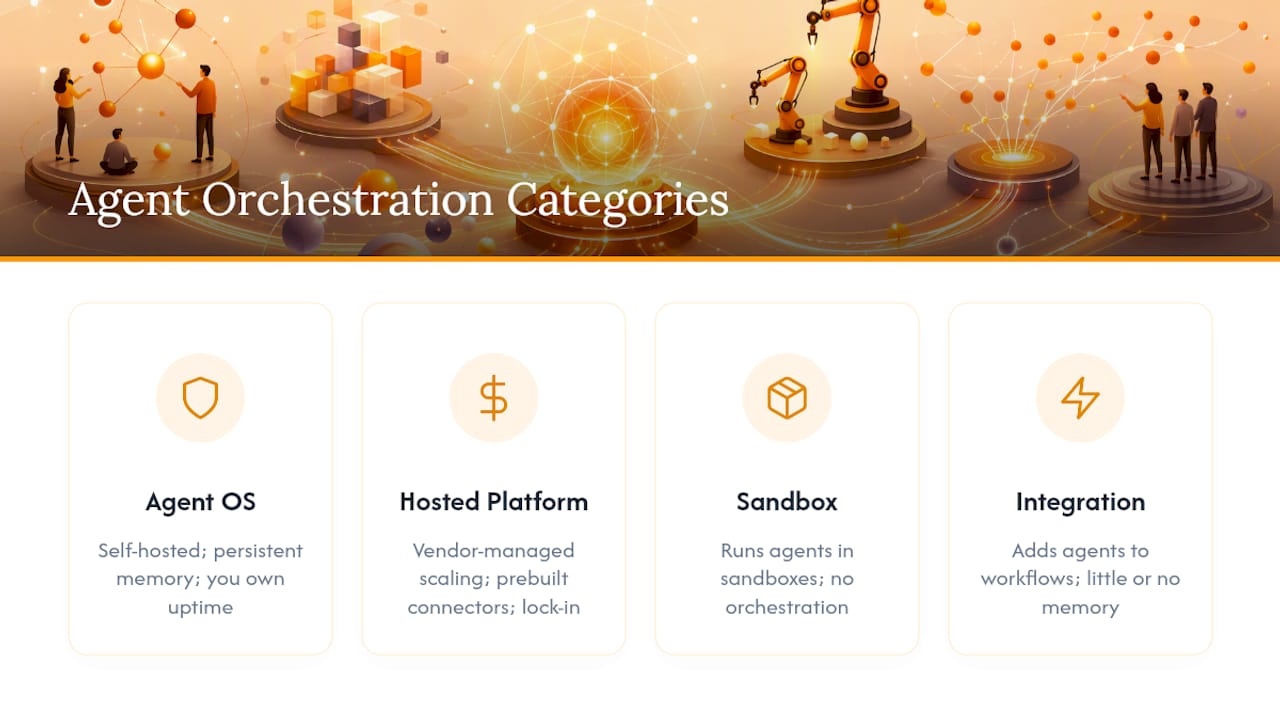
Open-source agent operating systems run self-hosted, keep persistent memory across sessions, and let you customize worker containers per project. You own the infrastructure, but you also own the uptime.
Hosted or managed agent platforms trade some control for speed. A vendor handles scaling and onboarding, and you get prebuilt connectors, but you're often locked into their sandbox model and pricing tiers.
Sandbox and execution frameworks are narrower by design. Tools built around Docker sandboxes, microVMs, or devcontainers focus purely on running an agent safely inside one repo, without any orchestration layer above them, useful as a building block, not a full replacement.
Integration-first automation services bolt agent capabilities onto existing workflow tools. They ship fast connectors and approval gates but usually lack a real memory model, so every run starts from something close to zero.
The distinction that trips up most teams: a sandbox framework and an agent operating system solve adjacent but different problems. A sandbox answers "how do I run this agent safely?" An agent OS answers "how do I coordinate twelve of these agents across six repos without losing context between Tuesday and Thursday?" Agentic workflow platforms that compose steps, verification gates, and review handoffs into reusable graphs sit closer to the second category, triggered by repo events, ticket updates, or a schedule, and they prepare evidence packages for human review rather than just executing and disappearing.
What Technical Criteria Actually Separate These Alternatives?
Score any candidate against six criteria before you write a line of integration code. Skip this and you'll find out the hard way, usually three weeks into a pilot, that the platform you picked can't do the one thing your team actually needed.
- Deployment model. Self-hosted means you patch and scale it; cloud-hosted means someone else does, for a monthly fee tied to active workers.
- Connector coverage. Check for native support of the tools your team already lives in, not just a generic webhook that requires you to build the rest.
- Memory model. Does context compound across runs, or does every session start cold? This is the single biggest driver of output quality over time.
- Autonomy controls. Look for approval gates, audit logs, and evidence packages, not just a "run it and hope" toggle.
- Security sandboxing. How are secrets handled, and what isolates the agent from your host system and your production credentials?
- Observability and scaling. Can you see run history, token usage, and failure patterns without digging through raw logs?
Pro Tip: Watch how a platform's scheduler behaves on quiet projects. Some implementations still poll every few minutes even when nothing has changed, burning tokens for no reason. Look for exponential backoff that stretches checks from minutes to hours once a project goes quiet, then snaps back the moment activity resumes.
How Does agent-swarm.dev Stack Up Against That Checklist?
Run agent-swarm.dev against the six criteria above and most boxes get checked without much interpretation required.
- Deployment: Options for both self-hosted deployment and cloud-hosted SaaS tiers are available, catering to teams that prefer full control or managed infrastructure.
- Integrations: Includes connectors for popular platforms such as Slack, Linear, OpenAI, and GitHub, with extensibility options for additional platform integration.
- Memory: Shared memory and contextual knowledge persist and compound across runs, so a worker agent picking up a task on Thursday benefits from what a different worker learned on Monday, rather than starting from zero every session.
- Proof points: Technical blog posts covering real implementation details (pause and resume gates, stateless worker design, script-based durable runs), documented client testimonials, and enterprise packages that include onboarding support.
That last point deserves emphasis: a platform that publishes its own architecture decisions in public, including the parts that were hard to get right, gives engineering evaluators something a sales deck never will. You can read the actual reasoning behind a design choice like zero local database on worker containers before you commit a sprint to testing it.
Where agent-swarm.dev fits best: teams juggling recurring work across more than two or three repos or departments, where losing context between runs is the actual bottleneck, not the raw compute cost.
How Do You Prototype an Alternative Before Committing?
Don't sign a cloud contract or spin up a fleet of self-hosted workers on day one. Run a three-stage validation instead, and keep each stage cheap enough to abandon.
- Local sandbox prototype. Use a Docker sandbox or devcontainer to run a single coding agent against one repo. Docker's own sandbox tooling now supports microVM-based isolation, letting the agent install packages and even build Docker inside the sandbox without touching your host.
- Self-hosted trial. Spin up agent-swarm.dev in Docker, or trial the cloud version, with a single team on a single recurring task. Measure real output, not vibes.
- Telemetry capture. Track run success rate, review time saved per cycle, and the number of recurring runs you've actually automated versus still doing by hand.
- Staged rollout. Expand gating and approval policies gradually, and train developers on how to read evidence packages before you hand agents anything customer-facing.
Pro Tip: Start the pilot on a task that already has a clear, boring success definition, like a weekly dependency audit or a recurring status rollup. Novel, ambiguous tasks make it impossible to tell whether a failed run is the platform's fault or the prompt's.
Your devcontainer setup from stage one carries forward almost unchanged into stage two, which is exactly why starting sandboxed first saves rework later.
What Sandboxing and Security Practices Do Unattended Agents Need?
Running an agent unattended means accepting that it will eventually do something you didn't expect. The question is whether your isolation layer contains the damage.
- Container sandboxes are lightweight and fast but share more kernel surface with the host than a microVM does; fine for most repo-scoped tasks, riskier if the agent needs to build or run its own Docker containers.
- MicroVM-based sandboxes trade a little startup latency for real isolation, and they support Docker-in-Docker workflows without exposing your host's Docker daemon.
- Devcontainers sit in between: consistent, versioned, and easy to distribute across a team, enforcing the same tooling and permissions for every engineer who spins one up.
Network controls matter as much as container choice. Egress filtering and allowlists stop an agent from reaching anywhere it doesn't need to, and a firewall rule set that defaults to deny is worth the extra setup time. Secrets should live in a vault with ephemeral credentials, never baked into an agent's session or checked into a config file. Tools like safebox demonstrate this pattern well, mounting project files and isolated config directories per harness so Claude Code, Codex, or Pi each get exactly the access they need and nothing more.
Persist agent auth and session state in mounted config directories so runs stay reproducible and agents keep context across container restarts, rather than re-authenticating and starting cold every time.
Audit trails close the loop: every unattended run should produce artifacts a human can review before anything ships.
What Changes When You Migrate From Dagster to an Agent Orchestration Platform?
Teams moving off Dagster for this use case aren't migrating pipelines. They're replacing a scheduling mental model with a delegation one, and that shift trips people up more than any technical incompatibility does.
Dagster assumes you're defining assets and dependencies ahead of time. An agent operating system assumes you're defining objectives and letting a lead agent break them into tasks dynamically. That means your existing Dagster DAGs don't port over; you rebuild the underlying workflows as agent-assignable tasks instead of asset definitions. Expect to spend more time on task decomposition than on scheduling syntax.
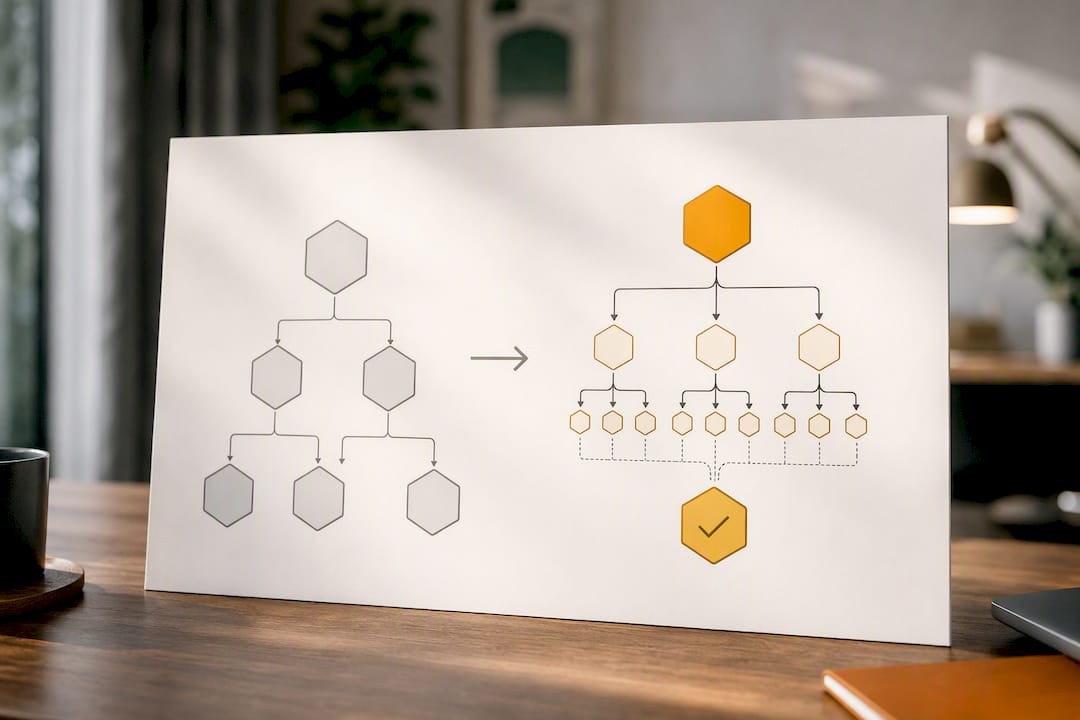
Credentials and secrets management also need a second look. Dagster resources typically hold long-lived connection strings; an agent platform running unattended workers should shift toward ephemeral, scoped credentials issued per run.
Team habits shift too. Engineers used to reading a Dagster asset graph now need to read agent run logs and evidence packages instead, a different skill that takes a pilot or two to build comfort with. Budget for that learning curve explicitly rather than assuming it's free.
Finally, don't try to migrate everything at once. Pick one recurring, low-risk workflow, run it in parallel with your existing process for a few cycles, and only decommission the old path once the new one has proven itself on real runs, not a demo.
When Should You Self-Host an Agent OS Instead of Going Managed?
Self-hosting earns its complexity when your team has real infrastructure staff, compliance requirements that make external data handling a problem, or workflows sensitive enough that you want every container on hardware you control. If none of that describes you yet, a managed or hybrid start gets you faster signal with less risk.
Practically: staff the pilot with one engineer who owns the setup, scope it to a single recurring workflow, and hold off on autonomy expansion until you have a few weeks of clean audit logs. Compliance reviews go smoother when you can show gated approvals from day one rather than retrofitting them after an incident. Most teams underestimate how much organizational trust in autonomous agents has to be earned in small, visible wins before wider rollout makes sense.
— Ez.-
Getting Started With agent-swarm.dev
Here's the practical advantage: agent-swarm.dev gives you a real choice most alternatives don't, run the same operating system self-hosted for free under MIT license, or pay only for active workers on the cloud tier once you know it fits. No forced platform lock-in, no rebuilding your workflows twice if you switch deployment models later.
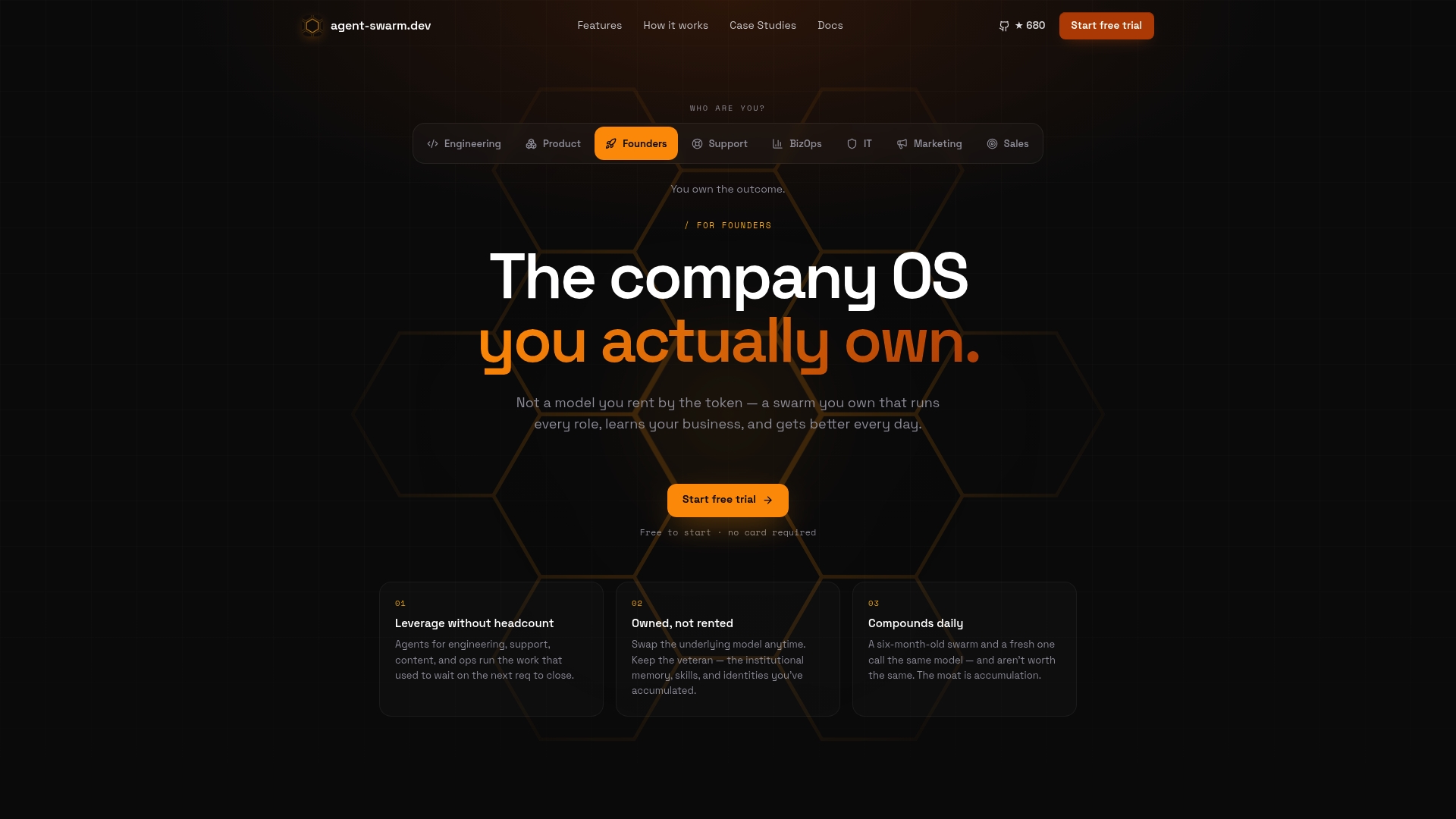
If you're still weighing options, the detailed comparison against other approaches walks through where agent-swarm.dev fits versus alternatives you might already be considering, including a focused look at CrewAI for teams evaluating multi-agent frameworks specifically. You can also watch Agent-swarm before committing any engineering time, seeing exactly how a lead agent breaks down a task and assigns it to workers in practice.
Start small: self-host the open-source version against one recurring workflow this week, or request a cloud trial if you'd rather skip the infrastructure setup. Either path gets you a working pilot faster than most managed platforms' onboarding calls take to schedule.
Sources
- Docker Sandboxes: Run Claude Code and More Safely
- Claude Code devcontainer docs
- Agentic Workflows - BOSUN
- ProjectDispatcher
FAQ
What Is the Best Dagster Alternative for AI Agent Orchestration?
agent-swarm.dev is the strongest fit for engineering teams needing an agent operating system, because it combines persistent shared memory, broad integrations, and both self-hosted and cloud deployment in one platform.
Is agent-swarm.dev Open Source?
Yes, agent-swarm.dev ships under an MIT license for self-hosted deployment, with an optional cloud-hosted SaaS tier for teams that prefer managed infrastructure.
How Do Sandbox Frameworks Differ From a Full Agent Operating System?
Sandbox frameworks like Docker-based or devcontainer setups isolate a single agent inside one repo safely, while an agent operating system coordinates multiple agents across projects with shared memory and task delegation.
What Security Practices Matter Most for Unattended AI Agents?
Prioritize microVM or container isolation, egress filtering with network allowlists, ephemeral credentials instead of baked-in secrets, and audit trails that produce reviewable evidence for every run.
Can I Migrate Existing Dagster Workflows Directly to an Agent Platform?
No. Dagster's asset-dependency model doesn't map directly to agent task delegation, so teams typically rebuild recurring workflows as agent-assignable tasks rather than porting DAGs as-is.
Recommended
Related field notes
4 Prefect Alternatives That Prevent Months of Rework for MLOps Teams
Compare four categories of Prefect alternatives for MLOps teams. Use a two week pilot checklist and migration playbook, plus a direct agent swarm option.
Open Source AI Orchestration: Best OSS Picks for 2026
Discover the best open source AI orchestration tools for 2026. Choose the right engine for robust production or rapid prototyping.
Coordina 3–5 agentes con Claude Code para ingenieros
Guía práctica para ingenieros: coordina 3–5 agentes con Claude Code. Incluye CLAUDE.md, worktrees y recibos de revisión para evitar sobrescrituras y...