4 Prefect Alternatives That Prevent Months of Rework for MLOps Teams
Compare four categories of Prefect alternatives for MLOps teams. Use a two week pilot checklist and migration playbook, plus a direct agent swarm option.

For most engineering teams outgrowing Prefect, agent-swarm.dev is the practical next step: it replaces manual pipeline coordination with agent-driven orchestration that keeps memory across runs and plugs into hundreds of existing tools. That said, teams whose bottleneck is asset lineage, strict Kubernetes-native infra control, or a fully hosted zero-ops engine may still find a specialized category tool fits better. Scan the shortlists below. Then check the migration playbook before you commit to a rebuild.
TL;DR:
- Python-native orchestrators are ideal for teams prioritizing rapid development and local testing, but require pairing with separate artifact and experiment tracking tools.
- Asset-centric platforms excel in providing robust lineage, metadata, and data product management, yet demand upfront modeling of pipelines as assets before migration.
- Kubernetes-native tools offer infrastructure consistency and event-driven execution but involve less Python ergonomics and higher operational complexity for teams unfamiliar with Kubernetes.
- Running parallel pilots for one to two weeks before full migration reduces the risk of metadata drift and ensures output parity across systems.
- Cost drivers such as worker scaling, artifact retention policies, and infrastructure overhead outweigh licensing fees, making pilot-based cost assessments essential.
Table of Contents
- Prefect Alternatives by Category: Which Kind Fits Your Team?
- What Criteria Should You Use to Compare Prefect Alternatives?
- Python-Native Orchestrators: Fast to Adopt, Thin on Lineage
- Asset-Centric Platforms: Built for Lineage, Not for Speed
- Kubernetes-Native and Low-Code Orchestration: Infra Control vs. Developer Speed
- How to Pilot a Prefect Alternative Without Breaking Production
- Deployment Models and Cost Shapes: What to Actually Budget For
- Why Are Teams Actually Leaving Prefect?
- How Do Prefect Alternatives Perform Under Real Workloads?
- How Good Is the Support Ecosystem Around Each Alternative?
- How Do Security and Compliance Features Compare?
- How Platform Choices Shape an MLOps Team's Velocity and Governance
- A Direct Path Off Prefect for Teams That Want Less Manual Coordination
- Sources
- FAQ
Prefect Alternatives by Category: Which Kind Fits Your Team?
Not every team needs the same replacement. Before you evaluate any specific Prefect alternative, figure out which category actually matches your constraints, because the wrong category costs you months of rework later.
Four categories cover almost every serious contender on the market:
- Python-native, developer-first orchestrators. Flows are plain Python functions, testing looks like normal unit testing, and there's little ceremony between writing code and running it in production. This fits ML teams doing heavy experimentation where iteration speed matters more than governance.
- Asset-centric / data-product platforms. Pipelines are modeled as declared assets with lineage, materializations, and partitioning built in. This suits data platform teams that need to answer "where did this table come from" without building a separate catalog.
- Kubernetes-native / declarative orchestrators. Workflows are defined in YAML or CRDs and scheduled natively on k8s, often event-driven. Infra-heavy teams that already run everything on Kubernetes and want orchestration to behave like every other cluster resource gravitate here.
- Low-code / hosted workflow engines. Minimal operational surface, usually SaaS first, aimed at teams that don't want to run a scheduler, workers, or a metadata database at all.
Each category makes a different trade. Python-native tools win on developer speed but usually require pairing with a separate experiment tracker and artifact store, since lineage isn't a first-class concept in the framework itself. Asset-centric platforms win on governance and reproducibility, according to comparisons of Dagster's asset-model strengths against Prefect's flow-first approach, but they demand more upfront modeling before a pipeline runs at all. Kubernetes-native tools win on infra consistency for teams already fluent in Helm charts and CRDs, at the cost of some Pythonic ergonomics. Low-code hosted engines win on time-to-first-pipeline for smaller teams, but they cap out fast once you need custom retry logic or multi-cloud execution.
If your team is an ML group iterating on features and models daily, pilot a Python-native tool first. If you're a data platform team fielding "where did this number come from" questions from stakeholders every week, pilot an asset-centric platform first. If your infra team already owns a Kubernetes fleet and treats every service as a manifest, a declarative k8s-native runtime will feel native immediately. And if you're a five-person team that just needs schedules to fire reliably without anyone paging at 2 a.m., a hosted low-code engine solves that faster than anything requiring self-managed infrastructure.
Pro Tip: Run two categories in parallel for two weeks before committing. The cost of a wrong category pick (months of re-modeling pipelines) dwarfs the cost of a short parallel pilot.
What Criteria Should You Use to Compare Prefect Alternatives?
Most credible roundups and vendor comparisons converge on the same evaluation axes, which is useful: you don't have to invent a rubric from scratch. Recent category roundups of orchestration platforms consistently score alternatives against deployment flexibility, observability, ecosystem integrations, ML-first features, and cost, and that convergence is a decent signal you're not missing a dimension.
Here's the six-axis version worth running during any pilot:
- Deployment flexibility. Can you run it self-hosted, in a managed cloud, or hybrid, and does switching between them require a rewrite? Test this by deploying the same pipeline definition to two environments without touching business logic.
- Observability and lineage. Can you trace a bad output back to the exact code version and input data that produced it? Test this by deliberately breaking a downstream task and timing how long it takes to find the root cause.
- ML-first features. Does it integrate with experiment tracking and model registries natively, or do you need custom glue code? Test this by logging one real training run end to end.
- Ecosystem and integrations. Are dbt, cloud storage, and your existing data warehouse supported out of the box? Integration breadth is a real deciding factor during migration, since prebuilt connectors to dbt and cloud storage cut the engineering lift teams otherwise spend rebuilding integrations from scratch.
- Developer ergonomics and testing. Can an engineer write, test, and debug a flow locally without deploying anything? This is where Python-native tools tend to win outright.
- Operational cost and scaling. What's the actual infra footprint at 10x your current pipeline volume, not just at pilot scale?
Three numbers are worth logging on every pilot, regardless of which category you're testing: time-to-first-pipeline (how long until a real workload runs end to end), mean-time-to-recover (how fast you diagnose and fix a failed run), and infra footprint (services, containers, and compute required to keep it running). Practitioner guides consistently point to these three as the metrics that actually predict long-term operational cost and team productivity, more than any feature checklist.
Pro Tip: Instrument both the control plane and worker-level telemetry (CPU, memory, queue latency) during your pilot. Comparing only scheduler logs hides the operational overhead that shows up later at scale.
Python-Native Orchestrators: Fast to Adopt, Thin on Lineage
Python-native tools exist because Prefect proved a point: engineers adopt orchestration faster when a workflow is just a decorated Python function, not a DAG defined in a separate DSL. Comparisons of Prefect against more mature schedulers note that its decorator-based API and local-development friendliness remain a genuine differentiator, even against tools with larger provider ecosystems. If your team is moving off Prefect but still wants that same "run it like a script" feel, other Python-native engines in this category preserve it.
The strengths are concrete:
- Low ceremony. A flow is a function with decorators; there's no separate metadata service you need to stand up before writing your first pipeline.
- Local testing that behaves like real testing. You call the function, assert on its output, and move on. No need to spin up a scheduler to validate logic.
- Fast iteration. Changing a pipeline and re-running it locally takes seconds, which matters enormously during active model development.
The trade-offs show up once you're past the prototype stage. Local development ergonomics that make onboarding painless also mean lineage and cataloging weren't designed in from day one, and tools that run as normal Python scripts trade some governance depth for that early-adoption speed. You'll typically need to pair the orchestrator with a dedicated experiment tracker and a separate artifact store, since most Python-native engines treat "what version of this dataset produced this model" as your problem to solve, not theirs.
Migrating from Prefect into another Python-native engine is usually the least disruptive move you can make, precisely because the mental model doesn't change. The typical code changes involve swapping decorators and task definitions, not rearchitecting your pipeline graph. Artifact persistence is the part teams underestimate: decide up front whether artifacts live in object storage keyed by run ID, or in a metadata table your new orchestrator can query, because retrofitting that decision after 200 pipelines exist is painful. For testing strategy, treat flows-as-code the same way you'd treat any Python module: write unit tests against the underlying functions, then a smaller set of integration tests against the orchestrated flow itself. Teams handling one-off or ad-hoc runs during this transition often lean on durable script-based workflow patterns to keep retries and idempotency intact while the rest of the pipeline graph is still being rebuilt.
Pro Tip: Don't migrate your entire DAG graph at once. Cut over one leaf pipeline first, and validate that its artifact outputs match the old system bit-for-bit before touching anything upstream.
Asset-Centric Platforms: Built for Lineage, Not for Speed
If your team's real pain isn't "our pipelines are slow to write," it's "nobody can tell me where this number came from," an asset-centric platform solves a different problem than Prefect was built to solve. These platforms model pipelines as declared assets rather than task sequences, and that single modeling choice cascades into real advantages. Comparative analyses of asset-centric orchestration consistently identify lineage, cataloging, and partition management as Dagster's core structural strengths against Python-first orchestrators like Prefect.
What you gain:
- First-class lineage. Every asset knows its upstream dependencies natively, so "what breaks if I change this table" is a query, not an investigation.
- Materializations as a concept. The system tracks when an asset was last produced and with what inputs, which turns debugging stale data into a lookup rather than an archaeology project.
- Partitions and backfills baked in. Re-running a specific date range doesn't require custom scripting; it's a first-class operation.
The trade-off is upfront cost. You have to model your pipeline as assets before you get any of these benefits, and that modeling work is real: mapping existing Prefect flows onto asset definitions usually means rethinking task boundaries, not just renaming functions. Teams that skip this step and try to force-fit existing task graphs into asset definitions tend to end up with assets that don't actually represent meaningful data products, which defeats the purpose.
The migration pattern that works best treats idempotency and explicit materializations as first-class concerns from the start, defining I/O managers early and standardizing artifact metadata before writing the first asset. Skipping that step is how teams end up with metadata drift, where two assets disagree about what "latest" means. Concretely: start by mapping each existing Prefect flow to one or more assets, decide on an I/O manager for artifact handoff between assets (local disk for early pilots, object storage for anything production-bound), and standardize the metadata interface (owner, freshness policy, schema version) before you migrate a second pipeline. Hybrid patterns are common here, and practical for good reason: teams often run asset-centric platforms for governed, stable pipelines while keeping a lightweight orchestrator for experimentation and ad-hoc tasks, rather than forcing every workload into one paradigm.
Kubernetes-Native and Low-Code Orchestration: Infra Control vs. Developer Speed
Some teams don't have a Python ergonomics problem at all. Their problem is that Prefect doesn't fit cleanly into an infrastructure model where every service is a Kubernetes manifest, deployed the same way, observed the same way, and scaled the same way as everything else in the cluster.
Kubernetes-native and declarative orchestrators solve exactly that. Workflows get defined in YAML or CRDs, scaling happens through the same node pools and autoscalers that manage every other workload, and event-driven triggers (a new object landing in storage, a message on a queue) fire pipeline runs without a separate polling scheduler. For infra teams that already run everything this way, this consistency is worth real ergonomics trade-offs elsewhere.
Those trade-offs are worth naming plainly:
- Less Pythonic. Writing a pipeline in YAML or a CRD spec is not the same experience as writing a decorated Python function, and data scientists on the team will feel that friction immediately.
- Higher operational complexity. You now own more Kubernetes primitives, and debugging a failed run often means reading pod logs and CRD status rather than a clean stack trace.
- Steeper onboarding. New team members need k8s fluency before they can meaningfully contribute to pipeline changes, which is a real hiring and ramp-up cost.
Integration is where this category needs the most deliberate design work. Exposing a model registry, an experiment tracker, or an artifact store to a declarative runtime usually means wrapping each as a sidecar or an init container rather than a native SDK call, since these runtimes weren't built with ML-specific integrations as the primary use case. Plan for that wrapping work explicitly in your migration timeline, not as an afterthought discovered mid-pilot.
Low-code and hosted engines sit at the opposite end of the same spectrum: minimal operational footprint, often no infrastructure to manage at all, ideal for teams that want schedules and simple DAGs to just work. The trade-off mirrors the k8s-native case in reverse: you get almost no infra burden, but also less control over custom execution environments, retry semantics, and complex branching logic. Choose this path when your actual workload is straightforward and your team's real scarcity is engineering time, not orchestration sophistication.
How to Pilot a Prefect Alternative Without Breaking Production
A migration fails less often because the new tool is bad, and more often because nobody inventoried what the old system was actually doing. Before you write a single line in a new orchestrator, build the inventory.
- Inventory every existing task, schedule, and dependency. List each Prefect flow, its trigger schedule, its artifact outputs, its owner, and any SLA attached to it. If nobody knows who owns a given flow, that's a signal it might be dead code worth retiring instead of migrating.
- Pick one pipeline for the first pilot, not your most critical one. Choose something representative of your typical workload complexity but low enough stakes that a rough week doesn't page anyone.
- Define success criteria before you start. Time-to-first-pipeline under a target threshold, output parity with the old system, and no increase in mean-time-to-recover are reasonable defaults.
- Instrument observability from day one of the pilot. Capture control-plane logs and worker-level telemetry (CPU, memory, queue latency) so you're comparing real operational overhead, not just whether the pipeline ran.
- Run both systems in parallel for at least two full cycles. Compare outputs directly rather than trusting that "no errors" means "same results."
- Cut over incrementally, one pipeline at a time. Full cutovers are where orchestration fragmentation happens: half your team debugging the old system, half debugging the new one, and nobody sure which one is authoritative for a given dataset.
The most common pitfall is metadata drift: two systems disagreeing about what "the latest run" or "the current schema" means during the overlap period. The fix is boring but effective. Assign one system as the source of truth for each pipeline during migration, and don't let both write to the same downstream table simultaneously. Treat the last 40% as its own project with its own deadline, not a tail that finishes itself. For teams looking for a structured playbook here, the practitioner-level guidance on mapping orchestration requirements to operational practice is worth reviewing before your first cutover.
Pro Tip: Keep the old Prefect flow's code frozen and tagged the moment you start the pilot. When output comparisons disagree, you need a stable reference to diff against, not a moving target.
Deployment Models and Cost Shapes: What to Actually Budget For
The sticker price of an orchestration tool is rarely the number that determines your real cost. Worker scaling patterns and artifact retention policies tend to dominate long-term spend far more than the subscription line item, since how you scale workers and how long you retain artifacts compounds monthly in ways a licensing fee doesn't.
Three cost drivers show up consistently across every deployment shape:
- Worker count and idle time. Workers that sit provisioned but idle between scheduled runs are pure waste; autoscaling workers to zero between jobs is the single biggest lever most teams underuse.
- Scheduler and metadata service overhead. Some orchestrators require a database, a scheduler process, a webserver, and a message broker running continuously. Others need one process. That difference alone changes your minimum viable infrastructure footprint.
- Artifact storage and retention. Every pipeline run that writes intermediate artifacts to object storage accumulates cost silently unless retention policies are set explicitly from day one.
Infra footprint reality check: Self-hosted setups vary enormously by architecture. Comparisons of self-hosting Prefect against classic multi-service orchestrators found that lightweight single-server Prefect deployments can run with meaningfully fewer services than typical multi-container Airflow stacks, a difference that matters most for small teams without dedicated infrastructure staff.
Three heuristics help you plan capacity before committing to a deployment model. First, size your pilot environment at roughly your expected peak load, not average load. Orchestration overhead often shows up only under concurrent execution, and a pilot run at average load will hide scaling problems until production. Second, measure cost per pipeline run, not cost per month, during the pilot; this normalizes comparisons across tools with wildly different pricing models (subscription versus compute-based versus flat self-hosted infra). Third, test your retention policy under load by deliberately generating a week's worth of artifacts and confirming your storage costs match projections. Managed and hybrid options shift some of this burden to a vendor, but the underlying cost drivers, worker scaling and artifact retention, don't disappear. They just move onto someone else's invoice.
Why Are Teams Actually Leaving Prefect?
Three recurring complaints show up across nearly every migration conversation, and they cluster around gaps rather than outright failures.
The first is missing ML-specific experiment management. Prefect orchestrates task execution well, but it doesn't natively track hyperparameters, model versions, or evaluation metrics across runs. Teams doing serious model iteration end up bolting on a separate experiment tracker anyway, and once that's true, the case for an orchestrator with tighter native ML integration gets stronger.
The second is artifact and dataset versioning. Knowing that a pipeline ran successfully isn't the same as knowing exactly which version of a dataset it consumed. Teams that need audit trails for compliance or reproducibility reasons often find this gap is what finally pushes them toward an asset-centric platform where materializations track this by default.
The third is cost and cloud lock-in. Teams on a managed cloud offering sometimes discover that scaling workers or increasing retention windows scales cost faster than expected, and switching to self-hosted later means rearchitecting deployment from scratch. Locking into a single cloud's managed orchestration service can also limit portability if the team later needs multi-cloud or on-prem flexibility for compliance reasons.
None of these gaps are unique to Prefect. Every orchestrator makes trade-offs somewhere. But these three account for most of the migration conversations happening across data and MLOps teams right now, and knowing which one is driving your search narrows the category list fast.
How Do Prefect Alternatives Perform Under Real Workloads?
Performance comparisons across orchestration tools rarely come down to raw scheduler speed, since most modern engines can trigger a task within milliseconds of its scheduled time. The differences that actually matter show up under specific workload shapes.
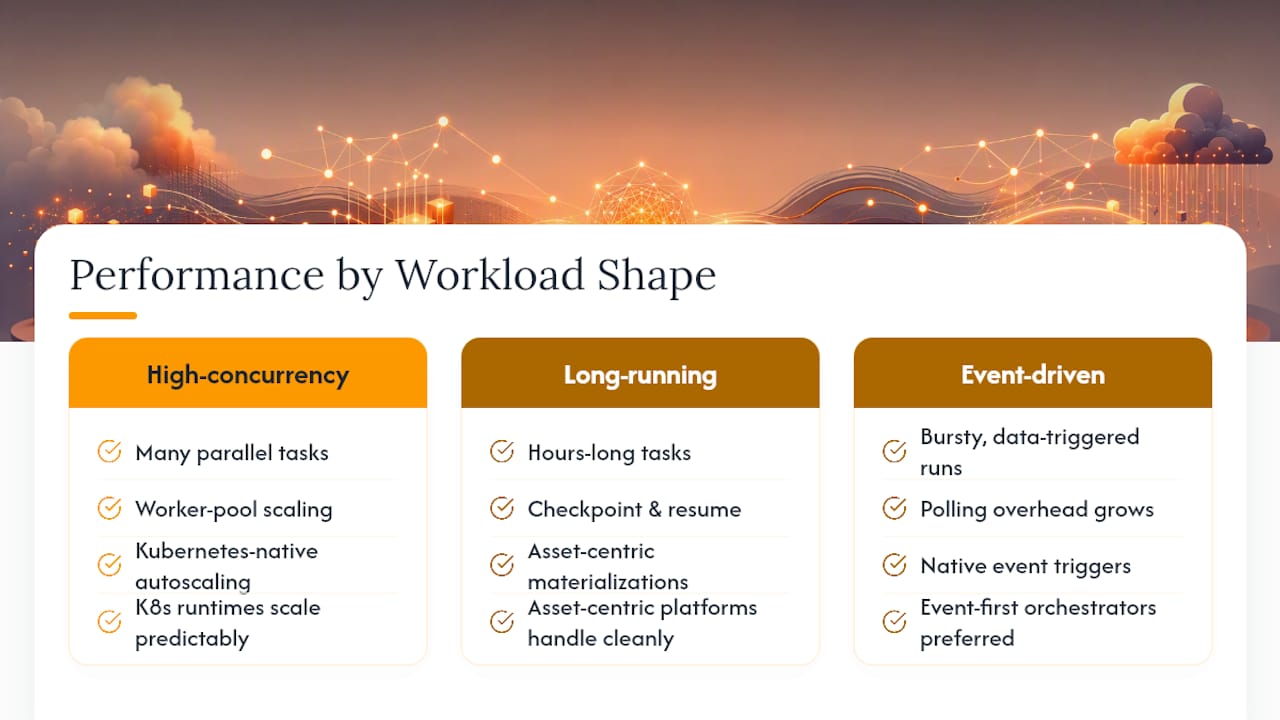
High-concurrency batch workloads (hundreds of parallel tasks firing at once) stress worker pool scaling and queue management differently across tools. Python-native orchestrators generally handle this well up to moderate concurrency, but teams running thousands of simultaneous tasks often find Kubernetes-native runtimes scale more predictably, since they inherit the cluster's existing autoscaling behavior rather than managing a separate worker pool abstraction.
Long-running ML training workloads stress a different dimension: how gracefully the orchestrator handles a task that runs for hours rather than seconds, including checkpointing and resume behavior after a failure. Asset-centric platforms tend to handle this cleanly because materializations are designed around exactly this kind of long-lived, resumable unit of work.
Event-driven, bursty workloads (a pipeline that only runs when new data lands) favor tools with native event triggers over pure polling schedulers, since polling at fine intervals adds overhead that scales poorly as pipeline count grows.
The honest takeaway: there's no universal performance winner. The right choice depends on whether your dominant workload shape is high-concurrency batch, long-running training, or event-driven bursts, and testing your actual workload pattern during a pilot matters more than any generic benchmark claim.
How Good Is the Support Ecosystem Around Each Alternative?
Documentation quality varies more across this category than most engineers expect going in. Some platforms maintain extensive, example-driven docs with runnable code snippets for every core concept. Others lean heavily on API reference documentation and expect users to piece together patterns from community forums or GitHub issues.
Community size correlates loosely with how fast you'll find an answer to an obscure error message. Larger, more mature ecosystems tend to have deeper Stack Overflow and GitHub Discussions coverage simply because more people have hit the same edge cases over more years. Newer or more specialized tools may have smaller communities but often compensate with more responsive maintainers directly engaging on GitHub issues.
Enterprise support offerings differ meaningfully in scope. Some vendors offer dedicated Slack channels or named support engineers as part of a paid tier; others offer only community support regardless of spend. If your team is regulated or has strict uptime requirements, confirm what "enterprise support" actually includes (response time SLAs, dedicated engineers, migration assistance) before assuming a paid tier covers what you need.
When evaluating any alternative, spend an afternoon actually searching its documentation for a real problem you're currently solving, and separately search its community forum or Discord for that same problem. That single test tells you more about the support ecosystem than any marketing page will.
How Do Security and Compliance Features Compare?
Role-based access control is close to table stakes at this point, but the granularity varies. Some orchestrators offer access control down to the individual pipeline or asset level; others only support workspace-level or project-level permissions, which can be too coarse for teams with strict data-access separation requirements.
Data encryption in transit is standard across credible platforms. Encryption at rest for stored artifacts and metadata is less universal, particularly among self-hosted open-source deployments where the responsibility for enabling it shifts to the team running the infrastructure rather than the vendor.
Compliance certifications (SOC 2, HIPAA readiness, and similar) mostly matter for managed and hosted offerings, since a self-hosted open-source tool's compliance posture is determined by how your team deploys and audits it, not by anything the vendor certifies. If your team is in a regulated industry, confirm whether compliance certifications apply to the managed offering specifically, since a vendor's SOC 2 report on their cloud product says nothing about a self-hosted deployment of the same open-source codebase.
Audit logging, tracking who triggered a run, who changed a schedule, who accessed a specific artifact, is worth testing directly during a pilot rather than trusting a feature list. Trigger a few administrative actions yourself and confirm they show up in an audit trail before you assume the capability exists in practice.
How Platform Choices Shape an MLOps Team's Velocity and Governance
The tension underneath every one of these comparisons is the same: developer speed and long-term governance pull in opposite directions, and most teams pick a tool that optimizes for whichever one hurt them most recently. That's a reasonable instinct, but it's short-sighted if the tool you pick can't flex as your team's constraints change.
What's underrated in most orchestration comparisons is how much of the actual pain isn't the orchestration logic itself. It's the handoffs. A data engineer hands a pipeline spec to an ML engineer, who hands a trained model to a platform engineer, and every handoff is a place where context gets lost and someone has to re-explain what the pipeline is actually supposed to do. Agent-driven orchestration attacks that problem directly by having a coordinating agent retain context across runs and delegate to specialized workers, which is the kind of compounding contextual memory that traditional schedulers were never designed to carry.
If you're choosing based purely on today's pain, you'll probably pick right for today and wrong for next year. Choose based on where your handoffs actually are.
A Direct Path Off Prefect for Teams That Want Less Manual Coordination
agent-swarm is the alternative to rebuilding your orchestration stack piece by piece: instead of choosing a single category and living with its gaps, a lead agent breaks pipeline objectives into tasks and delegates them to specialized workers running Claude Code, Codex, or OpenCode, each in an isolated container, with memory that compounds across runs instead of resetting every time.
That persistent memory is the practical difference for teams tired of re-explaining pipeline context after every handoff between data engineering and ML. agent-swarm integrates with Slack, Linear, GitHub, and hundreds of other platforms, and it runs self-hosted under MIT, with enterprise support available by conversation. Engineering teams have used it to cut the recurring coordination work that eats a surprising share of a sprint, documented in the Capchase case study. If you're comparing this approach against a single coordinating agent model, the breakdown on agent fleets versus a coordinated swarm walks through the architectural difference directly.
If your pilot checklist from earlier in this piece is ready, the fastest next step is to walk through real agent-swarm sessions and see how a delegated pipeline objective actually executes end to end before you commit engineering time to a migration.
Sources
The comparisons and figures referenced throughout this piece draw on a handful of sources worth reading directly if you want to go deeper on a specific category:
- Dagster vs Prefect: Orchestration Compared (2026) | Modern DataTools
- Apache Airflow vs Prefect: Best Scheduler? · Analytics Engineering
- Selfhosting
FAQ
How much engineering effort does migrating off Prefect typically take?
Effort depends on category choice more than tool choice. Staying Python-native usually takes days to weeks per pipeline, while moving to an asset-centric model adds real upfront modeling time before the first migrated pipeline runs.
How long should a Prefect alternative pilot run?
Run both systems in parallel for at least two full scheduling cycles so you can compare outputs directly rather than trusting a lack of errors as proof of parity.
Do Prefect alternatives cost less than Prefect?
Cost depends far more on worker scaling and artifact retention policy than on the subscription price itself, so compare cost per pipeline run during your pilot rather than sticker prices.
Does agent-swarm.dev replace the need for a dedicated experiment tracker?
agent-swarm.dev focuses on orchestrating and delegating work across specialized agents with persistent memory rather than replacing model-specific experiment tracking, so most ML teams still pair it with a dedicated tracker for hyperparameters and metrics.
When should a team keep Prefect instead of switching?
If your pipelines are simple, your team already has deep Prefect expertise, and neither lineage gaps nor cost scaling have caused real pain, switching categories adds migration risk without a clear operational payoff.
Recommended
Related field notes
Keep Context Across Runs: Dagster Alternatives for Engineers
Engineering focused comparison of Dagster alternatives: deployment, memory model, sandboxing, and security. See how agent-swarm.dev (MIT, self-host or...
How to Avoid Vendor Lock-In for Coding Agents: A Layer-by-Layer Exit Test
Coding-agent lock-in lives in the context layers, not the model. Audit eight layers, run the exit test, and keep memory and traces exportable.
Shared-Context AI Agents: Patterns, Risks, and Setup
What shared-context AI agents are, how shared context differs from memory and private state, the risks, and how to run governed sharing.