Engineers: Cut Token Costs by Managing Context Windows in Production
Production guidance for engineers to manage context windows, reduce token costs, prevent context rot, and add retrieval and observability.

Context window management is the disciplined practice of treating an LLM's context as a token budget, not an inbox. The recommended production approach combines hybrid retrieval, rolling summarization, and structured state so only the highest-value tokens survive into each request. Done right, this means flat costs, stable latency, and no dropped facts as a session grows.
TL;DR:
- Managing context as a token budget is essential, as effective recall degrades in longer sessions despite large maximum window sizes.
- Combining strategies such as sliding windows, recursive summarization, structured facts, and targeted retrieval helps maintain accuracy and control costs.
- Proper chunking, overlap, and hybrid search methods improve retrieval relevance, reducing token waste and distraction from irrelevant information.
- Enforcing explicit token budgets and monitoring relevance scores and latency helps prevent context rot and ensure high-quality responses.
- Infrastructure choices like approximate indexes, in-memory vector search, and structured memory are critical for balancing speed, cost, and recall in production systems.
Table of Contents
- What Is a Context Window in Context Window Management?
- Why Context Window Management Matters in Production
- Core Strategies for Managing Context: Trade-offs and When to Use Each
- Building a Precise Retrieval Pipeline: Chunking and Hybrid Search
- Token Budgeting and Prompt Assembly Guardrails
- Monitoring and Testing for Context Failures
- Infrastructure Choices: Vector Stores, Caching, and Index Strategy
- How agent-swarm.dev Applies Compaction and Structured State in Practice
- The Checklist: Shipping Better Context Management This Week
- What Actually Moves the Needle in Context Window Management
- Give Your Agents a Context Management Layer They Don't Have to Fight
- Sources
- FAQ
What Is a Context Window in Context Window Management?
A context window is the fixed maximum number of tokens a model can process in one request. That count includes the system prompt, the full message history, any tool outputs, retrieved documents, and the tokens the model generates in response. Anthropic's documentation frames it exactly this way, and the framing matters because engineers often forget that generated output eats from the same budget as everything else feeding in.
Tokens are not words. A tokenizer splits text into subword units, so "management" might become two or three tokens depending on the model's vocabulary. This gap between "words I typed" and "tokens I'm billed for" catches a lot of teams off guard during their first production cost review.
Advertised context length and effective context length are different numbers. A model might list a 200,000-token window, but recall and reasoning quality can degrade well before that ceiling, especially for information buried in the middle of a long prompt.
Representative model context sizes include entry-tier chat models with tens of thousands of tokens, mainstream production models with over one hundred thousand tokens, and frontier long-context models supporting up to around one million tokens, though effective recall varies.
Why Context Window Management Matters in Production
Token cost and latency both scale with context size, and neither scales gracefully. Every additional thousand tokens of history you pass in gets re-processed on every turn, so a chatty 50-turn agent session can cost far more per response than the same conversation compacted down to its essentials.
Larger windows introduce a subtler problem: context rot. Even with generous advertised limits, models tend to lose track of details placed in the middle of a long prompt, favoring information near the start or end. Redis's engineering team calls this out directly, arguing that raw window size is not a proxy for reliability and that "context hygiene" matters more than headroom.
Agentic systems add two more failure modes. Retrieval blind spots happen when a RAG pipeline confidently returns the wrong chunks and the agent never notices. Mission drift happens when a long-running agent slowly forgets its original objective because the instruction got pushed out of the effective window by newer conversation turns.
Core Strategies for Managing Context: Trade-offs and When to Use Each
MachineLearningMastery's breakdown identifies five core strategies for long-running agents, and picking the right combination depends entirely on your session length and how much fidelity you can afford to lose.
Sliding windows keep only the most recent N messages or tokens, dropping older turns wholesale. They're cheap and simple to implement, but anything important said early in a session vanishes the moment it scrolls out of range.
Recursive summarization periodically compresses older turns into a running summary, then feeds that summary forward instead of the raw transcript. This preserves gist while shrinking token count, though summarization is lossy by nature and can quietly drop a number or a name that mattered.
Structured state management pulls specific facts out of the conversation entirely and stores them as typed fields (a customer ID, a decision that was made, a deadline) rather than prose the model has to re-read and re-interpret every turn.
Ephemeral RAG retrieves only the documents relevant to the current turn, rather than keeping a growing pile of source material resident in context. Retrieval quality becomes the bottleneck here.
Dynamic context routing sends different requests to different context configurations (or different models entirely) based on task complexity, so a simple lookup doesn't pay for a 100,000-token prompt it never needed.
Here's how those map to real scenarios:
- Short, single-session chat: sliding window alone is usually enough.
- Long-running support or coding agents: recursive summarization plus structured state for anything mission-critical.
- Knowledge-heavy assistants: ephemeral RAG, refreshed every turn rather than accumulated.
- Mixed-complexity workloads: dynamic routing to control cost across a fleet of agents.
In practice, the strongest production systems don't pick one strategy. They layer a sliding window for recency, a rolling summary for continuity, and RAG for facts the model shouldn't have to memorize. MachineLearningMastery notes that combining recursive summarization with structured state is a common pattern specifically because it keeps per-request token counts low while protecting the facts an agent absolutely cannot forget.
Pro Tip: Don't summarize structured facts. If a value belongs in a database field (a ticket ID, a dollar amount, a deadline), pull it out of the prose loop entirely instead of trusting a summarizer to carry it forward turn after turn.
Building a Precise Retrieval Pipeline: Chunking and Hybrid Search
Retrieval quality determines whether your RAG layer helps or actively hurts. A pipeline that returns ten mediocre chunks burns tokens the model has to sift through, and each irrelevant chunk increases the odds it distracts from the answer.
- Size chunks for boundary integrity, not convenience. A chunk that splits a sentence or a table row loses the context needed to interpret it correctly. Most production systems use chunk sizes in the low hundreds of tokens, adjusted for document type.
- Overlap chunks deliberately. Redis recommends smart chunking with strategic overlap as one of the highest-return changes a team can make before touching any infrastructure at all, because overlap prevents a fact from being sliced in half between two chunks that never get retrieved together.
- Combine vector search with keyword matching. Semantic embeddings catch conceptual matches; BM25-style keyword search catches exact terms, product codes, and acronyms that embeddings tend to blur. Running both and merging results, a pattern also detailed in guidance on hybrid retrieval for search relevance, consistently outperforms either method alone.
- Fuse and re-rank before the tokens ever reach the prompt. Reciprocal rank fusion is a simple way to merge two ranked lists (vector and keyword) into one ordering. A lightweight re-ranker pass on the top candidates catches cases where raw similarity scores mislead.
- Cache repeated queries semantically, not just by exact string match, so a rephrased version of a question already answered doesn't trigger a fresh, expensive retrieval pass.
Token Budgeting and Prompt Assembly Guardrails
Treat every prompt as a fixed pool of tokens divided across competing zones, not an open-ended container. Once you assign rough percentage ranges to each zone, you can enforce them programmatically rather than discovering the problem after a bill spikes.
A typical token budget is divided across zones such as system prompt (a small share), conversation history (a moderate share), retrieved documents (a large portion), and output reserve (a reserved fraction). Percentages vary but approximate ranges guide balance.
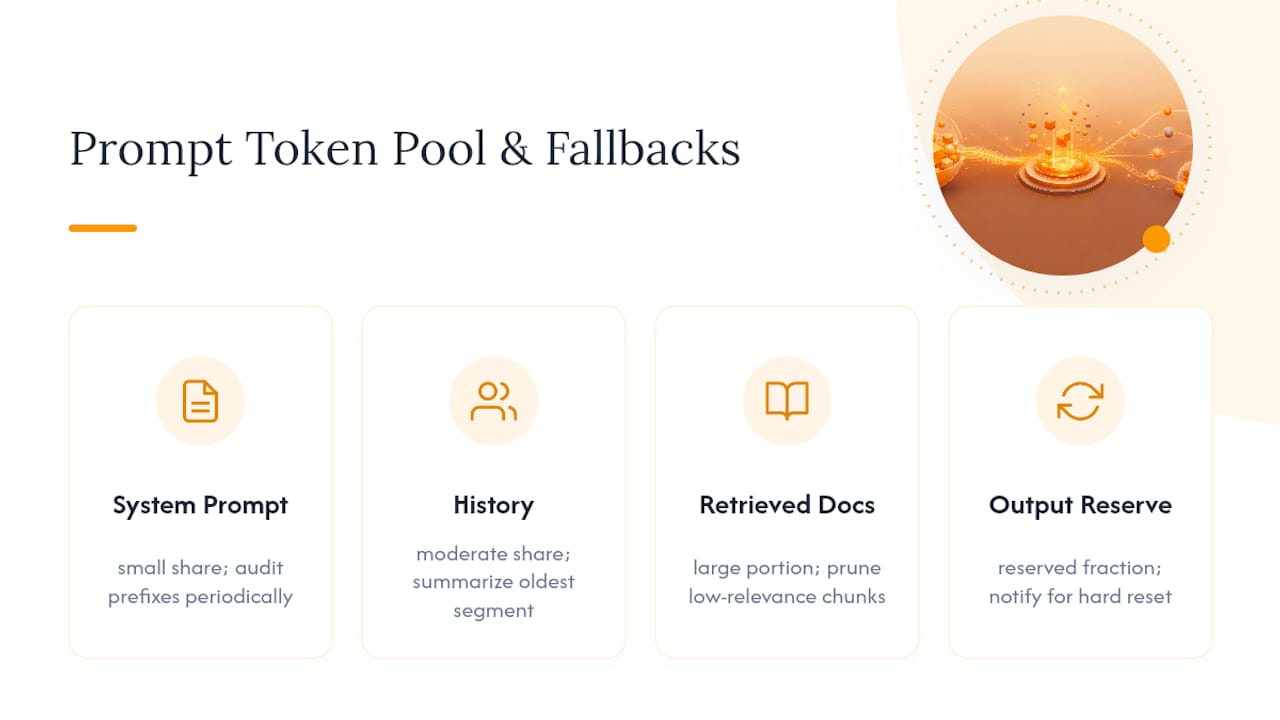
When a request approaches its cap, the system needs a defined fallback rather than a silent truncation. Common patterns include triggering summarization on the oldest history segment, pruning the lowest-relevance retrieved chunk, or notifying the calling service that the session needs a hard reset. Server-side compaction, where the platform automatically summarizes on your behalf, extends effective conversation lifespan well past the model's native window without your application code managing every trim manually.
Schedule periodic prompt prefix audits. System prompts accumulate cruft: an instruction added for one edge case six months ago that nobody has removed since.
Pro Tip: Log your actual zone percentages weekly, not just in a design doc. Budgets drift as prompts evolve, and the drift is invisible until someone asks why costs quietly doubled.
Monitoring and Testing for Context Failures
You can't fix what you don't log. Redis's guidance on production monitoring points to a specific set of signals that catch context problems before users do:
- Token count broken down by zone (system, history, retrieval, output) on every request
- Response latency correlated against total context length, not just averaged
- Retrieval relevance scores per query, so a silent drop in precision gets flagged early
- Response quality tracked turn by turn within a session, not just at session end
Set alert thresholds on relevance score drops and latency spikes tied to context growth, rather than static latency alarms that ignore the cause. Automated quality-by-turn tests, run against a fixed set of long conversations, catch regressions introduced by a prompt change before they reach production traffic.
For A/B testing, isolate one variable at a time: chunk size, retrieved document count, or embedding model. Running all three changes simultaneously makes it impossible to attribute a quality shift to the actual cause. Guardrails that escalate to a larger-context model only when relevance scores drop below a threshold keep most traffic cheap while reserving expensive fallbacks for genuinely hard cases.
Infrastructure Choices: Vector Stores, Caching, and Index Strategy
Retrieval latency lives or dies on index choice, and the trade-off is recall versus speed at scale.
- FLAT (exact) indexes compute similarity against every vector, guaranteeing perfect recall but scaling poorly past a few hundred thousand vectors.
- HNSW (approximate) indexes trade a small amount of recall for dramatically faster lookups, and this trade-off is usually invisible to end users once tuned correctly.
- In-memory vector search removes disk I/O from the retrieval path entirely. Redis benchmarks show substantial gains in queries-per-second and latency when vectors stay resident in memory with a tuned HNSW index, a real consideration once you're running an agent fleet rather than a single chatbot.
- Semantic caching stores answers to previously seen (or near-duplicate) queries, cutting both latency and retrieval cost for repeat traffic.
- Choose approximate indexes once your corpus outgrows what exact search can serve within your latency SLA. Below that threshold, FLAT's perfect recall is worth the extra compute.
How agent-swarm.dev Applies Compaction and Structured State in Practice
Production agent systems need the same discipline this guide describes, applied at the infrastructure layer rather than left to each individual prompt. agent-swarm's architecture builds several of these patterns in directly:
- Worker containers run stateless, so context doesn't silently accumulate across tasks the way it does in a single long-lived chat session.
- A structured identity and memory stack, detailed in the SOUL.md identity stack breakdown, keeps persistent facts out of the prompt and in durable storage instead.
- Compaction is treated as a design constraint from the start rather than a patch applied after a session hits its limit, a pattern explored further in this piece on designing for compaction.
- Task recovery uses an explicit state machine, covered in the task lifecycle deep dive, so a crashed worker doesn't need its full context replayed to resume correctly.
The Checklist: Shipping Better Context Management This Week
- Measure first. Log token counts by zone before changing anything. You can't budget what you haven't measured.
- Set explicit budgets for system prompt, history, retrieved documents, and output, and enforce them with code, not convention.
- Deploy the baseline stack: chunking with overlap, hybrid retrieval, and a sliding window for recency. This covers most single-session use cases.
- Add summarization and structured state once sessions run long enough that a sliding window alone starts dropping facts that matter.
- Monitor relevance and latency continuously, and A/B test one retrieval variable at a time rather than shipping bundled changes.
- Escalate selectively. Route only low-relevance-score cases to larger, more expensive context windows instead of defaulting every request to your biggest model.
What Actually Moves the Needle in Context Window Management
Most advice on this topic treats bigger context windows as the solution. It isn't. A 1,000,000-token window with no chunking discipline and no relevance monitoring will cost more and perform worse than a well-managed 32,000-token setup, because the failure mode isn't capacity, it's noise. The model spends its attention on irrelevant history instead of the three facts that actually matter for the current turn.
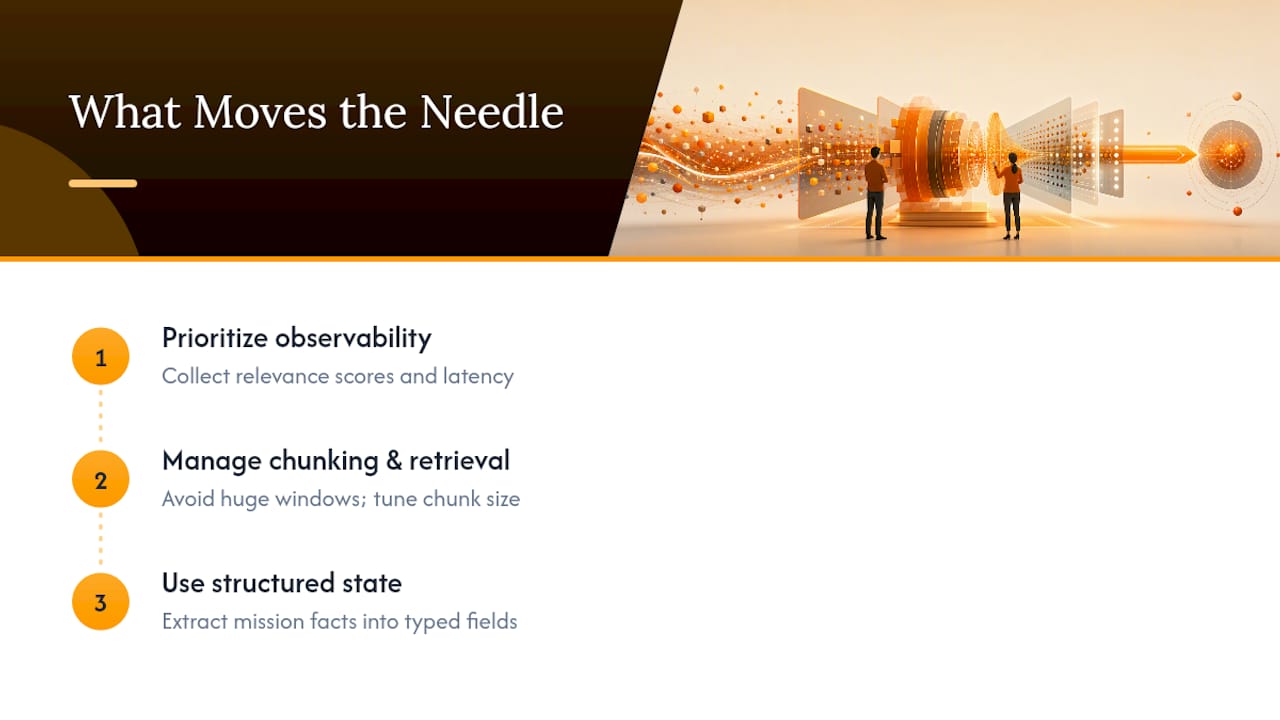
The conventional wisdom also underrates structured state. Engineers reach for summarization first because it feels like the natural extension of "just compress the conversation." But summarization is lossy by design, and mission-critical facts (an account ID, a compliance decision, a deadline) don't belong in prose that gets rewritten every few turns. Pull them out into typed fields and let the model reference them instead of re-deriving them.
If you're building anything that runs longer than a handful of turns, prioritize observability before you prioritize architecture. You cannot tune chunk size or retrieval count intelligently without relevance scores and latency data in front of you first. Everything else in this guide is downstream of that decision.
— Ez.-
Give Your Agents a Context Management Layer They Don't Have to Fight
Most teams build context management by hand, one summarization function and one sliding window at a time, then rebuild it again for the next agent. [Agent swarm software] manages context at the orchestration layer by running stateless worker containers and storing mission-critical facts in persistent structured memory rather than continually growing prompts, with compaction designed in as a fundamental pattern.
That structure is what lets a lead agent break a large objective into tasks, hand them to specialized workers, and keep shared memory compounding across runs instead of starting from zero every session. If you're deciding whether to build this orchestration layer yourself or run it on infrastructure that already handles compaction and state, Agent-swarm show exactly how it plays out in production. Compare the approach against alternatives on the Agent-swarm and see which fits your team's workflow.
Sources
- Context windows — Claude Platform docs
- Context window management for long-running agents — MachineLearningMastery
- Context window management for LLM applications — Redis blog
FAQ
What Is a Context Window in Simple Terms?
A context window is the total amount of text, measured in tokens, that a model can read and respond to in a single request, including the system prompt, conversation history, and any documents retrieved for that turn.
How Big Is a 200K Context Window?
A 200,000-token context window holds roughly a book-length document, though effective recall for details buried in the middle often degrades well before that ceiling is reached.
What Does a 1 Million Token Context Window Mean?
A one-million-token window means the model can technically accept an enormous amount of input in one request, but large windows don't guarantee reliable recall, so treating it as unlimited headroom rather than a budget still causes context rot.
Which AI Has the Highest Context Window?
Context window sizes change frequently as providers release new models, with frontier models reaching into the millions of tokens; check each provider's current documentation rather than relying on a fixed figure, since the ranking shifts often.
Do I Still Need RAG if My Model Has a Huge Context Window?
Yes. A larger window doesn't fix retrieval precision. Ephemeral RAG combined with hybrid semantic and keyword search still returns fewer, higher-value tokens than stuffing an entire knowledge base into a massive prompt, which keeps both cost and accuracy in check.
Recommended
Related field notes
Recorta 40–70 %: prioriza optimización de costos LLM para ingenieros
Guía para ingenieros que prioriza palancas según ahorro y esfuerzo, con pruebas y plantillas para arquitecturas multiagente. Ahorro estimado 40–70 %.
CI Rules That Make Pull Request Summarization Reliable for Engineers
Set up reliable pull request summarization in CI: incremental diff fallback, ignore patterns, templates, and multi-agent validation proven across 242 PRs.
4 recetas para ingenieros: Slack y GitHub con IA y agent-swarm.dev
Instala la aplicación, lanza workflows de agentes y prueba agent-swarm.dev. Cuatro recetas para revisión de PR, triaje y creación en Slack.