CI Rules That Make Pull Request Summarization Reliable for Engineers
Set up reliable pull request summarization in CI: incremental diff fallback, ignore patterns, templates, and multi-agent validation proven across 242 PRs.

Use AI-assisted generation plus a guarded CI workflow to produce concise PR summaries. Automate the drafting, not the acceptance. GitHub Copilot or a GitHub Action can draft the overview and bullet points on opened and synchronize events, but a human still signs off before merge. That split, machine drafts, human verifies, is what makes pull request summarization reliable enough to trust at scale.
TL;DR:
- Automated PR summaries work best when using incremental diff processing and fallback to full diffs for large changes to optimize accuracy and costs.
- Human sign-off remains essential, especially for high-risk changes like database migrations, even when using AI-assisted drafting tools.
- Filtering out non-essential files such as lock files and build artifacts ensures summaries focus on meaningful code changes and stay within token limits.
- Multi-agent workflows improve reliability by separating drafting, validation, and error handling, reducing hallucinations and ensuring better accuracy over time.
- Effective summaries follow a clear structure, stating the purpose, listing concrete changes, and highlighting any risky modifications or verification steps.
Table of Contents
- What Is Pull Request Summarization, and Which Approach Fits Your Team?
- How Do Automated PR Summarizers Actually Work?
- What Should a Good PR Summary Actually Include?
- How Do You Implement Automated PR Summaries in CI?
- Can You Trust AI-Generated PR Summaries?
- What Does Real-World Automation at Scale Look Like?
- Which Tools Handle PR Summarization Beyond Copilot?
- What Do High-Quality PR Summaries Look Like in Practice?
- The Conventional Advice on PR Summaries Gets the Priority Backward
- Let agent-swarm.dev Draft and Guard Your PR Summaries
- Sources
- FAQ
What Is Pull Request Summarization, and Which Approach Fits Your Team?
Pull request summarization is the practice of condensing a diff into a short, structured description a reviewer can scan in under a minute, instead of scrolling through hundreds of changed lines. There's no single correct method. The right one depends on the risk of the change and how much consistency your team needs across repos.
- Author-written summaries. Still the safest option for high-risk changes: database migrations, auth logic, payment code. A human who understands the intent writes it, and nothing beats that for sensitive reviews.
- IDE or Copilot-assisted drafts. GitHub Copilot can generate a PR summary directly in the PR body or as a comment, producing a prose overview plus a bulleted list of key changes linked to files. Good for small features and UI tweaks where speed matters more than nuance.
- CI/GitHub Actions automation. Runs on every PR, posts a consistent template, and scales across dozens of repos without anyone remembering to write a description. Best for standardizing output across a whole engineering org.
- Local CLI tools and editor extensions. On-demand summaries generated before you even open the PR, often using the same template your CI enforces later.
Automation should stay incremental for routine updates and fall back to a full diff when the incremental change is large. Author sign-off should be mandatory regardless of which tool drafted the text.
How Do Automated PR Summarizers Actually Work?
Most automated PR summarizers follow the same basic pipeline, whether they're a marketplace GitHub Action or a custom script.
- Retrieve the diff. The tool compares the base branch against the head commit. Incremental diff processing (comparing only what changed since the last run) is cheaper than reprocessing the full diff every time, but incremental fallback matters: if the incremental change exceeds a certain portion of the total diff, most implementations switch to a full diff(https://github.com/marketplace/actions/pr-summarizing-using-ai) to avoid losing context.
- Filter and chunk. Binary files, lock files, and generated code get excluded before anything reaches the model. This keeps token costs predictable and stops the summary from drowning in noise.
- Build the prompt. The tool assembles a structured prompt, usually requesting an overview paragraph, a bulleted list of key changes, and sometimes a reviewer checklist.
- Call the model and handle failures. Providers vary (OpenAI, Anthropic, Groq are common choices in marketplace actions), and retries need to degrade gracefully rather than crash the workflow.
- Check idempotency. A well-built action tracks the processed head SHA so it doesn't regenerate the same summary on every unrelated CI trigger, a detail open-source summarizer actions build in from the start.
Pro Tip: Cap max_diff_lines per file and let the tool truncate oversized diffs rather than skipping them entirely. A partial summary of a 2,000-line file beats no summary at all.
What Should a Good PR Summary Actually Include?
A summary that reviewers actually read starts with one sentence stating the purpose, then two to five bullets covering the substance. Anything longer gets skimmed; anything shorter gets ignored.
- One-line purpose: what problem this PR solves, not how.
- Two to five bullets of key changes, each linked to the relevant file or ticket.
- Explicit callouts for anything risky: database migrations, breaking behavior changes, config flag flips.
- Test steps and screenshots for anything touching the UI.
GitHub's own Copilot summaries exclude files with more than 400 combined additions and deletions, and generation on larger PRs can take a couple of minutes. That's a useful reminder that automated summarization has hard limits baked in, not a reason to skip it.
Standard templates help here. A Short/Medium/Long template scheme, enforced through your automation's configuration, keeps summaries consistent whether the author is a new hire or a ten-year veteran. Several open-source summary tools ship with templates plus history tracking so summaries stay auditable across a team, and preserving the developer's own notes in the PR body (rather than overwriting them) keeps the human context intact alongside the AI draft.
How Do You Implement Automated PR Summaries in CI?
Wiring a summarizer into your pipeline is mostly a checklist problem. Get the permissions, filtering, and failure handling right, and the rest is configuration.
- Set the triggers and permissions. Run the workflow on
openedandsynchronizeevents. Grantpull-requests: writeso the action can post or update the summary, andcontents: readso it can pull the diff. - Decide your diff strategy. Compare the incremental diff against the full diff on every run; when the incremental portion crosses a certain fraction of total lines changed, fall back to processing the full diff instead of the delta, a pattern PR Pilot Summary implements directly in its action inputs.
- Configure filtering and limits. Set
max_diff_lines, ignore patterns fornode_modules/,dist/,build/, and lock files, and a reasonable chunk size for language detection by file extension. - Handle secrets and failures deliberately. Store your
llm_api_keyas a repo secret, never in plain text. On failure, post an error comment. Never overwrite the existing PR body if the run fails partway through. - Roll out gradually. Start on opt-in branches with dry-run comments before flipping automation on for the whole org, and give developers an override to edit or replace the generated summary.
Pro Tip: Treat the head SHA check as a first-class feature, not an afterthought. Without it, every unrelated status check re-triggers a full regeneration and burns through your model budget for no reason.
Related patterns for structured, auditable automation apply beyond PR summaries too. Release notes automation uses much the same pipeline against commit history instead of diffs.
Can You Trust AI-Generated PR Summaries?
Not without a human checking the work. Academic research on automated PR-description generation with large language models finds the output is genuinely useful but models can still err, which is why human verification stays a required step, not an optional one.
- Treat every AI summary as a triage layer that speeds up the reviewer's first pass, never as the final word on what a PR does.
- Specialist agents focused on security or style checks, running alongside the summarizer, catch issues a single general-purpose model misses and reduce hallucination risk.
- Lock down which repos can auto-post summaries, and store LLM API keys with the same care as any other production secret.
- Keep an audit trail: preserve the original developer notes, and mark generated text as AI-generated so nobody mistakes it for a human account.
- Design for graceful failure. If the model call fails or returns something malformed, post a comment or skip the update entirely. Never silently overwrite a working PR body with a broken one.
Code review agents built around this multi-agent, specialist-check model tend to hold up better under real usage than a single monolithic summarizer prompt.
What Does Real-World Automation at Scale Look Like?
Most guides on this topic theorize about scale. Agent-swarm.dev has run it: our operational data covers 80 days, 242 pull requests, and coordination across 6 agents working in parallel containers. A lead agent breaks the PR workflow into tasks, delegating diff analysis, security scanning, and prose summary generation to separate workers that share persistent memory across runs.
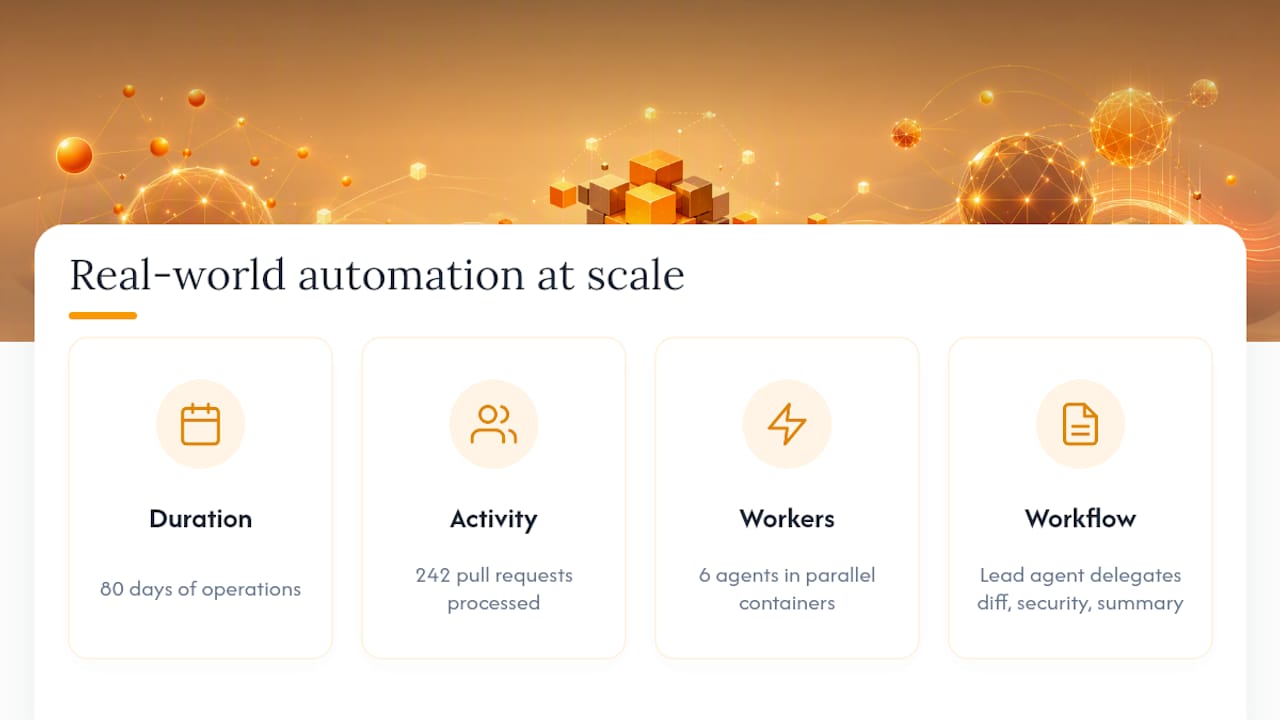
That architecture matters for accuracy. When one agent writes the summary and a second validates it against the actual diff, hallucinated claims get caught before they reach a reviewer. Projects like Write-Only Radar, run inside this same swarm, show what happens when agent memory tuning lets context (past PR patterns, prior review comments) carry forward instead of resetting on every run. Teams evaluating a summarization setup should look for that same separation of drafting and checking, whether they build it themselves or adopt an existing framework.
Which Tools Handle PR Summarization Beyond Copilot?
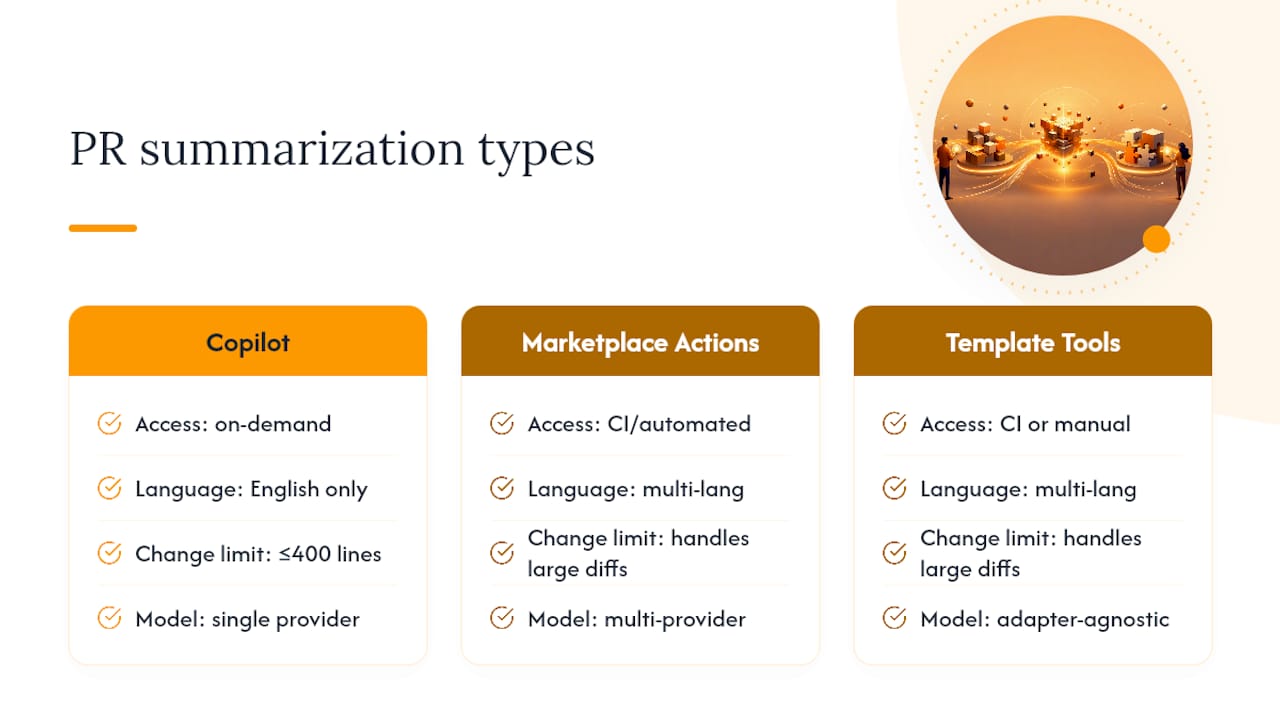
GitHub Copilot handles the on-demand case well: open a PR, ask for a summary, get a prose paragraph and linked bullets inside a couple minutes. But it's English-only and skips any file with more than 400 combined line changes, which leaves gaps for teams running large refactors or multi-language codebases.
Marketplace GitHub Actions fill that gap differently. Some, like PR Summarizer, support multiple model providers, OpenAI, Anthropic, Groq, through configurable inputs, so teams aren't locked into one vendor if pricing or quality shifts. Others, like PR Pilot Summary, build in idempotency checks and incremental diff handling as core features rather than afterthoughts.
A third category focuses on templates and integrations rather than the underlying model. Tools like the open-source PR Summary extension ship Short/Medium/Long templates plus JIRA linking, so a summary automatically references the ticket it closes instead of relying on the author to paste a link. That kind of ticket integration connects naturally with how teams already turn feedback into product decisions, since a well-linked PR summary becomes part of the paper trail product teams use to trace a shipped change back to the request that triggered it.
The practical difference between these tools isn't really the AI quality; most modern models produce comparable prose. It's the operational details: does it handle idempotency, does it filter lock files by default, does it degrade gracefully on error. Those details decide whether a tool survives contact with a real CI pipeline or gets disabled after the first bad run.
What Do High-Quality PR Summaries Look Like in Practice?
Strong summaries share a shape regardless of what generated them. Here's what separates a summary reviewers actually trust from one they skim past.
A bug fix summary should name the failure condition, not just the fix: "Fixes a race condition where syncUserState could write stale data when two requests arrived within 50ms. Adds a mutex lock around the write path. No schema changes." That tells a reviewer exactly what to verify without opening every file.
A feature addition summary needs scope and impact up front: "Adds CSV export to the reports dashboard. New endpoint /api/reports/export, gated behind the csv_export feature flag. No changes to existing endpoints. Screenshots attached for the new export button placement." Notice the flag mention. That's the kind of detail that keeps a reviewer from assuming a feature ships live immediately.
A refactoring summary should reassure reviewers that behavior didn't change, and prove it: "Extracts duplicate validation logic from OrderController and InvoiceController into a shared ValidationService. No behavior changes. Existing test suite passes unmodified; no new tests needed."
The common thread: each example states purpose in one line, lists concrete changes, and flags exactly what a reviewer needs to double check. None of them pad the summary with restated code. That restraint is the actual skill.
The Conventional Advice on PR Summaries Gets the Priority Backward
Most guidance on this topic treats the AI model as the hard part and the CI plumbing as a footnote. That's backward. The model choice barely matters anymore, GPT-class and Claude-class models all produce serviceable prose from a diff. What separates a summarization setup that survives six months of production use from one that gets disabled after week two is the boring engineering underneath: idempotency checks, ignore patterns, incremental diff thresholds, and graceful failure on error.
Teams that skip straight to "which model is best" end up with a summarizer that regenerates on every unrelated status check, burns through API budget, and eventually gets muted by frustrated developers.
The other place conventional advice underdelivers is accuracy expectations. Treating an AI summary as authoritative rather than as a triage aid is where hallucination actually causes damage, not in the drafting itself. Prioritize the guardrails first. The prose quality mostly takes care of itself.
— Ez.-
Let agent-swarm.dev Draft and Guard Your PR Summaries
Building your own summarizer means solving diff chunking, idempotency, and failure handling from scratch before you write a single prompt. A multi-agent system can run that pipeline in production, coordinating specialist agents for diff analysis, security checks, and prose drafting across isolated containers with persistent memory between runs.

That multi-agent split is the practical advantage here: one agent drafts the summary, another validates it against the actual diff before anything posts to your PR, which is exactly the guardrail this article argues for. Self-host it for free under the MIT license, or run it as a hosted swarm if you'd rather skip the infrastructure work. Either way, you keep the audit trail and the incremental diff fallback logic without hand-building it. Browse real agent-swarm sessions to see the multi-agent PR workflow in action, then decide whether self-hosted or cloud fits your team's setup.
Sources
- Creating a pull request summary with GitHub Copilot
- Automatic Pull Request Description Generation Using LLMs
FAQ
What Is the Fastest Way to Get a PR Summary Right Now?
Open the pull request on GitHub and ask Copilot to generate a summary directly in the PR body or as a comment. Larger PRs can take a couple of minutes, and files with more than 400 combined line changes get excluded.
Should PR Summaries Be Fully Automated or Human Written?
Neither exclusively. Automate the draft with CI or Copilot for consistency, but keep a human sign-off step before merge, since research on LLM-generated PR descriptions confirms models can still produce errors.
How Do You Handle Large Diffs in Automated Summaries?
Use incremental diff processing for routine updates, then fall back to a full diff when the incremental change exceeds roughly 30% of the total, a pattern built into several marketplace actions.
Which Files Should Be Excluded From PR Summarization?
Filter out lock files, build artifacts, and dependency folders like node_modules/ and dist/ before the diff reaches the model, which keeps token costs predictable and the summary focused on actual logic changes.
Does agent-swarm.dev Support Automated PR Summarization?
Yes. Multi-agent PR workflows exist that draw on operational data from many pull requests, with separate agents handling drafting and validation to reduce hallucination risk.
Recommended
Related field notes
Recorta 40–70 %: prioriza optimización de costos LLM para ingenieros
Guía para ingenieros que prioriza palancas según ahorro y esfuerzo, con pruebas y plantillas para arquitecturas multiagente. Ahorro estimado 40–70 %.
4 recetas para ingenieros: Slack y GitHub con IA y agent-swarm.dev
Instala la aplicación, lanza workflows de agentes y prueba agent-swarm.dev. Cuatro recetas para revisión de PR, triaje y creación en Slack.
Cover 80% of Debugging: Agent Dashboard Design for Engineers
Implementation-first guide for engineers to build operable agent dashboards: span tracing, checkpoint replays, review queues, and live cost tracking for...