Code Review Agents for Engineering Teams: CI-Ready, Multi-Agent PR Checks
Discover how code review agents streamline PR checks, reduce trivial comments, and enhance team efficiency with automated insights.

A code review agent is an automated, context-aware reviewer that runs on pull requests and CI pipelines, analyzes diffs against your full codebase, and posts evidence-grounded inline comments directly to the PR. The verdict: adopt them now for routine checks, style enforcement, and regression triage. Then keep humans focused on architecture decisions and cross-service ownership. Teams that deploy them correctly see fewer trivial review comments cluttering PRs, faster initial triage on large diffs, and the ability to dial review depth up or down based on PR risk level.
Concrete outcomes to expect in the first month:
- Routine comment volume on style and obvious logic errors drops, freeing reviewer attention for substantive feedback.
- PR triage time shrinks because the agent surfaces the highest-risk findings first, ranked by severity.
- Effort levels (Lite for fast inner-loop checks, Balanced for deeper pre-merge analysis) let you qualitatively match compute spend to PR risk without manual configuration per PR.
Key Takeaways
Multi-agent code review pipelines with verification loops and repo-level configuration deliver the highest precision, and teams that invest in REVIEW.md setup and falsifiability gates see measurably lower false-positive rates than teams running agents on defaults.
| Point | Details |
|---|---|
| Multi-agent pipelines outperform single-pass | Parallel specialized subagents with verification loops catch more issues with fewer false positives. |
| Repo-level config is the highest-leverage step | A REVIEW.md with team priorities and accepted-PR examples cuts noise faster than any other tuning. |
| Agents complement, not replace, static analysis | Keep a static analyzer as an independent layer for deterministic security and linting rules. |
| Effort levels control cost and latency | Lite mode for inner-loop pushes, Balanced mode for pre-merge gating on protected branches. |
| agent-swarm for production orchestration | agent-swarm runs multi-agent review pipelines with persistent memory, GitHub integration, and self-hosted or cloud deployment. |
Table of Contents
- How code review agents work: the multi-agent pipeline
- Where and how agents run: deployment options
- What agents check vs. what static analyzers enforce
- How to configure an agent for accurate, relevant reviews
- Operational considerations: cost, latency, credentials, and data residency
- Concrete workflows teams run in production
- When to use agents vs. human reviewers
- Evidence-backed patterns from authoritative documentation
- Metrics and KPIs to evaluate agent effectiveness
- Security and compliance considerations
- Future trends in AI-powered code review
- Limitations and failure modes to plan for
- Best practices for teams adopting code review agents
- An engineering team's honest take on where agents actually help
- agent-swarm runs multi-agent code reviews in production
- Sources
- FAQ
How code review agents work: the multi-agent pipeline
The typical pipeline runs in four stages: context retrieval, parallel subagent analysis, verification and deduplication, then PR posting. Understanding each stage is what separates teams that get high-precision results from teams that drown in false positives.
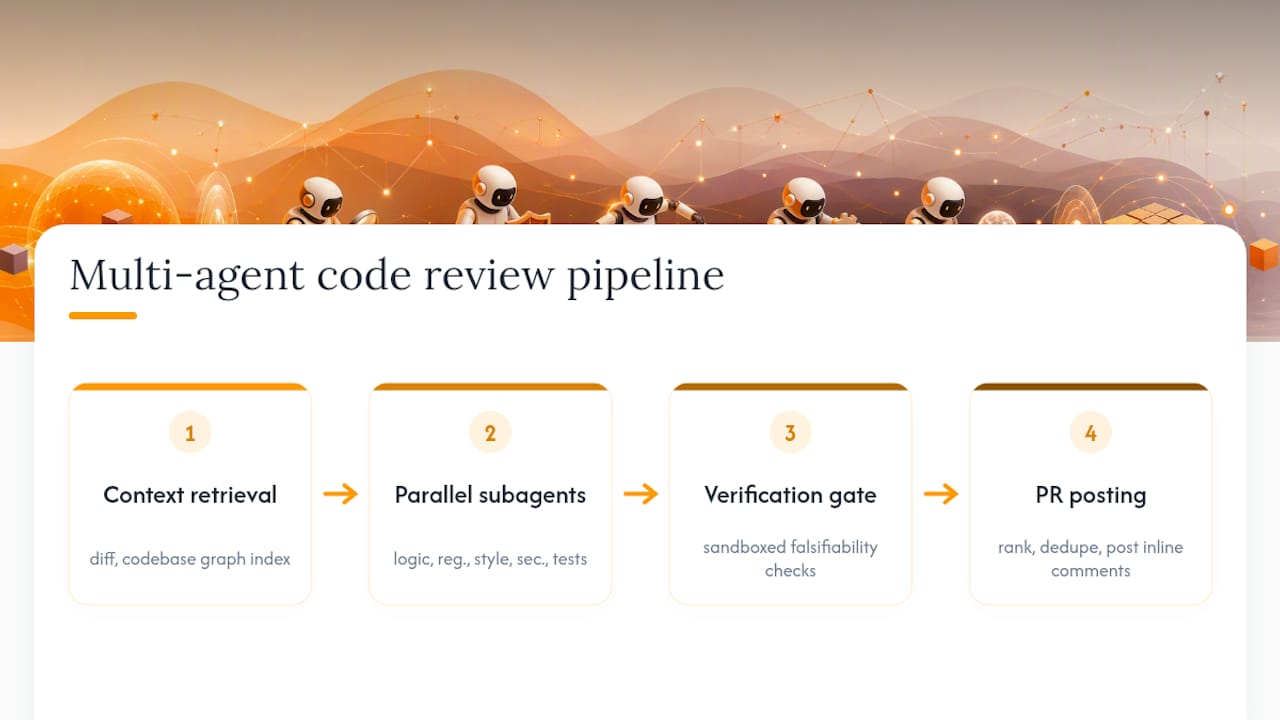
Context retrieval comes first. The agent pulls the diff, but also indexes the surrounding codebase using a semantic or graph-based index so it can reason about cross-file impact. Tools like Greptile build codebase graph indices specifically to give agents visibility beyond the changed lines, which improves recall on systemic issues that a diff-only review would miss entirely.
Parallel subagent analysis is where the multi-agent architecture earns its name. Rather than running a single LLM pass over the diff, modern systems spawn specialized subagents in parallel, each focused on a different review dimension: logic correctness, regression risk, style consistency, security surface, and test coverage. Some open-source pipelines, like PR-AF, dynamically compile the set of reviewer agents based on the PR's topology, so a migration PR gets a different agent composition than a hotfix.
Verification and falsifiability is the stage most teams underestimate. Before any finding gets posted, a well-designed pipeline tries to invalidate it. OpenReview documents a sandboxed validation phase where small behavioral checks run against the PR changes to confirm a finding is real. This falsifiability gate is the single highest-leverage step for reducing noise.

Ranking, deduplication, and PR posting close the loop. Surviving findings are ranked by severity, duplicates across subagents are merged, and the agent posts inline comments under a bot identity so the team can distinguish AI-assisted findings from human review.
Hybrid architectures that combine deterministic static analysis with LLM agents, as documented in Alibaba's open-code-review, reduce hallucinations further by using the static layer as a hard filter before the LLM reasoning layer runs.
Repo-level context is not optional. Agents that receive architecture docs, coding standards, and examples of accepted PRs produce materially more precise findings than agents running against defaults. A
REVIEW.mdorCLAUDE.mdfile in the repository root is the fastest configuration win available.
Pro Tip: Start your REVIEW.md with three sections: "What we care about most," "What we intentionally ignore," and "Two examples of PRs we approved." That structure maps directly to how LLM-based agents weight their findings.
Where and how agents run: deployment options
Agent code review tools typically expose three usage modes: a Go SDK or language-specific SDK for programmatic integration into existing tooling, a CLI for scripts and manual invocation, and an MCP-style server for native integration into agent platforms. Reviews post under a GitHub App bot identity, which keeps AI-assisted findings visually distinct from human comments in the PR timeline.
Common deployment trade-offs:
- GitHub App + Actions: lowest setup friction, automatic triggers on PR open or push, but token and credential scope must be locked down carefully.
- CLI: maximum control over when and how reviews run; useful for pre-commit hooks or manual deep-dive reviews on complex PRs.
- Self-hosted containers: full data residency control, no third-party token exposure, but you own the compute and maintenance overhead.
- Cloud-hosted: faster to start, vendor-managed scaling, but your diff and codebase context leave your perimeter.
A minimal CLI trigger looks like this:
# Trigger a balanced review on the current PR branch
agent-review run \
  --repo owner/repo \
  --pr 142 \
  --effort balanced \
  --config .review/REVIEW.md
Automatic triggers fire on pull_request events (opened, synchronized, reopened) and can be scoped to specific paths or base branches. The agent posts a check run alongside inline comments, so CI gating on the check status is straightforward.
- Install the GitHub App or add the CLI to your CI job.
- Add
REVIEW.mdto the repository root with team-specific guidance. - Configure the trigger event and effort level in your workflow file.
- Set the check run as a required status check on protected branches.
- Review the first 10 PRs manually alongside agent output to calibrate signal quality.
What agents check vs. what static analyzers enforce
Agents excel at reasoning about logic, regressions, style preferences, and cross-file impacts. Static analyzers remain the standard for deterministic security and style enforcement. These are complementary roles, not competing ones.
What agents handle best:
- Logic errors and off-by-one conditions that require understanding intent, not just syntax.
- Regression risk: "this change breaks the invariant established in
auth/session.go." - Style preferences that require context ("this naming convention conflicts with the pattern used in adjacent modules").
- Cross-file impact analysis: detecting that a function signature change ripples into three callers the diff doesn't show.
What static analyzers handle best:
- Deterministic security rules: SQL injection patterns, hardcoded secrets, known CVE signatures.
- Linting and formatting enforcement with zero false-positive tolerance.
- License compliance and dependency scanning.
SonarSource's documentation frames this clearly: AI reviewers complement static analysis rather than replace it, with static analyzers remaining the standard for consistent security-focused rule enforcement. JetBrains Qodana is a concrete example of a static tool designed to run consistent inspections in IDEs and CI, functioning as an independent quality gate alongside an AI reviewer.
Configurable effort levels let teams tune this balance. Lite mode runs faster with shallower context, suitable for every push on a feature branch. Balanced mode increases analysis depth and cross-file reasoning but costs more compute and takes longer.
Pro Tip: Never remove your static analyzer when you add an agent. Run them as independent layers. If the agent and the static analyzer both flag the same file, treat that as a high-confidence signal worth immediate human review.
How to configure an agent for accurate, relevant reviews
Repository-specific guidance cuts false positives more than any other single change. The default configuration of any agent is tuned for the average codebase, which is not your codebase.
Concrete configuration checklist:
- Add a
REVIEW.mdorCLAUDE.mdto the repository root with team priorities, ignored patterns, and two or three accepted-PR examples. - Supply architecture docs as context: service boundaries, data flow diagrams, and ownership maps.
- Set the default effort level explicitly in your CI workflow rather than relying on the tool default.
- Configure CI gating policy: decide which severity levels block merge vs. post as advisory comments.
- Scope reviews to relevant paths using include/exclude patterns to avoid noise on generated files or vendored code.
A minimal pseudo-config illustrates the structure:
review:
  effort: balanced
  scopes:
    include: ["src/**", "lib/**"]
    exclude: ["vendor/**", "generated/**"]
  severity_gates:
    block_merge: ["critical", "high"]
    advisory: ["medium", "low"]
  context_files:
    - REVIEW.md
    - docs/architecture.md
Teams that treat the agent like a team member, loading it with coding standards and examples of accepted PRs, consistently achieve higher signal-to-noise ratios than teams running defaults. The SOUL.md identity architecture pattern extends this further: giving the agent an explicit job description, including what it should and should not flag, produces more consistent behavior across PRs.
Continuous improvement matters here. Log which agent findings get dismissed by human reviewers post-merge, then update REVIEW.md to suppress that class of finding. This feedback loop compounds over weeks.
Operational considerations: cost, latency, credentials, and data residency
The four axes that determine whether a code review agent is viable in production are cost per review, review latency, credential scope, and data residency.
Key operational factors:
- Cost/credits: LLM-backed agents consume tokens proportional to diff size and context window. Balanced mode on a 500-line PR costs meaningfully more than Lite mode. Budget by PR volume, not by seat.
- Latency: Lite reviews complete in under two minutes for most PRs. Deep Balanced reviews on large diffs can take five to ten minutes, which affects inner-loop developer experience if blocking merge.
- Credential scope: GitHub App tokens should be scoped to read-only repository access plus PR write for comment posting. Never grant broader organization-level permissions.
- Data residency: Cloud-hosted agents send your diff and codebase context to a third-party endpoint. Self-hosted agents in Docker containers keep all data within your perimeter.
Least-privilege is not a best practice here — it is a requirement. A code review agent that has write access beyond PR comments can be manipulated into modifying code or approving its own findings. Scope tokens to the minimum, sandbox the verification step, and maintain audit logs of every agent action.
Security hardening for production deployments: isolate the agent's execution environment from production credentials, rotate tokens on a schedule, and review agentic privilege escalation patterns before granting the agent any write permissions beyond PR comments.
Concrete workflows teams run in production
The most common deployment pattern is auto-review on PR open, but three other patterns cover the majority of real-world use cases.
Pattern 1: Fast inner-loop review (Lite mode, every push)
- Developer pushes a commit to a feature branch.
- GitHub Actions triggers the agent with
effort: lite. - Agent posts inline comments within 90 seconds.
- Developer addresses comments before requesting human review.
Pattern 2: CI-gated deep review (Balanced mode, pre-merge)
- PR is opened or marked ready for review.
- Agent runs with
effort: balanced, full context window, cross-file analysis enabled. - Agent posts a check run. Critical and high findings block merge.
- Human reviewer sees a pre-triaged list of medium and low findings as advisory comments.
Pattern 3: Nightly architecture scan (scheduled, full repo)
# Scheduled CI job — runs at 02:00 UTC
agent-review scan \
  --repo owner/repo \
  --scope src/ \
  --effort balanced \
  --output report.json
The nightly scan catches systemic issues that individual PR reviews miss: accumulating technical debt patterns, drift from architectural standards, and cross-service coupling that no single PR introduced but that compound over time.
Team role notes:
- The agent handles first-pass triage; human reviewers act on its ranked findings rather than reading the raw diff.
- Assign one engineer per sprint to review dismissed agent findings and update
REVIEW.mdaccordingly. - Surface actionable results in Slack or Linear using agent-swarm's integration layer to close the loop without requiring engineers to monitor CI dashboards manually.
For teams working with AI-generated code, pairing the review agent with a vibe coding remediation workflow adds a fix-and-repost cycle that handles the higher defect density typical of LLM-generated diffs.
When to use agents vs. human reviewers
Automate routine, high-volume checks and low-risk refactors. Humans should lead on architecture decisions, domain-specific business logic, and cross-service ownership calls.
| Task class | Recommended reviewer | Rationale |
|---|---|---|
| Syntax and formatting | Agent | Deterministic, zero human value-add |
| Logic errors and off-by-one | Agent (verify) | Agents catch these well; human confirms critical cases |
| Regression risk | Agent + human | Agent surfaces candidates; human judges impact |
| Security vulnerabilities | Static analyzer + human | Deterministic rules first; human for novel patterns |
| Architecture decisions | Human | Requires organizational context agents lack |
| Business logic correctness | Human | Domain knowledge not in the codebase |
| Cross-service ownership | Human | Requires team topology awareness |
| Style and naming conventions | Agent | Fast, consistent, low stakes |
Pro Tip: Use the agent's ranked findings as a structured agenda for human review. Instead of reading the diff top-to-bottom, the human reviewer starts at the agent's highest-severity findings and works down. This cuts average human review time on large PRs significantly.
The multi-agent coordination anti-patterns post is worth reading before you decide how much autonomy to grant the agent. Over-automation, where the agent can approve and merge without human sign-off, introduces coordination failure modes that are harder to debug than the review bottleneck you were solving.
Evidence-backed patterns from authoritative documentation
The consensus across vendor docs and open-source implementations is consistent: multi-agent pipelines with verification loops and repo-level configuration outperform single-pass LLM reviews on both precision and recall.
Claude's code review documentation describes a fleet of specialized agents running in parallel, with candidate findings verified against repository evidence before posting. The PR-AF project implements dynamic agent compilation based on PR topology, with explicit falsifiability gates before comment posting. Alibaba's open-code-review documents the hybrid static-plus-LLM architecture and notes that treating the agent as a team member, with architecture docs and approved-PR examples loaded as context, produces better outcomes than running the agent as a black box.
Key patterns the evidence supports:
- Verification loops before posting are the highest-leverage false-positive reduction step.
- Parallel subagent architectures yield deeper audits than sequential single-agent passes.
- Repo-level configuration files (
REVIEW.md,CLAUDE.md) measurably improve precision over defaults. - Semantic or graph-based codebase indexing improves recall on cross-file systemic issues.
The agent-swarm metrics post documents 242 PRs across 80 days with 6 agents, providing a concrete reference point for what multi-agent throughput looks like in a production engineering workflow.
Metrics and KPIs to evaluate agent effectiveness
Measuring ROI on a code review agent requires tracking both efficiency metrics and quality metrics. Efficiency without quality improvement is just faster noise.
Efficiency metrics:
- Time to first review comment: how quickly the agent posts after PR creation. Target under two minutes for Lite mode.
- Human reviewer time per PR: track before and after deployment. A well-tuned agent should reduce this by reducing trivial back-and-forth.
- PR cycle time: total time from PR open to merge. Agents reduce cycle time only when they catch issues early, not when they add a blocking step with low-signal findings.
Quality metrics:
- Agent finding acceptance rate: what percentage of agent comments result in a code change. Below 40% suggests the agent needs configuration tuning.
- Post-merge defect rate: bugs found in production or QA that the agent reviewed but missed. Track by severity.
- False positive rate: findings dismissed by human reviewers without any code change. This is your primary tuning signal.
ROI framing: the payoff is not in replacing human reviewers. It is in shifting human attention from routine checks to high-judgment decisions.
Security and compliance considerations
Code review agents introduce a distinct security surface that most teams underestimate at deployment time.
Token and credential scope is the first concern. The agent needs read access to the repository and write access to PR comments. It should not need access to secrets, environment variables, or deployment pipelines. Audit the GitHub App permissions before installation and remove any scope that is not strictly required.
Data residency and confidentiality matter for regulated industries. Cloud-hosted agents send your diff, and potentially your full codebase context, to a third-party LLM endpoint. For codebases containing PII, financial logic, or regulated data, self-hosted deployment is the only compliant option in most jurisdictions. Verify your vendor's data processing agreement before routing sensitive diffs through a cloud agent.
Prompt injection via PR content is a real attack vector. A malicious PR can include content designed to manipulate the agent's output, suppress findings, or exfiltrate context. Sandboxing the agent's execution environment and logging all agent actions to an immutable audit trail are the primary mitigations. The OWASP agentic threats analysis covers privilege escalation patterns specific to agent systems.
Compliance audit trails: for SOC 2 or ISO 27001 compliance, you need evidence that code review occurred. Agent-posted PR comments with timestamps satisfy this for many auditors, but confirm with your compliance team whether AI-assisted review counts as a qualified review under your specific controls framework.
Future trends in AI-powered code review
The current generation of code review agents operates primarily on diffs with codebase context. The next generation is moving in three directions simultaneously.
Agentic fix-and-repost loops are already emerging. Rather than posting a comment and waiting for a human to fix it, the agent opens a follow-up commit or branch with the proposed fix applied, then re-reviews its own change. This closes the feedback loop entirely for low-risk findings.
Persistent memory across PRs is the architectural shift that will matter most for precision. Agents that remember which findings were accepted or dismissed in previous PRs, and why, can adapt their behavior without manual REVIEW.md updates. This is the direction agent-swarm's shared memory and compounding context architecture points toward.

Deeper CI integration beyond PR review is coming. Agents will run on scheduled architecture scans, monitor dependency graphs for drift, and flag systemic coupling issues before they manifest in individual PRs. The nightly scan pattern described earlier is a preview of this.
Model capability improvements will reduce the current context-limit constraints. Today, very large PRs (2,000+ lines) hit context windows that force the agent to truncate analysis. As context windows expand and retrieval-augmented approaches improve, this constraint will shrink.
Limitations and failure modes to plan for
False positives are the primary adoption killer. An agent that flags 60% of its findings incorrectly trains developers to ignore all agent output within weeks. The falsifiability gate and repo-level configuration exist specifically to prevent this, but they require investment to set up correctly.
Hallucinations on complex logic remain a real risk. Agents can confidently assert that a function has a race condition when it does not, particularly when the relevant synchronization logic lives in a file not included in the context window. Cross-file graph indexing reduces this, but does not eliminate it.
Context limits on large PRs force truncation. A 3,000-line PR will exceed most agents' effective context window, causing the agent to review only a portion of the diff. The practical mitigation is enforcing smaller PRs as a team norm, which is good practice regardless of agent use.
Latency on deep reviews affects developer experience. A Balanced-mode review that takes eight minutes on a large PR is not compatible with a fast inner-loop workflow. Teams that gate merge on deep review need to set developer expectations accordingly, or run deep reviews only on specific protected branches.
Credential and token management adds operational overhead. Rotating tokens, managing GitHub App installations across multiple repositories, and auditing permission scope requires ongoing attention that teams often underestimate in the initial deployment plan.
Best practices for teams adopting code review agents
Change management matters as much as technical configuration. The teams that fail at agent adoption are usually not failing at the technical setup; they are failing at the human side.
Start with a pilot PR stream. Pick one repository with moderate PR volume and low business criticality. Run the agent in advisory mode (no merge blocking) for two weeks. Measure the finding acceptance rate before touching configuration.
Set role expectations explicitly. Developers need to know: the agent is a first-pass reviewer, not an approver. Human reviewers need to know: their job shifts from catching everything to validating the agent's ranked findings and focusing on what the agent cannot assess.
Train on dismissal, not just acceptance. Every time a developer dismisses an agent finding, that is a training signal. Build a lightweight process for capturing dismissal reasons and feeding them back into REVIEW.md updates.
Avoid over-automation in the first 90 days. Do not gate merge on agent findings until you have measured the false-positive rate and tuned the configuration. Blocking merges on a poorly tuned agent creates friction that poisons team sentiment toward the tool permanently.
Align with your security team early. Token scope, data residency, and audit trail requirements are easier to address before deployment than after. A conversation with your security team in week one prevents a forced rollback in week eight.
An engineering team's honest take on where agents actually help
The conventional wisdom says code review agents will replace human reviewers. That framing is wrong, and it leads teams to deploy agents in ways that create more friction than they resolve.
The real value is narrower and more durable: agents are exceptionally good at the review work that humans are worst at, which is the high-volume, low-judgment, attention-draining work of catching obvious issues on the fifteenth PR of the day. Human reviewers are worst at this work not because they lack skill, but because sustained attention on routine checks degrades over time. An agent does not get fatigued.
Where teams consistently go wrong is skipping the configuration investment. An agent running on defaults against a codebase it knows nothing about will produce a false-positive rate that makes the tool feel useless. The configuration work, writing REVIEW.md, loading architecture docs, tuning effort levels, is not setup overhead. It is the product. The agent's precision is a direct function of how well you have described your codebase to it.
The other underappreciated point: the falsifiability step is not a nice-to-have. An agent that posts every candidate finding without trying to invalidate it first is a noise machine. The teams getting the most value from these tools are the ones that have invested in verification pipelines, whether through a sandboxed test execution step or through a second-pass agent that challenges the first pass's findings.
Start small, measure the finding acceptance rate obsessively in the first month, and treat every dismissed finding as a configuration bug rather than an agent limitation.
agent-swarm runs multi-agent code reviews in production
Most teams bolt a single AI reviewer onto their CI pipeline and wonder why the signal quality is mediocre. agent-swarm takes a different approach: a lead agent breaks the review task into specialized subtasks, assigns them to worker agents running in isolated Docker containers, and compounds context across PRs using persistent shared memory. The result is a review pipeline that gets more precise over time, not less.
For engineering teams that want GitHub integration, CLI and SDK access, and self-hosted or cloud deployment without building the orchestration layer themselves, agent-swarm handles the coordination. Worker agents run Claude Code, Codex, or OpenCode depending on the task, post findings under a bot identity, and integrate with Slack and Linear to surface results where your team already works. The comparison page shows how this stacks up against single-agent approaches and managed alternatives. See real session examples to evaluate the output quality before committing, or start a cloud trial directly at Agent-swarm.
Sources
FAQ
Which agent is best for code review?
No single agent is best for every team. Claude-backed pipelines with multi-agent verification, like those agent-swarm orchestrates, perform well on logic and cross-file reasoning; static analyzers like Qodana remain the standard for deterministic security rules. The best setup combines both.
What is the best AI agent for code reviews?
The best AI code review agent is one configured with repo-level context (a REVIEW.md, architecture docs, and accepted-PR examples) and a falsifiability verification step. Without that configuration, even the most capable model produces too many false positives to be useful in production.
Can ChatGPT do a code review?
ChatGPT can analyze code snippets and suggest improvements, but it lacks native PR integration, codebase indexing, and CI triggering. Purpose-built code review agents run on diffs with full repository context and post findings directly to the pull request, which is a meaningfully different capability.
Is Claude an agent for code review?
Claude is the underlying model in several code review agent implementations, including Claude Code's native review feature. Claude itself is a model, not an agent; the agent layer, which handles context retrieval, subagent orchestration, verification, and PR posting, is built on top of it.
Recommended
Related field notes
We Rebuilt Linear's “Loops updates” Clip as a Swarm Video in Eight Rounds
Three video models read Linear's motion-design teaser; the two Gemini models called the 3D scene 2D until 7.5s. A frame-by-frame check caught it. The replica is 858 frames of Remotion and three.js, reviewed eight times.
SEO con agentes IA: guía práctica para automatizar sin perder el control
Aprende a automatizar tareas SEO con agentes de IA sin perder el control: define reglas, supervisa aprobaciones y gana tiempo para estrategia.
Pick Best AI Workflow Automation That Preserves Memory for Engineers
Engineering first guide to AI workflow automation: pilot plan to prove ROI and why agent-swarm.dev fits teams needing persistent memory.