2–3 vs 5–7 Day Prototypes: AutoGen vs CrewAI for Engineers
Engineer focused comparison of AutoGen and CrewAI with benchmarks (2–3 vs 5–7 engineer days), token and migration checklist, and a 30-job pilot plan.
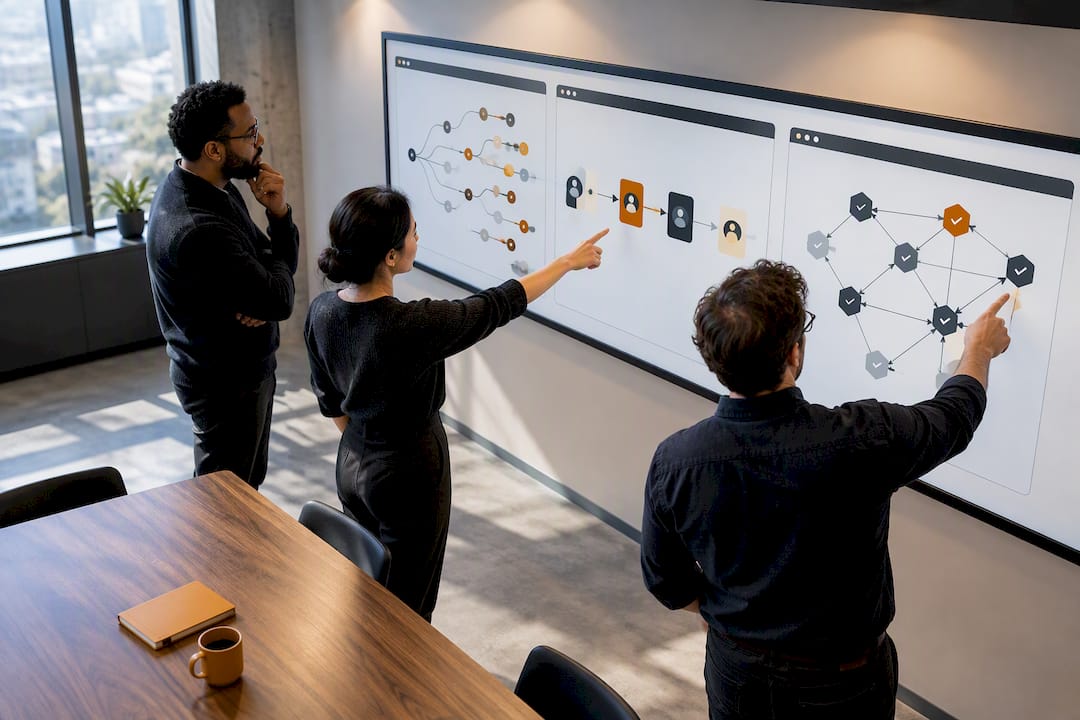
Pick role and process driven frameworks like CrewAI when you need repeatable, auditable workflows, and pick conversation driven frameworks like AutoGen when the job is open-ended research with emergent, hard-to-script behavior. For teams that need to run either pattern at production scale, self-hosted or cloud. Agent-swarm is the option we recommend evaluating first. The sections below back that call with architecture detail, cost data, and a migration checklist.
TL;DR:
- Role-driven frameworks like CrewAI enable faster prototype development at 2 to 3 engineer-days and are best suited for repeatable, predictable workflows.
- Conversation-driven frameworks like AutoGen require 5 to 7 engineer-days for a prototype and are more appropriate for open-ended research and brainstorming tasks.
- Structuring workflows as flowcharts helps determine if a role-based or graph-driven framework is suitable, especially when workflows can be drawn with boxes and arrows beforehand.
- Migrating AutoGen from version 0.2 to 0.4 involves significant architecture changes, demanding thorough testing of key workflows to avoid silent failures in production.
- For high-volume, repetitive workloads, token efficiency and operator recovery time are critical factors, with structured pipelines generally offering lower costs and easier debugging.
Table of Contents
- AutoGen vs CrewAI at a Glance
- How Are AutoGen, CrewAI, and LangGraph Actually Built?
- What Do Prototype Speed and Token Costs Actually Look Like?
- How Risky Is Migrating Between Framework Versions?
- How Do You Choose With Data Instead of Opinion?
- Where Does agent-swarm Fit Against These Frameworks?
- What Engineers Consistently Get Wrong Here
- Ready to Run Your Own Framework Pilot?
- Sources
- FAQ
AutoGen vs CrewAI at a Glance
Before you write a line of orchestration code, match your project to a pattern. We group the landscape into three orchestration styles, and each one carries a different cost, predictability, and time-to-demo profile.
- Conversation-driven (AutoGen): agents talk to each other in a shared message history; strong for research, brainstorming, and tasks where the path to the answer isn't known in advance.
- Role/process-driven (CrewAI): agents get fixed roles, tasks, and a defined process (sequential or hierarchical); strong for repeatable pipelines with predictable checkpoints.
- Graph-driven (LangGraph): you define nodes and edges explicitly, including branches, loops, and checkpoints; strong for complex state machines that need fine-grained control over every transition.
- Chain-driven (LangChain): the older, linear composition model that many teams still use for simple retrieval-augmented pipelines, now often paired with LangGraph for anything with branching logic.
On predictability, role-driven and graph-driven setups win because the execution path is declared up front rather than negotiated between agents at runtime. On time-to-demo, CrewAI-style frameworks tend to get a working prototype out in 2 to 3 engineer-days, versus 5 to 7 for AutoGen-style conversational setups. On cost, conversational multi-round setups tend to burn more tokens per task than structured pipelines, a gap that widens as job volume grows.
Pro Tip: If you're not sure which category fits, write down your task as a flowchart first. If you can draw it with boxes and arrows before writing code, you want a role or graph driven framework, not a conversational one.
For a broader look at orchestration categories beyond these four, our workflow orchestration tools guide breaks down selection criteria in more depth.
How Are AutoGen, CrewAI, and LangGraph Actually Built?
The runtime architecture underneath each framework is what actually determines how painful debugging gets at 2 a.m. when a production job fails silently.
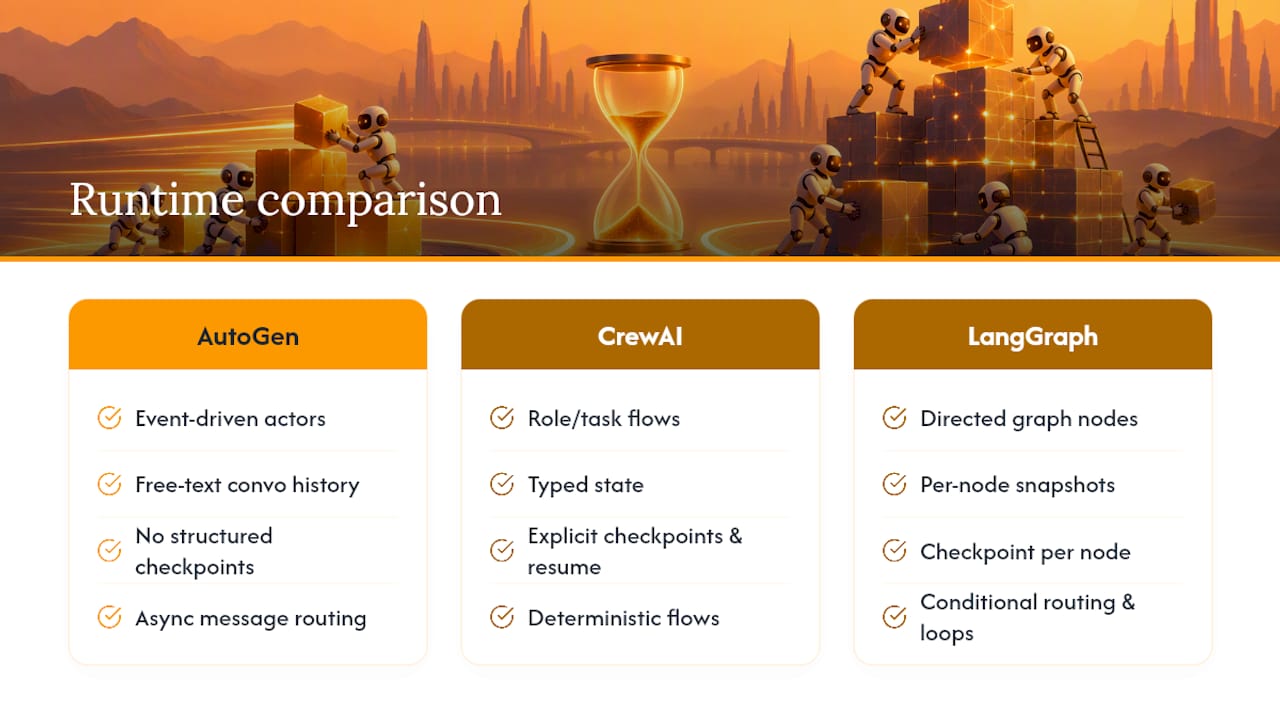
AutoGen's current generation (v0.4) is layered. A Core API implements an event-driven actor framework, where agents are actors that pass messages asynchronously through a runtime you can inspect and extend. On top of that sits AgentChat, a higher-level API with sane defaults for common patterns like two-agent chats or group chats. This split matters operationally: Core gives you custom routing, cancellable executions, and async streaming of an agent's intermediate reasoning, which is valuable when you need to debug what an agent is "thinking" mid-run or stream partial output to a user interface. AgentChat trades some of that control for faster setup. The primary state in AutoGen is conversation history, which means your debugging surface is a transcript, not a structured object.
CrewAI takes a different starting point. Instead of a conversation, you define roles, tasks, and a process (sequential or hierarchical) that governs how tasks flow between agents. State is typed rather than free-text, and the framework's @persist decorator lets you checkpoint and resume state explicitly. CrewAI's Flows layer adds deterministic control points where you can insert human review before an agent proceeds, which supports faster, more predictable production deployments because the possible execution paths are enumerable rather than emergent.
LangGraph sits closer to CrewAI's philosophy but with more granularity. You build a directed graph of nodes and edges, where nodes are functions or agent calls and edges define conditional routing, loops, and retries. LangGraph's checkpointing system snapshots state at every node, so you can pause a run, inspect exactly where it stopped, and resume from that point. This is the framework of choice when your workflow genuinely is a state machine with branches and backtracking, not a simple pipeline or an open conversation.
The operational consequence: when an AutoGen conversation goes off the rails, you're reading a message transcript and guessing which turn introduced the drift. When a CrewAI task fails, you get a task ID, a typed input and output, and usually a clear checkpoint to resume from. When a LangGraph run fails, you get a graph state snapshot showing exactly which node broke. Architecture isn't cosmetic here. It's the difference between a five-minute fix and a half-day forensic exercise, a point multiple architecture comparisons make explicitly.
What Do Prototype Speed and Token Costs Actually Look Like?
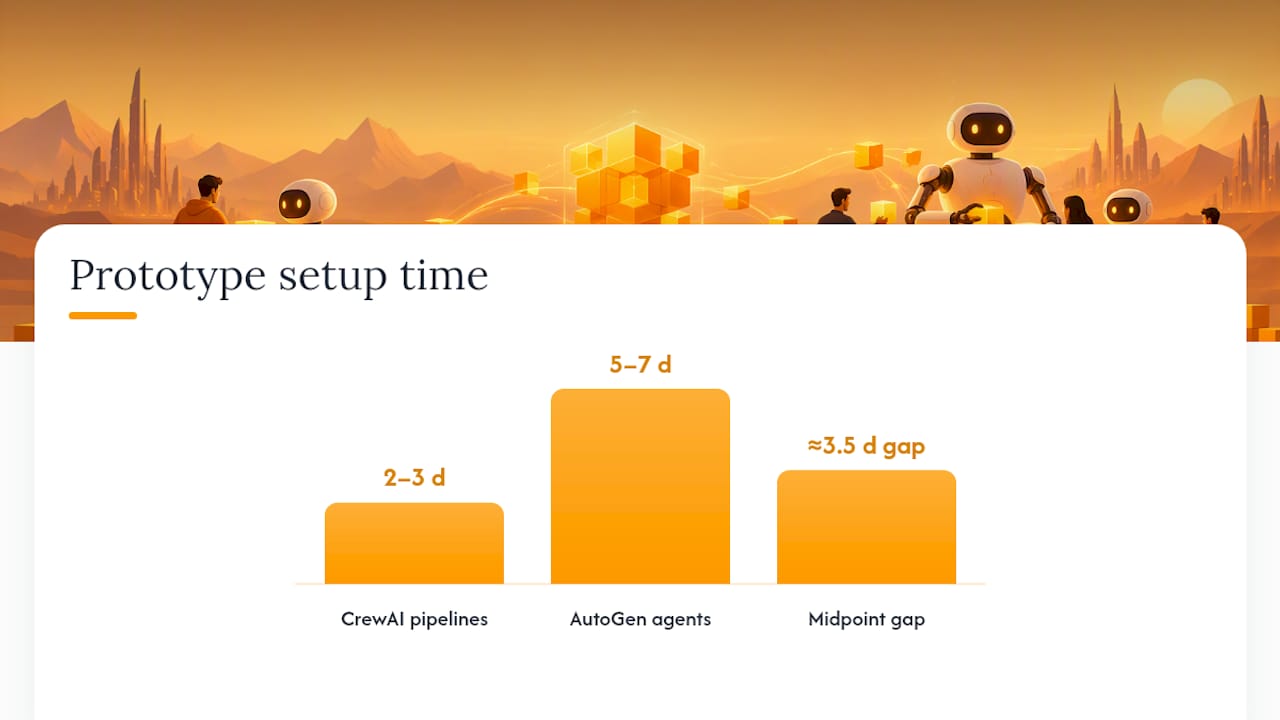
Time-to-first-demo runs roughly 2 to 3 engineer-days for CrewAI-style pipelines versus 5 to 7 for AutoGen-style conversational agents, according to comparative benchmarking from Informatica. The gap comes from setup overhead: role-based frameworks ask you to define inputs and outputs upfront, which front-loads some design work but removes the trial-and-error tuning that conversational prompting often requires.
Token cost follows a similar pattern. Conversational, multi-round agent exchanges generate more back-and-forth messages per task, and each round resends context, which compounds cost at scale according to practitioner benchmarking. A structured pipeline that calls an agent once per defined task with a bounded input tends to use fewer tokens for the same outcome, especially once you're running thousands of jobs a month rather than a handful of demos.
That cost gap matters most for high-volume, repetitive workloads (customer support triage, data extraction, report generation) where a moderate token difference per run turns into a significant cost at scale. It matters less for low-volume research or exploratory agents where flexibility outweighs efficiency.
Operationally, whichever pattern you pick, you need visibility into what agents are doing:
- Instrument every run with tracing (Langfuse, Helicone, or Arize are common choices) so you can replay a failed job instead of guessing.
- Log token usage per agent, not just per run, to find which step is burning your budget.
- For any workflow that executes code, use a sandboxed executor rather than raw shell access; AutoGen ships built-in code execution and sandboxing patterns specifically for this, and it's worth replicating that isolation even if you're not using AutoGen itself.
- Treat external tool calls (APIs, database writes) as side effects that need retry logic and idempotency checks, not fire-and-forget actions.
How Risky Is Migrating Between Framework Versions?
AutoGen's jump from v0.2 to v0.4 wasn't a minor point release. It was a full architectural rewrite to an asynchronous, event-driven Core with breaking changes throughout the API surface. Agent definitions, message passing, and runtime setup all changed. If you built on v0.2 and haven't ported yet, treat this as a real engineering project, not a dependency bump.
The practical risk isn't the migration itself. It's teams that skip validation and discover the gap in production. Practitioner accounts consistently point to the same failure mode: teams that adopt a framework without a repeatable test harness pay for it later, usually in an incident review nobody enjoys attending.
Run this checklist before you cut over any workflow, migration or fresh adoption alike:
- Port one representative workflow first. Pick your highest-volume or highest-risk job, not your simplest one. It'll surface real problems faster.
- Replay 30 historical jobs through the new version and diff outputs against the old system's actual production outputs, not against a hand-written spec.
- Inject failure conditions: timeouts, duplicate tool calls, and malformed inputs. Measure how long it takes an operator to notice and recover.
- Score the result on three axes: migration effort (engineer-days spent), business risk (what breaks if this job fails silently), and roadmap alignment (does the new version actually solve a problem you have, or just one you might have).
Pro Tip: Don't port your simplest workflow first because it's easy. Port your riskiest one first, because that's the one where a silent failure actually costs you something.
How Do You Choose With Data Instead of Opinion?
Decide on four criteria before you touch a framework's documentation: how deterministic does this workflow need to be, how often does it repeat, how sensitive is your budget to token cost, and how often does a human need to step in mid-run.
- If determinism and auditability matter more than flexibility, start with role or graph driven frameworks.
- If the task is genuinely open-ended and you can't specify the steps in advance, a conversational model earns its overhead.
- If you're running thousands of jobs a month, token efficiency should outweigh developer convenience.
- If compliance requires a human sign-off at specific points, pick whichever framework makes that checkpoint explicit and loggable, not implicit in a prompt.
Then run a pilot instead of debating in a meeting. Pick one representative job, define success metrics up front (latency, token cost, failure rate, and operator time spent babysitting the run), and execute the same job 30 times across your top candidate frameworks. This mirrors the reproducible evaluation approach Datacamp recommends for comparing agent frameworks honestly rather than by vibes.
Before you call the pilot done, run three governance tests:
- Confirm every side effect (an email sent, a record written, a deploy triggered) is gated behind an explicit check, not assumed safe.
- Validate every agent-to-agent handoff against a schema, so a malformed output doesn't silently propagate downstream.
- Inject a human approval step mid-run and measure how cleanly the framework pauses and resumes.
Frameworks that pass all three with minimal custom glue code are the ones worth building your production roadmap around. Our agentic workflow automation guide walks through designing these checkpoints in more detail.
Where Does agent-swarm Fit Against These Frameworks?
agent-swarm is an open-source, self-hostable operating system for AI work, built around a lead agent that breaks objectives into tasks and assigns them to specialized workers running various AI tools, each isolated in its own container. That containerized isolation solves the same problem CrewAI's typed state and AutoGen's Core runtime are each solving from a different angle: keeping a failed or misbehaving worker from corrupting the rest of the run.
Where agent-swarm diverges from both frameworks is persistence across runs, not just within one. Shared memory and contextual knowledge compound over time across workers, so a team's second month of automation benefits from what the first month's agents learned, something neither a pure conversation history (AutoGen) nor a per-task state object (CrewAI) is designed to carry forward on its own.
For the integration surface criteria in your decision checklist, agent-swarm connects to hundreds of platforms, including Slack, Linear, Turso, OpenAI, and GitHub, which matters if your pilot workflow needs to touch real systems (ticket creation, code review, deploy approvals) rather than just calling an LLM API in isolation. Engineering teams evaluating this against a role-driven framework specifically can compare the two side by side on our CrewAI comparison page, and real session examples are available if you want to see the containerized worker model in action before committing engineering time to a pilot.
What Engineers Consistently Get Wrong Here
The single metric that should drive your decision is operator recovery time when something breaks, not raw capability or how impressive a demo looks in a meeting. A framework that produces brilliant conversational output but takes an engineer 40 minutes to diagnose a silent failure will lose to a boring, predictable pipeline every time at production scale.
Three mistakes show up again and again. Teams skip migration testing and discover breaking changes in production instead of in a replay harness. Teams build side-effect-heavy workflows (emails, deploys, database writes) without gating them behind explicit approval, then wonder why an agent did something irreversible. Teams under-invest in observability early because tracing feels like overhead, then spend three times that effort later reconstructing what happened after an incident.
Run the 30-job pilot before you commit. It's cheap insurance against a much more expensive mistake.
Ready to Run Your Own Framework Pilot?
If your pilot points toward needing persistent memory, containerized isolation, and enterprise integrations rather than a single-purpose framework, agent-swarm gives you an owned, self-hosted alternative instead of stitching that infrastructure together yourself. Unlike AutoGen or CrewAI, which you assemble and operate entirely on your own, agent-swarm ships as a working system: self-hosted deployment is available under the open-source MIT license, Cloud plans run from €30 to €100 per month, and Enterprise packages add dedicated support and custom integrations, all detailed on the pricing page.
You keep full control of your data and infrastructure, and you can switch underlying AI models without losing the institutional memory your workers have built up, which is the part most teams underestimate until they've already lost it once. Browse real session examples to see the container-per-worker model handling actual engineering tasks, or check the CrewAI comparison page if you're migrating an existing role-based pipeline. Either way, start with the self-hosted deployment this week and see how it holds up against your own 30-job pilot.
Sources
FAQ
Is AutoGen Discontinued?
No. AutoGen is actively maintained by Microsoft and underwent a major architectural rewrite in v0.4 that introduced breaking changes from v0.2, not a shutdown. Teams still running v0.2 in production should treat the upgrade as a scoped migration project rather than assume the framework is being sunset.
Who Are CrewAI's Main Competitors?
CrewAI competes most directly with AutoGen (conversation-driven orchestration) and LangGraph (graph-based state machines), with LangChain often used alongside either for simpler chain composition. Teams needing persistent memory and containerized worker isolation across recurring workflows also evaluate agent-swarm as a production alternative to assembling these frameworks manually.
Is AutoGen Better Than LangChain?
They solve different problems: AutoGen orchestrates multi-agent conversations, while LangChain is a composition toolkit for chaining LLM calls, retrieval, and tools, often in a single-agent or linear pipeline. Many production stacks use LangChain (or LangGraph) for the retrieval and tool layer while using AutoGen or CrewAI for multi-agent coordination on top.
Which AI Agent Framework Is Considered the Best?
There's no universal best, since CrewAI-style pipelines get a demo running in 2 to 3 engineer-days versus 5 to 7 for AutoGen-style conversational setups, but AutoGen fits open-ended research better. For teams past the prototype stage that need persistent memory and enterprise integrations across recurring workflows, agent-swarm is worth evaluating as the production layer rather than choosing based on prototype speed alone.
Should I Pick AutoGen or CrewAI for a New Production Project?
Pick CrewAI-style role-driven orchestration if your workflow is repeatable and needs auditable checkpoints, and pick AutoGen-style conversational orchestration if the task is genuinely open-ended. Run a 30-job pilot on your actual workload before committing, since reproducible evaluation beats a documentation comparison every time.
Recommended
Related field notes
12 Production Ready CrewAI Alternatives: agent-swarm for Engineers
Compare 12 production-ready CrewAI alternatives mapped to engineering constraints—graph control, typed outputs, RAG—and see why agent-swarm is the...
We Rebuilt Linear's “Loops updates” Clip as a Swarm Video in Eight Rounds
Three video models read Linear's motion-design teaser; the two Gemini models called the 3D scene 2D until 7.5s. A frame-by-frame check caught it. The replica is 858 frames of Remotion and three.js, reviewed eight times.
Trazabilidad de acciones de agentes: qué auditar y cómo
La trazabilidad de acciones de agentes permite auditar y reconstruir eventos con registros íntegros que facilitan cumplimiento y resolución.