6 Temporal Alternatives for Engineering Leaders: Avoid Replay Overhead
Compare six Temporal alternatives and follow a three step POC to choose the right durable orchestrator for self hosted or enterprise teams.

The right Temporal alternative depends entirely on what you're orchestrating: agent runtimes like agent-swarm.dev fit multi-agent AI work with persistent memory, Postgres-backed frameworks fit teams that already trust a relational database as source of truth, and Kubernetes-native DAG engines fit containerized batch pipelines. Keep Temporal if your team already has deep operational fluency with its replay model and determinism rules. Switch when that complexity costs more than it delivers, and for agent-based, memory-heavy automation, agent-swarm.dev is worth putting on the shortlist first.
TL;DR:
- Agent-swarm.dev is ideal for multi-agent AI workflows requiring persistent memory and containerized task dispatch, especially for teams managing complex, non-deterministic AI calls.
- Relational database-backed frameworks like Postgres are suited for teams with existing trust in transactional databases, but may face scaling limitations with high-throughput workflows.
- Serverless cloud solutions such as AWS Step Functions or Azure Durable Functions excel for teams seeking managed, cloud-native durability at the expense of vendor lock-in.
- Kubernetes-native engines like Argo Workflows demand advanced K8s operations maturity and are best for container-heavy pipelines already running on Kubernetes infrastructure.
- Proper testing includes modeling an actual workflow, forcing failures, and measuring recovery speed, with recovery times under an hour indicating solid debugging support.
Table of Contents
- Category Shortlist: What Each Class of Temporal Alternative Actually Solves
- How Do These Categories Compare Side by Side?
- How Do You Choose and Run a Short Proof of Concept?
- What Does an Agent-First Orchestration Architecture Actually Look Like?
- When Do We Actually Recommend Agent-Swarm Over the Alternatives?
- Try Agent-Swarm.dev for Multi-Agent Durable Automation
- Where to Read More on Durable Workflow Design
- Sources
- FAQ
Category Shortlist: What Each Class of Temporal Alternative Actually Solves
Comparative reviews of the orchestration space, including ZenML's rundown of nine Temporal alternatives, tend to group tools into five or six recognizable buckets. That taxonomy holds up well in practice, because each category solves a genuinely different operational problem rather than just offering a different API surface on top of the same idea.
Agent and runtime-first durable systems target teams building AI agent pipelines where the "workflow" is a lead agent breaking work into tasks and dispatching them to specialized workers. Platforms in this bucket, including agent-swarm.dev, LangGraph, and CrewAI, handle checkpoints around non-deterministic LLM calls rather than deterministic function replay. That distinction matters more than it sounds: an LLM call can return a different answer on retry, so the durability model has to checkpoint state and outcomes, not recompute them. Teams here care less about strict replay determinism and more about persistent memory across long-running, multi-step agent conversations that might span hours or days.
DB-backed durable frameworks use a relational database, usually Postgres, as the actual source of truth for workflow state. DBOS and Hatchet both lean into this model, and Restate blends it with a more code-first execution style. The appeal is straightforward: if your team already runs Postgres in production and trusts its transactional guarantees, you avoid standing up a separate workflow engine with its own replay semantics and its own failure modes to learn. The trade-off is that you inherit whatever scaling ceiling your database has, and very high-throughput workflows can start to strain a single relational backend faster than a purpose-built orchestrator would.
Event-driven durable functions push the durability burden onto a managed cloud runtime. AWS Step Functions and Azure Durable Functions are the clearest examples: you write orchestrator logic, and the platform's durable-task model handles checkpointing, timers, and retries without you running any infrastructure. Microsoft's own Durable Functions overview describes the orchestrator-function pattern that makes this work: stateful serverless code that survives process restarts because the platform, not your code, owns the replay log. Inngest and Trigger.dev follow a similar developer-experience philosophy, aimed at teams that want durable background jobs without managing servers.
Kubernetes-native DAG engines treat every workflow step as a container. Argo Workflows and Kestra both fit here, and Netflix Conductor leans this direction too for teams running it inside container-orchestrated infrastructure. These tools shine when your actual workloads are already packaged as Docker images and you want infrastructure-as-code integration with your existing K8s cluster. Kestra's own guidance on choosing an orchestrator recommends mapping your team's primary use case, whether that's data pipelines, microservices, or infrastructure automation, to the platform's modeling paradigm before anything else. The catch is real: you need genuine Kubernetes operations maturity, or the orchestration layer becomes another cluster to babysit.
BPMN and process engines exist for a different constituency entirely: teams that need human-in-the-loop tasks, audit trails, and process models that a compliance officer or business analyst can actually read. Camunda is the standard-bearer here, built around the BPMN 2.0 standard rather than code-first workflow definitions. If your workflow includes an approval step that a non-engineer needs to trace six months later, this category earns its operational overhead in ways the others don't.
Developer-first background job frameworks round out the list for lighter use cases. Prefect, Dagster, Windmill, and Apache Airflow occupy this space, often leaning toward data-pipeline scheduling rather than long-running distributed workflows. Cadence, Temporal's own predecessor, and newer entrants like Didact and Kitaru also sit in adjacent territory, offering lighter-weight patterns for teams that don't need the full ceremony of a distributed workflow engine for every background job.
- Agent runtimes: agent-swarm.dev, LangGraph, CrewAI
- DB-backed frameworks: DBOS, Hatchet, Restate
- Event-driven durable functions: AWS Step Functions, Azure Durable Functions, Inngest, Trigger.dev
- Kubernetes-native DAG engines: Argo Workflows, Kestra, Netflix Conductor
- BPMN/process engines: Camunda
- Developer-first job frameworks: Prefect, Dagster, Windmill, Apache Airflow, Cadence, Didact, Kitaru
How Do These Categories Compare Side by Side?
Teams routinely choose an alternative to Temporal when determinism rules, replay overhead, or general operational weight outweigh the platform's benefits for their specific workload. Mapping the six categories against the criteria that actually drive a decision makes that trade-off concrete.
| Category | Primary use case | Deployment model | Programming paradigm | Durability guarantees | Operational overhead | Observability/debugging | Ecosystem |
|---|---|---|---|---|---|---|---|
| Agent runtimes | Multi-agent AI orchestration, persistent memory | Self-hosted or managed | Code-first, container isolated workers | Checkpointed agent state, DB-backed memory | Low to medium | Session logs, task lineage | Growing, LLM-tooling focused |
| DB-backed frameworks | Transactional workflows on existing infra | Self-hosted | Code-first | Postgres-backed state, no replay engine | Low | SQL queryable state | Moderate, Postgres ecosystem |
| Event-driven durable functions | Serverless background jobs, cloud-native pipelines | Managed/cloud only | Code-first orchestrator functions | Platform-managed checkpoints and timers | Low (cloud manages it) | Cloud-native tracing | Large, cloud-vendor backed |
| Kubernetes DAG engines | Containerized batch and data pipelines | Self-hosted on K8s | Declarative YAML or container DAG | Step-level container state | High (cluster ops) | K8s-native logs, UI dashboards | Large, CNCF-adjacent |
| BPMN/process engines | Human tasks, regulated processes, audit trails | Self-hosted or managed | Declarative BPMN | Process-instance persistence, audit logs | Medium to high | Visual process history | Mature, enterprise-focused |
A few decision heuristics fall out of that table almost immediately. Pick a DB-backed framework if you already trust Postgres as your operational source of truth and don't want to learn a second persistence model on top of it, a point ZenML's comparison makes directly when weighing transactional guarantees against platform-level replay determinism. Pick event-driven durable functions if you're already committed to a single cloud and want the vendor to own uptime, keeping in mind that this convenience comes with real platform lock-in, a trade-off Microsoft's own Durable Functions documentation implicitly acknowledges by tying the pattern so tightly to Azure Functions infrastructure. Pick a Kubernetes-native engine only if your team already runs K8s with confidence, because Kestra's guidance is clear that these engines add real orchestration complexity on top of container ops you're presumably already managing.
Migration complexity varies sharply by category, and it's worth sizing that before you commit engineering time to a proof of concept.
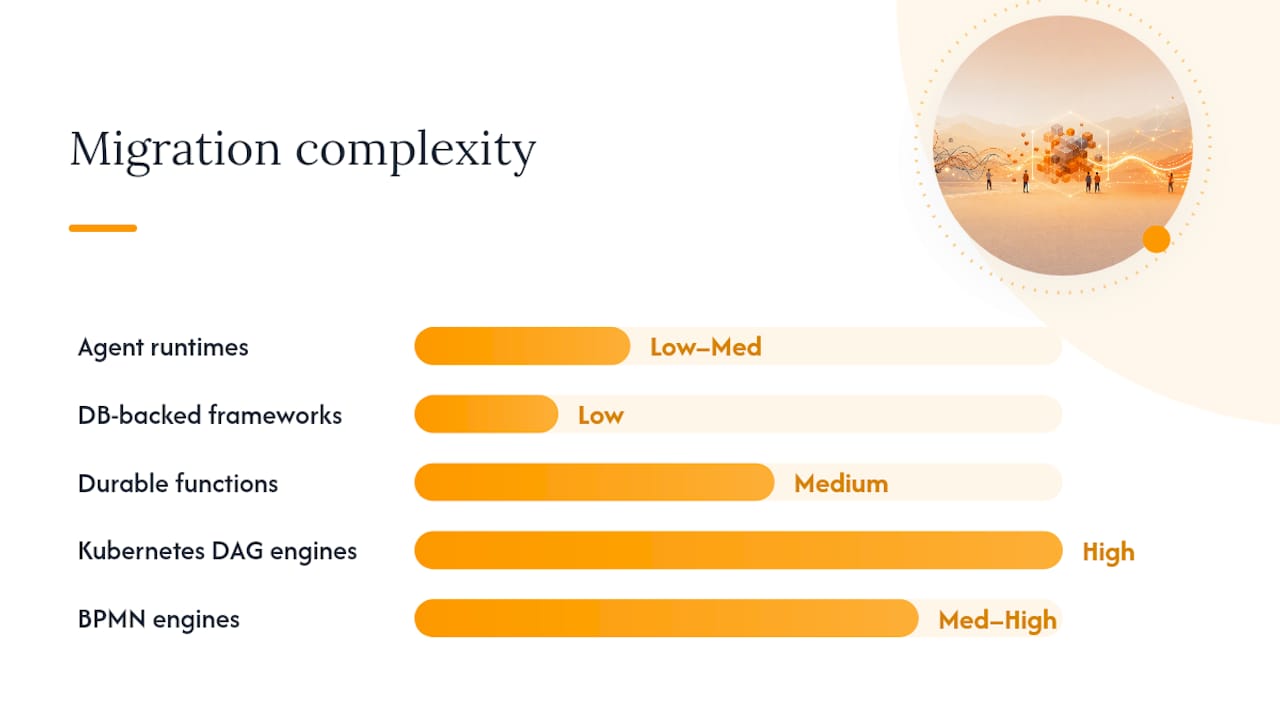
Agent runtimes carry low to medium migration complexity from Temporal, mainly because you're usually not migrating existing deterministic workflows at all. You're building new agent-based automation, so the first step is modeling one lead-agent-to-worker delegation pattern rather than porting old workflow code.
DB-backed frameworks carry medium complexity. The core work is translating Temporal's workflow-and-activity split into whatever primitives the new framework uses, then validating that your Postgres schema can hold workflow state without becoming a bottleneck.
Event-driven durable functions carry medium to high complexity if you're leaving self-hosted infrastructure for a specific cloud vendor, since your team also has to adopt that vendor's deployment and IAM model alongside the workflow code itself.
Kubernetes-native DAG engines carry high complexity when your team lacks existing K8s operations experience, because you're adopting a new orchestration paradigm and a new infrastructure layer at the same time.
BPMN/process engines carry high complexity for teams without prior process-modeling experience, since BPMN's declarative modeling style is a genuinely different mental model from code-first workflow definitions.
How Do You Choose and Run a Short Proof of Concept?
Run the checklist first, then the three-step POC. Skipping straight to a POC without checking these items wastes engineering time on a platform that was never going to fit your deployment constraints anyway.
- Deployment fit. Confirm whether the platform supports self-hosted, managed, or hybrid deployment in a way that matches your compliance and infrastructure constraints, not just what the vendor's homepage emphasizes.
- Failure modes. Understand exactly what happens when a worker process crashes mid-task: does state resume automatically, or do you need custom recovery logic?
- Persistence model. Determine whether workflow state lives in a purpose-built engine, a relational database you already operate, or a cloud vendor's managed store.
- SDK and language support. Check that the platform has first-class support for your team's primary language, not a community-maintained wrapper three versions behind.
- Observability. Verify you can trace a single workflow execution end to end, including retries and partial failures, without stitching together three separate log sources.
- Cost profile. Model the cost curve at your expected throughput, since managed platforms often scale cost non-linearly with execution volume.
Once the checklist clears, run this three-step POC before committing to a migration:
- Model one canonical workflow. Pick the single workflow your team runs most often, and rebuild it faithfully in the new platform, including every retry and branch it currently handles.
- Force a failure and recover. Kill the worker process mid-execution, restart it, and confirm state resumes correctly and side effects don't duplicate. This is where agent-swarm's own durable one-off run pattern is useful reference material, since it walks through exactly this kind of recovery validation for script-based agent work.
- Measure operational overhead. Time how long it takes to debug the forced failure from step two, and log every extra infrastructure piece you had to stand up just to run the POC.
Watch for a few red flags along the way: opaque observability tooling that can't show you a failed step without a support ticket, undocumented durability guarantees that only get clarified in a sales call, ad-hoc state storage that wasn't designed for concurrent access, and vague upgrade or compatibility policies that leave you guessing whether a version bump will break your workflows.
Pro Tip: Time-box the recovery test in step two to under an hour. If forcing a failure and confirming clean recovery takes longer than that on a single canonical workflow, the platform's debugging story is already telling you something about production incident response.
What Does an Agent-First Orchestration Architecture Actually Look Like?
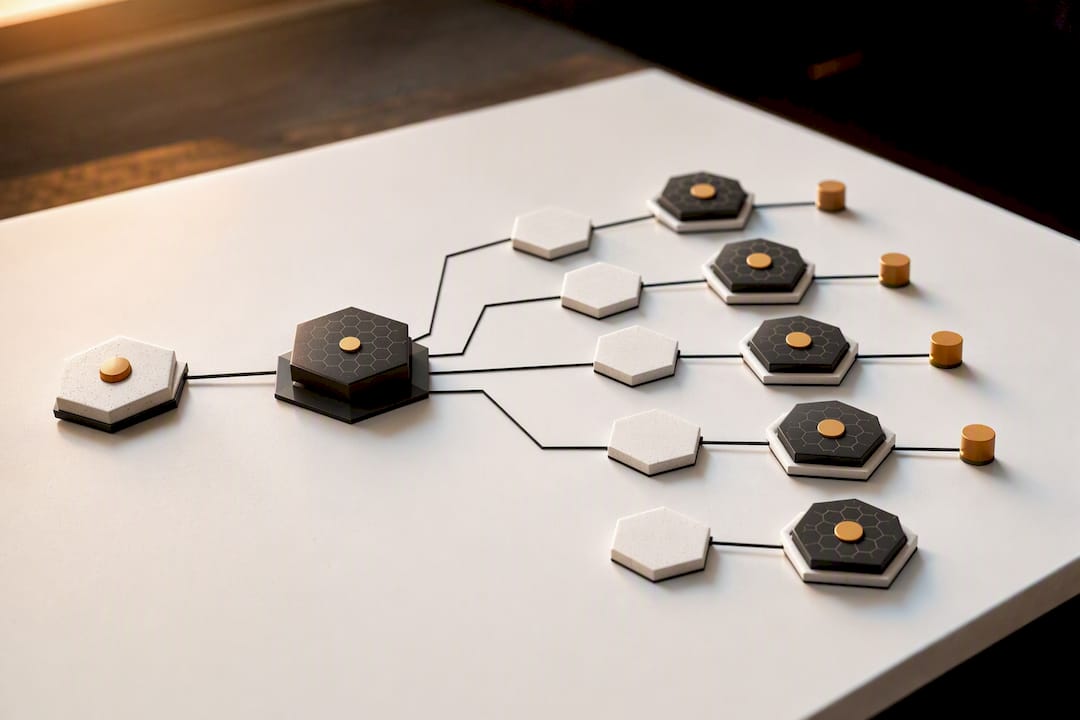
A practical agent-based durable architecture starts with a lead agent that decomposes an objective into discrete tasks, then dispatches each one to a specialized worker running in its own isolated container. Each worker checkpoints its progress and outcome back to shared, persistent memory, so a crash doesn't wipe out context the way an in-memory-only system would. That persistent memory is what compounds: the same context that resolved a bug last week is available to the worker handling a related task this week.
For a POC, try injecting failures deliberately rather than waiting for production to surface them:
- Kill a worker container mid-task and confirm the lead agent detects it and reassigns work.
- Force a network partition between a worker and its memory store, then verify no duplicate side effects occur on reconnect.
- Track the task lifecycle through its recovery states, a pattern detailed in agent-swarm's task state machine breakdown, which walks through the seven-state lifecycle used to recover cleanly from agent crashes.
- Test pause and resume on a long-running DAG, following the convergence-gate pattern described in agent-swarm's DAG workflow engine deep dive.
When Do We Actually Recommend Agent-Swarm Over the Alternatives?
The honest answer: it depends on what's actually failing in production today, not on category loyalty.
We'd point a team toward agent-swarm when the core problem is multi-agent AI orchestration that needs persistent, compounding context across dozens of recurring engineering or operations tasks, and when isolating each worker in its own container matters for safety or reproducibility. We'd point the same team toward a DB-backed framework instead if the workflows are simpler transactional sequences and the team already trusts Postgres more than any new persistence layer. We'd point them toward a Kubernetes-native engine if every workload is already a container and the team has real K8s operations depth.
Before any of that, check readiness honestly: does the team have container operations comfort, and does at least one engineer understand the failure-recovery model well enough to debug it at 2 a.m.?
— Ez.-
Try Agent-Swarm.dev for Multi-Agent Durable Automation
An option worth trialing when your bottleneck is coordinating specialized AI workers across recurring engineering, content, or operations tasks, not just running deterministic function chains. It is available as open-source for self-hosted deployment, or as a cloud-hosted SaaS with pricing details available on its website if you'd rather skip the infrastructure setup entirely.
You can see the delegation pattern in action: the lead agent breaks down an objective, dispatches to isolated containerized workers, and checkpoints persistent memory by browsing real agent-swarm sessions. For a look at measurable outcomes, the Capchase case study shows how one engineering team applied the same swarm pattern to cut recurring manual work. If you're comparing operational models more broadly, the agent fleet versus coordinated swarm breakdown lays out the structural difference directly. Clone the repository, run the local example against one real workflow, or set up an enterprise demo if your team needs onboarding support for a self-hosted rollout.
Where to Read More on Durable Workflow Design
For deeper implementation detail beyond this shortlist, Microsoft's Durable Functions overview remains the clearest reference for the orchestrator-function pattern used across the serverless category. ZenML's comparative review and Kestra's orchestrator guide both offer useful category framing if you want a second opinion on the taxonomy used here. For teams evaluating integration and onboarding support, Ampersand's AI automation practice covers system integration patterns worth reviewing, and agent-swarm's own workflow orchestration tool comparison digs deeper into agent-specific evaluation criteria.
Sources
- Durable Task code constraints
- I Tried and Tested the 9 Best Temporal Alternatives for Durable Execution and AI Agent Workflows
- Temporal alternatives: Find your workflow orchestrator
FAQ
Is Temporal Still a Good Choice for New Projects?
Temporal remains solid for teams that already understand its replay-based determinism model and need strict, deterministic workflow guarantees across long-running distributed transactions.
What's the Cheapest Self-Hosted Temporal Alternative?
DB-backed frameworks that run on infrastructure you already operate, and agent-swarm's MIT-licensed self-hosted deployment, both avoid the licensing and cluster costs that come with running a dedicated workflow engine.
Do Agent Runtimes Handle Failure Recovery as Well as Temporal?
Agent runtimes like agent-swarm checkpoint state to persistent memory rather than relying on deterministic replay, which handles non-deterministic LLM calls better than Temporal's strict replay model but requires validating idempotency during a proof of concept.
How Do I Avoid Vendor Lock-In When Picking an Alternative?
Favor self-hosted or open-source options with a documented, portable persistence model. Managed serverless platforms trade that portability for lower operational overhead, so weigh that trade-off against your multi-cloud requirements before committing.
What Support Options Exist Beyond the Open-Source Community?
Most categories offer a mix of active open-source communities, third-party consulting, and vendor-backed enterprise contracts. agent-swarm follows this same pattern, with a free MIT-licensed self-hosted path and enterprise packages that add dedicated support and tailored integrations.
Recommended
- Orchestrator Loops Are a Trap: Why Process-Level Orchestration Wins
- Building a DAG Workflow Engine That Waits: Pause, Resume, and Convergence Gates
- The Architecture Behind Task Delegation: Pools, Routing, and Dependencies
- Your Agent's Memory Is a Log File, Not a Lesson: The Prescriptive Memory Problem
Related field notes
Implementa OAuth para agentes IA y ahorra semanas: IETF y agent-swarm
Implementa OAuth seguro para agentes IA: flujos recomendados (Client Credentials, PKCE, OBO), binding mTLS/DPoP, claim «act», gateway MCP y checklist...
Keep Context Across Runs: Dagster Alternatives for Engineers
Engineering focused comparison of Dagster alternatives: deployment, memory model, sandboxing, and security. See how agent-swarm.dev (MIT, self-host or...
Coordina 3–5 agentes con Claude Code para ingenieros
Guía práctica para ingenieros: coordina 3–5 agentes con Claude Code. Incluye CLAUDE.md, worktrees y recibos de revisión para evitar sobrescrituras y...