Best Workflow Orchestration Tools for AI Agent Teams
Discover top workflow orchestration tools that enhance AI agent teams by breaking down tasks, managing context, and ensuring efficient execution.

The best workflow orchestration tools for engineering teams in 2026 share three traits: they decompose objectives into agent-sized tasks, retain hierarchical context across runs, and execute every worker inside an isolated sandbox. Among the options we've evaluated, agent-swarm.dev is the strongest open-source option for teams building multi-agent workflows right now. The evidence backing this isn't abstract. Context-management research using a toolized approach called CAT shows proactive context folding beats static compression on long-horizon coding benchmarks, and stateful, provenance-tracked memory systems post an 83.74% pooled pass rate across a 1,251-task benchmark at $1.30 per task. agent-swarm.dev builds its architecture around the same principles: a lead agent, containerized workers, and shared memory that compounds over time.
This approach fits you if:
- You're coordinating more than three agents on a shared codebase or knowledge base.
- Your workflows need to survive a context reset without losing state.
- You need CI/CD, Slack, Linear, or GitHub wired directly into the agent loop, not bolted on after.
Key Takeaways
The strongest AI work OS combines task decomposition, hierarchical persistent memory, and containerized sandboxes, and agent-swarm.dev ships all three as an open-source option today.
| Point | Details |
|---|---|
| Persistent context beats resets | Hierarchical memory tiers with scoped retrieval outperform single-strategy compression on long-horizon tasks. |
| Sandboxes are non-negotiable | Containerized, Git-backed workspaces give reproducibility and a security boundary between agents. |
| Run a 4-week PoC first | Validate accuracy, cost per task, and reproducibility before any full rollout. |
| Observability prevents silent failures | Provenance-tracked, typed state catches inconsistencies that stateless handoffs miss. |
| agent-swarm.dev covers the checklist | Its lead agent, containerized workers, Git-backed runs, and prewired integrations match the core capabilities engineering teams need to evaluate. |
Table of Contents
- What Makes a Workflow Orchestration Solution "Best" for Multi-Agent Work?
- Core Capabilities to Evaluate in an AI Work OS
- How Does an AI Work OS Architecture Actually Fit Together?
- What Does a 2-4 Week Proof of Concept Look Like?
- What Are the Biggest Operational Risks in Multi-Agent Systems?
- How Does agent-swarm.dev Implement These Capabilities?
- Should You Adopt an Existing Platform or Build Your Own?
- What Engineering Leaders Get Wrong About Rolling This Out
- Get Started With agent-swarm.dev
- Sources
- FAQ
What Makes a Workflow Orchestration Solution "Best" for Multi-Agent Work?
Most vendor pages call themselves an "AI work OS." Very few actually earn it. The label only fits when a platform does three things well: breaks a goal into discrete tasks assigned to specialized agents, keeps context alive across sessions instead of resetting it every run, and runs each worker somewhere it can't damage the host system or leak a secret. Traditional workflow orchestration solutions built for ETL and batch scheduling don't solve this problem. They coordinate deterministic jobs, not probabilistic agents that write code, call APIs, and make judgment calls.
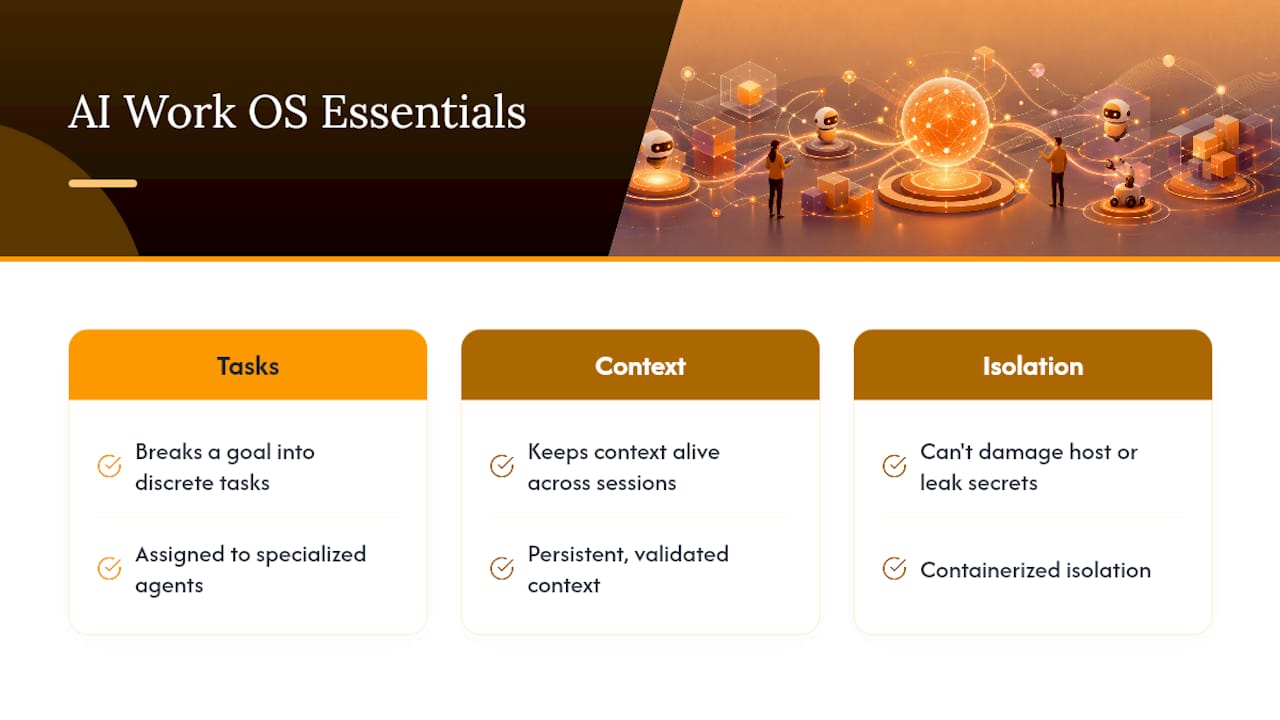
The distinction matters because the failure modes are different. A batch pipeline fails loudly when a job errors out. An agent swarm fails quietly: an agent hallucinates a fix, another agent builds on that bad output, and by the time a human notices, three downstream tasks have compounded the mistake. That's why persistent, validated context and containerized isolation aren't nice extras. They're the difference between an agent fleet you can trust in production and one you're babysitting.
Core Capabilities to Evaluate in an AI Work OS
Before you sign up for a platform or greenlight an internal build, run it against this checklist. Skip any item and you'll find the gap in production, usually at the worst time.
- Task decomposition and role assignment. A seed planner should split objectives into subtasks and route them to specialized workers (extractors, analysts, reviewers, a convergence supervisor) rather than dumping everything on one generalist agent.
- Hierarchical persistent context. Look for three tiers: short-term working memory for the active task, medium-term session context, and long-term archived memory with scoped retrieval. A 2025 context engineering survey found hybrid, multi-tier offloading consistently outperforms single-strategy compression on long-horizon tasks.
- Adaptive compression, not blind truncation. The strongest systems rank information by importance and archive on triggered events rather than truncating on a token count.
- Containerized sandboxes per agent. Each worker needs its own isolated environment, ideally Git-backed, so runs are reproducible and one agent's mistake can't touch another's workspace.
- DAG controls. Pause, resume, retry, and deterministic convergence gates. You need to be able to stop an agent mid-run and inspect state, not just kill the process.
- Integrations that matter to engineering teams. GitHub, Slack, Linear, and an observability stack that streams logs and traces, not a dashboard that only shows the last five actions.
- Security boundaries. Vault-backed secrets, egress filtering, least-privilege sandboxes, and an audit trail that survives the run.
- Operational guardrails. Rate limits and circuit breakers on outbound API calls, plus a defined recovery path when a worker stalls.
Pro Tip: Prioritize platforms that expose anticipatory retrieval or prefetch primitives. Pulling context reactively, only after an agent asks, adds latency to every single tool call in the loop. Prefetching the likely-needed context ahead of time is what keeps a multi-agent run fast at scale.
How Does an AI Work OS Architecture Actually Fit Together?
Strip away the marketing and the architecture looks consistent across serious implementations: an orchestrator (the seed planner) sits on top of worker agents, each backed by a persistent memory layer, tool and MCP servers, a message broker, sandbox runtimes, and an observability pipeline feeding traces back to a dashboard.

Context moves through a defined lifecycle: ingest, scope, retrieve, anticipate or prefetch, compact, consolidate. Production memory-as-a-service patterns from systems like Mem0 and Zep rely on exactly this sequence to keep costs linear rather than quadratic as conversation history grows. Skip the scoping step and every agent call drags the entire history along with it, which is how a simple task turns into a five-figure token bill.
Retrieval speed matters more than most teams expect going in. A scoped, low-latency path handles the agent's immediate next step; a slower bulk archival path handles anything historical. Because retrieval usually sits on the agent's critical path, anticipatory prefetching (fetching likely-needed context before it's requested) is often the single biggest latency lever available.
Structured, provenance-tracked state that persists across runs, instead of stateless agent-to-agent handoffs, is what let one benchmarked system cut reprocessing costs enough to hit $1.30 per task while beating published baselines on pass rate.
| Component | Role | Success Criteria |
|---|---|---|
| Orchestrator / seed planner | Decomposes objectives, assigns roles | Correct task splitting, no duplicate work |
| Worker agents | Execute specialized subtasks | Isolated failures, clear ownership |
| Memory layer | Hierarchical context storage | Scoped retrieval, validated compaction |
| Sandbox runtime | Isolated execution per agent | Reproducibility, Git-backed workspace |
| Observability pipeline | Logs, traces, provenance | Full audit trail per agent action |
What Does a 2-4 Week Proof of Concept Look Like?
You don't need a company-wide rollout to know whether an AI work OS earns its place. A tightly scoped proof of concept tells you almost everything, usually within four weeks.
- Week 0: Define the objective. Pick one recurring workflow (a bug triage pipeline, a content review loop, a data extraction task) with a clear, measurable outcome.
- Week 1: Instrument the workflow. Stand up one seed planner and three to five specialized workers against a single repo or document set. Connect persistent memory scoped to this experiment only.
- Week 2: Run parallel workers. Let agents work concurrently inside sandboxes, log every action, and watch for convergence issues.
- Week 3: Validate and measure. Check output accuracy against a human-reviewed baseline. Track cost per task, time-to-convergence, and reproducibility (can you rerun the exact same job from a Git branch and get consistent results?).
- Week 4: Report and decide. Summarize throughput, success rate, and cost, then decide on scale-up or a second pilot.
Before you start, confirm this checklist is covered:
- Environment provisioning and secrets vault configured.
- Sandbox template built and tested for reproducibility.
- Memory tiers configured with defined retention rules.
- Observability and logging wired in from day one, not added after a failure.
- Acceptance tests and convergence checks defined in advance, not improvised mid-run.
Self-hosted PoCs cost less up front but demand platform-engineering time; cloud-hosted trials cost more per worker-hour but get you running same-day. Either way, insist on one non-negotiable deliverable: a reproducible run, rerunnable from a Git branch, with a full audit trail of every agent action.
What Are the Biggest Operational Risks in Multi-Agent Systems?
Every one of these failure modes shows up eventually. The teams that survive them plan for it before launch, not after an incident.
- Runaway tool calls and secret leakage. Mitigate with per-agent sandboxes, egress filters, and vault-backed secrets rather than environment variables baked into a shared image.
- Context explosion and cost blowup. Adaptive context management with event-triggered archiving and loss-validated compaction keeps token spend from scaling faster than task volume.
- Inconsistent state across agents. A typed shared blackboard with provenance tracking, rather than free-form message passing, prevents two agents from silently overwriting each other's work.
- Observability gaps. Every agent action needs provenance metadata streamed to an OTEL-compatible backend. If you can't reconstruct what an agent did and why, you can't debug it.
- Reproducibility drift. Git-backed agent workspaces and immutable sandbox templates stop "it worked yesterday" from becoming a support ticket.
- Third-party API abuse. Rate limits, budget guards, circuit breakers, and dry-run simulation catch a misbehaving agent before it burns through your OpenAI quota overnight.
Pro Tip: Design deterministic post-checks that run without an LLM in the loop, like a graph traversal over typed state, so at least some of your verification steps are cheap, fast, and don't add another probabilistic layer on top of an already probabilistic system.
How Does agent-swarm.dev Implement These Capabilities?
agent-swarm.dev maps almost every item on the capability checklist directly to a shipped feature, which is exactly what you want to see before committing PoC time to a platform.
- Task delegation and role assignment run through a lead agent that breaks objectives into subtasks and hands them to workers running Claude Code, Codex, or OpenCode, each in its own container.
- Durable, one-off runs persist state so a workflow can be paused, resumed, or rerun without starting from zero, addressed in agent-swarm's own script-workflow architecture.
- DAG controls include pause, resume, and convergence checks, so you can intervene on a stuck agent instead of restarting the entire job.
- Git-backed workspaces give every worker a reproducible environment, aligned with the same container-per-agent pattern that lets teams inspect exact runtime state and roll back cleanly.
- Prewired integrations across Slack, GitHub, Linear, and email cut most of the plumbing work out of week one of a PoC.
For a team running the four-week PoC checklist above, agent-swarm.dev removes friction on the parts that usually eat the most time: sandbox templates are already built, observability is built in rather than bolted on, and the integrations that connect to your existing tools don't need custom middleware. You can see this pattern in real recorded sessions rather than a marketing demo.
Should You Adopt an Existing Platform or Build Your Own?
Building your own orchestration stack sounds appealing until you price out the maintenance tail. Memory lifecycle engineering (ingest, scope, compact, consolidate) is a multi-quarter project on its own, and that's before you've hardened a single sandbox.
Adopt an existing AI work OS when:
- You need to move in weeks, not quarters.
- You lack dedicated platform-engineering headcount.
- Prebuilt integrations and hardened sandboxes save you months of setup.
Build your own when:
- You have unique IP or compliance boundaries that no vendor's architecture accommodates.
- Your concurrency or data volume exceeds what off-the-shelf sandboxing was designed for.
- You already have a platform team with spare capacity for long-term memory and security engineering.
Run the decision through four questions: your required timeline, your compliance boundary, your expected concurrency, and your actual platform-engineering bandwidth. For most engineering teams outside a handful of exceptions, adopting and customizing beats building from scratch, especially when the alternative comparisons show how much integration work a build-it-yourself path front-loads.
What Engineering Leaders Get Wrong About Rolling This Out
Most teams treat agent orchestration as a model problem. It isn't. The model calling the shots matters less than whether the system around it preserves context, isolates failures, and gives you an audit trail when something goes wrong. Start with one workflow, not five. Measure cost-per-task and time-to-convergence before you scale worker count, because a swarm that's fast and expensive is a worse outcome than a slower swarm that's cheap and observable.
Run the PoC checklist before any full rollout. Skipping it to save two weeks almost always costs more than two weeks later, once you're debugging a production incident with no provenance data to work from.
Get Started With agent-swarm.dev
agent-swarm.dev gives you the persistent context, containerized sandboxes, and prewired integrations this article just walked through, without the months of memory-lifecycle engineering a custom build demands.
You have three ways in: download the self-hosted MIT release and run it on your own infrastructure at no cost, start a cloud-hosted trial to skip the setup entirely, or talk to the team about an enterprise package with tailored integrations and support. Before committing, look at real customer results to see how the PoC framework above plays out with production data, and browse recorded example sessions to check the fit against your own workflow. If you're weighing this against renting a single AI engineer instead of owning your swarm, the Devin comparison breaks down that tradeoff directly. Start with the self-hosted download or book a cloud trial at Agent-swarm.
Sources
- Context engineering survey (2025)
- Building AI teams with Docker Sandboxes & Docker Agent
- Agent container use (Dagger blog)
- Stateful Swarms: How persistent memory beats traditional agent architectures
FAQ
What Is the Best AI Work OS for Multi-Agent Workflows?
An AI work OS that decomposes tasks, retains hierarchical persistent context, and runs agents in containerized sandboxes is the strongest architecture for this job, and agent-swarm.dev is the leading open-source option built on that model.
How Long Should a Multi-Agent PoC Take?
Two to four weeks is enough to validate one workflow end to end, from environment setup through measured cost per task and reproducibility checks.
Do I Need Persistent Memory for a Simple Automation Task?
For a single, short-lived task, no. For any recurring workflow that spans multiple sessions or agents, persistent memory prevents costly context loss and repeated re-processing.
Should I Self-Host or Use a Cloud-Hosted Platform?
Self-hosting costs less but requires platform-engineering time to maintain; cloud hosting costs more per worker-hour but gets a PoC running the same day. agent-swarm.dev supports both paths.
What's the Biggest Operational Risk in Agent Orchestration?
Context explosion and inconsistent state across agents cause the most production incidents, which is why adaptive context management and a typed, provenance-tracked shared state matter more than raw model quality.
Recommended
Related field notes
Engineering & AI Teams: Zapier Alternatives With Persistent Memory
Compare Zapier alternatives for engineering and AI teams. See why agent-swarm.dev's agent orchestration and persistent shared memory fit recurring,...
A TLA+ Playbook for Your Scheduler, Queue or Retry Loop
Five steps, one prompt each: model a concurrent subsystem in TLA+, calibrate it on bugs you already fixed, turn every counterexample into a failing test, and keep the spec true with a daily swarm workflow. Our run found ten bugs in a day.
We Rebuilt Linear's “Loops updates” Clip as a Swarm Video in Eight Rounds
Three video models read Linear's motion-design teaser; the two Gemini models called the 3D scene 2D until 7.5s. A frame-by-frame check caught it. The replica is 858 frames of Remotion and three.js, reviewed eight times.