Ship in Weeks: Open Source AI Agents for Engineers
Engineers: deploy open source AI agents safely. Prototype fast, then add telemetry, sandboxing, and runtime governance before production.

Open source AI agents are autonomous software components, built on agent SDKs or multi-agent frameworks, that plan, call tools, and act on goals with minimal human steering. The recommended approach for engineering teams is a two-phase one: prototype fast with a lightweight SDK to validate the workflow, then harden the system with runtime telemetry and governance before anything touches production. This article walks through the ecosystem, the evaluation criteria that separate a toy from a deployable system, the technical building blocks, and the governance layer that most teams skip until something breaks.
TL;DR:
- Framework evaluation should prioritize production readiness, governance capabilities, structured telemetry, and isolation measures over feature lists and popularity metrics.
- The core components of agent systems include runtime, orchestration pattern, execution environment, memory design, and interoperability, each influencing deployment security and reliability.
- Governance enforcement, especially via inline policy checks and tamper-evident telemetry, is critical to prevent bad actions and reduce operational risks in production.
- Successful deployments focus on narrow, verifiable tasks with extensive telemetry before expanding scope, avoiding broad authority due to governance and safety concerns.
- Open source tools like agent-swarm offer integrated solutions for orchestration, governance, and telemetry, simplifying deployment and ongoing maintenance in production environments.
Table of Contents
- What Counts as an Open Source Agent Framework?
- How Do You Evaluate an Open Source Agent Framework?
- Runtimes, Orchestration Patterns, and Memory: the Core Components
- Why Runtime Governance Is the Real Barrier to Production
- What Does an Agent-Swarm Deployment Look Like in Practice?
- Prototype to Production: a Short Migration Checklist
- How Did Open Source AI Agents Evolve?
- Who Builds and Maintains These Frameworks?
- What Licensing Terms Apply to Open Source Agents?
- Where Are Open Source Agents Already Working?
- What's Next for Open Source Agent Development?
- Trade-offs and Hard Lessons in Production Agent Deployments
- Get Open-Source Orchestration and Governance in One System
- Sources
- FAQ
What Counts as an Open Source Agent Framework?
The category splits into four working buckets, and knowing which one you're actually looking at saves weeks of misapplied effort. Teams routinely grab a lightweight SDK meant for a weekend prototype and try to run it as a production orchestrator, then wonder why sessions drift or credentials leak.
Agent SDKs give you the primitives: a way to define instructions, register tools, manage a session, and run an agentic loop where the model reasons, calls a tool, observes the result, and repeats. They're intentionally thin. You write the orchestration logic yourself.
Multi-agent frameworks sit a layer up. They give you patterns for coordinating several agents at once: a planner agent that decomposes a goal, worker agents that execute subtasks, and some mechanism for handing off context between them. This is where most "open source multi agent" projects actually live.
Orchestrators manage the runtime lifecycle across agents and jobs: queuing, retries, state persistence, and scaling workers up or down. Think of this as the layer between your agent logic and your infrastructure.
Security and evaluation tools are the newest and most underused category. These test agents for tool-chain vulnerabilities, sandbox behavior under adversarial input, and log execution traces for post-mortem analysis.
Here's how each maps to a typical build phase:
- Agent SDKs: best for prototyping a single-agent workflow, testing prompt and tool design, validating that the task is even solvable by an LLM loop.
- Multi-agent frameworks: best once you need task decomposition across specialized roles, like a coding agent, a review agent, and a deployment agent working in sequence.
- Orchestrators: best when you're running agents as a persistent service, not a script, and need job queuing, retries, and horizontal scaling.
- Security/eval tools: best layered in before any agent gets write access to production systems, customer data, or external APIs.
The mistake we see most often is teams treating the SDK layer as production-ready simply because it runs reliably in a demo. A demo has one user, one happy path, and no adversarial input. Production has none of those guarantees, which is exactly why the next section exists.
How Do You Evaluate an Open Source Agent Framework?
Most teams evaluate frameworks on the wrong axis first: they check feature lists and GitHub stars before checking whether the project can survive contact with real, uncontrolled input. Flip that order. Here's the checklist we use, in priority order.
- Production-readiness signals. Does the project have a documented deployment path beyond
pip installand a notebook? Look for Docker images, health checks, and a changelog that shows active maintenance, not just a burst of commits before an abandoned repo. - Governance hooks. Can you intercept an agent's action before it executes, not just log it after the fact? A framework with no policy-enforcement adapter forces you to bolt governance on from outside, which is harder and less reliable.
- Telemetry and observability. Does it expose structured traces, ideally across cognitive (reasoning steps), operational (tool calls), and contextual (I/O) surfaces, the way frameworks like AgentTrace define them? Check whether traces export to OpenTelemetry or a similarly standard backend.
- Interoperability. Does the project support or plan to support protocols like Agent2Agent (A2A) or Model Context Protocol (MCP), so agents built on different frameworks can hand off work without custom glue code?
- Sandboxing and isolation. Does the runtime default to containerized or microVM execution, or does it assume the agent runs with the same privileges as your main application process?
- Credential handling. Does the framework support short-lived, scoped tokens for tool access, or does it expect you to hand agents a long-lived API key?
- Operational cost. What does it cost to run at your expected concurrency, factoring in both compute and the engineering time needed to maintain custom orchestration code?
- Community and support. Is there an active issue tracker, a real maintainer response time, and a community channel where production questions get answered, not just feature requests?
Pro Tip: Before adopting any framework, try to break it on purpose. Feed a tool call malformed input, or simulate a tool timeout mid-task. How the framework fails tells you more than how it succeeds in the happy path.
The minimum bar for production, in our view, is items 2 through 6. A framework can be missing a polished dashboard or a large community and still be viable. A framework with no way to enforce a policy at runtime, no structured telemetry, and no isolation model is not production ready, regardless of how clean its demo looks.
Runtimes, Orchestration Patterns, and Memory: the Core Components
Every agent system, no matter which framework wraps it, is built from the same five components. Understanding each one on its own terms makes framework comparisons far less confusing.
The agent runtime is the loop itself: instructions (the system prompt and behavioral constraints), tools (functions the agent can call), a session (conversation and task state), and guardrails (input/output filters, rate limits, refusal conditions). This is the part every SDK, from thin wrappers to full frameworks, implements in some form.
Orchestration patterns determine how multiple agents cooperate, and picking the wrong one is a common source of wasted engineering time:
- Sequential: agent A finishes, hands its output to agent B. Simple, predictable, easy to debug. Good for pipelines like "research, then draft, then edit."
- Concurrent: several agents work the same problem in parallel, then a reducer step merges results. Useful for tasks where diverse approaches beat a single deep pass.
- Handoff: one agent recognizes it's out of scope and explicitly transfers control to a specialist agent. Common in customer-support-style systems where routing matters.
- Crew/graph: a directed graph of agents with conditional edges, where the path through the graph depends on intermediate results. Most flexible, hardest to test exhaustively.
Start sequential unless you have a specific reason not to. Every additional coordination pattern adds a new class of failure mode you have to test for.
Execution environments decide how isolated each agent's actions are from your host system and from each other. Standard Docker containers are the common default: fast to spin up, well understood, but sharing a kernel means a container escape is a real risk if an agent executes arbitrary code. MicroVMs like Firecracker add a hardware-virtualization boundary at a small performance cost, which is why they show up repeatedly in enterprise security playbooks as a baseline for agents that execute untrusted code. WebAssembly (WASM) sandboxes go further still, restricting the agent to a narrow, capability-scoped interface, at the cost of needing tools compiled or ported to WASM targets. A containerized agent deployment guide is worth reading before you pick a default here, since the isolation choice you make early is expensive to retrofit later.

Memory design splits into session memory (scoped to one task, discarded after) and durable memory (persisted across sessions, searchable, and often the difference between an agent that repeats mistakes and one that improves). Durable memory costs more to build and store, but it's what lets a coding agent remember that a particular API always needs a specific header, instead of rediscovering that fact every run.
Interoperability matters the moment you have agents built on different frameworks that need to cooperate, which is increasingly common as teams adopt best-of-breed tools for different jobs. A2A and MCP are the two protocols worth tracking here: A2A standardizes agent-to-agent task delegation, while MCP standardizes how an agent connects to external tools and data sources. Designing for these protocols from day one, even if you don't need cross-framework handoffs yet, avoids a painful rewrite later.
Observability closes the loop. Collect cognitive traces (what the model reasoned and why), operational traces (which tools ran, with what arguments), and contextual traces (what external data came in and out), the three-surface model that AgentTrace's structured logging framework formalizes for exactly this purpose. Skip this and your first production incident becomes an unsolvable mystery.
Why Runtime Governance Is the Real Barrier to Production
Telemetry alone does not stop a bad action. That's the gap most teams discover the hard way: they build a beautiful dashboard, watch an agent do something it shouldn't, and realize the dashboard only told them after the fact.
Research on this exact problem found that dashboard-first observability stacks, built on tools like OpenTelemetry or Langfuse, have low visibility-to-policy remediation, because enforcement sits downstream of collection instead of inline with it, according to GAAT's closed-loop enforcement research. Watching is not the same as stopping.
Three frameworks address this directly, and each maps to a concrete architectural piece you can actually build:
- GAAT (Governance-Aware Agent Telemetry) extends OpenTelemetry with governance attributes like sensitivity, jurisdiction, and lineage, evaluates policy with Open Policy Agent, and enforces decisions through a Governance Enforcement Bus. GAAT's own benchmarks report very fast policy evaluation with graduated enforcement actions, from an alert up to a full quarantine, per GAAT's paper on multi-agent enforcement.
- MI9 takes a broader runtime governance stance: continuous authorization monitoring instead of static role-based access, conformance engines that check behavior against expected patterns, and drift detection, all feeding into the same graduated containment idea, as detailed in MI9's runtime governance protocol.
- AgentTrace supplies the telemetry substrate both of the above depend on: cognitive, operational, and contextual traces that are schema-consistent enough to feed a policy engine automatically, rather than requiring a human to eyeball logs.
Concrete controls worth implementing regardless of which framework you adopt:
| Control | What it does | Where it lives |
|---|---|---|
| Least-privilege credentials | Scopes each agent's tool access to the minimum needed for its task | Credential/identity layer |
| Short-lived tokens | Limits blast radius if a token leaks or an agent is compromised | Auth service, issued per-session |
| Graduated containment | Escalates from alert to redirect to quarantine instead of binary allow/block | Enforcement bus |
| Circuit breakers | Halts an agent after a defined violation threshold to stop cascading failures | Policy engine |
| Sandboxing by default | Runs agent-executed code inside containers, microVMs, or WASM, never bare metal | Execution environment |
GAAT's benchmark result is the number worth remembering here: sub-200 millisecond policy evaluation, proving that closed-loop enforcement doesn't have to trade away responsiveness, per the GAAT enforcement research.
Emerging research is also pushing toward receiver-attested receipts and cryptographically tamper-evident logs, so a compromised agent can't simply forge a clean trace, an idea explored in recent work on receiver-attested telemetry. A short rollout checklist: instrument all three telemetry surfaces first, wire a policy engine to at least one graduated action (start with alerting), then add short-lived credentials before you grant any agent write access to a system of record. Our own governance-first blueprint walks through this sequencing in more detail.
What Does an Agent-Swarm Deployment Look Like in Practice?
A working reference helps more than another abstract diagram. In an agent-swarm deployment, a lead agent breaks an objective into discrete tasks and assigns each to a worker agent, running models like Claude Code, Codex, or OpenCode, inside its own isolated container. Shared memory persists across tasks, so a worker doesn't relearn a codebase's quirks every run.
Integrations map directly to the evaluation criteria covered above:
- Slack and Linear handle task routing and human-in-the-loop approvals, keeping oversight without constant manual intervention.
- GitHub gives worker agents scoped, auditable access to code, satisfying the credential-handling and telemetry criteria at once.
- Turso backs the durable memory layer, so contextual knowledge compounds across sessions instead of resetting.
- OpenAI and comparable model providers plug in as swappable reasoning engines, which matters when you want to change models without losing institutional memory.
Real deployment sessions and outcomes are documented on the Agent-swarm.
Prototype to Production: a Short Migration Checklist
Practitioner trend data consistently shows teams following the same pattern: prototype fast on a lightweight SDK, then migrate orchestration to a more governed framework once the workflow proves out. Skipping straight to a hardened build usually wastes time on governance for a workflow that gets scrapped after week one.
- Validate the workflow end-to-end with a minimal SDK, no governance layer yet.
- Add container or microVM sandboxing before any agent gets tool access to real systems.
- Wire in structured telemetry (cognitive, operational, contextual) before granting write permissions.
- Layer in a policy engine with at least alert-level enforcement, then graduate to quarantine actions.
- Roll out to production in stages, one workflow at a time, watching enforcement metrics before expanding scope.
Expect this to take a few weeks for a single workflow, longer if your team is building the governance layer from scratch rather than adopting an existing pattern.
How Did Open Source AI Agents Evolve?
Early agent experiments in 2022 and 2023, projects that chained large language model calls into simple loops, proved the concept but broke constantly: they looped forever, hallucinated tool calls, or lost context after a few steps. That first wave taught the field a hard lesson: a model that can reason is not the same as a system that can act reliably.
The next phase brought structured SDKs that formalized the agentic loop, tool calling, and session management, replacing ad hoc prompt chains with reusable primitives. This is when the SDK and multi-agent-framework categories described earlier actually took shape as distinct products rather than research demos.
The current phase, the one this article is written for, is the governance phase. As agents moved from demos into systems with real write access to codebases, customer data, and financial systems, the industry ran into the same wall repeatedly: telemetry without enforcement doesn't stop bad actions, and static access controls don't fit agents whose permissions and delegation chains shift mid-task. That realization is what produced frameworks like MI9 and GAAT, and it's why "production-ready" now means something closer to "governed" than "functional." The milestone worth marking isn't a specific release date. It's the shift from "can the agent do the task" to "can we prove, in real time, that the agent is doing only the task we authorized."
Who Builds and Maintains These Frameworks?
Open source agent development doesn't have one center of gravity. It spans independent maintainers publishing SDKs on GitHub, research labs releasing reference implementations alongside papers, and companies open-sourcing internal tooling once it proves useful beyond their own walls. That mix is a strength: a framework built by a research team tends to prioritize novel orchestration patterns, while one built by an engineering team under production pressure tends to prioritize reliability and governance hooks.
Governance models vary as much as the projects themselves. Some frameworks run under a single maintainer's judgment calls, which moves fast but creates a bus-factor risk if that person moves on. Others adopt a foundation-style structure with a technical steering committee, published contribution guidelines, and a formal request-for-comment process before major changes ship. Neither model is inherently better. A single-maintainer project can still be production-grade if it has active issue response and a stable API; a foundation-governed project can still stagnate if its steering committee is slow to act.
Collaboration happens mostly where you'd expect: GitHub issues and pull requests for code, Discord or Slack communities for real-time troubleshooting, and increasingly, shared standards work around protocols like A2A and MCP that require coordination across otherwise competing frameworks. That standards-layer collaboration is worth watching closely. It's the clearest sign of a maturing ecosystem, since it means projects that don't share a codebase are still agreeing on how agents should talk to each other.
What Licensing Terms Apply to Open Source Agents?
Licensing determines what you can build, sell, and modify without legal exposure, and agent frameworks span the same license spectrum as the rest of the open source world. Permissive licenses like MIT and Apache 2.0 let you use, modify, and redistribute the code, including in closed-source commercial products, with minimal obligations beyond preserving the license notice. Most agent SDKs and frameworks favor this category because it maximizes adoption.
Copyleft licenses like the GPL family attach stronger conditions: if you modify and distribute the code, you generally must release your modifications under the same license. This matters if you're forking a framework and shipping it as part of a proprietary product. Read the specific license text rather than assuming; GPL variants (GPLv2, GPLv3, LGPL, AGPL) differ meaningfully in how far their obligations reach, and AGPL in particular extends copyleft obligations to network use, which catches teams offering a modified framework as a hosted service.
A growing number of projects use source-available licenses that aren't technically open source under the Open Source Initiative's definition, restricting commercial hosting by competitors while still publishing the code. If you're evaluating a framework for a commercial product, check this distinction before you build anything on top of it. It's easy to assume "the code is on GitHub" means "the code is unrestricted," and that assumption has caused real legal headaches for teams that built on a source-available project expecting MIT-style freedom.
For contributors, most projects require a contributor license agreement or rely on the inbound license terms themselves, meaning your pull request is automatically licensed the same way as the project. Check the CONTRIBUTING.md file before submitting anything you'd want to retain rights over.
Where Are Open Source Agents Already Working?
Engineering teams have had the most consistent success applying open source agents to software delivery itself: agents that triage incoming bug reports, draft a fix, open a pull request, and route it to a human reviewer. This use case works well because the feedback loop is short and the failure mode (a bad pull request) is cheap and easy to catch before merge.
Customer support is a second area with real traction, particularly for tiered handoff systems where a first-line agent resolves routine tickets and escalates anything ambiguous to a human or a specialist agent. The handoff orchestration pattern described earlier in this article exists largely because of exactly this use case.
Content and research operations teams use multi-agent setups for tasks like competitive monitoring: one agent gathers data from multiple sources, a second synthesizes it, a third drafts a summary for human review. The pattern holds up because each agent's task is narrow enough to verify independently, which limits how far an error can propagate before someone notices.
The common thread across working implementations is not the industry. It's task scope. Every successful deployment we've seen starts an agent on a narrow, verifiable task and expands scope only after telemetry shows the agent behaving predictably across a meaningful volume of real runs. Teams that instead handed an agent broad, loosely defined authority on day one are disproportionately the ones with governance failures to report.
What's Next for Open Source Agent Development?
Interoperability standards are the clearest near-term trend. As more teams run agents built on different frameworks side by side, A2A and MCP adoption will keep expanding, and frameworks that ignore these protocols will increasingly look isolated rather than independent.
Governance tooling is moving from research paper to default feature. Expect the patterns behind MI9, GAAT, and AgentTrace to show up as built-in options in mainstream frameworks rather than bolt-on research projects, simply because the demand from engineering teams burned by a governance-free deployment is not going away.
The emerging challenge that deserves more attention than it currently gets is telemetry integrity itself. If policy engines start making automated enforcement decisions based on an agent's own self-reported logs, a compromised or misaligned agent has a strong incentive to falsify those logs. Work on receiver-attested receipts and cryptographic provenance is a direct response to that risk, and it's likely to move from niche research into standard practice faster than most teams expect.
Cost is the other pressure point worth watching. As agents take on longer-running, more autonomous tasks, the compute cost of durable memory, sandboxed execution, and continuous telemetry adds up. Teams that treat governance as an afterthought will keep discovering it's cheaper to build in early than to retrofit after an incident forces the issue.
Trade-offs and Hard Lessons in Production Agent Deployments
Fast iteration is fine while you're validating whether a workflow is even solvable. The mistake is carrying that same looseness into production. Telemetry and policy enforcement need to go in before an agent touches real credentials, not after the first incident. The costliest errors we've seen came from teams treating governance as a feature to add later, when it's really the foundation everything else depends on.
Get Open-Source Orchestration and Governance in One System
Building the orchestration layer, the telemetry schema, and the policy engine described throughout this article from scratch takes real engineering time, time most teams would rather spend on their actual product. agent-swarm provides an open-source, self-hostable system where a lead agent decomposes objectives and assigns tasks to worker agents running models inside isolated containers, with shared memory that persists across sessions.
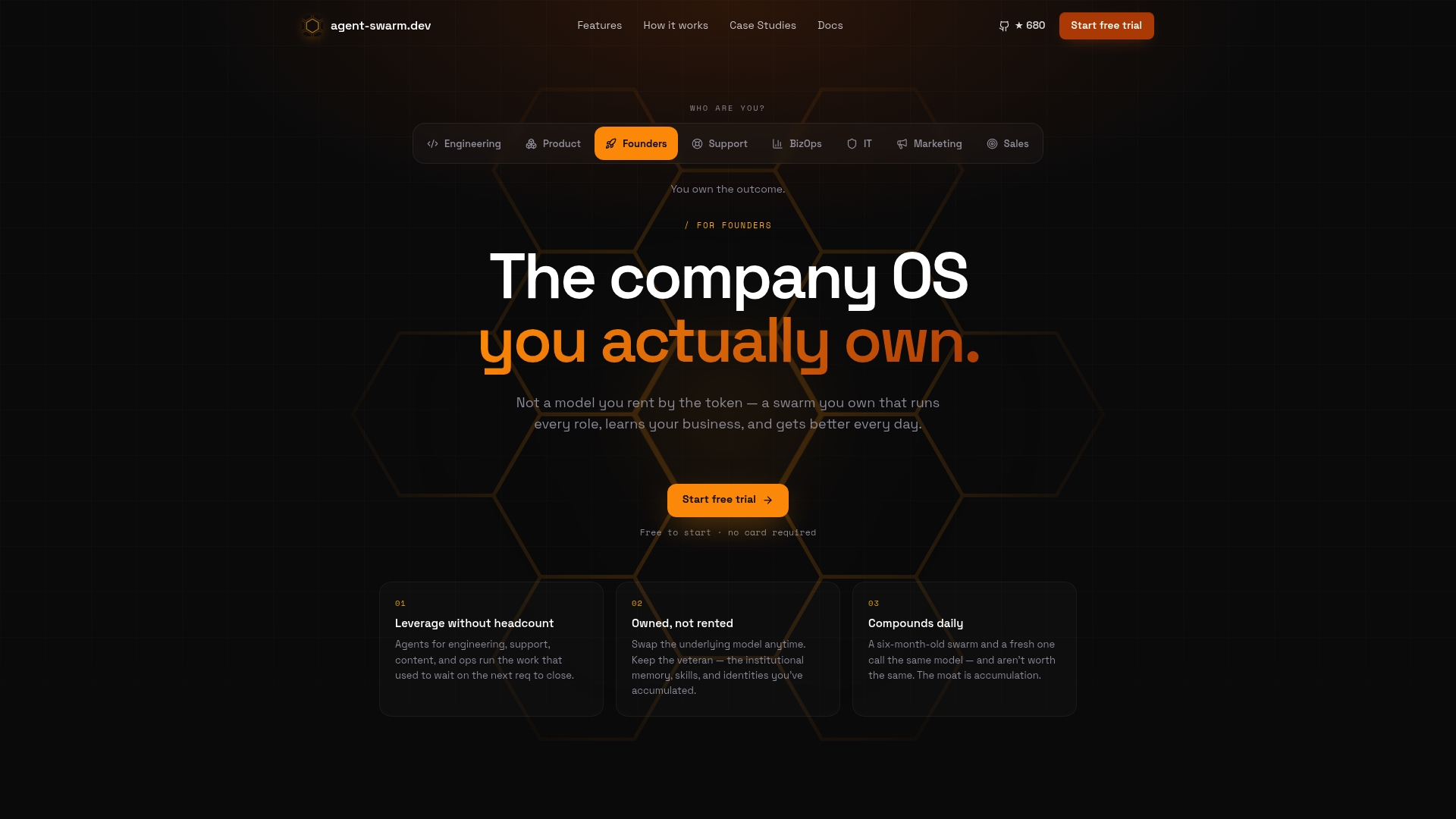
It integrates with communication, code, and data platforms, enabling governance and telemetry patterns to be part of practical workflows. You can self-host it for free under an MIT license, or run it on the Cloud plan at €30 to €100 per month, or talk to sales about an Enterprise deployment with dedicated onboarding. Whichever underlying model you switch to later, your institutional memory stays put. Start by reviewing real deployment sessions to see how the pieces fit together, then check the pricing page to pick the deployment option that matches your team's size.
Sources
- AgentTrace: A Structured Logging Framework for Agent System Observability
- The Enterprise AI Security Playbook: Securing LLMs and Agents in Production — AI Insiders Research
FAQ
Is There Any Free AI Agent Framework?
Yes. Most agent SDKs and multi-agent frameworks, including agent-swarm's self-hosted deployment, are released under permissive licenses like MIT or Apache 2.0, meaning you can run and modify them at no cost. Self-hosting does require you to provide your own infrastructure and, in most cases, your own model API keys.
What Are the Best Open Source AI Agents to Start With?
The best starting point depends on your task: a thin agent SDK for a single-agent prototype, a multi-agent framework once you need task decomposition across specialized roles, and a governed platform like agent-swarm once you're moving toward production with real credential and telemetry requirements. Evaluate against the checklist covered earlier, prioritizing governance hooks and structured telemetry over feature count.
Is There a Free, Fully Open Source AI Platform?
Several exist across the SDK, framework, and orchestration categories, and agent-swarm's core platform is one of them, distributed under an MIT license for self-hosted deployment. Free and open source doesn't mean zero operational cost, since you still need to run infrastructure, provide model access, and implement the sandboxing and telemetry controls covered in this article.
What Are the Main Types of AI Agents?
Common groupings include simple reflex agents, model-based reflex agents, goal-based agents, utility-based agents, learning agents, multi-agent systems, and hierarchical agents that combine several of these patterns. Most production open source agents today are goal-based or multi-agent systems built on an LLM reasoning loop, coordinated through one of the orchestration patterns, sequential, concurrent, handoff, or graph, described earlier in this article.
Recommended
Related field notes
Memoria corporativa con IA: la guía práctica para pymes
Aprende a crear una memoria corporativa con IA que conserva conocimiento, reduce preguntas repetidas, acelera incorporación y agiliza decisiones.
Engineers, Avoid the 3 AM Pager With These Camunda Alternatives
Engineer focused Camunda alternatives for durable, agentic workflows. Compare Temporal, Step Functions, Airflow, Inngest, and agent-swarm.
Propiedad de datos IA: qué exige la ley al entrenar modelos
Saber qué exige la ley sobre la propiedad de datos en IA: documentar orígenes y base legal, evaluar impacto y cumplir el RGPD al entrenar.