Secure Containerized AI Agents: 4 Steps to Package and Run for Devs
For developers: four packaging steps to build and run secure containerized AI agents, pick microVM or container sandboxes, and scale safely.
A containerized AI agent is a model plus its runtime, tools, and dependencies packaged as an OCI image or sandbox environment, so it can execute code, edit files, and hold state without touching the host directly. Use containerization the moment an agent needs to run untrusted code or persist beyond a single prompt. For anything touching sensitive data or arbitrary code execution, we recommend microVM-backed sandboxes (Firecracker, gVisor, or Kata) over plain Docker isolation.
TL;DR:
- Containers package AI agents with their runtime, tools, and dependencies to ensure portability and reproducibility but do not isolate the host kernel by default.
- For untrusted code or sensitive data, microVM-backed sandboxes like Firecracker or Kata provide stronger security than standard Docker or OCI containers.
- Resource limits, network restrictions, and filesystem scope must be enforced, with disposable sandboxes used for untrusted input and reusable pools for trusted, repetitive tasks.
- Regular security and dependency audits, including testing for prompt injection, are essential before deploying agents in production.
- Wire agent orchestration to observability signals such as lifecycle events, resource usage, and audit logs for effective monitoring and scaling at scale.
Table of Contents
- What Are Containerized AI Agents, and Why Does Packaging Matter?
- How Do You Package and Run an Agent Safely?
- Standard Containers, gVisor, or Firecracker: Which Isolation Do You Need?
- Running Agents at Scale: Orchestration Patterns That Hold Up
- Which Tools and SDKs Should You Actually Use?
- A Security-First Checklist Before You Ship
- What Running Agent Swarms in Production Actually Teaches You
- agent-swarm.dev: Built for Teams Running Agents in Production, Not Just Experiments
- Where to Read More on Containerized Agents
- Sources
- FAQ
What Are Containerized AI Agents, and Why Does Packaging Matter?
A containerized AI agent bundles four things into one deployable unit: the agent's logic, its Python or Node runtime, pinned libraries, and a config file describing its tools and permissions. That bundle ships as an OCI artifact, the same format Docker images already use, which means it moves through a registry, a CI pipeline, and a Kubernetes cluster exactly like any other workload.
The payoff is straightforward. You get reproducibility (the agent that passed tests is the agent that runs in production), versioning (roll back a bad prompt template the same way you'd roll back a broken build), and dependency isolation (one agent's numpy version can't break another's).
The catch is the one thing containers don't isolate by default: the kernel.
- Standard Docker containers share the host kernel, so a container escape gives an attacker a path to the host.
- CI-friendly OCI images make agent deployment portable, but portability isn't the same as security.
- Dependency isolation stops version conflicts, not malicious code execution.
That kernel-sharing gap is exactly why the sandboxing choices later in this guide matter more for agents than for ordinary microservices. An agent writing and executing its own code is a fundamentally different threat model than a stateless API handler.
How Do You Package and Run an Agent Safely?
Packaging an agent is less about the Dockerfile and more about what you deliberately leave out of it. Docker's own docker-agent tooling packages agent configs as OCI artifacts, and that declarative approach, a YAML manifest describing tools, model provider, and permissions, is now the closest thing to a standard pattern.
A minimal build follows four steps:
- Write the Dockerfile. Pin runtime versions, install only the binaries the agent's tools need, and set a non-root
ENTRYPOINTthat launches the agent loop, not a shell. - Package the config as an OCI artifact. Push the agent's YAML manifest, tool definitions, and any model provider hooks to a registry alongside the image, so a deployment is one pull, not a manual setup.
- Choose the mount strategy. Mount only the project workspace, never the host filesystem root. For untrusted runs, prefer a snapshot copy-in and copy-out pattern over live mounts, so the agent edits a throwaway copy and you diff the results before merging.
- Set resource limits before first run. Cgroup limits on CPU and memory stop a runaway agentic loop (an agent stuck retrying a failed tool call) from taking down the host or the cluster node.
For local development, run every agent session in a disposable sandbox, pre-install trusted binaries rather than letting the agent pip install at runtime, and log the filesystem diff on teardown so you have a record of exactly what changed. OpenAI's sandbox agents follow this pattern closely: a persistent workspace defined by a manifest and a SandboxRunConfig, letting the Agents SDK stage files and pick an execution backend before the agent touches anything.
Pro Tip: Treat every agent's Dockerfile like production infrastructure code, not a scratch script. Pin exact dependency versions with a lockfile, because an agent that silently upgrades a library mid-run is one of the hardest bugs to reproduce.
Standard Containers, gVisor, or Firecracker: Which Isolation Do You Need?
Kernel-sharing is fine for a stateless API. It's a liability the moment an agent runs arbitrary, model-generated code, because a container escape in that scenario reaches the host kernel directly. LangChain's sandbox guidance lists the non-negotiables for agent sandboxes plainly: isolated filesystem, limited network access, resource limits, controlled reusability, and kernel-level isolation where the workload demands it.
Three isolation tiers cover most real deployments:
- Standard Docker/OCI containers work for low-risk agents whose tool access is tightly scoped and whose host isn't sensitive.
- gVisor intercepts syscalls in userspace, adding a security boundary without the overhead of a full virtual machine.
- Kata Containers run each container in a lightweight VM, trading some performance for stronger isolation than gVisor.
- Firecracker microVMs give near-container startup speed with genuine kernel isolation, which is why Docker Sandboxes build on microVM technology to let agents install packages and even run nested Docker safely.
The general rule from Docker's own sandboxing approach: prefer microVMs for truly untrusted code, and reserve standard containers for constrained, lower-stakes workloads.
Latency is the tradeoff for isolation, and warm pools help reduce it. Instead of booting a fresh microVM per task, pre-initialized sandboxes sit ready, and snapshot restore quickly brings one to a working state, much faster than a cold boot. That single mechanism, snapshotting a warmed environment instead of building one from scratch, is what makes interactive, latency-sensitive agents viable at any real scale.
The reuse decision splits cleanly along trust lines: disposable sandboxes for anything touching untrusted input, reused warm instances for repetitive, trusted internal tasks. Either way, four operational controls are non-negotiable: an egress allowlist restricting outbound network calls, credential injection at the proxy layer so secrets never live inside the sandbox itself, hard resource quotas per container, and audit logs covering every filesystem change and network call an agent makes.
Running Agents at Scale: Orchestration Patterns That Hold Up
Kubernetes has started treating agent sandboxes as a first-class workload type rather than a generic pod. GKE Agent Sandbox introduces a claim model, SandboxClaim and SandboxTemplate custom resources, that abstracts the lifecycle: request a sandbox, use it, release it, and let the platform handle warm-pool assignment behind the scenes.
That abstraction is what turns "spin up a sandbox" from a slow, manual operation into something an autoscaler can reason about. Warm pools with snapshot restore cut sandbox startup from a cold multi-second boot to near-instant reuse, which matters enormously for anything a human is waiting on.
Production observability for agent fleets needs a few specific signals beyond standard container metrics:
- Sandbox lifecycle events: claim, warm-pool hit or miss, teardown, and reset reasons.
- Per-agent resource consumption against its cgroup limits, to catch runaway loops before they cascade.
- Audit log completeness: every filesystem diff and outbound network call, attributable to a specific agent run.
- Autoscaling triggers based on queue depth for sandbox claims, not just raw CPU.
Getting this instrumentation right early saves you from debugging a swarm of forty agents with nothing but container-level CPU graphs.
Which Tools and SDKs Should You Actually Use?
The toolchain here has consolidated faster than most infrastructure categories. A short, practical reference list:
- docker-agent: declarative YAML for multi-agent teams, with configs packaged as portable OCI artifacts.
- OpenAI's sandbox agents: persistent workspaces with manifest-driven staging and pluggable execution backends.
- Docker Sandboxes: microVM-backed, disposable environments that let agents run nested containers without host risk.
- GKE Agent Sandbox: Kubernetes-native claim model with warm pools built in.
- OpenSandbox: an open-source alternative supporting multiple secure runtimes, including gVisor, Kata, and Firecracker, with Layer 7 egress controls.
Integration is where these pieces earn their keep: Slack and GitHub hooks for triggering agent work, credential vaults for secret storage outside the sandbox, and MCP-style gateways for exposing tools to agents without hardcoding API access. agent-swarm.dev applies this at the orchestration layer with a lead agent that decomposes objectives and hands tasks to specialized worker containers, each running its own scoped tool access and contributing to a memory layer that compounds across hundreds of integrated platforms.
A Security-First Checklist Before You Ship
Run through this before any containerized agent touches production data:
- Scope filesystem access to the project workspace only, and use snapshot copy-in/copy-out for anything touching untrusted input.
- Enforce an egress allowlist and inject credentials at the proxy, never inside the sandbox filesystem.
- Set hard cgroup limits on CPU, memory, and process count per agent container.
- Choose microVM-backed sandboxes (Firecracker, Kata) for any high-risk or untrusted-code workload.
- Test against prompt-injection scenarios specifically, not just standard penetration testing.
- Keep audit logs and file diffs for every run, retained long enough to reconstruct an incident.
Pro Tip: Run a monthly "red team the agent" exercise where someone tries to get your own agent to exfiltrate a credential through a tool call. It surfaces gaps no static checklist catches.
What Running Agent Swarms in Production Actually Teaches You
The surprises are rarely in the agent code. They're in hidden host dependencies, a container that quietly assumed a host-mounted binary existed, or a privilege escalation path through a tool nobody audited closely enough. Composing a lead agent with narrowly scoped worker containers, rather than one agent with broad permissions, makes those audits tractable, because each worker's blast radius is small and provable. For most engineering teams, that argues for starting self-hosted to understand the failure modes before trusting a managed layer with production credentials.
agent-swarm.dev: Built for Teams Running Agents in Production, Not Just Experiments
agent-swarm is the alternative to stitching together your own orchestration layer from scratch: it ships an open-source operating system where a lead agent breaks objectives into tasks, assigns them to specialized workers (running Claude Code, Codex, or OpenCode inside isolated containers), and retains shared memory across runs instead of starting cold every time.
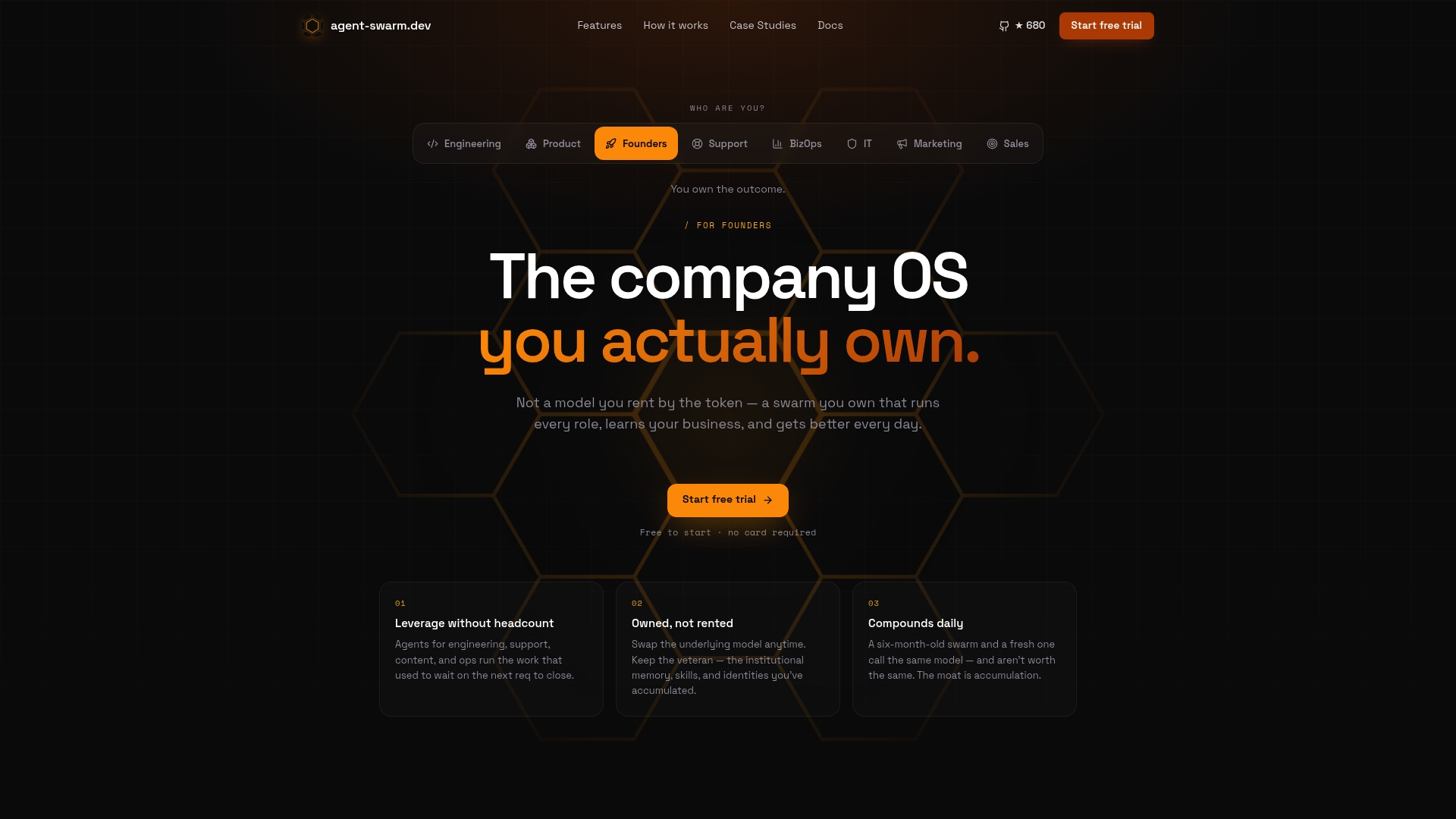
You can self-host the MIT-licensed version for free and keep full control of your infrastructure, with enterprise support available by conversation, with services and scope agreed separately. Either path plugs into Slack, GitHub, Linear, and hundreds of other platforms, so agents pick up tasks and report back without someone manually wiring webhooks. If you're weighing this against a rented AI employee model or a single always-on assistant, the comparison against Devin and the comparison against OpenClaw lay out the trade-offs directly. See how the worker-container pattern plays out with a real customer in the Capchase case study, then browse the example sessions to see the lead-agent and worker pattern running on actual tasks before you commit to an architecture.
Where to Read More on Containerized Agents
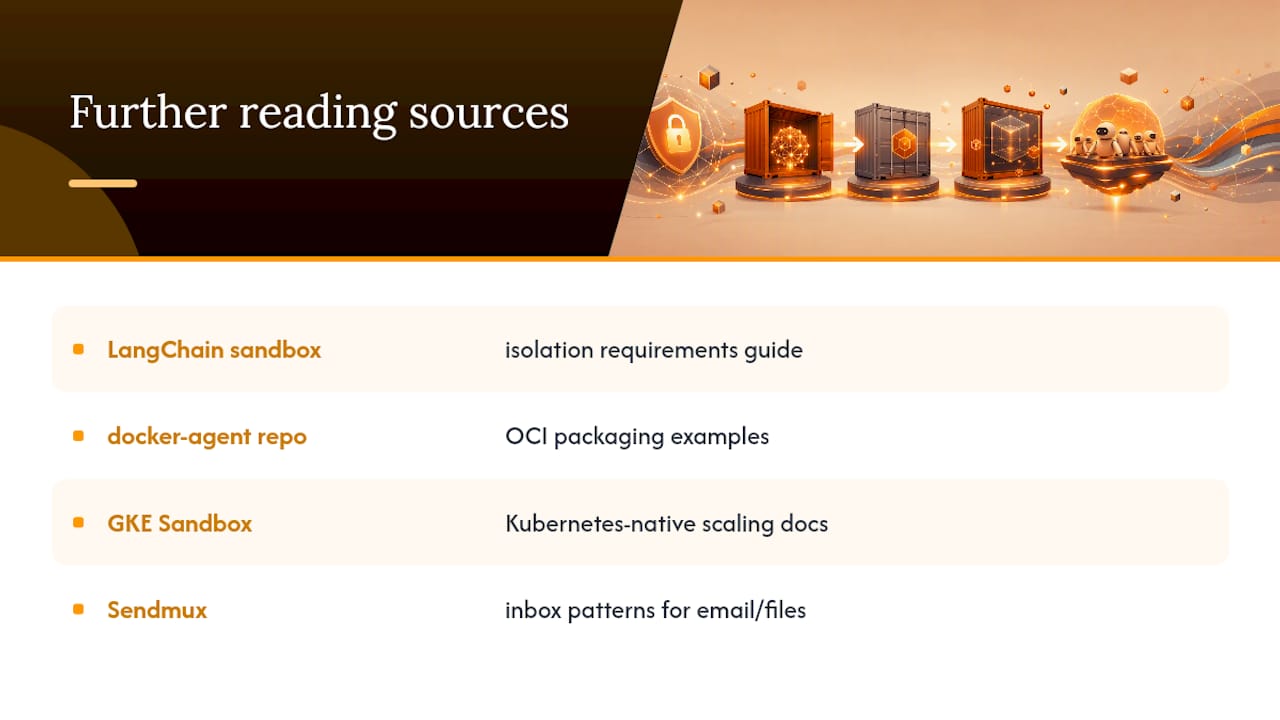
Start with the LangChain sandbox guide for isolation requirements, the docker-agent repo for OCI packaging, and GKE Agent Sandbox docs for Kubernetes-native scaling. For agents handling email or file-based input, Sendmux offers inbox patterns worth reviewing.
Sources
- docker-agent (GitHub)
- OpenAI Agents SDK — sandbox agents (docs)
- How to choose the right sandbox for your agent — LangChain
FAQ
Is Docker still relevant for AI agents in 2026?
Yes. Docker's OCI image format remains the packaging standard, and Docker's own Agent and Sandboxes products show the company building agent-specific tooling directly on top of it rather than being displaced by it.
What Is Docker Agent?
Docker Agent is a declarative framework that lets you define multi-agent teams in YAML and packages those agent configs as portable OCI artifacts for deployment across registries and clusters.
Why Are Some Teams Moving Away From Plain Docker Containers for Agents?
Standard Docker containers share the host kernel, which is an acceptable risk for stateless services but a real concern once an agent executes untrusted or model-generated code. That's driving adoption of microVM-backed runtimes like Firecracker and Kata for higher-risk agent workloads, not abandonment of containers themselves.
What Are the Main Types of AI Agents You'll Containerize?
Common categories include reactive agents, planning agents, tool-using agents, retrieval-augmented agents, multi-agent orchestrators, code-execution agents, and stateful workflow agents. Each carries a different sandboxing need, with code-execution and multi-agent orchestrators demanding the strongest isolation.
Should I Use a Disposable or Reusable Sandbox for My Agent?
Use disposable sandboxes for anything processing untrusted input, and reserve reusable warm-pool instances for repetitive, trusted internal tasks where startup latency matters more than fresh isolation each run.
Recommended
Related field notes
Self Hosted AI Agents With Auditable, Persistent Memory for Engineers
A practical shortlist for engineering teams needing self-hosted AI agents that keep owned, auditable memory. Includes deployment runbooks, security...
How to Avoid Vendor Lock-In for Coding Agents: A Layer-by-Layer Exit Test
Coding-agent lock-in lives in the context layers, not the model. Audit eight layers, run the exit test, and keep memory and traces exportable.
Shared-Context AI Agents: Patterns, Risks, and Setup
What shared-context AI agents are, how shared context differs from memory and private state, the risks, and how to run governed sharing.