Engineers, Avoid the 3 AM Pager With These Camunda Alternatives
Engineer focused Camunda alternatives for durable, agentic workflows. Compare Temporal, Step Functions, Airflow, Inngest, and agent-swarm.

For engineer-owned durable workflows, Temporal and AWS Step Functions lead the code-first field, Apache Airflow still owns batch orchestration, and agent-swarm is the strongest pick when the job is multi-agent orchestration with persistent memory rather than classic BPMN. Camunda still earns its keep when auditors and process owners need to read and change the workflow themselves. Start your shortlist with Temporal, AWS Step Functions, Apache Airflow, and Inngest, then narrow based on who actually owns the workflow.
TL;DR:
- Code-first workflows like Temporal and Inngest are ideal for engineering teams owning end-to-end processes, especially when persistence and reliability are critical.
- Multi-agent orchestration with persistent memory is best served by agent-swarm, designed specifically for running specialized, stateful agents rather than traditional BPMN models.
- Operational costs for self-hosted durable engines can be high due to database tuning, backup, and SRE demands, making managed solutions or lightweight alternatives more attractive for smaller teams.
- Choosing the right tool heavily depends on ownership: whether business analysts need visual workflows or engineers handle code, which influences whether BPMN-based or code-first engines are appropriate.
- Run real pilots with representative workflows, measure recovery time after failures, and ask vendors how they handle worker crashes at 2 AM to estimate true operational costs.
Table of Contents
- Camunda Alternatives Compared Side by Side
- How Do You Choose the Right Camunda Alternative?
- What Each Camunda Alternative Actually Does Well
- What Migrating Off Camunda Actually Costs You
- Why We Built agent-swarm Instead of Another BPMN Layer
- An Engineer's Take on Picking a Camunda Alternative
- Try agent-swarm Before You Rebuild Your Orchestration Stack
- Sources
- FAQ
Camunda Alternatives Compared Side by Side
We built this table the way we'd want it if we were the ones evaluating tools at 11 PM before a sprint planning meeting: modeling approach first, deployment second, license third, because those three variables predict 80% of your future operational headaches.
agent-swarm leads the table because it's the option built specifically for the workload this article's audience is actually solving: multi-agent orchestration with memory that persists across runs, not another BPMN engine wearing an AI wrapper.
| Tool | Persona Fit | Modeling Approach | Deployment | License | Best For |
|---|---|---|---|---|---|
| agent-swarm | Engineering teams running multi-agent workflows | Code/config with persistent agent memory | Self-hosted or cloud | Open-source (MIT), self-hosted free | Stateful agent orchestration and engineering-owned automation |
| Temporal | Backend engineers | Code-first, deterministic replay | Self-hosted or Temporal Cloud | Open-source core, managed cloud paid | Long-running application workflows engineers own end to end |
| AWS Step Functions | AWS-centric teams | Declarative state machines (ASL) | Fully managed (AWS only) | Proprietary, pay-per-use | Serverless workflows already living inside AWS |
| Apache Airflow | Data engineers | Python DAGs | Self-hosted or managed (MWAA, Astronomer) | Apache open-source | Scheduled ETL and batch data pipelines |
| Inngest | App developers | Code-first event functions | Managed cloud, self-host option | Open-source SDK, paid cloud tiers | Event-driven background jobs with low ops overhead |
| Restate | Backend engineers | Code-first durable services | Self-hosted (single binary) or cloud | Open-source | Compact durable services and interactive agent tasks |
| Flowable | Business/process owners | BPMN/DMN | Self-hosted or managed | Open-source core, commercial editions | Teams that still need BPMN and business-user tooling |
| Bonita | Citizen developers | BPMN with low-code layer | Self-hosted or cloud | Open-source community edition, paid enterprise | Business-process apps built with non-engineers involved |
| LangGraph | AI/ML engineers | Graph-based agent state | Self-hosted or LangGraph Platform | Open-source | Stateful AI agent loops with explicit checkpoints |
| Orkes Conductor | Platform/microservice teams | Task-worker JSON DAGs | Self-hosted or Orkes Cloud | Open-source (Conductor OSS), paid cloud | Polyglot microservice task coordination |
| Diagrid Catalyst | Platform engineering teams | Code-first with policy controls | Managed cloud | Proprietary | Governed agent frameworks needing deployment controls |
| Kestra | Infra/data/platform teams | Declarative YAML | Self-hosted or cloud | Open-source | Cross-domain pipelines spanning infra, data, and apps |
The operational-overhead signal worth flagging before you pick a favorite: anything marketed as "self-hosted" that also needs a Cassandra or Postgres cluster with failover tuning is not a weekend install. That's true for Camunda's Zeebe broker and it's true for Temporal's persistence layer. agent-swarm and Restate both trade some of that weight for a smaller footprint, which matters if your team doesn't have a dedicated SRE rotation.
How Do You Choose the Right Camunda Alternative?
The single most useful filter, according to Automation Atlas's comparison of Camunda and Temporal, is ownership: will a business analyst or auditor need to open the workflow and read it, or does an engineer own it end to end and ship changes through code review? That one question eliminates half the field immediately.
Run through this checklist before you commit to a pilot:
- Modeling needs. Does anyone outside engineering need to view or edit the process visually? If yes, BPMN tools (Flowable, Bonita, Camunda itself) stay on the table.
- Audit and compliance. Regulated industries often need a diagram-as-artifact trail. Code-first engines can satisfy this too, but you'll need to generate the audit view yourself.
- Human tasks. If your process pauses for a person to approve or fill a form, check whether the tool has that built in. Apache Airflow, for instance, lacks native human-task and form support because it was never built for that job.
- SDK maturity. Count the languages your team actually writes in against the tool's SDK list. Temporal's growing TypeScript and Python coverage reflects real demand from AI and agent workloads.
- Persistence and storage. Know what database the engine expects and what its retention story looks like before day one, not after your first incident.
- Observability. Ask whether tracing, replay, and history inspection ship out of the box or require bolting on a separate admin console.
- Expected throughput. A tool that handles thousands of executions a day behaves very differently at millions.
- SRE cost. Be honest about who's on call for the persistence layer at 3 AM.
Once you've narrowed to two or three candidates, run a real pilot instead of a spec-sheet comparison. Pick one or two representative workflows, not toy examples, and measure time-to-recover after a forced failure, storage growth over a week of real traffic, cost per execution, and how fast your engineers actually ship changes against it.
Pro Tip: Ask every vendor the same blunt question during evaluation: "What does a failed worker look like at 2 AM, and what do I have to do manually to recover it?" The answer tells you more about real operational cost than any pricing page.
What Each Camunda Alternative Actually Does Well
agent-swarm is built for a different problem than most of this list solves. Rather than modeling a business process as a diagram, it runs a lead agent that breaks an objective into tasks and hands them to specialized workers (Claude Code, Codex, OpenCode, and others) inside isolated containers. The part that matters for engineering teams: memory and context persist across runs, so the swarm doesn't relearn your codebase every session. It integrates with various platforms, and you can self-host it under an MIT license or run it on a cloud tier. Migration note: this isn't a lift-and-shift from Camunda. It's the right move when your bottleneck is recurring engineering, content, or ops work that needs an owned, stateful agent team rather than a modeled business process.
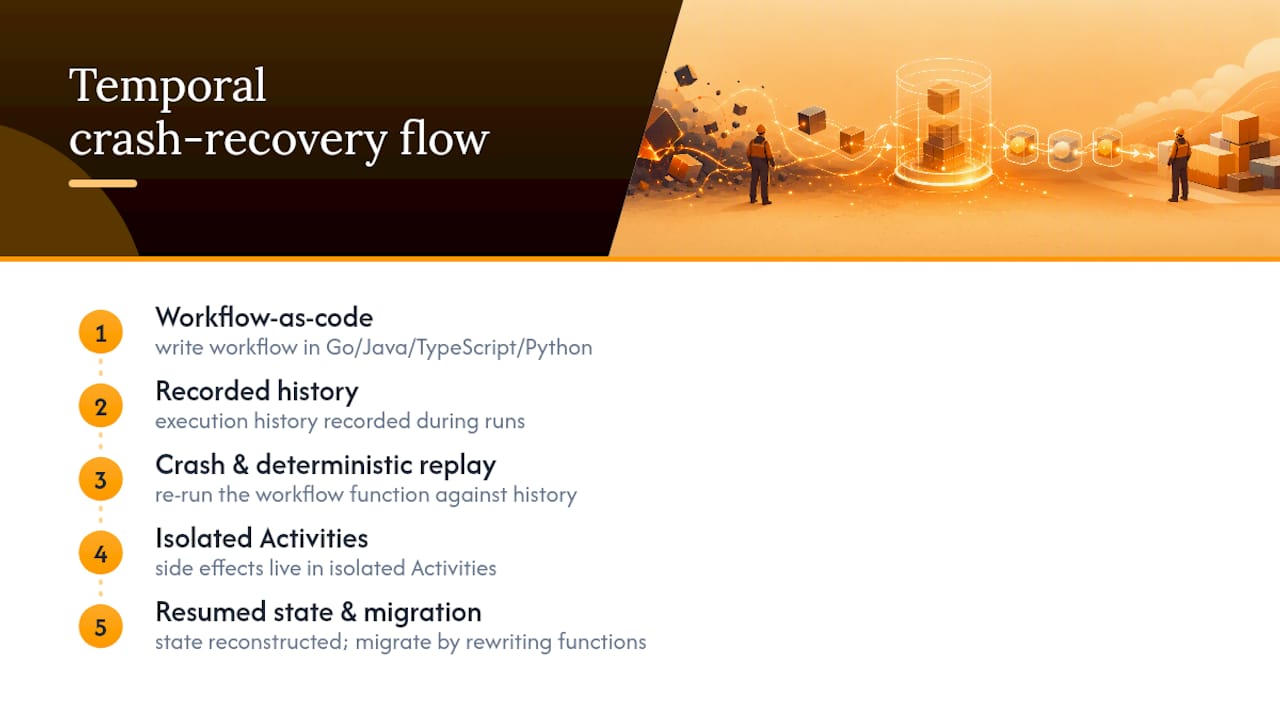
Temporal takes workflows-as-code seriously. You write a workflow in Go, Java, TypeScript, Python, or another supported SDK, and Temporal's deterministic replay reconstructs state after a crash by re-running the workflow function against recorded history. That constraint means side effects must live in isolated Activities, which takes discipline to learn but pays off in reliability. Migration tip: teams moving off Camunda 7 toward Temporal usually rewrite BPMN diagrams as workflow code function by function, not through an automated converter.
AWS Step Functions removes almost all the operational burden if your architecture already lives inside AWS. State machines are defined in Amazon States Language, and teams report faster time-to-production specifically because the ops overhead of running your own cluster disappears. The tradeoff is lock-in: portability outside AWS is limited.
Apache Airflow solves a narrower problem than Camunda ever tried to. It's a task-based DAG scheduler tuned for batch and ETL workloads, not a stateful business-process engine, and it has no native concept of a human task or form. If your "workflow" is really a nightly data pipeline, Airflow is the mature, ecosystem-rich choice. If it's a business process with approval steps, it isn't.
Inngest targets developers who want durable, event-triggered functions without standing up infrastructure. Steps within a function survive retries and crashes, and the operational footprint stays close to zero, which is why smaller teams gravitate toward it over running their own Cassandra-backed cluster.
Restate takes the durable-execution idea and compresses the runtime into a single binary. It's a strong fit for compact services and interactive agent tasks where you want durability guarantees without the cluster-management tax that comes with Temporal or Zeebe.
Flowable and Bonita both keep BPMN at the center. Choose one of these, not a code-first engine, when business users genuinely need to open the diagram and understand (or edit) the process. Bonita adds a low-code layer on top, which helps when citizen developers are building the app around the process.
LangGraph isn't a BPM tool at all; it's a graph-based runtime for stateful AI agents, with explicit checkpoints so an agent loop can pause, resume, and recover. If you're building agent logic in Python and want fine control over state transitions, LangGraph sits closer to your code than a full orchestration platform does.
Orkes Conductor carries the lineage of Netflix's original Conductor project into a polyglot, task-worker model well suited to microservice fleets that need to coordinate across many services and languages.
Diagrid Catalyst adds governance on top of durable agent orchestration, aimed at teams that need policy controls around how agent frameworks get deployed in production, not just how they run.
Kestra goes fully declarative: workflows are defined in YAML, which appeals to platform and infrastructure teams who want orchestration logic that reads like configuration rather than application code, spanning infra, data, and app tasks in one place.
What Migrating Off Camunda Actually Costs You
Two directions dominate real migrations. The conservative path is Camunda 7 to Camunda 8, which keeps BPMN and its audit artifacts intact while moving to the Zeebe engine. The disruptive path is Camunda to a code-first engine like Temporal, which means rewriting diagrams as workflow code and rebuilding your test suite around that code rather than around a modeled diagram.
Either path drags in operational costs that rarely show up in the pitch deck:
- Persistence tuning for Cassandra, Postgres, MySQL, or embedded RocksDB, depending on the engine.
- Retention policies and backup schedules for workflow history.
- An SRE on-call rotation that understands the failure modes of your specific persistence layer.
- Monitoring and replay tooling, since Zeebe's broker model separates execution from user code and needs Operate, Tasklist, and Optimize for admin visibility.
Self-hosting durable engines can cost more in SRE time than a managed tier's fees, which is exactly why smaller teams lean toward Inngest or Restate over running their own cluster. Sometimes the right move isn't replacing Camunda at all. If auditors are happy with the current process model, build a lighter authoring or approval layer on top instead of ripping out the runtime, and many enterprises run Camunda and Temporal side by side, Camunda for human-governed processes, Temporal for backend logic that never needs a business user's eyes on it.
Why We Built agent-swarm Instead of Another BPMN Layer
We didn't set out to compete with Camunda on its own terms. BPMN solves a governance problem: making a process legible to an auditor. Multi-agent orchestration solves a different problem entirely: keeping context and memory alive across dozens of agent runs so a swarm gets better at your codebase instead of starting cold every session.
agent-swarm's lead agent breaks an objective into tasks and routes them to workers running Claude Code, Codex, or OpenCode inside isolated containers, with shared memory that compounds over time. It integrates with Slack, GitHub, Linear, and hundreds of other tools, and you can self-host it under MIT or run it on our cloud tier. For engineering teams drowning in recurring, repeatable work, that persistent context is the entire point.
An Engineer's Take on Picking a Camunda Alternative
Most comparisons in this space are written for a buying committee, not for the person who'll actually be paged when a workflow gets stuck at 2 AM. That's the gap we keep seeing: vendors lead with governance dashboards and compliance checkboxes, but the engineer evaluating the tool wants to know how replay works, what the SDK feels like at 2 AM, and whether recovery from a crashed worker takes one command or an afternoon.
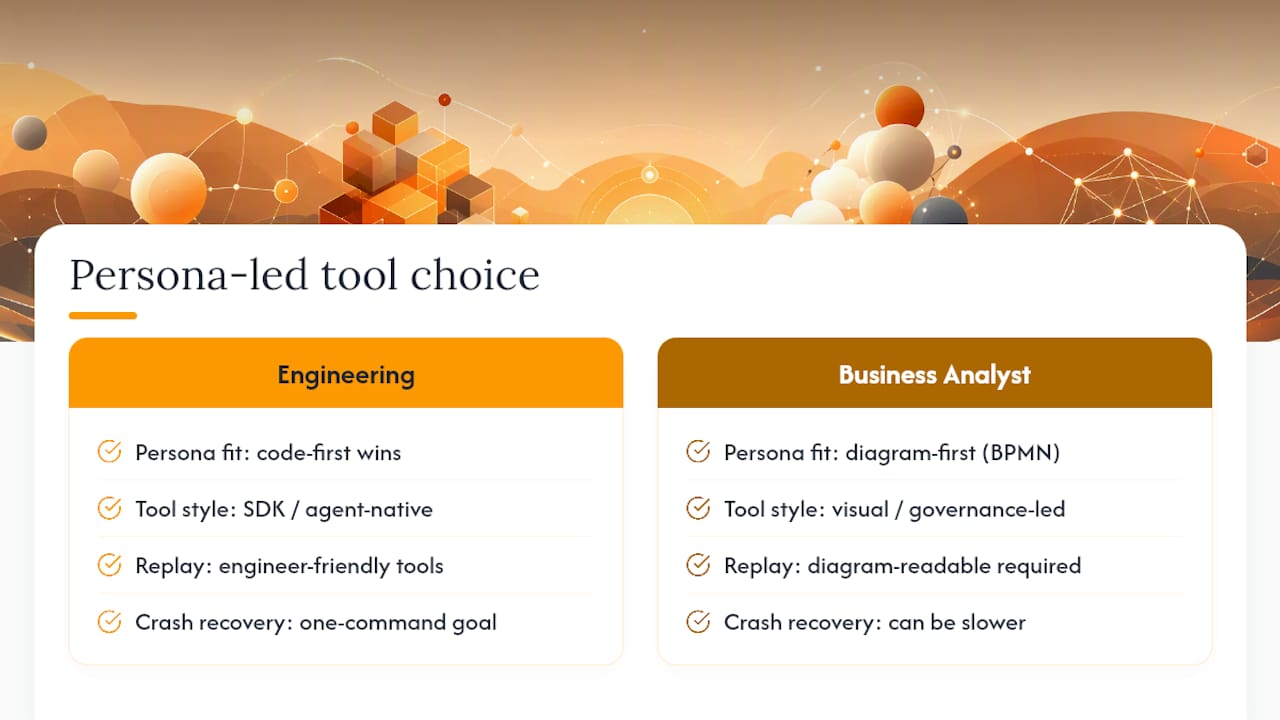
Here's our honest read. Persona fit beats feature lists every time. If a business analyst genuinely needs to read the process diagram, no amount of clever code-first tooling fixes that mismatch, and you should stay closer to BPMN. But if the workflow lives entirely in engineering's hands, and especially if the "workflow" is really a team of agents that needs to remember what it learned last week, the calculus flips hard toward code-first and agent-native tools.
The overrated criterion in most vendor comparisons is raw throughput. The underrated one is what happens the first time a worker crashes mid-task. Ask that question before you ask about pricing tiers.
Try agent-swarm Before You Rebuild Your Orchestration Stack
If you've read this far and recognized your team in the "engineer-owned, agent-heavy, tired-of-relearning-context-every-run" category, agent-swarm is built for exactly that gap. Unlike a BPMN platform that models a process once and executes it the same way forever, agent-swarm's lead agent breaks down objectives, assigns them to specialized workers, and keeps shared memory that compounds across runs, so your swarm gets sharper on your codebase instead of starting from zero every session.
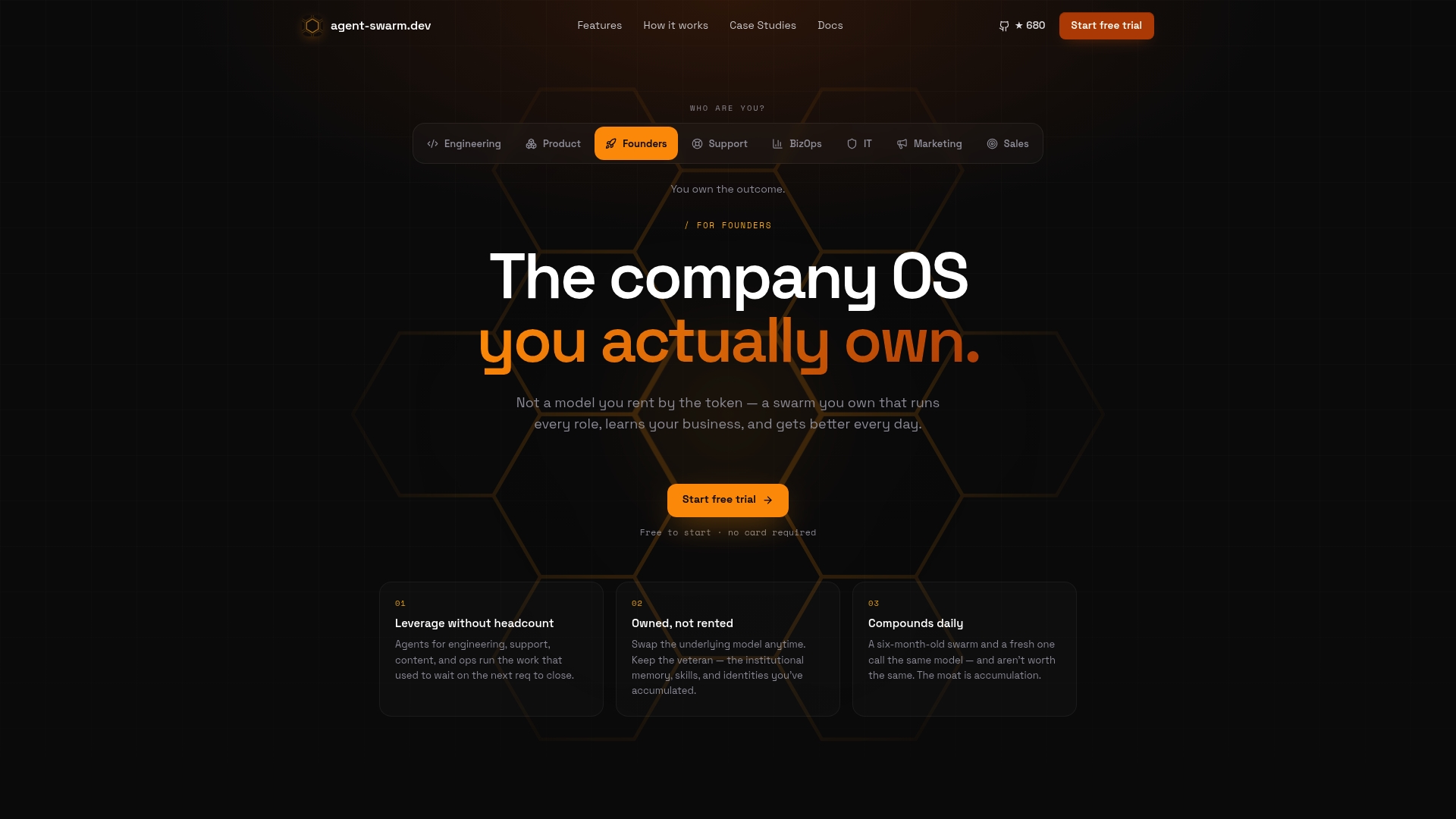
You can self-host the open-source version for free, or start on the Cloud plan at €30 to €100 per month if you'd rather skip standing up your own infrastructure. Enterprise support with tailored integrations is also available. A good first pilot: pick one recurring engineering task your team dreads, wire it into a swarm, and measure how much less human intervention it needs by week two. Browse real agent-swarm sessions to see what that looks like in practice, or check the pricing page to pick your starting tier.
Sources
- Automation Atlas — Camunda vs Temporal 2026
- TrustRadius — Apache Airflow vs Camunda BPM
- Enterprise Software Review — Temporal vs Camunda Cloud vs Step Functions
FAQ
What Are the Best Alternatives to Camunda?
The strongest alternatives depend on who owns the workflow. For engineer-led durable execution, Temporal and AWS Step Functions lead; for data pipelines, Apache Airflow; for multi-agent orchestration with persistent memory, agent-swarm is built specifically for that job.
What Is the Best BPM Software?
There's no single best BPM platform. Flowable and Bonita suit teams that need BPMN and business-user tooling, while Appian, Pega, and ServiceNow serve larger enterprise process portfolios with broader compliance requirements.
Is Camunda 7 End of Life?
Camunda has been steering customers toward Camunda 8 and its Zeebe engine, which changes the persistence model and monitoring stack from Camunda 7. Teams still running Camunda 7 should plan a migration path, either upgrading to Camunda 8 or moving to a code-first engine like Temporal.
What Is the Best Workflow Automation Platform?
The best platform matches your team's ownership model, not a generic ranking. Code-first engines like Temporal fit engineer-owned workflows, AWS Step Functions fits AWS-native serverless stacks, and agent-swarm fits teams automating recurring work with multiple AI agents that need shared memory across runs.
How Much Does agent-swarm Cost?
agent-swarm's Cloud plan runs €30 to €100 per month based on active workers. Self-hosted deployment is open-source and free, and Enterprise pricing is available on request.
Recommended
Related field notes
6 Approval Workflow Features That Prove agent-swarm.dev Fits Engineers
Why agent-swarm.dev suits engineering teams: AI enabled orchestration, persistent workflow memory, and self-hosted or cloud deployment. Learn how to...
Propiedad de datos IA: qué exige la ley al entrenar modelos
Saber qué exige la ley sobre la propiedad de datos en IA: documentar orígenes y base legal, evaluar impacto y cumplir el RGPD al entrenar.
2026 Dev Decision: LlamaIndex vs LangChain and When to Add LangGraph
Developer first 2026 comparison of LlamaIndex and LangChain. Learn when to start with retrieval, add LangGraph agents, or move to a production...