Agentic Workflow Automation: A Practical Engineering Guide
Discover how agentic workflow automation transforms complex tasks with AI, speeding up processes from hours to minutes. Learn more now!

Agentic workflow automation is an AI-driven orchestration layer that lets autonomous agents perceive context, reason over a goal, select and call tools, and loop back to validate results — all without a human scripting each step. The primary outcome is cycle-time compression on complex, multi-step processes: incident response, document triage, and engineering task pipelines that previously required hours of human coordination can complete in minutes. Agentic workflows adapt at runtime rather than follow fixed scripts, which is their core advantage over traditional rule-based automation — and also the source of their primary risks.
Before you commit: The teams that succeed treat governance and observability as first-class requirements from day one, not afterthoughts bolted on after a failed pilot.
Three signals tell you whether you're looking at a real use case:
- Efficiency signal: The task involves ambiguous intermediate steps where a human currently makes judgment calls — routing, synthesis, or multi-system lookups.
- Cost/complexity signal: Compute costs scale with agent reasoning depth; a poorly scoped pilot can burn through LLM budget in days.
- Governance caution: Every agent action must be auditable. If you cannot reconstruct a decision from logs, the workflow is not production-ready.
Key Takeaways
Agentic workflow automation delivers measurable cycle-time compression on judgment-dependent, multi-step processes — but only when governance, observability, and scoped agent identities are built in from the start.
| Point | Details |
|---|---|
| Governance is architecture | Audit trails, credential scoping, and tiered human approvals belong in the orchestration layer, not added after deployment. |
| Six patterns cover most cases | Evaluator-Optimizer, Context-Augmentation, Prompt-Chaining, Parallelization, Routing, and Orchestrator-Workers address the majority of production agentic workflow needs. |
| Hybrid strategy reduces risk | Use deterministic automation for predictable steps and agentic reasoning only where judgment or adaptation is genuinely required. |
| Agent-swarm as a starting point | Agent-swarm provides pre-built orchestration, container isolation, shared memory, and native integrations so teams can pilot without building infrastructure from scratch. |
Table of Contents
- How agentic workflow automation is actually structured
- What design patterns actually work in production
- Where agentic workflows deliver measurable enterprise impact
- How to build and implement an agentic workflow
- Governance, safety, and human-in-the-loop controls
- Operationalizing and scaling agentic workflows
- How Agent-swarm approaches agentic workflow implementation
- The case for patience over speed in agentic adoption
- Agent-swarm gives engineering teams a running start
- Sources
- FAQ
How agentic workflow automation is actually structured
The architecture of a production agentic workflow has seven distinct layers, and conflating them is the most common source of fragility.
Orchestrator (workflow runtime): The orchestrator is the deterministic backbone. It sequences steps, manages state transitions, handles retries, and enforces timeouts. The Hybrid Agentic Workflow spec extends Serverless Workflow DSL with an agentTask type, letting the orchestrator hand off to an agent and resume when the agent returns a result or a generated sub-workflow.
Planner/coordinator agents: These agents receive a high-level goal and decompose it into a task graph. They decide which worker agents to invoke, in what order, and with what context. The planner does not execute tool calls directly.
Worker agents: Specialized agents that execute discrete subtasks — a code-review agent, a data-extraction agent, a summarization agent. Each worker operates within a defined tool scope and credential boundary.
Tool bindings: APIs, function-call interfaces, database queries, and shell commands that agents invoke. Tool schemas must be strict and versioned; output validation at every agent-to-agent boundary prevents downstream agents from trusting unverified results.
Data stores (RAG + vector DBs + knowledge graphs): Retrieval-Augmented Generation connects agents to live knowledge without baking facts into prompts. Vector databases (Pinecone, Weaviate, pgvector) handle semantic search; knowledge graphs handle structured relationship queries.
Credential and identity layer: Each agent gets a scoped identity with least-privilege credentials. A code-review agent should not hold write access to production infrastructure. Secrets managers (HashiCorp Vault, AWS Secrets Manager) handle rotation and injection.
Persistent state and checkpointing: Workflows must survive agent failures. Checkpointing records the last successful step so a resume picks up mid-run rather than restarting from scratch.
The flow sequence: Goal → Plan → Execute (tool calls) → Observe (validate output) → Loop or learn → Terminate or escalate. Deterministic guarantees belong in the orchestrator layer (transactional tool calls, audit log writes). Probabilistic reasoning belongs in the agent layer. Mixing them in the same component is a design error that makes both harder to test and audit.
Pro Tip: When drawing your architecture diagram, mark every component boundary with: (1) the audit log write point, (2) the agent identity, and (3) the circuit breaker. If any of those three are missing from a boundary, the component is not production-ready.
What design patterns actually work in production
Six foundational patterns cover the majority of production agentic workflow implementations, each addressing a specific failure mode.
Evaluator-Optimizer runs a generator agent and a separate critic agent in a loop. The critic scores the output against a rubric and returns feedback; the generator revises until the score meets a threshold or a max-iteration cap fires. Use this for any output where quality variance is high: code generation, legal document drafting, or structured data extraction from noisy sources. The pattern directly reduces hallucination rates by catching errors before they propagate downstream.

Context-Augmentation injects retrieved context (from RAG, a knowledge graph, or a live API) into the agent's prompt before reasoning begins. It keeps prompts lean and facts current without retraining the model. Combine it with Evaluator-Optimizer when the task requires synthesizing retrieved knowledge — the evaluator can verify that the output actually cites the retrieved material.
Prompt-Chaining breaks a complex task into a linear sequence of smaller prompts, each feeding its output as input to the next. The pattern is simple to debug because each step has a discrete, inspectable output. It works well for document pipelines: extract → normalize → classify → summarize. The failure mode is brittleness at handoffs; validate schema at each boundary.
Parallelization fans a task out to multiple agents running concurrently, then aggregates results. Use it when subtasks are independent and latency matters more than cost. A multi-source research task — pulling from three different APIs simultaneously — is the canonical example. Watch for race conditions in shared state and budget for the multiplicative compute cost.
Routing classifies an incoming request and dispatches it to the appropriate specialized agent or workflow branch. It is the pattern that keeps a general-purpose orchestrator from becoming a monolith. A customer intent router that sends billing questions to one agent and technical issues to another is a straightforward instance.
Orchestrator-Workers places a central orchestrator agent above a pool of worker agents. The orchestrator decomposes the goal, assigns subtasks, monitors progress, and synthesizes results. This is the right pattern for business intelligence pipelines, multi-repository code workflows, and cross-system orchestration. The bottleneck risk is real: if the orchestrator agent itself becomes a reasoning bottleneck, the entire workflow stalls.
Model Context Protocol (MCP) and the Serverless Workflow agentTask extensions are the two specs that make these patterns portable across runtimes. MCP standardizes how agents access tools and data sources so you can swap a tool implementation without editing agent logic. The agentTask spec lets an agent generate a runtime workflow definition that the orchestrator then executes — enabling Plan & Execute patterns where the task graph cannot be known at deploy time.
Pro Tip: Externalize your system prompts to a prompt store (a versioned config file, a feature flag system, or a dedicated prompt management tool like LangSmith or PromptLayer). Coupling prompts to agent code means every prompt tweak requires a code deploy — and makes A/B testing agent behavior nearly impossible.
Where agentic workflows deliver measurable enterprise impact
The highest-value use cases share a common profile: they are multi-step, multi-system, judgment-dependent, and currently bottlenecked by human coordination time.
- Incident response automation: An agent monitors alerts, queries runbooks, correlates logs across systems, drafts a root-cause hypothesis, and pages the right on-call engineer with a pre-populated incident ticket. Mean time to resolution (MTTR) is the KPI.
- Document processing and claims: Insurance claims, contract review, and compliance filings involve extraction, classification, cross-referencing, and decision routing. Cycle time per document and manual-handoff rate are the metrics.
- Engineering task automation: PR review, dependency updates, test generation, and issue triage. Engineering throughput (PRs merged per sprint, time-to-first-review) tracks impact.
- Customer intent resolution: Multi-turn intent classification, knowledge base lookup, and response drafting before a human agent ever sees the ticket. Cost per ticket and first-contact resolution rate are the KPIs.
- Cross-system orchestration: Syncing data across CRM, ERP, and ticketing systems based on business events, with conditional logic that rule-based ETL cannot handle. Error rate and data-freshness SLAs are the measures.
A concrete scenario: an engineering team's PR review process averaged four hours from open to first substantive review. After deploying a Context-Augmentation + Evaluator-Optimizer workflow that retrieves relevant codebase context, runs static analysis tools, and drafts a structured review, the first-pass review time dropped to under 20 minutes, with human reviewers focusing only on the flagged high-risk sections.
Do not use agentic workflows for: real-time control systems where deterministic latency guarantees are required, high-compliance financial transactions without mandatory human approval gates, or any process where the cost of an incorrect autonomous action exceeds the cost of a human handoff. The hybrid strategy from Salesforce's decision guide is the right frame: deterministic automation for predictable rule-based steps, agentic reasoning only where judgment or adaptation is genuinely required.
How to build and implement an agentic workflow
A staged approach reduces the risk of an expensive misfire. Here is the order of operations we recommend for a first production pilot.
- Define goal and success criteria. Write a one-sentence goal statement and three measurable KPIs before touching any code. If you cannot define done, the agent cannot either.
- Map deterministic vs. agentic nodes. Draw the workflow and label each node: deterministic (rule-based, scripted) or agentic (requires reasoning). Minimize agentic nodes in the first pilot.
- Select models and tools. Match model capability to task complexity. GPT-4o or Claude 3.5 Sonnet for reasoning-heavy steps; smaller, faster models for classification and routing. Define tool schemas strictly — every parameter typed, every output schema validated.
- Define agent identities and credentials. Each agent gets a named identity in your secrets manager. Scope credentials to the minimum required. Document which agent can call which tool.
- Build RAG and data connectors. Stand up your vector DB, index your knowledge sources, and test retrieval quality before connecting it to an agent. Bad retrieval produces confident wrong answers.
- Instrument observability and audit logs. Use OpenTelemetry to emit trace spans for every agent invocation, tool call, and state transition. Write immutable audit log entries for every decision point. This is not optional for production.
- Implement human-in-loop gates. Define the risk threshold that triggers a human approval request. Use the
agentTaskspec'shumanTaskextension or an equivalent approval workflow in your orchestrator. - Capacity and cost planning. Estimate token consumption per run, multiply by expected run frequency, and set a hard budget cap with an alert at 80%. LLM costs compound fast in looping patterns.
- Staged rollout. Shadow-run the workflow against real inputs for one week before it takes any live actions. Compare outputs to human decisions. Promote to production only after the shadow run meets your KPIs.
For the tech stack: the Hybrid Agentic Workflow spec covers orchestration runtime with agentTask support. Add a vector DB (Pinecone, Weaviate, or pgvector), MCP for tool and context access, OpenTelemetry for tracing, a SIEM (Splunk, Datadog, or Elastic) for audit log aggregation, and a secrets manager for credential injection.
A minimal agentTask YAML block looks like this: the agentTask node names the agent, references its systemPrompt and capabilities (the tool list), and specifies dataStores for RAG access. The orchestrator executes the task, captures the agent's output as a named variable, and passes it to the next workflow node. For Plan & Execute patterns, the agent returns a workflow definition object that the orchestrator validates and runs as a child workflow.
Pro Tip: Write contract tests for every tool schema before you wire it to an agent. A tool that returns an unexpected field shape will silently corrupt downstream agent reasoning — and the failure will look like a model quality problem, not a schema bug.
For content workflows specifically, AI-powered content automation is one of the lower-risk entry points for a first agentic pilot: the failure mode is a bad draft, not a corrupted database.
Governance, safety, and human-in-the-loop controls
Governance belongs in the orchestration layer, not bolted on after the fact. A single orchestration surface that coordinates deterministic steps, agentic reasoning, and human checkpoints is the architecture that keeps decisions reconstructable.
Audit trail requirements:
- Capture the full prompt (including injected context), intermediate reasoning steps, tool selections, tool inputs/outputs, and final agent output for every run.
- Write audit entries to tamper-evident storage (append-only log, WORM-compliant object store).
- Integrate with your SIEM via OpenTelemetry trace hierarchies so security teams can query agent decisions the same way they query application logs.
Safety controls:
- Circuit breakers: if an agent exceeds a call-rate threshold or produces N consecutive low-confidence outputs, halt and escalate.
- Idempotent tool calls: design every tool so that calling it twice with the same input produces the same result and no side effect. This makes retries safe.
- Output validation at agent-to-agent boundaries: never let a downstream agent consume an upstream agent's output without schema validation. OWASP LLM05:2025 (Improper Output Handling) covers the injection and trust-chain risks this addresses.
- Rate limits and timeouts on every agent invocation, not just at the API gateway level.
Human-in-loop patterns:
- Approval gates: High-risk actions (write to production, send external communication, execute financial transaction) require explicit human sign-off before the orchestrator proceeds.
- Verification tasks: A human reviews a sample of agent outputs on a rolling basis, not just when something breaks.
- Escalation rules: Define the conditions that trigger escalation (confidence below threshold, tool call failure count, cost budget exceeded) and the SLA for human response.
Avoid approval fatigue by tiering approvals: low-risk actions run autonomously, medium-risk actions get async notification with a veto window, high-risk actions block until approved. Routing every action through a human approval queue defeats the purpose and trains teams to rubber-stamp requests.
Operationalizing and scaling agentic workflows
Getting a pilot to work is not the same as running it reliably at scale. These are the failure modes we see most often in production.
Common pitfalls:
- Agent sprawl: Teams add new agents for every new task without retiring old ones. The result is an unaudited, overlapping agent population with no clear ownership.
- Brittle context: Prompts that embed facts directly become stale. Externalize facts to RAG; externalize prompts to a prompt store.
- Runaway loops: An agent stuck in a retry loop with no circuit breaker will exhaust your token budget before anyone notices.
- Insufficient checkpointing: A workflow that restarts from step one after a failure at step 47 is not production-ready. Persistent checkpointing is non-negotiable.
- Observability gaps: If you cannot answer "what did the agent decide and why" from logs alone, you cannot debug failures or satisfy an auditor.
- Escalating compute costs: Looping patterns multiply token consumption. A workflow that runs 1,000 times per day at 10,000 tokens per run is 10M tokens daily — budget accordingly.
Production best practices:
- Persistent checkpointing with durable state storage (resume from last successful step, not from the beginning).
- Idempotent tool interfaces across the board.
- Agent-specific circuit breakers with configurable thresholds per agent type.
- Throttling at the orchestrator level, not just at individual tool endpoints.
- Hard cost budgets per workflow run, with alerts at 80% and hard stops at 100%.
For agent density specifically, the node composition and agent density post on the Agent-swarm blog covers when adding more agents helps versus when it creates coordination overhead that slows everything down.
Monitoring SLOs to track: p95 latency per workflow run, cost per run (in tokens and dollars), retry rate per agent, human escalation rate, and audit log completeness (percentage of runs with a full decision trace).
For blue/green rollout of agent behavior changes: treat a prompt update or tool schema change the same way you treat a code deploy. Shadow-run the new behavior against production traffic, compare outputs, and promote only when KPIs hold. The script workflows post covers durable one-off run patterns that work well for canary testing new agent configurations.
How Agent-swarm approaches agentic workflow implementation
Agent-swarm's architecture maps directly onto the component model described above. A lead agent receives the high-level objective and decomposes it into a task graph. Worker agents — running as isolated Docker containers — execute individual subtasks using models like Claude Code, Codex, or OpenCode. The container isolation means a worker agent's tool access is scoped to its container; a compromised or misbehaving worker cannot affect the state of other workers or the orchestrator.

Shared memory and contextual knowledge persist across runs. When a worker completes a task, its output and reasoning are written back to the shared memory store, so subsequent runs on the same project start with accumulated context rather than a blank slate. This compounds over time: a team that has run 50 PR reviews through Agent-swarm has a richer context store than one running its first.
Outcomes reported by engineering teams using Agent-swarm:
- Reduced manual handoffs on recurring engineering tasks (issue triage, dependency updates, test generation).
- Shorter cycle times on multi-step workflows that previously required human coordination across tools.
- Persistent memory that eliminates repeated context-setting for recurring workflow types.
Agent-swarm integrates natively with Slack, GitHub, Linear, and email, so approval gates and escalation notifications land in the tools teams already use. Deployment options cover both self-hosted (MIT open-source, Docker Compose) and cloud-hosted SaaS. The self-hosted path suits engineering teams that need full data residency control; the cloud path suits teams that want to skip infrastructure management.
Real Agent-swarm sessions show the architecture in action across engineering, content, and operations workflows — useful for teams scoping a pilot before committing to implementation.
The case for patience over speed in agentic adoption
The teams that get the most out of agentic workflow automation are not the ones who move fastest. They are the ones who pick the right first workflow: one with a clear goal, a measurable baseline, and a failure mode that is recoverable.
The anti-pattern we see repeatedly is a team that scopes an agentic workflow around a process they do not fully understand themselves. If the human version of the workflow is ad hoc and undocumented, the agentic version will be ad hoc and undocumented at higher speed and cost. Agentic automation amplifies the quality of the underlying process design, for better or worse.
The adoption signal worth waiting for: you have a workflow where the steps are known, the judgment calls are identifiable, the success criteria are measurable, and the cost of an incorrect autonomous action is bounded. That last condition is the one most teams skip. "Bounded failure" means the worst-case autonomous action is recoverable without a production incident or a compliance violation.
For a pilot scope, we recommend: one workflow, one goal statement, three KPIs, a max compute budget of $500 for the first 30 days, human approval required for any action that touches production systems, and a shadow-run period of at least five business days before live execution. If the pilot cannot meet its KPIs within that budget and timeline, the workflow is either too complex for an initial agentic implementation or the goal definition needs tightening.
The governance and observability infrastructure you build for the pilot is not pilot-specific. It is the foundation for every subsequent agentic workflow. Invest in it proportionally.
Agent-swarm gives engineering teams a running start
Most teams spend their first agentic pilot building infrastructure: container orchestration, shared memory, credential scoping, approval routing, and integration connectors. Agent-swarm ships all of that as the baseline.
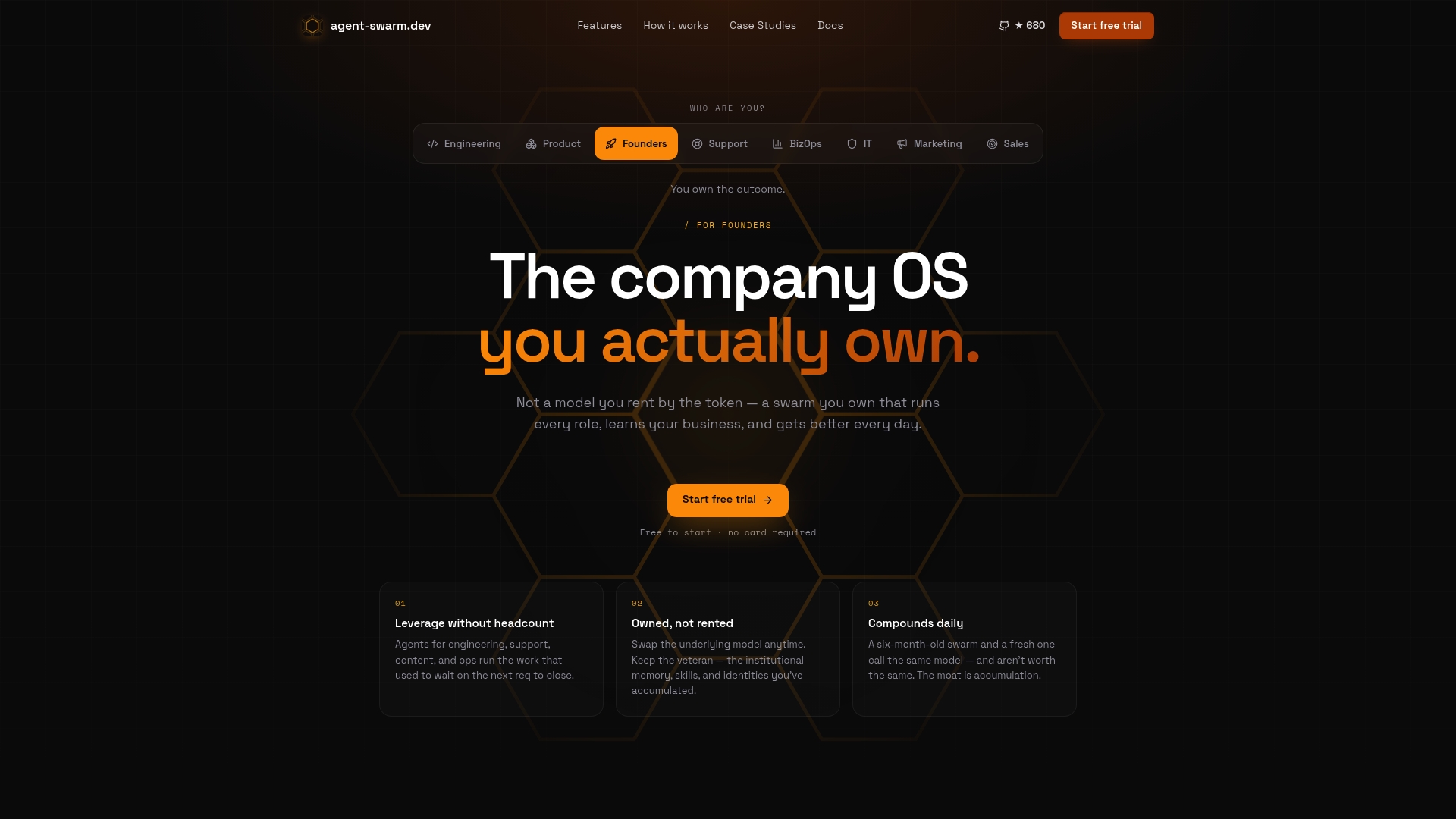
The lead agent decomposes your goal, assigns workers in isolated containers, persists memory across runs, and routes approvals through Slack or email — without you writing orchestration boilerplate. Integrations with GitHub, Linear, and your existing toolchain are pre-built. The MIT open-source version lets you self-host with full data control; the cloud SaaS removes the infrastructure overhead entirely.
Engineering teams at companies up to 500 employees use Agent-swarm to automate PR review, issue triage, dependency management, and cross-tool orchestration. The Capchase case study shows the architecture and outcomes in a real production context. To see the patterns in action before committing, browse real Agent-swarm sessions or check cloud pricing to scope your pilot budget.
Sources
The sources below are the primary references for implementation details, specs, and governance guidance cited throughout this article.
- Design Patterns for Building Agentic Workflows
- Hybrid Agentic Workflow specification (GitHub)
- Agentic workflow automation: governing AI agents inside workflows
- Determining Agentic and Traditional Workflow Automation | Platform Decision Guides | Salesforce Developers
- What are Agentic Workflows? | Databricks Blog
FAQ
What is agentic workflow automation?
Agentic workflow automation is an orchestration architecture where autonomous AI agents perceive context, reason over a goal, call tools, and loop back to validate results without a human scripting each step. Unlike fixed rule-based automation, agents adapt their execution path at runtime based on intermediate outputs.
How does agentic workflow automation differ from traditional RPA?
Traditional RPA follows deterministic, pre-scripted paths and breaks when inputs deviate from expected formats. Agentic workflows handle ambiguity by reasoning over context and selecting the appropriate tool or action dynamically, making them suited for judgment-dependent tasks that RPA cannot handle.
What governance controls are required for production agentic workflows?
Production deployments require tamper-evident audit logs capturing prompts, reasoning, and tool calls; scoped agent credentials with least-privilege access; tiered human approval gates for high-risk actions; circuit breakers; and OpenTelemetry-compatible traces integrated with a SIEM.
Which design pattern should I use for a first agentic workflow pilot?
Prompt-Chaining is the lowest-risk starting pattern: it breaks a complex task into a linear sequence of discrete, inspectable steps. Once the pipeline is stable, add Context-Augmentation to inject RAG-backed knowledge, then layer in Evaluator-Optimizer if output quality variance is a concern.
How does Agent-swarm support agentic workflow implementation?
Agent-swarm provides a pre-built orchestration layer with a lead agent that decomposes goals, worker agents running in isolated Docker containers, persistent shared memory, and native integrations with GitHub, Slack, and Linear. It is available as MIT open-source for self-hosted deployments or as a cloud SaaS with per-worker monthly pricing.
Recommended
- Script Workflows: Durable One-off Runs for Agent Work | agent-swarm.dev
- Your AI Workflow Has Too Many Agents | agent-swarm.dev
- Building a DAG Workflow Engine That Waits: Pause, Resume, and Convergence Gates | agent-swarm.dev
- Why Your AI Agent Needs a Job Description: SOUL.md & Identity Architecture | agent-swarm.dev
Related field notes
Ship to Production: Six n8n Alternatives for Engineering Teams
Engineering-first comparison of six production-ready n8n alternatives for stateful multi-agent orchestration. See which tools offer persistent memory,...
We Rebuilt Linear's “Loops updates” Clip as a Swarm Video in Eight Rounds
Three video models read Linear's motion-design teaser; the two Gemini models called the 3D scene 2D until 7.5s. A frame-by-frame check caught it. The replica is 858 frames of Remotion and three.js, reviewed eight times.
SEO con agentes IA: guía práctica para automatizar sin perder el control
Aprende a automatizar tareas SEO con agentes de IA sin perder el control: define reglas, supervisa aprobaciones y gana tiempo para estrategia.