Two small models triage every PR
Clairic and Jev triage every pull request, and a coding agent reviews only what they flag. About $0.02 and 30 seconds per PR, across 14 real PRs.
Most AI code review sends every pull request to a large model and hopes the bill stays small. We flipped it. Two small models triage every PR first, and a coding agent reads only the parts they flag. A clean PR never reaches the agent at all.
We built it in an afternoon, from stock workflow nodes and scripts.
What it does
Seven nodes. Three of them run at the same time.
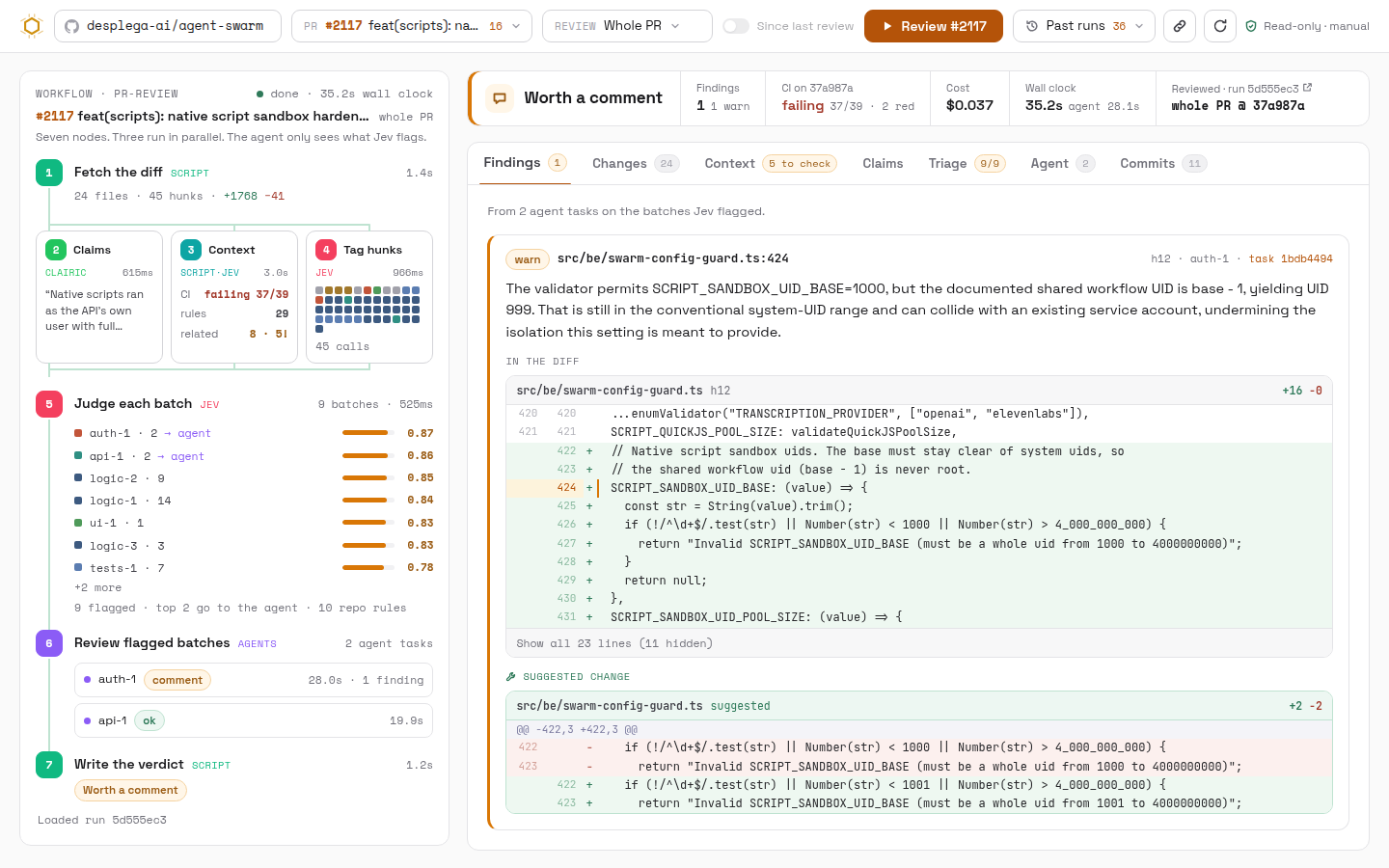
A script fetches the diff for a whole PR or a commit range, and splits it into hunks. Clairic reads the PR description and returns its claims: intent, stated risk, breaking changes, touched areas. Jev ranks the context: CI on the head commit, the repo rules, files that reference the changed modules, and recent PRs on the same paths. It also weighs files that usually change alongside the changed modules. Jev then tags every hunk with a category: tests, api, db, auth, ui, logic, docs.
Hunks group into batches by category, as many as the PR needs, and Jev judges every batch in parallel against the claims and the rules. Only the top flagged batches go to a coding agent (codex on gpt-5.6-luna), at most two per PR. It returns at most three concrete findings, each with a minimal patch. A final script writes the verdict: Looks fine, Worth a comment, or Request changes.
The numbers
We ran it over the 14 open PRs in desplega-ai/agent-swarm on 2026-10-21. Median run: 30 seconds per PR. Total cost: $0.26, about $0.02 per PR.
The split is the point. Jev made 495 decide calls for $0.024. The 24 agent tasks cost $0.24, about 16 seconds each, and they only run on what Jev flags. Verdicts: 2 clean, 4 where Jev flagged and the agent cleared it, 4 worth a comment, 4 request changes.
What a review looks like
PR #2117 touches 24 files: 45 hunks, 9 batches. The top two went to the agent, verdict Worth a comment, $0.037 in 35 seconds. The agent spotted a new uid bound that let the shared workflow uid land at 999, inside the system uid range. It wrote a two-line patch.
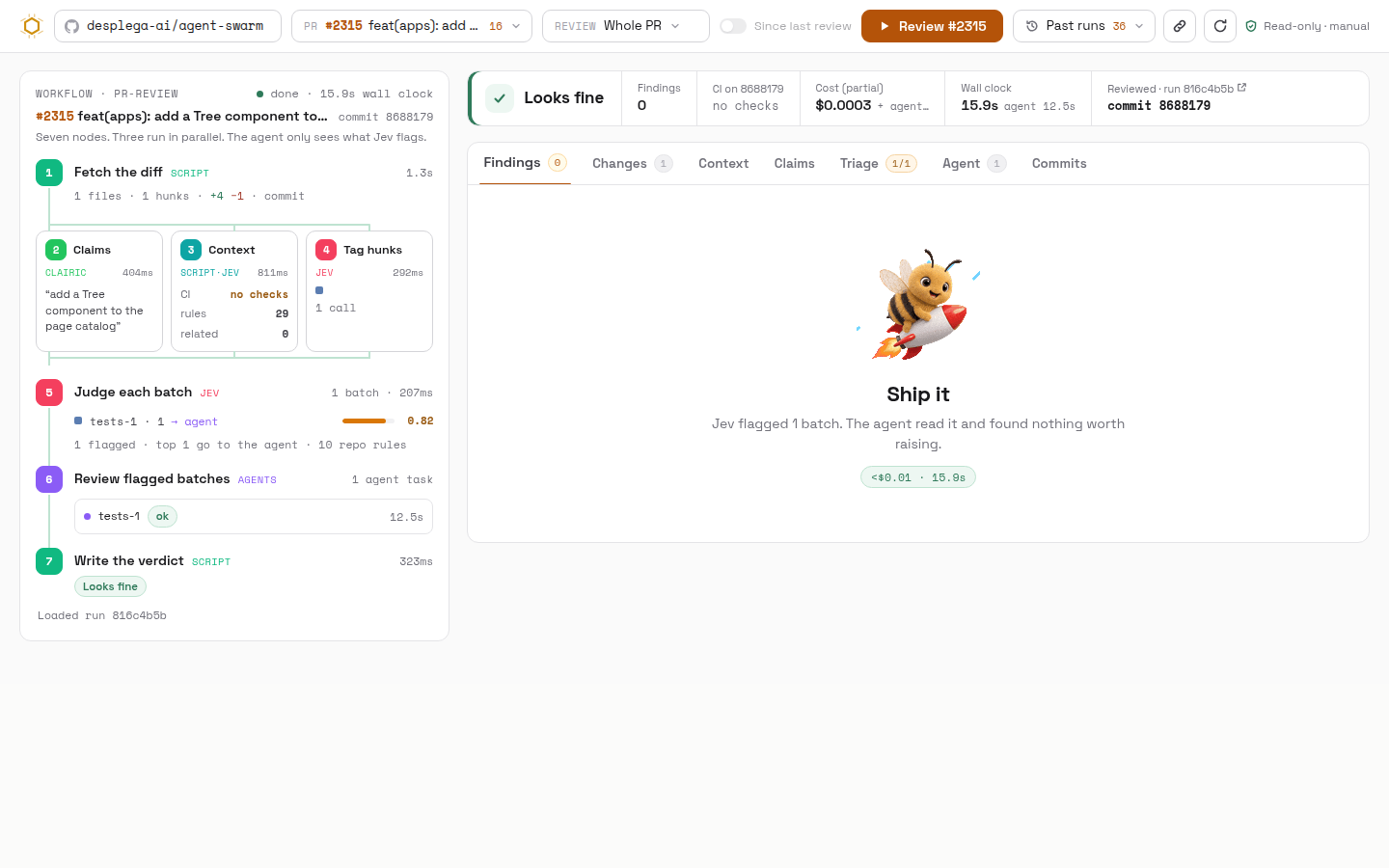
PR #2315 is a one-file commit. One batch, the agent found nothing, verdict Looks fine, under $0.01 in 16 seconds.
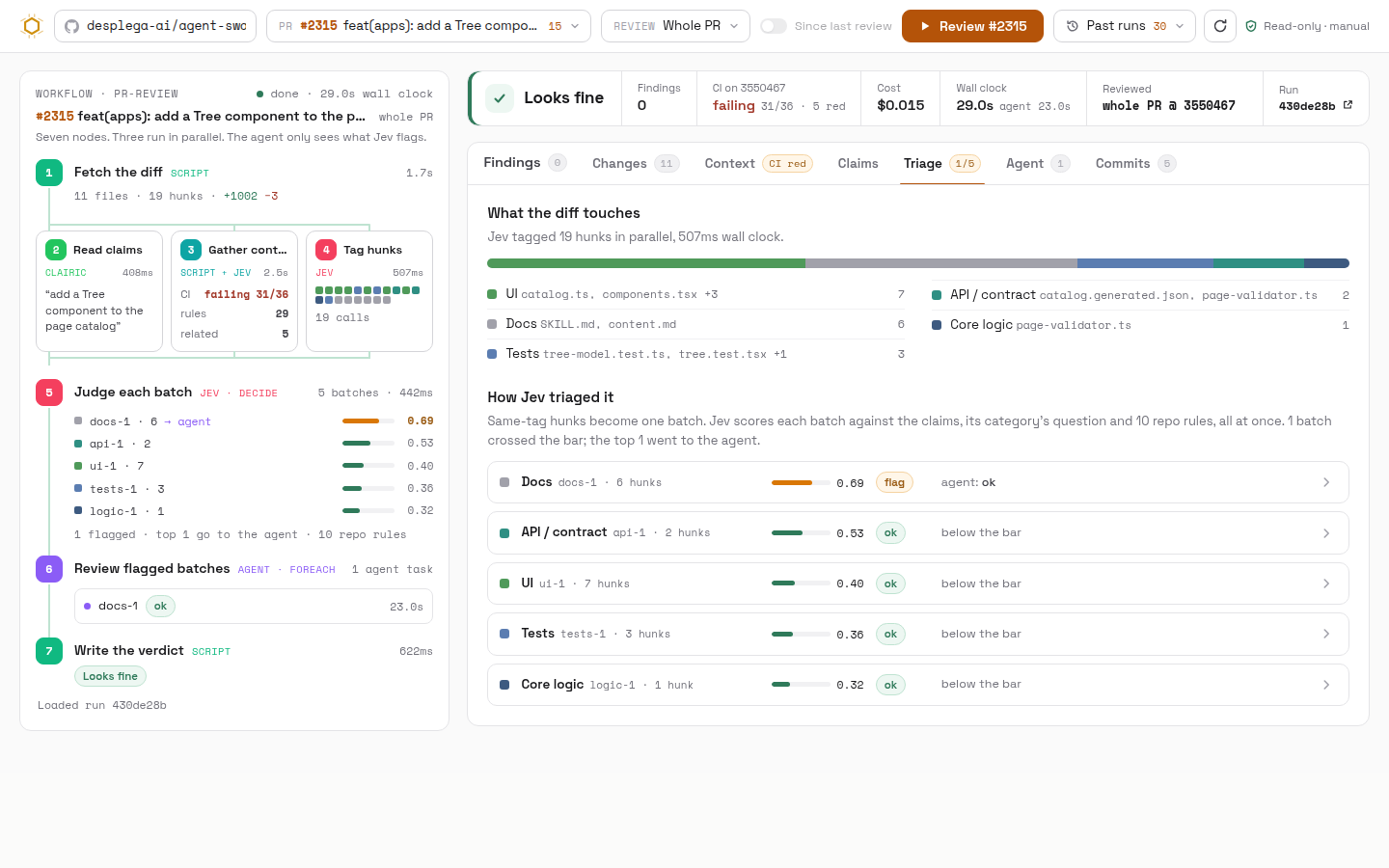
Push a fix and review again: the diff starts at the last reviewed commit, so a new push costs only its own size.
Run it yourself
The workflow ships in the repo, and both executors are open source. The PR review playbook walks through the setup and the node configuration.
The honest limits: findings are unverified model output, the agent sees only its batch, and nothing is posted back to GitHub.
Triage first
Cheap models should read everything. Your coding agent should read what matters. Star agent-swarm, run the workflow on your own repo, and tell us what it misses.
Related field notes
What if Devin is down?
Devin Oncall is one AI on-call vendor. Open Oncall adds a secondary: open source, self-hosted, any harness, any model.
How to Avoid Vendor Lock-In for Coding Agents: A Layer-by-Layer Exit Test
Coding-agent lock-in lives in the context layers, not the model. Audit eight layers, run the exit test, and keep memory and traces exportable.
Shared-Context AI Agents: Patterns, Risks, and Setup
What shared-context AI agents are, how shared context differs from memory and private state, the risks, and how to run governed sharing.