Agent Governance: The Engineering Team's Production OS Guide
Discover how effective agent governance can enhance your multi-agent systems with task orchestration, state management, and security strategies.

Agent governance, as we use the term here, is the OS-level control layer that orchestrates task assignment, enforces per-entity isolation, persists agent state, and gates access through RBAC and audit logging across a multi-agent swarm. The short recommendation: run a single-agent prototype first, then adopt a governed multi-agent OS only when concrete criteria are met. Azure Architecture Center's agent design patterns and the Azure Cloud Adoption Framework reinforce this sequence. Agent-swarm.dev is the open-source OS we recommend for teams ready to make that move.
The minimal governance surface every production deployment must cover:
- Orchestration: task decomposition, routing, and dependency resolution
- State persistence: per-entity event store with replayability
- RBAC and secrets: least-privilege roles, vault-backed credential injection
- Audit logging: immutable event stream for compliance and replay
Pro Tip: Run your first multi-agent workflow inside isolated per-entity Docker workspaces. Context leakage between agents is the most common silent failure in early swarms, and workspace isolation stops it before it compounds.
Key Takeaways
Agent governance requires deterministic routing, per-entity isolation, and audit logging from day one; retrofitting these controls into a live swarm is the most expensive mistake engineering teams make.
| Point | Details |
|---|---|
| Start single-agent | Run a single-agent prototype and measure error rate, latency, and cost before adding agents. |
| Evolve when criteria are met | Adopt a governed multi-agent OS only when security boundaries, parallelism needs, or team ownership justify the overhead. |
| Require deterministic routing | Use deterministic code for all state transitions; reserve LLMs for domain reasoning only. |
| Instrument for replay and cost | Wire OpenTelemetry, event sourcing, and per-run budget caps before the first multi-agent run. |
| Agent-swarm.dev | Provides the full governance OS: per-entity isolation, RBAC, audit logs, and GitHub/Slack integrations out of the box. |
Table of Contents
- What is agent governance and when do you actually need it?
- Core components every governance OS must provide
- Which orchestration pattern fits your workflow?
- How to build a production-ready governance architecture
- How to adopt agent governance without breaking production
- What breaks in production and how to prevent it
- What metrics and traces should you collect?
- How agent-swarm.dev performs in real deployments
- How compliance and regulation shape your governance framework
- Agent governance in practice across industries
- How to scale governance in highly dynamic environments
- What's next for agent governance and orchestration
- The production-first stance on agent governance
- Agent-swarm.dev covers the governance checklist end to end
- Sources
- FAQ
What is agent governance and when do you actually need it?
Start with a single agent unless at least one of these conditions is true:
- The workflow crosses a security or compliance boundary requiring separate credential scopes.
- Two or more independent teams own distinct parts of the pipeline.
- You need more than three to five distinct functions running in parallel.
- The task requires model diversity (e.g., a code-generation model plus a security-audit model).
- Planned growth across domains makes a monolithic agent context window unworkable.
Azure's single-agent vs. multi-agent guidance is explicit: the coordination overhead of a multi-agent system is only justified when those criteria apply. Specialization and parallelism are real advantages, but they come with expanded attack surface, orchestration latency, and harder debugging.
Decision tree (short form):
- Prototype with one agent. Measure error rate, latency, and cost.
- If context window overflows, handoff errors accumulate, or audits require isolation, proceed to step 3.
- Introduce an orchestrator and two to three specialized workers.
- Gate promotion on passing criteria from step 1 (error budget, latency baseline, deterministic replay).
Signals that you've hit the wall with a single agent: escalating context size per run, repeated handoff errors in logs, and audit requirements that demand per-role isolation.
Pro Tip: Don't add agents to fix a prompt problem. Most single-agent failures trace back to ambiguous task definitions, not insufficient parallelism.
Core components every governance OS must provide
Production orchestrators own more than message routing. Azure Architecture Center lists task decomposition, routing, state management, error handling, resource management, and observability as non-negotiable responsibilities. Miss any one of them and you have a prototype, not a production system.
| Component | Purpose | Implementation notes |
|---|---|---|
| Orchestration engine | Task decomposition, routing, dependency resolution | Deterministic code; not LLM-driven |
| State persistence | Per-entity event store, replayability | Redis streams or Postgres event log |
| Per-entity isolation | Scoped filesystems and process sandboxes | Docker per-entity workspace |
| RBAC | Least-privilege role assignment | OPA or native K8s RBAC |
| Secrets management | Vault-backed credential injection | HashiCorp Vault or K8s Secrets |
| Audit logging | Immutable event stream | OpenTelemetry + append-only store |
| Observability | Traces, metrics, dashboards | OpenTelemetry collector + Grafana |
| Human-in-the-loop gates | Approval checkpoints for high-risk actions | Slack approval bots, Linear tickets |
Deterministic routing is the architectural decision that separates recoverable systems from brittle ones. System nodes own state changes and event commits; agents run in scoped sessions and emit events that system nodes validate. That model makes runs replayable and auditable without re-running LLM inference.
Integration touchpoints to wire in from day one: GitHub PR triggers, Slack and Linear alerts, OpenTelemetry spans on every agent handoff, and an MCP-compatible tool registry for shared tool access. For deployment, self-hosted (open-source, full control, compliance-friendly) vs. cloud SaaS (faster onboarding, managed infra) is a genuine trade-off. Teams with strict data-residency requirements should default to self-hosted.
Which orchestration pattern fits your workflow?
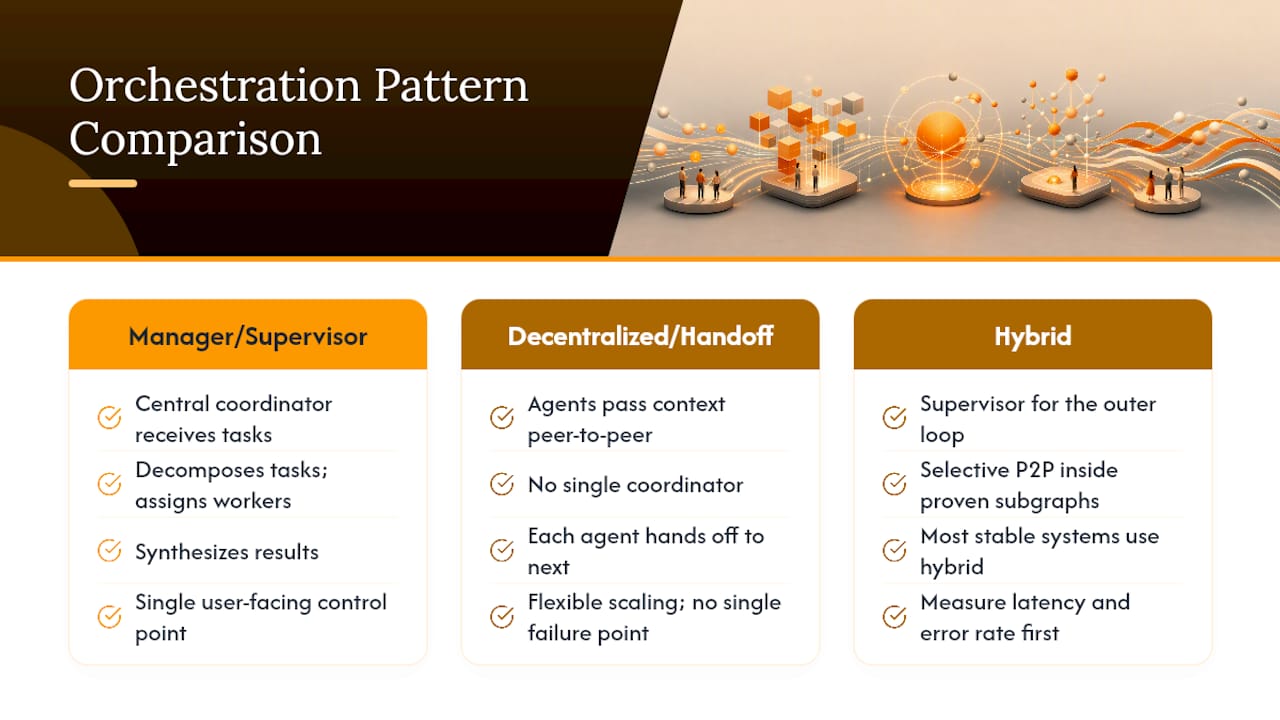
Two primary topologies dominate production swarms: manager/supervisor and decentralized/handoff.
Manager/supervisor: A central coordinator receives the task, decomposes it, assigns subtasks to workers, and synthesizes results. Single user-facing control point, easier auditing, and straightforward replay. The cost is a bottleneck at the coordinator and added latency on every round-trip. Use this pattern for early production deployments and any workflow where a single audit trail matters.
Decentralized/handoff: Agents pass context peer-to-peer along a defined sequence or graph. No single coordinator; each agent hands off to the next when its subtask completes. More flexible scaling and no single point of logic failure, but debugging a stuck handoff is significantly harder, and termination conditions must be explicit or you risk infinite loops.
Production experience shows most stable systems use hybrid patterns: a supervisor for the outer loop, with selective peer-to-peer handoffs inside proven, high-throughput subgraphs.
Pro Tip: Start every new workflow with a manager pattern. Move specific subgraphs to decentralized handoff only after you've measured their latency and error rate under the supervisor and confirmed the handoff logic is deterministic.
How to build a production-ready governance architecture
A minimal production architecture: containerized agents (Docker or K8s pods), an orchestrator runtime, a persistent event store, per-entity workspaces, a secrets store, an RBAC layer, and an OpenTelemetry pipeline.
Deployment checklist:
- Deploy K8s with per-entity pods; assign resource limits per agent role.
- Attach persistent storage (Redis streams or Postgres) for event sourcing.
- Configure RBAC: one role per agent type, least-privilege by default.
- Inject secrets via vault; never pass credentials through environment variables in shared namespaces.
- Enable audit logging on every state transition; write to an append-only store.
- Instrument OpenTelemetry spans on agent handoffs, tool calls, and LLM invocations.
- Set SLOs: max end-to-end latency, per-run budget cap, and error-rate threshold.
- Wire CI triggers (GitHub Actions), Slack/Linear alerts, and MCP tool registry.
- Run replay tests against the event store before promoting to production.
- Complete a threat-model sign-off covering prompt injection, credential leakage, and privilege escalation.
For the backplane, Redis streams give you ordered, replayable event delivery with consumer groups. An event bus (Kafka or a managed equivalent) fits higher-throughput multi-tenant deployments. Put deterministic routing logic in system nodes, not in LLM prompts. LLMs decide what to do; system nodes decide where the result goes and whether to commit it.
Pro Tip: Use a shared RAG retrieval layer to keep each agent's context window small. Sending full project state to every model invocation is the fastest way to blow your token budget and degrade response quality simultaneously.
How to adopt agent governance without breaking production
A four-step playbook that keeps risk bounded at each stage:
- Prototype single-agent. Pick one recurring workflow. Instrument cost, latency, and error rate. Set a baseline.
- Evaluate limits. After two to four weeks, review: context overflow, handoff errors, audit gaps, or parallelism bottlenecks. If none appear, stay single-agent.
- Introduce orchestrator plus two to three agents. Wire RBAC, secrets, and audit logging before the first multi-agent run. Start small — two agents and an orchestrator is a stable, debuggable starting point.
- Harden and scale. Add per-agent least-privilege manifests, budget emergency states, deterministic routing manifests, and human-in-the-loop approval gates. Expand agent count only after step 3 is stable for two weeks.
Role responsibilities: SRE owns infra, secrets, and SLOs. Product owns task definitions and human-approval criteria. Security reviews threat models at steps 3 and 4. Compliance signs off on audit log retention and access controls.
What breaks in production and how to prevent it
The five failure modes that hit most teams, and the mitigations that actually work:
- Deadlocks: Two agents waiting on each other's output. Mitigation: per-agent timeouts with explicit fallback paths; never let an agent block indefinitely.
- Cascading failures: One agent's error propagates through the swarm. Mitigation: circuit breakers at the orchestrator; isolate failing agents and route around them.
- Context leakage: Agent A reads state from Agent B's workspace. Mitigation: per-entity Docker workspaces; no shared filesystems between agent roles.
- Runaway cost: An agentic loop calls an LLM endpoint without a termination condition. Mitigation: per-run budget caps enforced at the orchestrator, not inside the agent.
- Termination failures: A decentralized handoff never reaches a terminal state. Mitigation: explicit termination conditions in routing manifests; max-hop limits.
For security-specific failures: inject credentials only via vault at runtime, never in prompts. Validate all tool-call inputs against a schema before execution to block prompt-injection attempts. Review the agent coordination anti-patterns catalog for the full list of failure topologies.
Pro Tip: Build a chaos test that kills a random worker mid-run and validates that the orchestrator replays from the last committed event. If replay fails, your event store isn't the source of truth yet.
Testing checklist: inject partial failures, simulate stuck agents, validate replay from arbitrary checkpoints, fuzz handoff payloads, and run a privilege-escalation probe against your RBAC configuration.
What metrics and traces should you collect?
Prioritize these signals, in order:
- End-to-end run latency (P50, P95, P99)
- Per-agent API call count and token consumption per run
- Task completion rate and replay success rate
- Error rate by agent role
- Budget consumption vs. cap per run
- Event-store lag (how far behind the consumer group is)
- Audit event throughput
OpenSwarm's local-first experiments report orchestration bus overhead below 3ms, with LLM inference accounting for the dominant share of end-to-end latency. That ratio holds in most production deployments: optimize LLM call count and token usage, not the orchestration bus.
| Metric | Alert threshold | Action |
|---|---|---|
| Error rate | >5% over 10 minutes | Page on-call; pause new runs |
| Replay failures | >3 per hour | Trigger rollback; inspect event store |
| Budget consumption | >80% of cap mid-run | Notify; budget halts run |
| Event-store lag | > few seconds | Scale consumer group |
Dashboard widgets worth building: per-run timeline (Gantt-style), per-agent cost breakdown, event-store consumer lag, and a live audit event stream. Wire all spans through OpenTelemetry and surface per-entity traces so you can isolate a single agent's behavior within a multi-agent run.
How agent-swarm.dev performs in real deployments
Agent-swarm.dev runs persistent per-entity flows, drives PR automation, and reduces manual triage across repeating engineering tasks. The swarm metrics post documents 242 PRs across 80 days with a six-agent swarm, a concrete signal of what sustained, governed automation looks like at a small team scale.
Operational integration points: GitHub PR triggers fire agent runs on new issues or review requests; Slack surfaces approval gates and run summaries; Linear receives task status updates automatically. Per-entity isolation and event sourcing mean every run is auditable and replayable without re-invoking LLMs.
How compliance and regulation shape your governance framework
Regulatory pressure on multi-agent systems is increasing. The EU AI Act's transparency and human-oversight requirements apply to high-risk automated decision systems, and US federal guidance (NIST AI RMF) emphasizes accountability, traceability, and auditability for AI deployments. Both frameworks map directly to the governance components covered above: audit logs satisfy traceability, RBAC satisfies accountability, and human-in-the-loop gates satisfy oversight.
For teams in regulated industries (finance, healthcare, defense contracting), add data-residency controls to the deployment checklist: confirm your event store and secrets vault are hosted in the required jurisdiction, and document retention periods for audit logs. SOC 2 Type II audits increasingly ask for evidence of per-agent access controls and immutable event trails.
Agent governance in practice across industries
Software engineering teams use governed swarms to automate PR review, dependency updates, and security scanning. A typical topology: a manager agent decomposes an incoming GitHub issue, routes to a code-generation worker and a security-audit worker in parallel, and merges results before opening a PR. The audit log captures every tool call and state transition.
Growth and content operations teams run agent swarms for content generation, SEO auditing, and distribution. Per-entity isolation keeps each content project's context separate; human-in-the-loop gates hold drafts for editorial review before publication.
DevOps and SRE teams deploy agent swarms for incident triage: an orchestrator routes alert payloads to diagnostic agents, aggregates findings, and pages a human only when confidence in the automated diagnosis falls below a threshold. Budget caps prevent runaway LLM calls during high-alert-volume incidents.
How to scale governance in highly dynamic environments
Dynamic environments (high agent churn, variable workload, frequent topology changes) require a few specific design choices beyond the baseline checklist.
Use a node composition approach that keeps agent count low and role definitions narrow. Scaling by adding agents without narrowing roles produces context bloat and debugging complexity faster than it produces throughput gains. Prefer horizontal scaling of proven worker types over introducing new agent roles.
Event sourcing is your scaling safety net: because every state transition is committed before the next step executes, you can scale consumer groups independently of producer throughput. Redis streams with consumer groups handle this well up to moderate scale; Kafka fits higher-throughput multi-tenant deployments.
For topology changes, use feature flags on routing manifests rather than redeploying the orchestrator. That lets you A/B test a new agent role against the existing topology without a full rollout.
What's next for agent governance and orchestration
The Model Context Protocol (MCP) is becoming the standard interface for tool and context sharing across agent runtimes. Teams that build MCP-compatible tool registries now will have portable, interoperable tooling as the ecosystem matures.
AI-driven orchestration, where a meta-agent dynamically adjusts routing and agent assignment based on observed performance, is an active research area. In production today, it introduces non-determinism at the control layer, which conflicts directly with the replay and auditability requirements covered above. We'd treat it as experimental until deterministic fallback paths are standardized.
Persistent memory architectures (vector stores per entity, compressing long-horizon context) are maturing quickly. The practical near-term win is using a shared retrieval layer to keep per-agent context windows focused, rather than front-loading full project state into every invocation.
The production-first stance on agent governance
Governance isn't a feature you add after the swarm is running. It's the OS layer you build first, because retrofitting RBAC, audit logging, and deterministic routing into a live multi-agent system is significantly harder than starting with them. We've seen teams skip the single-agent prototype step, wire up five agents, and spend weeks debugging non-deterministic failures that a two-week single-agent experiment would have surfaced in days.
The practical recommendation: SRE and product must co-own governance from sprint one. SRE owns the infra contracts (SLOs, secrets, event store). Product owns the task definitions and approval criteria. Neither can do it alone, and the handoff between them is exactly where governance gaps appear.
Agent-swarm.dev covers the governance checklist end to end
Skip the months of glue code. Agent-swarm.dev ships the OS-level features this article describes: deterministic routing, per-entity persistence, RBAC, vault-backed secrets, immutable audit logs, and native integrations with GitHub, Slack, and Linear. Workers run in isolated Docker containers; event sourcing is built in, not bolted on.
The real session examples show what governed multi-agent automation looks like at production scale: 242 PRs, six agents, 80 days, with a full audit trail. Self-hosted (MIT license, free) or cloud-hosted (7-day free trial, then monthly by active worker count). Teams that need the governance checklist covered without building the plumbing from scratch should start the cloud trial or clone the repo today.
Sources
FAQ
What is agent governance in a multi-agent system?
Agent governance is the OS-level control layer that handles orchestration, per-entity isolation, RBAC, secrets management, and audit logging for a multi-agent swarm. It's what separates a production deployment from a prototype.
When should a team move from single-agent to multi-agent?
Move to multi-agent when the workflow crosses a security boundary, requires parallel execution across distinct functions, or involves multiple team ownership domains. Otherwise, a single-agent prototype is faster and cheaper to operate.
What orchestration pattern works best for early production deployments?
The manager/supervisor pattern is the safer starting point: one coordinator decomposes tasks, assigns workers, and synthesizes results, giving you a single audit trail and a predictable failure surface.
How does Agent-swarm handle deterministic routing?
Agent-swarm uses system nodes to own state transitions and event commits, keeping LLMs responsible for reasoning only. That separation makes runs replayable and auditable without re-invoking inference.
What metrics matter most for a governed agent swarm?
Prioritize end-to-end run latency (P95), per-run token consumption, task completion rate, replay success rate, and budget consumption vs. cap.
Recommended
Related field notes
We Rebuilt Linear's “Loops updates” Clip as a Swarm Video in Eight Rounds
Three video models read Linear's motion-design teaser; the two Gemini models called the 3D scene 2D until 7.5s. A frame-by-frame check caught it. The replica is 858 frames of Remotion and three.js, reviewed eight times.
SEO con agentes IA: guía práctica para automatizar sin perder el control
Aprende a automatizar tareas SEO con agentes de IA sin perder el control: define reglas, supervisa aprobaciones y gana tiempo para estrategia.
Pick Best AI Workflow Automation That Preserves Memory for Engineers
Engineering first guide to AI workflow automation: pilot plan to prove ROI and why agent-swarm.dev fits teams needing persistent memory.