Human-in-the-Loop AI: A Practitioner's Guide
Discover how human-in-the-loop AI combines human insight with machine learning to enhance accuracy, compliance, and decision-making.

Human-in-the-loop (HITL) AI is a design pattern where human judgment is embedded at one or more stages of a machine learning pipeline, whether during training, inference, or evaluation, so the system can handle cases the model alone cannot resolve reliably. Stanford HAI frames this as humans being "in charge" while AI remains a supportive part of the loop, preserving evaluative authority rather than delegating it entirely. Choose HITL when the cost of an uncorrected model error is high, when ground truth is ambiguous or norm-sensitive, or when a regulator requires an auditable human decision point.
Three practical triggers that make HITL the right call:
- Edge-case frequency is above your error budget. If your model often encounters out-of-distribution inputs, human review is cheaper than the downstream cost of silent failures.
- Regulatory or liability requirements mandate a human decision. FDA clearance pathways for AI-assisted diagnostics, EEOC guidance on automated hiring tools, and EU AI Act high-risk classifications all require documented human oversight.
- The cost of a wrong prediction is asymmetric. A false negative in fraud detection or medical triage carries far more cost than the labor of a human review queue.
Key Takeaways
Human-in-the-loop AI delivers the most value when human judgment is applied at task boundaries with full context, explicit authority, and a fast, rationale-driven review interface, not distributed across every model call.
| Point | Details |
|---|---|
| Apply HITL selectively | Route human review to high-uncertainty, high-cost, or regulation-mandated decisions; full coverage wastes labor without improving safety. |
| Track human cost per decision | This metric identifies the inflection point where additional human review no longer justifies its labor spend. |
| Oversight illusion is a real risk | Reviewers without domain expertise or override authority provide compliance theater, not safety. |
| Task-boundary review scales | In agentic systems, human approval at worker handoffs is tractable; per-token review is not. |
| Agent-swarm for HITL orchestration | Agent-swarm's lead-agent architecture and shared context logs place human oversight at task boundaries with full provenance. |
Table of Contents
- How humans join the ML lifecycle in practice
- What HITL system architectures actually look like
- Why HITL matters and where it's applied
- Design principles that make HITL workflows reliable
- Challenges and risks you need to plan for
- What tooling categories do you actually need?
- What recent research says about agentic HITL and collaboration layers
- How do you choose between HITL, human-on-the-loop, and full automation?
- Our take on strategic delegation and HITL
- Agent-swarm puts human oversight where it belongs
- Sources
- FAQ
How humans join the ML lifecycle in practice
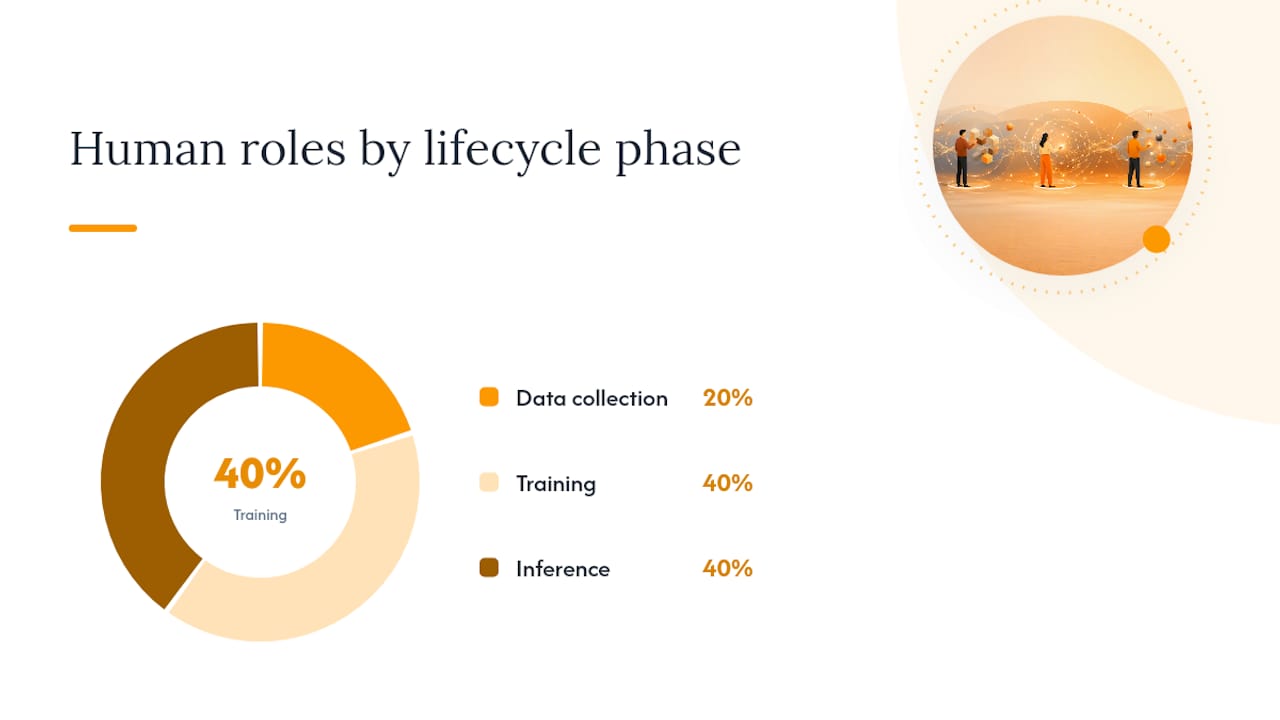
The core HITL mechanisms are data labeling, active learning, reinforcement learning from human feedback (RLHF), verification queues, and human approval gates. Each one maps to a distinct phase of the ML lifecycle.
Data labeling sits at the data-collection phase. Annotators assign ground-truth labels to raw examples, and the quality of those labels directly bounds model ceiling performance. Active learning runs during training: the model queries a human oracle for labels on the examples where its own uncertainty is highest, rather than labeling uniformly at random. Active learning with targeted human annotation yields faster error reduction per label than naive sampling, which matters when annotation budgets are tight.
RLHF (reinforcement learning from human feedback) is the mechanism behind instruction-tuned large language models. Human raters compare model outputs and assign preference scores; those scores train a reward model that shapes subsequent policy updates. The feedback loop runs continuously, not just at initial training.
Verification queues operate at inference time. The model processes a request, attaches a confidence score, and routes low-confidence outputs to a human reviewer before the result is returned to the end user. Human approval gates are a stricter variant: certain action classes (sending an email, executing a financial transaction, modifying a production database) require explicit human sign-off regardless of model confidence.
A practical implementation pattern for each:
- Labeling UI: A task-specific annotation interface (bounding box, span selection, classification radio buttons) with keyboard shortcuts, inter-annotator agreement tracking, and a reject/flag option for ambiguous items.
- Review queue: An API endpoint that accepts model outputs with confidence metadata, routes items below a threshold to a human dashboard, and returns the human decision as a labeled record for retraining.
- Human fallback API: A webhook or message-queue consumer that escalates to a human agent when the model's output fails a post-processing validation rule (e.g., a structured output schema check).
Providing high-level, human-readable rationales and confidence signals at each of these touchpoints consistently outperforms exposing raw model internals. Reviewers make faster, more accurate decisions when they see "confidence: 0.61, reason: ambiguous pronoun reference" than when they see a raw attention heatmap.
Pro Tip: In production, sample your review queue probabilistically rather than routing every low-confidence item. A stratified sample across confidence deciles gives you a representative signal for retraining without creating a human-review bottleneck that stalls your pipeline.
What HITL system architectures actually look like
The four canonical patterns, mapped to risk profile and throughput:
- Annotation pipeline: Humans label raw data before any model training. Throughput is low, quality ceiling is high. Used when ground truth requires expert judgment (radiology reads, legal clause classification).
- Human-in-the-loop at inference: The model runs, attaches uncertainty metadata, and routes uncertain outputs to a human queue before the result is committed. Latency increases by the human review time; accuracy on the routed subset approaches human-level.
- Human-in-the-loop for evaluation: Humans score model outputs periodically (A/B preference tests, red-team sessions, audit samples) without being in the live request path. Latency is unaffected; feedback is batched into retraining cycles.
- Human-on-the-loop: The model acts autonomously, but a human monitor watches a dashboard of outputs and can intervene or roll back. Intervention is reactive, not proactive.
- Human-behind-the-loop: Humans set policy, configure thresholds, and review aggregate metrics, but never touch individual decisions. Suitable for mature, well-calibrated models in lower-risk domains.
- Human-above-the-loop: Governance-level oversight. Humans define the objective function, audit the system periodically, and hold accountability. No per-decision involvement.
Orchestration and persistent memory change which pattern is viable. When a lead agent decomposes an objective into subtasks and assigns them to containerized workers, each with access to a shared context log, the human oversight surface shifts from individual model calls to task-level checkpoints. Task decomposition into specialized worker containers with shared memory improves throughput while preserving oversight pathways, because a human reviewer can approve or reject a task output at the boundary between workers rather than reviewing every intermediate token.
When documenting a HITL system architecture, your diagram should include:
- Data sources (raw inputs, external APIs, streaming feeds)
- Orchestration layer (task router, confidence thresholds, queue manager)
- Human roles (annotator, reviewer, overseer, policy setter) with explicit authority boundaries
- Latency surface (where human review adds wall-clock time and what the SLA is for each role)
- Feedback path (how human decisions flow back into retraining or threshold adjustment)
A collaboration layer sitting between user workspaces and AI tools unifies context across agents, enables proactive support, and manages memory, which is what makes the human-on-the-loop pattern tractable at scale rather than a theoretical ideal.
Why HITL matters and where it's applied
The immediate benefits are accuracy on hard cases, safety in high-stakes domains, norm alignment (the model learns what "correct" means in your specific context), edge-case coverage, and auditability. That last one is underappreciated: a human-reviewed decision leaves a provenance record that a fully automated decision does not.
Concrete domain examples:
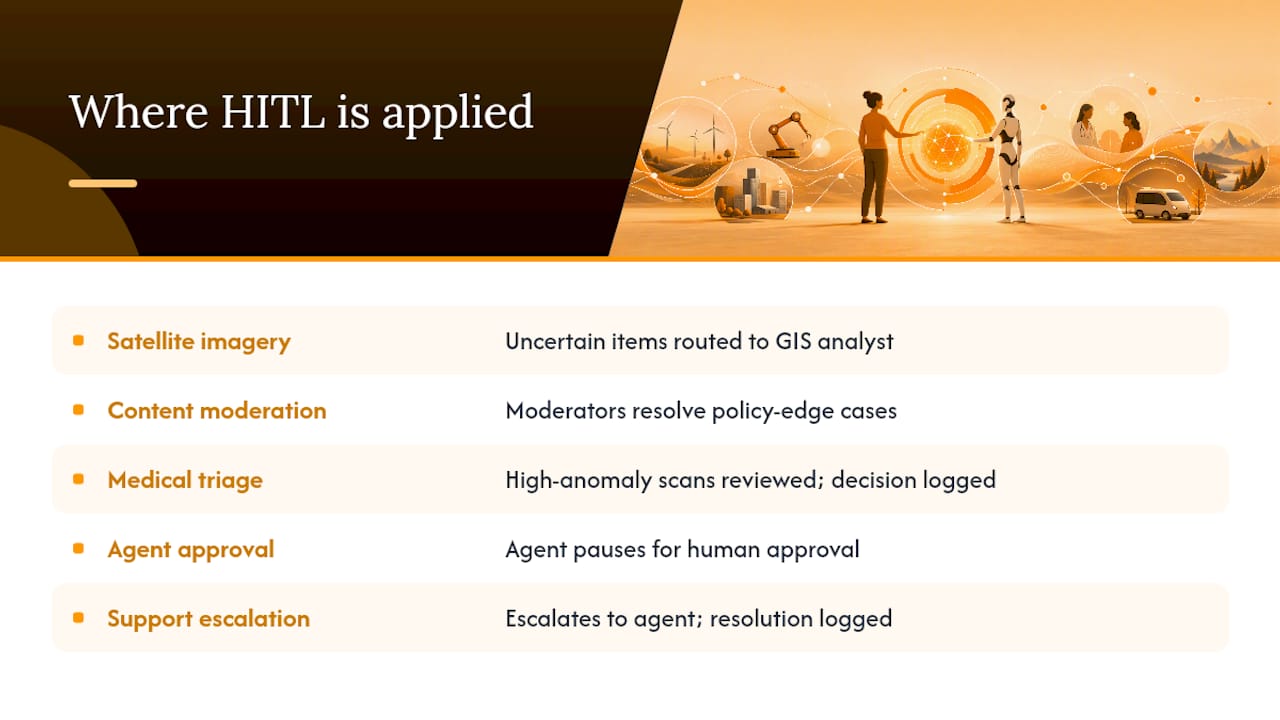
Image classification: A computer vision model classifies satellite imagery for land-use change detection. Items flagged as "uncertain" (confidence below 0.75) route to a GIS analyst who confirms or corrects the label. The corrected labels feed back into the next training run, tightening the model's decision boundary on the specific terrain types that caused uncertainty.
NLP labeling and content moderation: Large-scale content platforms use HITL to handle policy-edge cases that automated classifiers cannot resolve. A model flags content as potentially violating; a human moderator applies contextual judgment (satire, news reporting, regional norms) that the model lacks.
Medical triage: AI-assisted radiology tools route scans with anomaly scores above a threshold to a radiologist for review before a report is generated. The human decision is logged, timestamped, and attached to the patient record, satisfying both clinical and regulatory requirements.
Autonomous-agent approval gates: In agentic workflows, an agent proposes an action (send a contract, deploy a code change, update a customer record) and pauses for human approval before executing. This is the human-in-the-loop pattern applied to agentic AI rather than a static model.
Customer support escalation: A support bot handles routine queries autonomously and escalates to a human agent when sentiment drops below a threshold or the query matches a known escalation category. The human agent's resolution is logged and can retrain the escalation classifier.
Returns from HITL investment follow a curve. Early in a model's lifecycle, human labels and corrections produce large accuracy gains per unit of labor. As the model matures and its error rate drops, the marginal gain per human review shrinks while the cost per review stays constant. Teams that track human cost per decision alongside model accuracy can identify the inflection point where AI productivity gains from additional human review no longer justify the labor spend.
Design principles that make HITL workflows reliable
Start with this checklist before writing a line of code:
- Decompose tasks to the smallest reviewable unit. A human reviewer should be able to evaluate one item in under 30 seconds. Larger tasks compound cognitive load and inflate inter-annotator disagreement.
- Minimize cognitive load in the review UI. Present only the information needed for the decision. Confidence score, model rationale, and the input item. Nothing else on the primary view.
- Build explicit override affordances. Every human-facing interface needs a clear "reject," "correct," or "escalate" path. Passive acceptance (clicking "next" without a positive confirmation) inflates false-positive approval rates.
- Log provenance on every human decision. Annotator ID, timestamp, decision, confidence, and the model output being reviewed. This is your audit trail and your retraining signal.
- Separate annotator and overseer roles. The person labeling data should not be the same person auditing label quality. Role separation catches systematic annotator bias that self-review misses.
Metrics every HITL team should track
| Metric | Definition | Why it matters |
|---|---|---|
| Human review latency | Wall-clock time from item entering the queue to human decision | Directly bounds end-to-end pipeline SLA |
| Human cost per decision | Total labor cost divided by number of reviewed items | Tracks ROI of human oversight vs. automation |
| Human accuracy delta | Model accuracy on reviewed items vs. human-corrected accuracy | Quantifies the value humans add per review cycle |
| False override rate | Fraction of human corrections that later prove incorrect | Measures human error rate in the review role |
| Annotation churn | Fraction of labels changed between review rounds | Signals label drift or ambiguous task design |
| Detection lead time | Time from model error to human detection and correction | Key safety metric for high-risk deployments |
Effective oversight requires defined roles, monitoring-intervention loops, and clear authority at each layer. Without that structure, oversight becomes a formality rather than a functional control.
This catches label drift early — if your validation accuracy drops after incorporating new human labels, the labels themselves may have shifted, not the model.*
Challenges and risks you need to plan for
The main failure modes, in order of operational frequency:
Automation bias is the most common. Reviewers who see a model output before making their own judgment tend to anchor on it, even when the model is wrong. Trust calibration research shows that both under- and over-reliance on AI have measurable harms, and designers must actively balance transparency with friction to prevent reviewers from rubber-stamping model outputs.
The oversight illusion is subtler. Human oversight can fail in predictable ways: reviewers may not detect inaccurate outputs, may introduce their own bias, or may hold responsibility without real authority to prevent harm. A review queue that exists on paper but is staffed by reviewers who lack the domain expertise or decision authority to override the model is not oversight. It is liability theater.
Scalability and cost become binding constraints as volume grows. A high-volume model with a non-trivial routing rate can generate thousands of human reviews daily, which is a significant operational expense. Mitigation: active learning to reduce the routing rate over time, and tiered review (fast first-pass, deep second-pass for escalations only).
Human error introducing bias is a risk in annotation pipelines specifically. Annotators bring cultural assumptions, fatigue effects, and individual interpretive tendencies. Mitigation: inter-annotator agreement scoring (Cohen's kappa or Krippendorff's alpha), annotator calibration sessions, and regular audit sampling by a senior reviewer.
Privacy and regulatory exposure arise when human reviewers see sensitive data (medical records, financial transactions, personal communications) as part of the review workflow. Mitigation: data minimization (show only the fields needed for the decision), role-based access controls, and audit logging of who saw what.
Signal drift in monitoring is an operational challenge that effective oversight frameworks specifically catalog: probabilistic, multi-modal, and dynamically changing model outputs make it hard to define stable monitoring thresholds. Interventions may require retraining, data-pipeline fixes, or re-calibration of the human review threshold, and determining which intervention is correct requires its own diagnostic process.
What tooling categories do you actually need?
Three categories cover most HITL implementations:
Data labeling and quality control platforms handle annotation task design, annotator management, inter-annotator agreement, and label export. Representative tools in this category include Scale AI, Labelbox, and Prodigy (the Explosion.ai active-learning annotation tool). Open-source options like Label Studio support self-hosted deployments with custom labeling interfaces.
Human review and workflow orchestration layers manage routing logic, queue prioritization, human dashboards, and decision logging. This is where your confidence threshold rules, escalation paths, and approval gate logic live. Some teams build this in-house on top of message queues (SQS, Pub/Sub); others use workflow orchestration platforms that support human-in-the-loop steps natively.
Monitoring and retraining pipelines close the feedback loop. Tools like Evidently AI and Arize AI provide model monitoring with drift detection; MLflow and Weights & Biases handle experiment tracking and retraining orchestration. The human review decisions from your queue feed back into these pipelines as labeled data.
When evaluating any tool in these categories, ask:
- Does it expose an API for programmatic routing and decision retrieval, or is it UI-only?
- What is the latency SLA for human review steps, and does the tool support async vs. synchronous review modes?
- Does it support role-based access control with audit logs that satisfy your compliance requirements?
- Does it provide hooks for exporting human decisions as training data in a format your retraining pipeline can consume?
- How does it handle annotator disagreement — does it surface it, aggregate it, or silently pick a majority vote?
Operational monitoring requires tracking probabilistic, multi-modal, and dynamically changing signals, so your monitoring tooling needs to handle more than simple accuracy metrics. Plan for distribution shift detection, confidence calibration curves, and per-slice performance breakdowns from the start.
What recent research says about agentic HITL and collaboration layers
The field has shifted. Early HITL research focused on per-step human involvement in single-model pipelines. Current work addresses a harder problem: how do you preserve meaningful human authority when a system involves dozens of specialized agents, persistent memory, and multi-step task decomposition?
The answer emerging from recent research is a collaboration layer, an orchestration substrate that sits between user workspaces and AI agents, managing context, memory, and preferences across the full agent graph. Prototype collaboration-layer work demonstrates four core capabilities: proactive support, context understanding, smart orchestration, and persistent memory, and argues that democratizing agentic AI requires this layer rather than direct per-agent interaction.
The practical implication for HITL design: in agentic systems, human oversight points should be at task boundaries, not model-call boundaries. A human approves the output of a worker container (a completed subtask with a defined deliverable) rather than reviewing every intermediate generation. This is tractable; reviewing every token is not.
Early research on CollabSkill as a measurable quantity suggests that variance in human collaborator behavior matters more than variance in agent behavior for overall system performance. Identifying the user behaviors that most improve human-agent synergy is a more productive research direction than optimizing agent count alone.
For teams adopting agentic workflows, three instrumentation priorities:
- Log task-boundary decisions (human approvals, rejections, and modifications at worker handoffs) with full context: the task spec, the worker output, the human decision, and the timestamp.
- Track collaboration skill metrics per human role: approval accuracy (were approved outputs actually correct?), override rate, and time-to-decision at each task boundary.
- Preserve human authority at the orchestration layer by requiring explicit human sign-off for any action that is irreversible or that crosses a defined risk threshold, regardless of agent confidence.
Providing external reasoning faithfulness, meaning short, human-readable rationales linked to verifiable evidence rather than opaque model internals, is what makes task-boundary review fast enough to be practical. A reviewer who sees "worker completed: generated PR description, 3 files changed, tests pass, confidence 0.89" can approve in seconds. A reviewer who sees a raw token probability distribution cannot.
Their behavior patterns (what they check first, which rationale signals they use) are your best source of data for improving the review UI and the rationale format the model generates.*
How do you choose between HITL, human-on-the-loop, and full automation?
Work through this decision in order:
- What is the cost of an uncorrected error? If it is irreversible, legally consequential, or causes physical harm, human-in-the-loop is required. No further analysis needed.
- What is the model's current error rate on this task? If it exceeds your error budget, human review is mandatory until the model improves. Track this metric per task type, not globally.
- What is the throughput requirement? If volume makes synchronous human review impossible (millions of requests per hour), human-in-the-loop at inference is not viable. Human-on-the-loop or human-above-the-loop are the only options.
- Are there regulatory constraints? If yes, map the specific requirement to the oversight pattern it mandates. Some regulations require per-decision human sign-off; others require periodic audits. They are not equivalent.
- What is the ambiguity level of the task? High ambiguity (norm-sensitive, context-dependent, culturally variable) favors human-in-the-loop. Low ambiguity (well-defined, stable, high-volume) favors automation.
Mapping to outcomes:
- Keep human in the loop when: error cost is high, error rate exceeds budget, regulation requires per-decision sign-off, or task ambiguity is high.
- Human-on-the-loop supervision when: volume is too high for synchronous review, model error rate is low but not zero, and intervention capability (rollback, override) is sufficient for the risk profile.
- Full automation when: error rate is within budget, errors are reversible, no regulatory per-decision requirement exists, and the task is well-defined and stable.
On hybrid handoffs: phase out human review steps incrementally, not all at once. Run the human review in parallel with the automated decision for a validation period (typically 2–4 weeks), compare outcomes, and only remove the human step when the divergence rate drops below your error budget threshold. Workflow automation that cuts research time significantly still benefits from a validation period before full automation, even in lower-stakes domains.
Our take on strategic delegation and HITL
We've spent considerable time thinking about where human oversight actually adds value versus where it creates friction without safety benefit. Our position: the most productive HITL systems are not the ones with the most human touchpoints. They are the ones where human judgment is applied precisely at the decisions that matter, with the context and authority to act on it.
Agent-swarm is built around this principle. The platform's lead-agent architecture decomposes objectives into discrete tasks, assigns them to specialized workers running in isolated containers, and maintains a shared context log that compounds across runs. Human oversight in this model happens at task boundaries, where a reviewer has a complete, auditable record of what the worker did and why, not buried inside an opaque agentic loop. The prescriptive memory design means context is explicit and inspectable, which is what makes human review fast rather than a bottleneck.
The research on collaboration layers and CollabSkill reinforces what we see in practice: the teams that get the most out of human-AI collaboration are the ones who instrument their oversight carefully, identify which human behaviors drive accuracy, and design their review interfaces around those behaviors. That is an engineering problem, not just a policy one.
Agent-swarm puts human oversight where it belongs
Most teams building HITL workflows hit the same wall: the review queue becomes a bottleneck, context is lost between agent steps, and human reviewers spend more time reconstructing what happened than actually making decisions. Agent-swarm is built to eliminate that specific failure mode.

The platform's orchestration layer routes tasks to specialized workers, logs every step with full context, and surfaces human approval gates at task boundaries with the rationale and evidence a reviewer needs to decide in seconds, not minutes. Integrations with Slack, GitHub, Linear, and custom approval dashboards mean the oversight workflow lives where your team already works. See how the platform handles real multi-agent sessions, or check current pricing and start a 7-day free trial to run your own HITL workflow on the infrastructure.
Sources
The sources below support the article's core claims and are worth reading in full for teams designing or evaluating HITL systems.
- Keeping an Eye on AI: A framework for effective human oversight of AI systems
- Stanford HAI: what is human in the loop
- NCBI article on oversight failure modes and human–automation interaction
- Springer: external reasoning faithfulness and human verification
FAQ
What does human-in-the-loop mean in AI?
Human-in-the-loop AI is a system design pattern where a human provides input, correction, or approval at one or more stages of a machine learning pipeline, ensuring the model's outputs are validated or shaped by human judgment before being acted on.
What is the difference between human-in-the-loop and human-on-the-loop?
Human-in-the-loop means a human must actively review and approve outputs before the system proceeds, adding latency but maximizing control. Human-on-the-loop means the system acts autonomously while a human monitors outputs and can intervene reactively, trading control for throughput.
What is human-in-the-loop for AI agents?
For agentic AI systems, human-in-the-loop typically means approval gates at task boundaries: the agent proposes or completes a subtask, and a human reviews the output before the next step executes, rather than reviewing every intermediate model call.
What is human-on-the-loop in AI?
Human-on-the-loop is an oversight pattern where an AI system operates autonomously and a human monitor watches aggregate outputs or a dashboard, with the ability to intervene or roll back decisions. It suits high-volume, lower-risk tasks where synchronous human review is not feasible.
Recommended
Related field notes
We Rebuilt Linear's “Loops updates” Clip as a Swarm Video in Eight Rounds
Three video models read Linear's motion-design teaser; the two Gemini models called the 3D scene 2D until 7.5s. A frame-by-frame check caught it. The replica is 858 frames of Remotion and three.js, reviewed eight times.
SEO con agentes IA: guía práctica para automatizar sin perder el control
Aprende a automatizar tareas SEO con agentes de IA sin perder el control: define reglas, supervisa aprobaciones y gana tiempo para estrategia.
Pick Best AI Workflow Automation That Preserves Memory for Engineers
Engineering first guide to AI workflow automation: pilot plan to prove ROI and why agent-swarm.dev fits teams needing persistent memory.