Usage-Based Pricing for AI: A PM's Implementation Guide
Discover how to implement usage-based pricing for AI products effectively. Enhance profitability while meeting customer needs in this comprehensive guide.

Usage-based pricing is the right default for developer-facing AI products. If your marginal cost tracks consumption, your unit of value is measurable, and your buyers can tolerate a variable bill, start there. The trade-offs are real but manageable with the right guardrails. This guide covers everything from picking a meter to running the unit-economics math, wiring the event pipeline, and migrating existing customers without a revolt.
Three signals that push toward consumption-based billing:
- Your cost tracks usage directly. Token inference, GPU-seconds, and API calls all scale with demand. A flat seat price means your best customers are subsidized by your lightest ones.
- The unit of value is observable and legible. Documents processed, agent jobs completed, and API calls returned are things buyers understand. Raw tokens are not, unless your buyer is a developer.
- Buyers accept variable spend. Developer teams and technical buyers generally do. Procurement-heavy enterprise buyers often do not, which is where hybrid models earn their place.
The rest of this guide walks through model selection, metering architecture, guardrails, unit-economics experiments, and a migration playbook.
Key Takeaways
Hybrid pricing (subscription floor plus metered overage) is the most durable structure for AI products because it protects vendor margins, gives buyers cost predictability, and scales revenue with high-value customers.
| Point | Details |
|---|---|
| Start with shadow metering | Collect several months of usage data before setting prices; compute CV and top user share first. |
| Match meter to buyer type | Use job-level meters (documents, agent runs) for non-developer buyers; token meters for developer APIs. |
| Hybrid is the dominant pattern | Subscription floor plus metered overage balances revenue predictability and upside capture for mature AI products. |
| Build idempotency into the pipeline | Every usage event needs a unique ID; deduplication at ingestion prevents billing disputes before they start. |
| agent-swarm as a reference model | agent-swarm uses a subscription floor plus per-worker billing, with isolated containers per agent to keep cost and usage attribution clean. |
Table of Contents
- What does usage-based pricing mean for AI products?
- Which metrics should you actually meter?
- What pricing model shape fits your AI product?
- Why usage-based pricing helps — and where it creates AI-specific risk
- How to build a reliable metering and billing pipeline
- What guardrails prevent bill shock and protect your margins?
- Worked examples: unit economics and worst-case scenarios
- How to migrate from subscription or seat pricing to usage-based billing
- Where should you implement usage billing?
- Practitioner perspective: what teams actually get wrong
- agent-swarm runs on the hybrid model this guide describes
- Sources
- FAQ
What does usage-based pricing mean for AI products?
Usage-based pricing for AI means charging customers in proportion to what they actually consume, rather than a fixed periodic fee. "Usage" is not a single thing. Depending on your product, it could be:
- Tokens (input tokens, output tokens, or both) for LLM-backed features
- API calls or inference requests for model endpoints
- GPU-seconds or compute minutes for fine-tuning or batch jobs
- Documents or pages processed for document-intelligence pipelines
- Agent steps or actions for agentic workflows where a task spawns multiple sub-calls
- Storage and vector read units for retrieval-augmented generation (RAG) pipelines
The model makes sense when three conditions hold simultaneously: usage correlates with the value the customer receives, usage correlates with your marginal cost, and the buyer segment accepts metered billing. When all three align, you get a pricing structure that is self-correcting: high-value customers pay more, low-value customers pay less, and your gross margin stays roughly constant across the customer distribution.
When those conditions do not all hold, you get problems. An outcome-based model may capture value better when usage and value diverge. A subscription floor may be necessary when buyers need cost predictability. TSIA's analysis of AI pricing models makes the case clearly: usage-based pricing aligns cost with consumption but does not automatically capture value, and hybrid and outcome-based models are important alternatives precisely because they better align revenue with results.
Pro Tip: When selling to non-developers, meter at the job level (per-document, per-report, per-agent-run) rather than at the token level. Buyers understand "we processed 4,200 invoices this month" far more readily than "we consumed 18M input tokens."
Which metrics should you actually meter?
Choosing the wrong meter is one of the most expensive early mistakes a product team can make. The right metric is legible to buyers, correlates with the value they receive, correlates with your cost, and is not trivially gameable.
Common metering candidates and their trade-offs:
- Input + output tokens. High cost-correlation for LLM workloads. Poor legibility for non-developer buyers. Susceptible to prompt-engineering games that shift token counts without changing outcomes.
- API calls / inference requests. Simple to instrument, easy to explain. Breaks down when request complexity varies wildly (a one-sentence classification vs. a 32K-context summarization are both "one request").
- Inference or GPU-seconds. Accurate cost proxy for compute-heavy workloads. Difficult to explain to buyers and hard to predict before a job runs.
- Documents or pages processed. Excellent legibility for document-intelligence and contract-review products. Correlates well with value. Requires a clear definition of what counts as a "document."
- Agent steps or actions. Natural for agentic products. Risky if agent loops can inflate step counts without delivering proportional value; requires hard caps.
- Storage and vector reads. Relevant for RAG-heavy products. Often a secondary meter layered on top of a primary one.
- Human-review hours. Applies when your product includes a human-in-the-loop review stage. Easy to meter but introduces labor cost variability.
Google Cloud Marketplace's guidance on AI agent pricing recommends choosing reporting units carefully (seconds, MiB, GiB, requests) because granularity directly affects billing accuracy and customer trust. The same principle applies to any metering system you build.
For developer APIs, tokens or requests are acceptable because your buyer understands them. For end-user products, prefer job-level or document-level meters. For agentic workflows, meter agent steps but always pair them with a hard cap per session to prevent runaway loops from generating unpredictable bills.
What pricing model shape fits your AI product?
Four practical shapes cover most AI products. Each has a distinct commercial profile.
| Model | Best for | Metric to meter | Revenue predictability | Implementation complexity | Bill shock risk | Cost alignment |
|---|---|---|---|---|---|---|
| Pure consumption | Developer APIs, early-stage products | Tokens, requests, GPU-seconds | Low | Low | Medium | High |
| Tiered / volume | Mid-market SaaS, predictable workloads | Tokens, documents, requests | Medium | Medium | Low | Medium |
| Hybrid (floor + overage) | Enterprise, mixed buyer base | Any primary meter + overage | High | Medium-High | Low | High |
| Outcome-based | Mature products with attributable ROI | Outcomes (leads, contracts, resolved tickets) | Medium | High | Low | Very high |
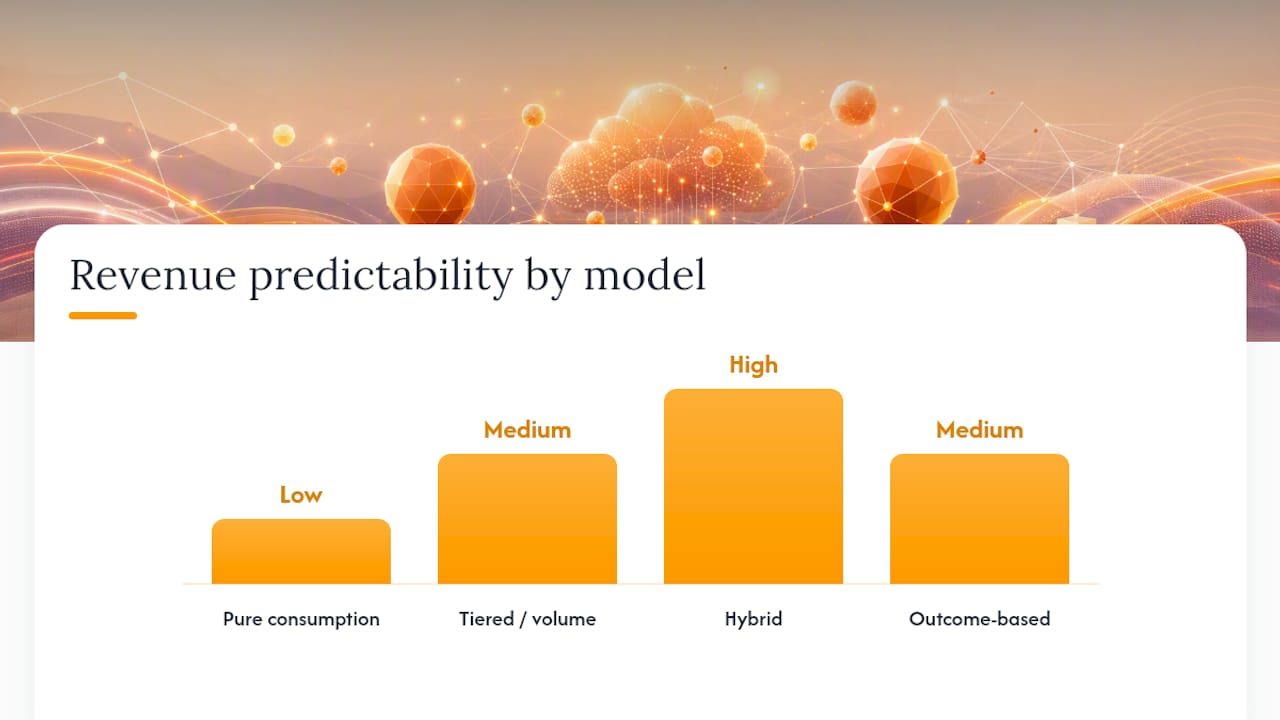
Pure consumption is the right starting point for developer-first products. It removes adoption friction: a developer can call your API with a credit card and pay exactly what they use. Stripe's guidance on AI pricing models confirms that developer-facing AI products often launch with pure usage-based pricing for exactly this reason, but teams commonly add a subscription floor later once revenue unpredictability becomes a problem.
Tiered pricing applies volume discounts at defined thresholds. It rewards high-volume customers and gives them a reason to consolidate usage on your platform. The trade-off is that tier boundaries create cliff effects: a customer sitting just above a tier boundary has an incentive to reduce usage to drop into the cheaper tier.
Hybrid (subscription floor + metered overage) is where most mature AI businesses land. A monthly base fee covers a defined allowance; usage above that allowance is billed at a per-unit overage rate. Lago's market analysis reports that hybrid pricing is the dominant pattern for mature AI businesses, with many vendors converging to a subscription floor plus metered overage to balance predictability and upside. The agent-swarm pricing model itself follows this shape: a base subscription plus per-worker billing.
Outcome-based pricing charges for results rather than consumption. It requires strong attribution (you can prove the outcome happened and that your product caused it), a clear outcome definition, and a customer willing to share outcome data. It is the highest-value model when it works, but it demands attribution maturity most early-stage products do not yet have.
Credits and prepaid systems sit across all of these shapes as a UX abstraction. Prepaid credits improve legibility and reduce payment friction, but they introduce balance-sheet complexity: unspent credits are a liability, and expiry rules affect customer trust. As Multigrid's analysis of AI pricing models notes, credits and prepay systems improve legibility but introduce breakage, liability, and churn dynamics that finance teams must plan for explicitly.
Why usage-based pricing helps — and where it creates AI-specific risk
The commercial case for consumption-based billing is straightforward. It lowers acquisition friction (no upfront commitment), scales revenue with your most valuable customers, and aligns your cost structure with your revenue structure. For AI products specifically, it also removes the awkward conversation about "how many seats does an AI agent need?"
The AI-specific risks are less obvious and worth naming precisely:
- Inference cost spikes. A model update, a new modality, or a change in prompt length can shift your per-request cost materially without changing the price the customer pays. Your margin compresses silently.
- Agent loops and cascade calls. An agentic workflow that spawns sub-agents, retries on failure, or calls external tools can generate 10x the token volume of a simple request. Without per-session caps, a single runaway job can cost more than the customer's entire monthly contract.
- The efficiency penalty. As your model gets cheaper to run (better quantization, distillation, caching), your revenue per customer falls even if usage stays flat. Pure token pricing punishes you for improving your product.
- Revenue unpredictability. Usage varies. A customer who processes 50,000 documents in January may process 8,000 in February. Coefficient of variation (CV) across your customer base determines how volatile your monthly recurring revenue actually is.
The efficiency penalty deserves particular attention. TSIA's analysis argues that usage-based pricing alone rarely captures long-term value, and that outcome-based and value-based approaches are where product differentiation and higher margins appear. That is the strategic case for evolving toward hybrid or outcome pricing as your product matures, even if you start with pure consumption.
A practical note on human-review costs: A8gent's cost breakdown for AI agents shows that a single workflow can generate costs across multiple meters simultaneously (model tokens, automation steps, telephony, storage, tracing, and human review). Understanding which meter your workflow looks expensive on is the core question when setting prices, not just the token rate.
How to build a reliable metering and billing pipeline
Stripe's technical overview of usage-based billing for AI is direct: billing for AI requires a robust event pipeline covering emit, ingest, meter, and invoice stages. Failure to build this pipeline correctly is a common operational failure mode, not an edge case.

Event contract. Every usage event must carry: a stable unique ID (for deduplication), a timestamp (UTC, millisecond precision), a tenant and project identifier, a billing flag (billable: true/false), a reason code (inference, retry, cached-hit), and the raw unit count. Define this schema before you write a single billing rule. Changing it later means migrating historical records.
Ingestion and durability. Emit events to a durable, append-only store via a buffered queue (Kafka, SQS, or equivalent). Use at-least-once delivery semantics. Idempotency is not optional: your consumer must deduplicate on the event's unique ID before writing to the metering store. A duplicate event that slips through becomes a billing dispute.
Metering rules. Version your billing rules explicitly. When a rule changes (new token rate, new tier boundary), the old rule must still apply to events that occurred before the change date. Accept correction events (a negative adjustment with a reference to the original event ID) rather than editing historical records. Define your aggregation windows (hourly, daily, monthly) and your late-event cutoff policy (events arriving more than N hours after the window closes are either accepted with a flag or rejected with a correction).
Billing and reconciliation. For agentic workflows, reserve the expected cost against the customer's credit balance before executing the job. Settle the actual cost after execution. This prevents a runaway job from draining a balance that was already committed elsewhere. Generate invoices with line-item detail: customers who can see exactly what they were charged for dispute less. Keep a reconciliation dataset (raw events, applied rules, computed charges) that you can replay for any billing period to resolve disputes.
For agent sessions specifically, implement a kill-switch that halts execution when accumulated cost exceeds a configurable threshold.
The data flow in sequence: usage event emitted → durable queue → idempotent consumer → append-only event store → metering engine (rules + aggregation) → billing engine (reserve → settle → invoice) → reconciliation store → customer dashboard.
Pro Tip: For agentic workflows, reserve the expected cost against the customer's credit balance before the job starts (a credit preauthorization). Settle the actual cost after the job completes. This prevents a single runaway session from generating a bill that exceeds the customer's entire monthly budget.
What guardrails prevent bill shock and protect your margins?
Guardrails serve two constituencies simultaneously: customers who need cost predictability and you, as the vendor, who needs margin protection. The two sets of controls are complementary, not competing.
UX controls for customers:
- In-product cost preview before a job runs (estimated tokens, estimated cost, estimated duration)
- Real-time spending dashboard with daily and monthly burn rates
- Soft alerts at configurable thresholds (50%, 80%, 100% of budget)
- Hard spending caps that pause execution rather than fail silently
- Clear line-item invoices that map charges to specific jobs or sessions
Commercial levers for vendors:
- Subscription floor with an included allowance: customers know their minimum monthly cost, and you know your minimum monthly revenue
- Prepaid credits with defined expiry: customers buy in advance, you recognize revenue on purchase, and breakage (unspent credits) is a known financial dynamic
- Tiered overage rates: the first N units above the allowance at rate X, the next M units at a lower rate Y, rewarding high-volume customers without giving away margin
- Negotiated caps for enterprise accounts: a contractual maximum monthly bill in exchange for a minimum annual commit
Contractual and sales tactics:
- Visibility dashboards for procurement teams (not just end users) so finance can see spend trends before the invoice arrives
- Commit-and-discount deals: a customer commits to $X annual spend and receives a percentage discount on overage rates
- SLA-backed predictability for enterprise plans: if your system generates a billing error, you have a defined resolution window and a credit policy
These controls also affect your sales motion. A product with no spending caps is a harder sell to procurement. A product with a subscription floor and a clear overage structure closes faster in enterprise deals because the finance team can model the worst-case cost. The x402 payment session example on agent-swarm shows how preauthorization flows can be built directly into agent execution, giving both the vendor and the customer a real-time cost signal before spend is committed.
Worked examples: unit economics and worst-case scenarios
So we picked one real usage distribution and ran the math across three pricing shapes to show what the numbers actually look like.
Assumptions (illustrative, using published OpenAI API token rates as a cost reference):
- Model cost: $2.50 per 1M input tokens, $10.00 per 1M output tokens (GPT-4o as of published pricing)
- Median customer: 500K input tokens + 200K output tokens per month
- Top-1% customer: 15M input tokens + 6M output tokens per month
- Your target gross margin: 60%
Pure usage maintains margin across the distribution but gives you no revenue floor.
Worst-case (runaway agent) scenario: A single agentic session with no cap generates 50M input tokens and 20M output tokens in one hour. At the pure-usage rates above, that is $125 + $200 = $325 in one session. If the customer's monthly budget is $100, you have a dispute. The guardrail: reserve $100 against the customer's credit balance before the session starts, and terminate the session when the reserve is exhausted.

Experiment plan: Run pricing shape experiments on new cohorts only (never change prices mid-contract on existing customers). Track conversion rate, monthly revenue per account, and churn rate. Compute the coefficient of variation (CV) of monthly usage per customer: a high CV (above 0.5) indicates that metered or hybrid pricing will outperform seat pricing in revenue stability.
How to migrate from subscription or seat pricing to usage-based billing
Migration is a sequenced process, not a cutover. Teams that try to flip all customers at once generate churn and support load simultaneously.
Phase 1: Instrument and observe (months 1–3)
- Deploy the event pipeline in shadow mode: emit usage events, ingest them, and meter them, but do not bill against them yet.
- Collect at least 3 months of per-customer usage data before setting any prices.
- Compute CV and top-1% share for your customer base. This determines which pricing shape fits your distribution.
- Identify customers who would pay more under usage pricing (high-usage accounts currently on cheap seats) and customers who would pay less (low-usage accounts on expensive seats).
Phase 2: Pilot on new accounts (months 3–6)
- Launch the new pricing shape for all new signups.
- Include a subscription floor for any account that goes through a sales motion (enterprise or mid-market).
- Set hard caps at 3x the median expected monthly bill for each tier.
- Run the billing pipeline in parallel with your existing billing system and reconcile weekly.
Phase 3: Migrate existing customers
- Offer existing customers an opt-in pilot: "Try the new plan for 60 days; if your bill would be higher, we'll credit the difference."
- Grandfather the highest-risk accounts (those who would see a significant price increase) on their current plan for 12 months with a clear sunset date.
- Provide each customer a usage dashboard showing their historical consumption and what their bill would have been under the new plan.
Sales and CS playbook:
- Train CS teams to present the change as a value alignment, not a price increase: "You now pay in proportion to what you get."
- Give procurement teams a worst-case cost model (cap × overage rate) so they can budget conservatively.
- Offer negotiated annual commits with a discount on overage rates for accounts that resist variable billing.
- Define your refund and dispute policy in writing before you migrate anyone: what triggers a credit, what the resolution SLA is, and who owns the dispute queue.
Operational checklist:
- Test invoice generation end-to-end before the first billing cycle on the new plan.
- Run a reconciliation pass on the first three invoices: raw events → metered totals → invoice line items must match exactly.
- Set a backstop cap for critical accounts (a contractual maximum monthly bill) and encode it in your billing system, not just in the contract.
For teams evaluating how different orchestration models affect pricing exposure, the agent-swarm comparison with Manus illustrates the difference between rented AI agents (vendor-hosted, opaque pricing) and owned-team models where cost visibility is built in.
Where should you implement usage billing?
Three reference points cover most of what a team needs to wire up metering and billing for an AI product.
- Stripe's usage-based billing guide for AI companies: The most complete engineering reference for event pipeline design, idempotency, correction events, and invoice generation. Start here for the technical architecture.
- OpenAI API pricing tables: Published per-1M token rates, modality-specific prices, and container/session charges. Required input for any unit-economics model.
- Google Cloud Marketplace AI agent pricing docs: Covers reporting unit selection (seconds, MiB, GiB, requests), granularity trade-offs, and combined (subscription + usage) pricing structures for agent products.
- Lago's AI pricing model analysis: Market-level framing of which models are gaining adoption and why hybrid is the dominant pattern in 2025–2026.
- A8gent's AI agent cost breakdown: Worked example of a multi-meter cost structure (tokens, automation steps, telephony, storage, human review) that shows how mixed-cost workflows complicate simple per-token pricing.
On the build-vs-buy question for metering infrastructure: building in-house gives you full control over event schema and rule versioning, but it is a non-trivial engineering investment. Billing platforms like Stripe handle ingestion, aggregation, and invoice generation but constrain your event schema to their data model. Most teams start with a billing platform and build custom metering on top of it for AI-specific meters (token counts, agent steps) that the platform does not natively support.
Practitioner perspective: what teams actually get wrong
The checklist looks clean on paper. Production is messier. Here is what we have seen trip teams up repeatedly.
Start with the simplest meter that is still honest. Teams that launch with five simultaneous meters (tokens, requests, GPU-seconds, storage, human-review hours) spend more time explaining invoices than selling. Pick one primary meter that correlates with value, add a secondary meter only when the primary one creates a clear misalignment, and add more only when you have data showing the need.
Instrument before you price. The most common mistake is setting prices before collecting usage data. You cannot set a reasonable allowance, a fair overage rate, or a defensible hard cap without knowing your actual usage distribution. Three months of shadow metering is not a luxury; it is the minimum viable dataset for pricing decisions.
If your pricing does not account for this tail, those customers will either be unprofitable (if you cap them) or generate billing disputes (if you do not). Compute their share before you set any caps.
Prepaid credits with a hard cap per session are the only reliable protection. A soft alert is not enough; by the time the alert fires, the damage may already be done.
Common pitfalls in production:
- Inconsistent event contracts. Different services emit events with different field names or timestamp formats. The metering engine silently drops malformed events. You discover the discrepancy during a billing dispute.
- Late-event leakage. Events from a batch job arrive 36 hours after the billing window closes. Your late-event policy was never defined, so the team makes an ad-hoc decision. The customer disputes the charge.
- Optimistic allowance setting. The allowance was set based on median usage from a beta cohort that was not representative of production customers. Half your customers hit the overage in month one.
- Underestimating human-review costs. A product that includes human review as part of its value proposition has a labor cost that scales with usage. If that cost is not in the unit-economics model, gross margin projections are wrong.
For teams building AI-driven pricing strategies, analysis of AI's impact on brand and GTM strategy covers how value capture and pricing positioning interact at the go-to-market level, which is a useful complement to the technical implementation work covered here.
agent-swarm runs on the hybrid model this guide describes
If you are building or migrating to usage-based billing for AI agents, the architecture decisions get concrete fast: which meter to expose, how to isolate cost per worker, and how to give customers visibility without exposing your cost structure. agent-swarm is built around exactly this shape. The platform runs each worker in an isolated Docker container, which means usage attribution is clean by design: every agent session maps to a discrete worker, and cost is bounded per container.

The agent-swarm pricing model follows the hybrid structure this guide recommends: a base subscription covers the platform and a defined number of workers, with additional workers billed per unit. Teams that need to see what multi-agent sessions actually look like in production can review real agent-swarm session examples to understand how task breakdown, worker assignment, and memory retention interact with billing. A 7-day free trial is available on the cloud plan. Start there, instrument your usage, and run the unit-economics math before you commit to a pricing shape.
Sources
- AI Pricing Models: Usage-Based, Outcome-Based, Hybrid — TSIA
- 7 AI Pricing Models: What Works, What Breaks | Lago
FAQ
What is usage-based pricing for AI products?
Usage-based pricing charges customers in proportion to what they consume: tokens, API calls, GPU-seconds, documents processed, or agent steps. It is the standard model for developer-facing AI APIs and is increasingly paired with a subscription floor for enterprise buyers.
When should you add a subscription floor to a usage-based model?
Add a subscription floor when revenue unpredictability becomes a planning problem or when enterprise buyers require cost predictability. Stripe's guidance confirms that developer-first AI products typically start with pure usage pricing and add a floor as the customer base matures.
How do you prevent bill shock in usage-based AI billing?
Implement in-product cost previews before jobs run, real-time spending dashboards, soft alerts at configurable thresholds, and hard caps that pause execution rather than fail silently. For agentic workflows, reserve expected cost against the customer's credit balance before the session starts.
What is the most common pricing model for mature AI businesses?
Hybrid pricing (subscription floor plus metered overage) is the dominant pattern. Lago's market analysis reports that many AI vendors converge to this structure because it balances revenue predictability with upside capture from high-volume customers.
How does agent-swarm handle usage-based billing?
agent-swarm uses a hybrid model: a base subscription covers the platform and a defined number of workers, with additional workers billed per unit. Each worker runs in an isolated container, which keeps cost attribution clean and makes per-session usage visible by design.
Recommended
Related field notes
We Rebuilt Linear's “Loops updates” Clip as a Swarm Video in Eight Rounds
Three video models read Linear's motion-design teaser; the two Gemini models called the 3D scene 2D until 7.5s. A frame-by-frame check caught it. The replica is 858 frames of Remotion and three.js, reviewed eight times.
SEO con agentes IA: guía práctica para automatizar sin perder el control
Aprende a automatizar tareas SEO con agentes de IA sin perder el control: define reglas, supervisa aprobaciones y gana tiempo para estrategia.
Pick Best AI Workflow Automation That Preserves Memory for Engineers
Engineering first guide to AI workflow automation: pilot plan to prove ROI and why agent-swarm.dev fits teams needing persistent memory.