Match the Tool to Failure: LangChain Alternatives for Engineers
Choose the right LangChain alternative by failure mode, data path, control flow, or role based, and see when agent-swarm.dev fits.

If your team needs production-grade multi-agent orchestration with secure, stateless workers and broad tool integrations, agent-swarm.dev is the strongest starting point. If your problem is graph-shaped, stateful branching logic, LangGraph fits better. If retrieval and document ingestion is the hard part, LlamaIndex earns its reputation. If you're prototyping role-based agent collaboration, CrewAI is the fastest way to test that shape. The rest of this article profiles twelve serious contenders, compares them side by side, and gives you a repeatable process for picking the right one.
TL;DR:
- For production multi-agent orchestration, agent-swarm.dev offers secure, stateless workers with broad tool integrations, suitable for scalable, containerized environments.
- If your problem involves stateful, branching logic, LangGraph provides explicit control flow modeling with visualization, though it has a steeper learning curve.
- LlamaIndex excels in retrieval-heavy applications, especially for messy document ingestion, but now overlaps with agent frameworks like LangChain, making it less specialized.
- Role-based prototyping of multi-agent collaboration is best served by CrewAI, which simplifies prompt generation for coherent team interactions but may mask coordination bugs under high load.
- Choosing the right tool depends on your specific failure mode, with emphasis on observability, durability, and migration effort, rather than just feature lists.
Table of Contents
- Which LangChain Alternatives Actually Solve Your Problem?
- Comparing the Shortlist on the Dimensions That Matter
- How Do You Choose the Right LangChain Alternative?
- How We Evaluated These LangChain Alternatives
- What Production Evidence Backs This Recommendation?
- What Actually Breaks When You Migrate Off LangChain?
- Match the Tool to the Failure You Expect, Not the One You Fear
- Ready to Try a Production-Grade Alternative?
- Sources
- FAQ
Which LangChain Alternatives Actually Solve Your Problem?
We've tested and read through enough LangChain migrations to know the question everyone asks first is wrong. Developers ask "what's the best LangChain alternative?" when they should be asking "what kind of failure am I trying to avoid?" A retrieval pipeline that hallucinates citations fails differently than an agent that loops forever on a tool call, and those two failures point to completely different tools.
LangChain itself frames this well in its own comparison resource: alternatives split across a framework layer (the libraries you write agent logic in) and a platform/runtime layer (observability, evals, deployment, durable execution), and no single tool matches the full LangChain stack of framework plus managed runtime plus tracing plus eval loop. That's the honest starting point. You're not picking one silver bullet. You're picking the framework that covers your hardest problem and accepting you'll assemble the rest.
Here's how the field breaks down, grouped by what each tool actually is rather than by marketing category.
Frameworks (you write code, they give structure)
agent-swarm.dev is an open-source operating system for multi-agent work, not a library you import into a script. A lead agent breaks objectives into tasks and hands them to specialized workers, each running in an isolated container using Claude Code, Codex, OpenCode, or similar coding agents. Best for engineering teams that need production orchestration where security and statelessness actually matter, not just a demo that works on your laptop. The standout is the stateless worker pattern: workers don't accumulate local state that leaks between runs, and shared memory compounds at the swarm level instead. The practical caution: this is infrastructure, not a prompt library, so teams expecting a drop-in LangChain replacement for a single-agent script will find it's built for a different scale of problem.
LangGraph models agents as explicit state graphs, which gives you visibility into every branch and transition instead of a black-box chain. Best for stateful, branchy agents where you need to reason about control flow, especially with tracing tools layered on top. The standout is the graph abstraction itself; you can look at a diagram and know exactly what state the agent occupies. Caution: the graph mental model has a real learning curve, and small teams sometimes over-engineer simple flows into graphs they didn't need.
LlamaIndex started as a document-indexing library and has grown into a full retrieval framework. Best for RAG-heavy applications where chunking, embedding, and retrieval quality are the actual bottleneck, not agent logic. The standout is ingestion tooling that handles messy document formats better than most agent-first frameworks bother to. One limitation worth flagging: the line between LlamaIndex and LangChain has blurred since both now ship agents, retrieval, and workflow features, so teams sometimes pick LlamaIndex expecting a narrower tool than they get.
CrewAI makes "role, goal, backstory" a first-class primitive for multi-agent collaboration. Best for teams prototyping role-based workflows, like a researcher agent handing off to a writer agent handing off to an editor agent. The standout is how naturally the role framing produces coherent multi-agent prompts without hand-tuning. Caution: role-based abstractions can mask coordination bugs that only surface once you push real concurrent load through the crew. For a direct look at where the two approaches diverge, see this comparison of CrewAI's role model against agent-swarm's orchestration approach.
PydanticAI brings type safety to agent development by validating structured outputs through Pydantic models. Best for Python teams that want compile-time-style guarantees on what an agent returns, rather than parsing loosely-typed JSON blobs. Standout: the validation layer catches malformed outputs before they cascade into downstream failures. Caution: it's young, and the ecosystem of pre-built integrations is thinner than more established frameworks.
Haystack is search-first, built by people who cared about NLP pipelines before agents were a buzzword. Best for enterprises running search-heavy RAG where hybrid retrieval (keyword plus vector) actually matters. Standout: enterprise-grade retrieval features that many agent frameworks bolt on as an afterthought. Caution: its agent orchestration layer is newer than its retrieval layer, so if agents are your primary need rather than search, it's a secondary fit.
AutoGen came out of Microsoft Research with conversation as the core primitive rather than a chain or graph. Best for research teams and conversational multi-agent experiments, like agents debating a plan before executing it. Standout: the conversation-as-primitive design is genuinely elegant for multi-agent brainstorming and generation tasks. Caution: comparative write-ups consistently position AutoGen closer to research tooling than hardened production infrastructure, so teams shipping to production should budget extra time for observability and error handling.
Griptape, Langroid, and Outlines round out the code-first framework tier. Griptape focuses on composable pipelines with structured task execution. Langroid takes a multi-agent, message-passing approach similar in spirit to AutoGen but lighter weight. Outlines specializes narrowly in constrained generation, guaranteeing an LLM's output matches a schema or grammar. Each is best for a specific slice of the problem rather than a general LangChain replacement, and none currently ships the breadth of integrations larger frameworks offer.
Platforms and visual builders (less code, more configuration)
Flowise exposes node-based visual flow building for agents and RAG pipelines. Best for developers and non-developers who think in diagrams and want to prototype fast without writing orchestration code. Standout: the visual editor genuinely speeds up early iteration. Caution: complex branching logic gets harder to manage visually past a certain size, and debugging a tangled node graph is its own skill.
Microsoft Semantic Kernel is Microsoft's SDK for orchestration with first-class .NET support and deep Azure integration. Best for teams already standardized on .NET or Azure who want orchestration that behaves like a native part of that stack. The official documentation details its plugin architecture and planner model. Standout: Azure-native workflows and enterprise support channels most open-source frameworks can't match. Caution: teams outside the Microsoft ecosystem gain little from its .NET-first design choices.
Google Vertex AI and Amazon Bedrock AgentCore are the two big cloud-native answers. Vertex AI is best for teams standardizing on Google Cloud and Gemini models, with managed hosting baked in. Bedrock AgentCore is best for AWS-committed teams wanting a managed agent runtime with IAM-based identity and sandboxing already wired in. Both trade flexibility for the operational simplicity of staying inside one cloud's walls. The caution is the same for both: migrating off either one later means untangling cloud-specific service calls from your agent logic.
Mastra is a TypeScript-native framework offering agents, workflows, and RAG with a visual local debugger called Mastra Studio. Best for TypeScript and Next.js teams who want end-to-end type safety without touching Python. One comparison of LangChain alternatives from Mastra's own team makes the case for TypeScript-first tooling directly. Standout: developer ergonomics for teams already living in the JavaScript ecosystem. Caution: if your models, data pipelines, or team skew Python, you're fighting the ecosystem's natural gravity.
Zapier, Make, Gumloop, StackAI, Langdock, n8n, Logic, and Flowise sit closer to no-code and low-code automation than agent frameworks. Zapier's own roundup of LangChain alternatives groups tools by narrow best-for labels, which is the right instinct: these platforms are best for teams automating recurring business workflows who want agent-like behavior without writing much code. n8n in particular has a strong following among developers who want visual workflows but still need occasional custom code nodes. Community review platforms echo this pattern; Gumloop's G2 listing shows the kind of sentiment signal buyers lean on for these lower-code tools. Caution across this whole tier: you trade code-level control for speed, and hitting a wall on a complex agent behavior often means bailing out to a real framework anyway.
Akka, Txtai, AgentGPT, AutoGPT, Rivet, SuperAGI, and GradientJ (Velos) each serve narrower niches. Akka brings its actor-model heritage to durable, distributed agent execution, useful if you already run Akka systems. Txtai is a lightweight embeddings and search library, best as a component rather than a full agent framework. AgentGPT and AutoGPT were early autonomous-agent experiments that popularized the "give an LLM a goal and let it loop" pattern; they're better learning tools today than production choices. Rivet offers a visual graph editor aimed at game and app developers building conversational logic. SuperAGI positions itself as a full agent infrastructure stack with built-in tooling for marketing and ops use cases. GradientJ (Velos) focuses on prompt management and evaluation tooling layered on top of whatever orchestration you already use.
Comparing the Shortlist on the Dimensions That Matter
Once you know your problem shape, the fastest way to narrow twelve options to two is a side-by-side scan of production fundamentals: what language ecosystem it lives in, how it models orchestration, and whether it has a real deployment and observability story or just a demo notebook.
| Tool | Best for | Language / ecosystem | Orchestration model | Production readiness | License / pricing shape |
|---|---|---|---|---|---|
| Agent-swarm | Secure, production multi-agent orchestration with stateless workers | Language-agnostic workers (Claude Code, Codex, OpenCode) | Lead agent + task delegation | Self-host with container isolation; integrations for Slack, Linear, GitHub | Open-source (self-hosted) or cloud SaaS |
| LangGraph | Stateful, branchy agents needing explicit control flow | Python / JavaScript | Explicit state graph | Strong when paired with tracing tooling | Open-source library |
| LlamaIndex | RAG and document-centric retrieval | Python / TypeScript | Pipeline / retrieval-centric | Ingestion tooling mature; agent runtime newer | Open-source library |
| CrewAI | Role-based multi-agent prototyping | Python | Role / goal / backstory primitive | Growing; less mature for high concurrency | Open-source, hosted tier available |
| PydanticAI | Typed contracts between agents and app code | Python | Function-call / structured output | Early stage; thinner integration ecosystem | Open-source library |
| Haystack | Search-heavy enterprise RAG pipelines | Python | Pipeline-based | Strong retrieval tooling; newer agent layer | Open-source, enterprise support available |
| Microsoft Semantic Kernel | .NET / Azure-standardized teams | .NET, Python, Java | Planner / plugin-based | Azure-native deployment and support | Open-source SDK, Azure-billed hosting |
| Google Vertex AI | Google Cloud / Gemini-standardized teams | Multi-language via API | Managed pipeline | Managed hosting built in | Cloud-billed, usage-based |
| Amazon Bedrock AgentCore | AWS-standardized teams wanting managed runtime | Multi-language via API | Managed agent runtime | IAM-integrated sandboxing and identity | Cloud-billed, usage-based |
| Mastra | TypeScript / Next.js teams | TypeScript | Agents, workflows, RAG | Local visual debugger (Mastra Studio) | Open-source library |
| AutoGen | Research and conversational multi-agent experiments | Python | Conversation-as-primitive | Lighter on production tooling | Open-source library |
| n8n | Workflow automation with occasional custom code | Node-based, JS-extensible | Visual workflow / trigger-based | Self-host or cloud, mature deployment options | Open-source core, paid cloud tiers |
"Production readiness" here means three specific things: can you see a trace of what the agent did (observability), can a long-running task survive a crash or restart (durable execution), and is there an actual deployment path beyond a local script. A framework that scores well on graph clarity but has no story for any of those three isn't production-ready yet, no matter how clean its API looks in a demo.
Pro Tip: Before committing to any tool on this table, run a 48-hour proof of concept. Day one: get the quickstart running and force a failure to see what the trace or log actually shows you. Day two: simulate a long-running task and kill the process midway to see if it recovers or silently loses state.
How Do You Choose the Right LangChain Alternative?
Start with one question: what problem are you actually solving? Not "which framework is popular" but "what does failure look like when this breaks in production." That answer sorts your options faster than any feature comparison.
- Identify your problem shape. Is it RAG and retrieval accuracy, branchy multi-step control flow, multi-agent role coordination, or a frontend that needs to stream tokens to a UI? Each shape favors a different tool tier from the profiles above.
- Ask about observability directly. Can you see a trace tree of every tool call and decision the agent made? If the answer involves reading raw logs and guessing, that's a red flag for anything beyond a prototype.
- Ask about durable runtime. Does a long-running agent survive a process crash or a deploy? Frameworks without checkpointing or state persistence will lose hours of agent work on the first bad deploy.
- Ask about evals and annotation. How do you know if a prompt change made things better or worse? Tools with no eval loop leave you guessing after every change.
- Ask about credential injection and sandboxing. If the agent executes code or calls tools with real credentials, how are those credentials scoped and isolated? This matters even more for any framework running arbitrary generated code.
- Estimate migration cost honestly. How much of your current LangChain logic lives in framework-specific classes versus your own code? The more it's entangled, the more expensive any switch becomes.
- Check scale and throughput claims against your actual load. A framework that handles ten concurrent agents gracefully might buckle at a hundred; ask for real numbers, not marketing claims.
Watch for a few consistent red flags across vendors and frameworks: documentation that stops at "hello world," no tracing or trace-tree concept anywhere in the product, no deployment or runtime story beyond "run it in a Docker container yourself," and license terms that quietly restrict commercial use once you read the fine print.
Pro Tip: Keep your prompts and retrieval logic in your own code, not buried inside framework-specific subclasses. This is the single cheapest insurance policy against lock-in, and it makes a future migration a data-extraction exercise instead of a rewrite.
How We Evaluated These LangChain Alternatives
We compared these tools across six axes rather than ranking by popularity alone: integration breadth (how many real systems it connects to out of the box), orchestration model clarity (can you explain the control flow to a new hire in five minutes), runtime and deployment story (does it run in production or only in a notebook), observability and eval tooling (can you see and measure what the agent did), license and vendor lock-in risk, and community activity (issue response times, release cadence, third-party plugin ecosystem).
Three smoke tests filtered noise from signal:
- A 30 to 60 minute quickstart, run cold, to see how much friction a new developer hits before anything works.
- A 48-hour proof-of-concept checklist covering the five checkpoints from the buying guide above: quickstart, tracing, durable execution, credential sandboxing, and migration cost.
- A basic RAG accuracy spot-check for tools that claim retrieval strength, comparing retrieved chunks against known-correct answers on a small document set.
Some judgments here rest on documentation quality and community signal rather than deep production deployment, particularly for newer entrants like PydanticAI and Outlines. Where that's the case, we've flagged it in the profile rather than overstating certainty. Community review data, like the sentiment reflected on Gumloop's G2 seller page, supplements but never replaces a hands-on quickstart test.
What Production Evidence Backs This Recommendation?
The stateless worker pattern that anchors agent-swarm.dev's design isn't theoretical. Technical deep dives on the Agent-swarm blog document the mechanics behind it directly, including the specific engineering discipline that keeps workers from accumulating hidden state:
- A stateless worker pattern where each container spins up clean, does its assigned task, and shuts down without leaking local state into the next run.
- A roughly 30-line Bash script pattern specifically written to block workers from writing to a local database, forcing all persistence through shared, auditable memory instead.
- Integration coverage spanning Slack, Linear, Turso, OpenAI, and GitHub, verified through real session examples rather than a marketing feature list.
A case study with Capchase, referenced in agent-swarm.dev's published materials, describes measurable workflow automation gains from adopting this orchestration approach in an active engineering environment. You can walk through comparable real session examples yourself rather than taking a summary's word for it.
Map this back to the production-readiness checklist from the buying guide: observability comes from the shared memory layer being inspectable across runs, durable runtime comes from the container-per-task isolation model, and the credential-injection concern gets addressed by workers never touching a shared local database in the first place. That's not a coincidence. It's the same checklist teams should run against any alternative on this list.
What Actually Breaks When You Migrate Off LangChain?
The expensive part of leaving LangChain is rarely the orchestration logic. It's the prompt templates and retrieval configurations quietly wrapped inside LangChain-specific classes like chains, output parsers, and memory objects. Extract those first, before you touch the orchestration layer, and the migration shrinks from a rewrite to a wiring exercise.
The second common trap is memory and state. LangChain's memory abstractions don't map cleanly onto a graph-based tool like LangGraph or a role-based one like CrewAI, so teams that assumed a drop-in swap end up redesigning how conversational or task state persists across steps. Budget real time for this, particularly if your agents run long or multi-turn.
Third, tooling and callbacks. If your observability, logging, or eval pipeline hooks into LangChain-specific callback handlers, that instrumentation needs rebuilding against whatever tracing model your new tool uses, whether that's LangGraph's execution traces or a platform's native dashboard.
The safest migration path: extract prompts and retrieval code into framework-agnostic functions first, run the new tool's quickstart in parallel against a known test set, and only cut over traffic once the new tracing and durable-execution story checks out under real load, not a demo script.

Match the Tool to the Failure You Expect, Not the One You Fear
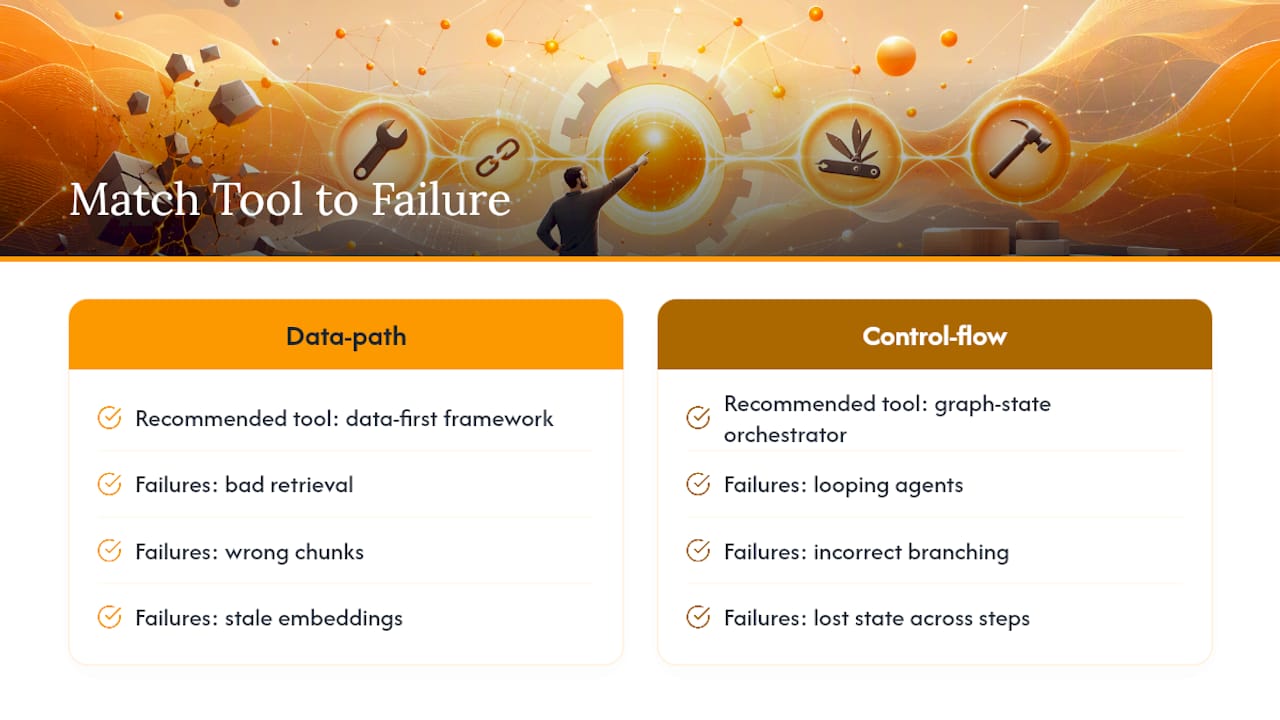
The decision rule that actually holds up under production load is boring: match the tool's debugging surface to your anticipated failure mode. If your problem is a data-path issue (bad retrieval, wrong chunks, stale embeddings), pick a data-first framework and accept its lighter agent tooling. If your problem is control-flow (an agent looping, branching wrong, or losing track of state across steps), pick a graph-state orchestrator and accept its steeper learning curve. Trying to force one tool to cover both jobs well is how teams end up rebuilding half the framework themselves anyway.
The advice to keep prompts and retrieval logic outside framework-specific classes isn't caution for caution's sake. It's the difference between a two-day migration and a two-month rewrite when (not if) you outgrow your first choice.
Ecosystem convergence is real and worth watching. LlamaIndex now ships agents, and LangChain now ships retrieval tooling. The lines that used to make tool selection simple are blurring, which means the "best-for" labels in this article will keep shifting. Pick for your problem today, keep your core logic portable, and revisit the choice in a year rather than treating it as permanent.
— Ez.-
Ready to Try a Production-Grade Alternative?
agent-swarm.dev offers a lead agent that breaks down objectives, delegates tasks to isolated workers running various coding agents, and maintains a shared memory that compounds across runs rather than resetting each session. You can self-host the open-source version under MIT for free, or choose a hosted cloud SaaS option billed per active worker.
Where CrewAI gives you role primitives and LangGraph gives you explicit graphs, agent-swarm.dev gives you the operational layer both of those still need in production: container-isolated workers, integrations across Slack, Linear, Turso, GitHub, and OpenAI already wired in, and a memory model built to compound rather than reset. If you're weighing agent-swarm.dev specifically against a role-based framework, the CrewAI comparison page walks through exactly where each approach earns its keep, and the full alternatives comparison hub covers the rest of the field. If you want developer-tooling context for code-generation workflows alongside your orchestration setup, AmmarAI's AI code generator is worth a look too.
Start with the real session examples and run a 48-hour proof of concept against your own workflow before deciding anything.
Sources
- Semantic Kernel overview - Microsoft Learn
- LangChain Alternatives: A Full Comparison for Agent Engineering
- LlamaIndex vs LangChain: Which Framework in 2026, and When Neither Is the Answer
- The 7 best LangChain alternatives in 2026 — Zapier
FAQ
What are the top alternatives to LangChain in 2026?
For production multi-agent orchestration, agent-swarm.dev leads on stateless worker security and integration breadth; LangGraph fits stateful graph-based agents, LlamaIndex fits RAG-heavy retrieval work, and CrewAI fits role-based multi-agent prototyping.
What are some frameworks similar to LangChain?
LangGraph, LlamaIndex, CrewAI, PydanticAI, Haystack, and AutoGen all cover pieces of what LangChain does, though no single one matches its full framework-plus-runtime-plus-observability stack.
Is LlamaIndex better than LangChain?
Neither is universally better; LlamaIndex has an edge for document ingestion and retrieval accuracy, but the line between the two has blurred since both now support agents and retrieval.
Is AutoGen better than LangChain?
AutoGen's conversation-first design suits multi-agent research and collaborative generation well, but it's generally viewed as less production-hardened than LangChain or dedicated orchestration platforms like agent-swarm.dev.
How do I choose between LangGraph, CrewAI, and agent-swarm.dev?
Match the choice to your problem shape: LangGraph for explicit branchy control flow, CrewAI for role-based agent prototyping, and agent-swarm.dev for production orchestration that needs secure, stateless workers and real integration coverage across tools your team already uses.
Recommended
Related field notes
TasteLabs Found Design Drift in Our Own Sites
Our landing sites had three amber ramps, 34 untokenized brand-color literals, and no BRAND.md files. One fix PR has merged; one is still open.
Respuestas de soporte IA: guía para empezar sin arriesgar tu servicio
Implementa respuestas de soporte con IA sin arriesgar tu servicio: inicia en modo copiloto, prueba con tickets históricos y acelera la atención.
Evaluate SEO Automation Tools by Connectors & Provenance for Engineers
How engineers choose SEO automation tools by connector quality, provenance, and isolation. Includes a 4–8 week pilot checklist for GitHub, Slack, and Linear.