Memory vs Context Window: 4 Steps to Measure MECW, Build Tiered Memory
Practical playbook for engineers: measure your model’s MECW, avoid quadratic attention costs, and deploy a tiered retrieval memory system in four clear...

The context window is your model's volatile working memory. It resets every session and holds whatever tokens fit inside the current prompt. Memory is a durable, curated store that persists across sessions and feeds relevant facts back into that window through retrieval. The practical takeaway: stop chasing bigger context windows and start building a retrieval layer that injects only what matters, because raw token capacity doesn't behave like real memory.
TL;DR:
- Effective context window sizes are often much smaller than the advertised maximums, with real MOMs typically dropping accuracy before hitting those limits.
- Memory systems should prioritize retrieval-augmented structures, like vector stores, over trying to extend raw prompt length, because token capacity alone doesn't equate to true memory.
- Building a tiered memory architecture with summaries, recent turns, and on-demand retrieval from long-term storage improves model coherence by reducing the need for large, expensive context windows.
- Conduct task-specific MECW tests to determine optimal prompt lengths, as different tasks can reach performance degradation at vastly different token counts.
- Proper memory management involves validation, classification, and caching strategies to prevent poisoning, eviction, and cost blowouts, rather than relying on raw history replay.
Table of Contents
- What Is the Difference Between Memory and a Context Window?
- How Context Windows Actually Work Under the Hood
- MECW vs MCW: What the Research Actually Shows
- Building Memory That Actually Feeds the Context Window
- A Practical Checklist for Engineers Building Memory Systems
- Where Memory Systems Break in Production
- What Actually Matters When You Design Memory Policy
- Where agent-swarm.dev Fits Into Your Memory Stack
- Sources
- FAQ
What Is the Difference Between Memory and a Context Window?
A context window is the set of tokens a model can attend to in a single forward pass, prompt, completion, and any injected history combined. It exists only for the duration of that request. Close the session, and it's gone, unless something outside the model wrote it down first.
Memory is that "something outside." It's a system, usually a database or vector store, that consolidates facts, resolves entities (knowing "Sarah from the Tuesday standup" and "Sarah Chen, backend lead" are the same person), timestamps events, and decides what's worth keeping. According to platform documentation from Claude, every token in a request, including system prompts, tool definitions, and prior turns, counts against the window budget. Nothing is free, and nothing sticks around unless memory puts it back.
Two more terms matter here, and practitioners routinely conflate them:
- Maximum Context Window (MCW): the advertised token limit a vendor publishes, the number on the spec sheet.
- Maximum Effective Context Window (MECW): the point at which the model actually stops using information reliably, which is often far smaller than MCW.
- KV cache: the stored key/value attention states for every token processed so far, which grows linearly with context length and eats GPU memory.
- Context rot: the gradual degradation in retrieval accuracy as relevant information gets buried deeper in a long context.
- Compaction: server-side or client-side compression of older turns into shorter summaries to reclaim token budget.
- RAG (Retrieval-Augmented Generation): the pattern of pulling relevant chunks from an external store and injecting them into the window at inference time.
The distinction isn't academic. A neuroscience-adjacent framing is useful here: biological memory retrieval works through indexed, time-stamped engrams and contextual cues, not by holding every experience in active attention simultaneously. LLM memory systems that skip indexing and just dump raw history into the window are trying to think without an index card catalog.
How Context Windows Actually Work Under the Hood
Context windows aren't an arbitrary product decision. They're a direct consequence of how transformer attention scales, and understanding the mechanics tells you exactly where the trade-offs live.
Self-attention computes a relationship score between every token pair in the sequence. That's O(n²) complexity: double the sequence length, and you roughly quadruple the compute for the attention step alone. According to Redis's breakdown of context window mechanics, this quadratic cost, combined with KV cache memory growth and GPU memory bandwidth limits, is what actually bounds context length, not model architecture preferences.
Here's what compounds the problem in production:
- The KV cache stores attention states for every processed token, and it grows linearly with sequence length, consuming VRAM that could otherwise serve more concurrent requests.
- Memory bandwidth, not raw compute, often becomes the bottleneck once the cache gets large, because the GPU spends cycles shuttling cache data rather than computing new tokens.
- Batch size and concurrent user count both shrink as context length grows, since each session's cache competes for the same finite VRAM pool.
A quick reality check on cost: the O(n²) attention cost means a 100,000-token context doesn't cost 10 times more than a 10,000-token one, it costs closer to 100 times more for the attention computation itself. That's why techniques like FlashAttention (which restructures the computation to reduce memory reads), sparse attention (which skips low-relevance token pairs), and distributed inference across multiple GPUs exist. They mitigate the wall. None of them remove it.
For engineers shipping real products, this translates directly to latency and cost. Longer context means slower time-to-first-token, lower request throughput per GPU, and a bill that scales faster than your context length does.
MECW vs MCW: What the Research Actually Shows
Vendors publish MCW numbers like badges, often very large token limits. Treat those numbers as marketing ceilings, not engineering targets, because a growing body of empirical work shows models degrade well before they hit that ceiling.
A large-scale study on effective context limits aggregated hundreds of thousands of data points across models and tasks, and the finding is stark: MECW is frequently a fraction of MCW. A model advertised at 200K tokens might start losing accuracy, or hallucinating outright, well before a substantial fraction of that on certain tasks. The gap isn't a rounding error. It's the difference between a design assumption that works and one that silently fails in production.
Critically, MECW isn't a single number per model. It varies by task structure. The same research found that some tasks break down with as few as 100 tokens of irrelevant filler, while others tolerate much longer spans without degrading. A needle-in-a-haystack retrieval task and a multi-document summarization task have completely different effective ceilings on the identical model.
Here's a lightweight MECW test you can run against your own workload this week:
- Take a representative task from production (not a synthetic benchmark) and fix the "signal" content constant.
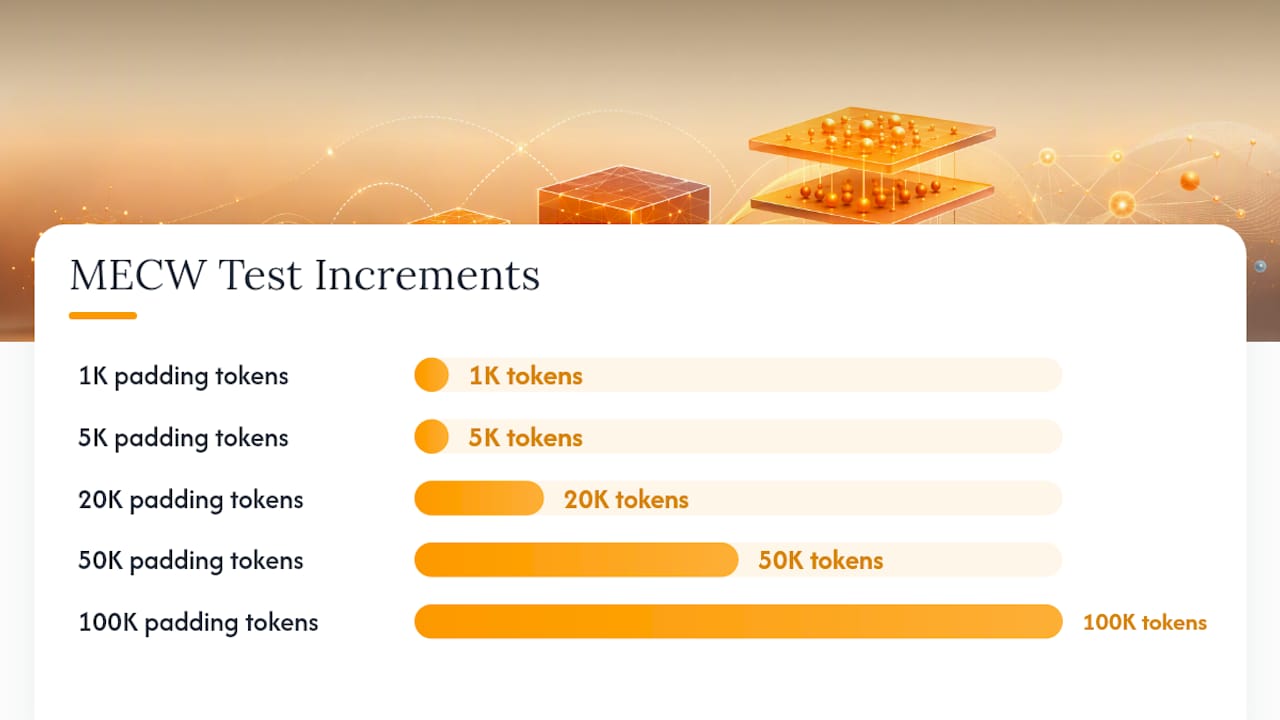
- Pad the surrounding context with realistic but irrelevant tokens in increasing increments (1K, 5K, 20K, 50K, 100K).
- Measure output accuracy and hallucination rate at each increment against a fixed ground truth.
- Plot where accuracy starts dropping. That inflection point is your working MECW for that task, not the vendor's spec sheet number.
The consequence for system design is simple: build your chunking, retrieval, and prompt-assembly logic around your measured MECW, not the advertised MCW. If your MECW for a given task tops out around 40K tokens, stuffing 150K tokens of "just in case" context doesn't add safety margin. It adds failure risk.
Building Memory That Actually Feeds the Context Window
Production systems that get this right almost never rely on a single flat context. They use a tiered structure that treats the window as a scarce resource to be curated, not filled.
The pattern that shows up repeatedly across practitioner writeups on memory architecture looks like this:
- Rolling summary at the front of the window. A compact, continuously updated synopsis of the conversation or task state, usually a few hundred tokens, sits at the top of every prompt.
- Recent raw turns immediately after it. The last several exchanges stay in full fidelity, since recency matters for coherence and the model needs unsummarized detail for the immediate task.
- Retrieval from long-term storage, pulled on demand. A vector store or structured database holds everything else, and the system queries it only when the current turn suggests relevant history exists.
Injection strategy matters as much as storage. Critical constraints, a user's stated preferences, hard business rules, safety boundaries, should be pinned near the top of the prompt every time, not left to compete with recent chat noise for the model's attention. Everything older gets summarized rather than replayed verbatim; you lose some narrative texture but keep the token budget under control.
Server-side compaction handles a lot of this automatically now. Claude's platform documentation describes compaction and prompt caching as built-in mechanisms that reduce token costs and extend usable session length without requiring a bigger raw window, and extraction-at-session-close (pulling durable facts out before the session's working memory disappears) is what actually populates your long-term store for next time.
This is the exact problem some multi-agent architectures address: a lead agent breaks work into tasks, assigns them to isolated workers, and shared memory compounds across runs instead of resetting with every new session, so contextual knowledge accumulates rather than evaporating.
Pro Tip: Run your extraction-at-session-close logic through a readability check, like the one at BabyLoveGrowth's LLM readability tool, before storing summaries long-term. A summary that's dense and ambiguous to a human reviewer will retrieve poorly later, even if the model wrote it confidently.
A Practical Checklist for Engineers Building Memory Systems
Turning the architecture above into something you can actually ship comes down to four decisions, made in order.
- Run the MECW test on your top three production task types first. Don't guess. Use the padding method from the MECW section above and log accuracy against context length for each task category separately, since MECW is task-specific, not model-specific.
- Classify every piece of incoming information at ingestion time. Build a simple decision tree: is this session-only (discard after the conversation ends), short-term (relevant for days, store with a TTL), or long-term (durable fact, write to the vector store with a timestamp and source)? Most teams skip this step and end up with an undifferentiated memory dump that's expensive to query and impossible to trust.
- Standardize your injection pattern. Pin hard constraints at the top of every prompt regardless of recency. Compact older turns into summaries rather than replaying them raw. Set explicit TTLs on short-term memory so stale facts don't linger and get retrieved as if they're current.
- Instrument the right SLIs. Track token budget consumed per request, cache hit rate on your semantic or prompt cache, and hallucination rate normalized per thousand tokens of injected context, not just per request. A rising hallucination-per-token metric is often the earliest signal that context rot is creeping into your pipeline before users start complaining.
One number worth internalizing: because attention cost scales at O(n²), every doubling of your injected context roughly quadruples the attention compute for that request. If your MECW test shows accuracy plateaus at 30K tokens, injecting 80K "to be safe" isn't just wasteful, it's paying quadratic cost for tokens that measurably hurt output quality.
Where Memory Systems Break in Production
Three failure modes show up again and again, and each has a known fix.
Memory poisoning happens when bad or malicious data gets written into long-term storage and then gets treated as trusted fact in every future session. Validate on write, not just on read, apply TTLs so unverified facts expire, and keep a write-audit trail so you can trace and roll back a poisoned entry. The deeper mechanics of this problem, and how it compounds over repeated writes, are worth a closer look in this breakdown of memory poisoning and decay.
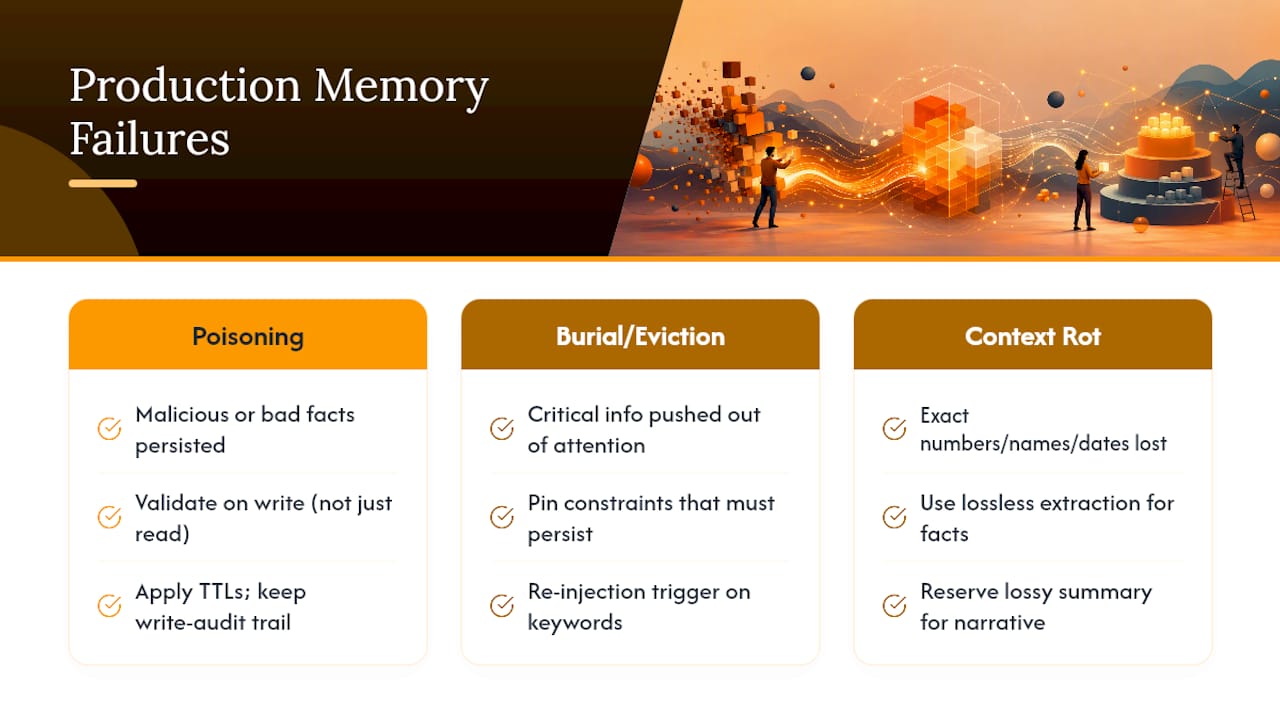
Burial and eviction occur when critical information gets pushed out of the effective attention range as new turns pile on, even though it's technically still in the window. Pin constraints that must never be forgotten, and build a re-injection trigger that surfaces them again when relevant keywords appear.
Context rot from over-compression loses exact values, numbers, names, dates, when summarization gets too aggressive. Use lossless extraction for anything numeric or identity-bound, and reserve lossy summarization for narrative flow only.
Pro Tip: Cost blowouts usually trace back to one habit: re-sending full history every turn instead of using prompt caching or semantic caching tiers. Fix the caching layer before you touch the model.
What Actually Matters When You Design Memory Policy
Memory policy isn't an infrastructure afterthought, it's a product decision disguised as a technical one. Every choice about what gets written, what gets forgotten, and what gets re-injected shapes how the system behaves for a real user, and most teams make these choices implicitly by default instead of deliberately.
The trade-off worth accepting early: pick your entity resolution and write-validation rules before you scale write volume, because retrofitting them onto a poisoned or messy store is far more expensive than building them in from day one. The trade-off worth postponing: exact eviction thresholds and TTL tuning, which you genuinely can't get right until you've measured real MECW behavior against production traffic.
What gets underrated across most engineering discussions of this topic is verifiability. A memory system that can't show you why it retrieved a given fact is a liability the moment something goes wrong in front of a customer. Architectures like the one behind agent-swarm.dev, where memory compounds across isolated worker containers with a lead agent coordinating retrieval, treat that traceability as a first-class requirement rather than a debugging afterthought.
— Ez.-
Where agent-swarm.dev Fits Into Your Memory Stack
If you've followed the architecture above, tiered memory, curated injection, retrieval on demand, the next question is whether to build it yourself or adopt something that already implements the pattern. Some open-source operating systems for multi-agent work use a lead agent to break objectives into tasks, assign them to workers running different AI tools inside isolated containers, and employ shared memory that compounds across runs instead of resetting with each session.

Such solutions fit teams that need owned, persistent memory across recurring engineering workflows, not a one-off chatbot with a bigger context window bolted on. Integrations typically span Slack, Linear, GitHub, and dashboards, allowing the orchestration layer to connect directly to common team tools, with options to self-host or use managed cloud subscriptions.
The fastest way to evaluate fit is to look at how it behaves against the alternatives you're already considering. Browse real session examples to see the memory-and-orchestration pattern in action, or check the comparison against other agent architectures if you're weighing it against a hosted workspace or a single-agent framework.
Sources
The MECW study is the primary empirical source for why advertised context limits overstate real-world performance, worth reading in full if you're designing chunking strategy. Redis's context window breakdown covers the hardware and algorithmic mechanics in more depth than most vendor docs bother to. The Hindsight piece on why context isn't memory makes the persistence argument concisely. Claude's platform documentation is the closest thing to a primary source on compaction and token accounting in a real production API.
- Context Is What You Need: The Maximum Effective Context Window for Real World Limits of LLMs
- LLM context windows: Understanding and optimizing working memory
- Your 1M-Token Context Window Is Not Memory | Hindsight
- Claude platform docs — context windows and compaction
FAQ
How is memory different from context?
Context is the volatile set of tokens a model can attend to in one request, and it disappears when the session ends. Memory is a persistent store that consolidates and timestamps facts, then retrieves relevant slices back into context on demand.
Is a higher context window better?
Not automatically. Research on maximum effective context window shows accuracy and reliability often degrade well before the advertised token limit, so a bigger MCW without curated retrieval can hurt performance rather than help it.
How much memory does AI require?
There's no fixed number. Requirements depend on task type, entity volume, and retention window; the right approach is to classify data as session-only, short-term, or long-term at write time rather than sizing a single flat store.
Which LLM model has the highest context window?
Published maximums change frequently across vendors, and the more useful question is each model's measured effective context window for your specific task, since MECW varies significantly by task type even within the same model.
Can a system like agent-swarm.dev replace manual memory management?
It handles the orchestration and persistence layer, letting shared memory compound across isolated agent workers instead of resetting per session, which removes most of the manual bookkeeping engineers otherwise build by hand.
Recommended
Related field notes
Patrones y dimensionado: autohospedaje de agentes para ingenieros
Cómo autohospedar agentes: patrones de sesión, fórmulas de dimensionado, checklist operativa y seguridad. Ejemplos en agent-swarm.dev
De horas a minutos: triage de tickets IA para soporte e ingeniería
Plan operativo para implantar triage de tickets con IA en colas reales: diseño del flujo, umbrales, riesgos y lista para líderes de soporte.
Cut AI Agent Cold Starts Up to 90% with Agent Sandbox on Kubernetes
A practical platform checklist to deploy AI agents on Kubernetes using Agent Sandbox, Kueue, KServe, KEDA, Pod Snapshots, warm pools, and full observability.