Multi-Agent Orchestration: The Production Architect's Guide
Discover how multi-agent orchestration enhances workflows by coordinating specialized AI agents for efficient, auditable task management.
Multi-agent orchestration is the engineering layer that coordinates specialized AI agents into a governed, auditable workflow. The recommended pattern: a coordinator agent decomposes objectives, routes tasks to workers running in isolated sessions, exchanges typed messages over protocol-backed channels (MCP for tool access, A2A for peer coordination), and aggregates results under continuous observability. Use multi-agent orchestration when a task exceeds a single context window, requires parallel execution across domains, or demands audit trails that a solo agent loop cannot produce. Stick with a single agent when the task is bounded, sequential, and low-stakes.
- Use multi-agent orchestration when: tasks span multiple domains, require parallelism, need role-based access controls, or must produce auditable decision trails.
- Stay with a single agent when: the workflow fits in one context window, failure recovery is trivial, and governance overhead would exceed the productivity gain.
Key Takeaways
Multi-agent orchestration requires a coordinator, bounded sessions, typed messages, and observability as the non-negotiable production baseline.
| Point | Details |
|---|---|
| Coordinator is the control plane | It decomposes, routes, enforces policy, and aggregates — workers only execute scoped tasks. |
| Pattern choice drives architecture | Sequential for ordered pipelines, concurrent for parallel tasks, hierarchical for org-scale governance. |
| Typed messages prevent deadlocks | Apply JSON Schema or Protobuf at every session boundary; use MSC projection for formal correctness. |
| Phased rollout reduces risk | Discovery → pilot → staged rollout → governance; gate each stage on measured KPIs, not calendar dates. |
| agent-swarm ships the infrastructure | Session manager, task router, RBAC, and observability are built in, covering the production baseline on day one. |
Table of Contents
- How does multi-agent orchestration actually work at runtime?
- What are the core orchestration patterns, and when should you use each?
- What architecture components does every production system need?
- LLM-driven planning vs. code-driven orchestration: which approach fits your system?
- How do you make multi-agent coordination provably correct?
- How should you design and roll out a multi-agent system in practice?
- Testing, monitoring, and governance for multi-agent workflows
- What do enterprise multi-agent workflows look like in practice?
- Our take: what most teams get wrong about multi-agent systems
- agent-swarm gives you the coordination infrastructure, not just the agents
- Sources
- FAQ
How does multi-agent orchestration actually work at runtime?
The coordinator is the control plane. It receives a high-level objective, decomposes it into discrete tasks, selects the appropriate worker agent for each task, opens a bounded coordination session, and enforces policy throughout. Enterprise orchestration requires at minimum a task routing engine, a memory/state layer, conflict-resolution guardrails, and monitoring — these four components define the production floor.
Each worker runs in an isolated execution context: its own tool-access scope, its own token budget, and no direct visibility into sibling workers' state. This isolation is not just a security boundary; it keeps logs coherent and makes replay debugging tractable. The coordinator passes typed messages into each worker's session and waits for a structured result before aggregating.
A minimal dispatch loop looks like this:
# coordinator.py
tasks = planner.decompose(objective)          # LLM or rule-based decomposition
futures = [worker_pool.dispatch(t) for t in tasks]  # isolated sessions per task
results = await asyncio.gather(*futures)       # wait for all workers
output = aggregator.merge(results)             # typed result merge
Microsoft's multi-agent guidance adds three authoring rules that materially reduce runtime errors: the parent agent must enforce the single-response principle, subagents must be explicitly told they are subagents and must not reply to the user directly, and subagents should have non-overlapping knowledge sources. Violating any of these produces duplicate responses, role confusion, and logs that are nearly impossible to audit.
Pro Tip: Instrument every session boundary, not just the final output. Log the task ID, worker ID, token count, and wall-clock duration at dispatch and at result receipt. That four-field tuple is enough to reconstruct any session post-mortem without storing full message payloads.
| Coordinator responsibility | Worker responsibility |
|---|---|
| Decompose objective into typed tasks | Execute one task within scoped tool access |
| Open and close bounded sessions | Report structured result or error code |
| Enforce policy and guardrails | Never write to shared state directly |
| Aggregate results and handle retries | Surface token usage and latency metrics |
What are the core orchestration patterns, and when should you use each?
Five patterns cover the majority of production workflows. Choosing the wrong one is the most common early-stage mistake, so the decision criteria matter as much as the pattern descriptions.
Sequential runs tasks in a strict dependency chain. Each agent's output is the next agent's input. Use this when correctness depends on ordering (e.g., data extraction → validation → report generation) and latency is acceptable. Testing is straightforward; a failure at step N halts the chain cleanly.
Concurrent dispatches independent tasks in parallel and merges results. Latency drops proportionally to the number of parallel branches, but cost rises with it. Use this when tasks are genuinely independent and the aggregation logic is deterministic. The tradeoff: partial failures require explicit merge-time handling.
Group chat routes messages through a shared channel where multiple agents can respond. This pattern fits brainstorming, multi-perspective review, and consensus workflows. Determinism is low; governance overhead is high. Coordination research frames "who to coordinate with" and "how to coordinate" as the two core questions — group chat answers both dynamically, which is its strength and its testing liability.
Handoff transfers full session context from one agent to another at a defined transition point. Use this for escalation paths (e.g., tier-1 support → specialist) where the receiving agent needs the full prior context. The risk is context bloat: passing an entire session history inflates token costs and can confuse the receiving agent if the handoff schema is not typed.
Hierarchical/federated nests coordinators: a top-level orchestrator delegates to sub-coordinators, each managing their own worker pools. This is the right pattern for org-scale automation where governance boundaries map to team or domain boundaries. Complexity scales with depth; test each layer independently before composing.
| Pattern | Best for | Key tradeoff |
|---|---|---|
| Sequential | Ordered pipelines, data transforms | Higher latency; clean failure propagation |
| Concurrent | Independent parallel tasks | Higher cost; partial-failure handling required |
| Group chat | Multi-perspective review, consensus | Low determinism; hard to test exhaustively |
| Handoff | Escalation, specialist routing | Context bloat risk; requires typed handoff schema |
| Hierarchical | Org-scale, multi-domain governance | High complexity; test layers independently |
What architecture components does every production system need?
Production multi-agent systems are not just a coordinator and some workers. Seven components define a complete control plane, and gaps in any of them show up as incidents.
- Task/router engine: Parses the decomposed task list, selects the worker agent by capability manifest, and enforces routing rules (e.g., PII-tagged tasks go only to compliant workers).
- Session manager: Opens, tracks, and closes bounded coordination sessions. Stores session metadata (task ID, worker ID, start time, status) durably so the coordinator can resume after a crash.
- Memory/state layer: Maintains shared context that compounds across sessions — prior results, user preferences, domain knowledge. Compaction is critical: summarize completed session outputs rather than appending raw transcripts, or token costs grow unbounded.
- Tool and connector layer: Scopes tool access per agent. An agent that needs only a read-only database query should never hold a write credential. MCP handles this boundary cleanly.
- Policy/guardrails: Enforces content filters, rate limits, cost caps, and compliance rules before any tool call executes. This is not optional in enterprise deployments.
- Observability/telemetry: Distributed tracing with parent/child session linkage, per-agent token and cost metrics, and business-outcome metrics (tasks completed, error rate, latency percentiles).
- QA/ops tooling: Synthetic replay tests, domain-mismatch detectors, and a human-escalation path for tasks the system cannot resolve with sufficient confidence.
Standardized orchestration architectures integrate planning, policy enforcement, state management, and quality operations into a coherent control plane — the framing that turns a collection of agents into a goal-directed collective.
Pro Tip: Set a per-session token budget at the session manager layer, not inside each worker's prompt. A worker that exceeds its budget should return a structured BUDGET_EXCEEDED error, not silently truncate its output. This keeps cost accounting exact and makes the coordinator's retry logic deterministic.
| Component | Primary function | Where to enforce access control |
|---|---|---|
| Task/router engine | Capability-based dispatch | Routing rules, capability manifests |
| Session manager | Lifecycle and durability | Session metadata store, crash recovery |
| Memory/state layer | Shared context, compaction | Read/write scopes per agent role |
| Tool/connector layer | External API and data access | MCP scopes, credential vaults |
| Policy/guardrails | Compliance, cost, content | Pre-execution policy engine |
| Observability | Tracing, metrics, alerting | Centralized telemetry pipeline |
LLM-driven planning vs. code-driven orchestration: which approach fits your system?
The choice between LLM-driven planning and code-driven orchestration is not binary, and treating it as such is where most teams get into trouble.
LLM-driven planning lets a runtime planner generate the workflow dynamically from a natural-language objective. The benefit is flexibility: the planner can handle novel task structures without code changes. The risk is unpredictability — the planner may produce structurally invalid workflows, hallucinate agent capabilities, or generate plans that deadlock under concurrent execution. Without a validation layer, these failures surface at runtime, often in production.
Code-driven orchestration uses deterministic schedulers or rule engines to execute pre-authored workflows. Correctness is high; adaptability is low. Any workflow change requires a code deployment. This is the right choice for high-volume, well-understood pipelines where the task space is stable.
The hybrid pattern is what most mature teams converge on:
- A planner LLM generates a candidate workflow (expressed as a typed task graph or MSC-style specification).
- A verifier validates the plan against session invariants and typed message schemas before execution begins.
- A scheduler enforces the validated plan, dispatching tasks to workers and handling retries according to the task state machine.
# hybrid_orchestrator.py
raw_plan = planner_llm.generate(objective)       # LLM output: task graph JSON
validated = verifier.check(raw_plan, schema)     # typed schema + invariant check
if not validated.ok:
    raise PlanValidationError(validated.errors)  # reject before any worker runs
scheduler.execute(validated.plan, worker_pool)   # deterministic dispatch
Research on MSC-based projection demonstrates that designing global workflows as message sequence chart specifications and projecting them into per-agent programs yields deadlock-free local programs even when LLM outputs are nondeterministic at action points. The open-source Python implementation ZipperGen shows this is practical, not just theoretical.
| Approach | Flexibility | Determinism | Testing complexity |
|---|---|---|---|
| LLM-driven planning | High | Low | High (nondeterministic outputs) |
| Code-driven orchestration | Low | High | Low (deterministic paths) |
| Hybrid (plan + validate + schedule) | Medium-high | Medium-high | Medium |
How do you make multi-agent coordination provably correct?
Correctness in distributed agent coordination is not a property you assert — it is one you design for. Two protocol layers and one formal method cover the ground.
Model Context Protocol (MCP) standardizes how agents access tools and external context. It gives each agent a typed, scoped interface to data sources and APIs, which means tool-access errors are caught at the protocol boundary rather than inside an agent's reasoning loop.
Agent-to-Agent (A2A) protocol handles peer coordination: how agents discover each other, negotiate capabilities, and exchange structured messages. Together, MCP and A2A create an interoperable communication substrate that reduces vendor lock-in and enables mixing specialized models in a single workflow.
MACP (Multi-Agent Coordination Protocol) goes further. It structures coordination around bounded Coordination Sessions and ambient Signals: Sessions are binding interactions with defined lifecycles; Signals are non-binding ambient broadcasts. The normative core is small and stable; domain-specific modes live in incubator RFCs, so runtimes can evolve without breaking backward compatibility.
For formal correctness, the MSC/projection approach is the most practical option available today:
Designing global workflows as message sequence chart (MSC) specifications and projecting them into per-agent local programs via syntax-directed projection yields deadlock-free coordination even when LLM outputs are nondeterministic. The ZipperGen implementation demonstrates this end-to-end in Python.
Source: Provable Coordination for LLM Agents via Message Sequence Charts
Where to apply typed schemas and session invariants:
- Message payloads between coordinator and workers (use JSON Schema or Protobuf, not free-form strings).
- Session open/close events (typed metadata: task ID, agent ID, capability version, timestamp).
- Tool call inputs and outputs (enforce at the MCP layer, not inside the agent prompt).
- Escalation and handoff events (typed handoff schema with required fields prevents context loss).
Pro Tip: Write agent instructions using strong imperative language — MUST, ONLY, NEVER — for every constraint that matters at runtime. Ambiguous instructions produce ambiguous behavior, and ambiguous behavior in a multi-agent system compounds across every worker that reads the same instruction set. Microsoft's authoring guidance confirms this as a production best practice.
How should you design and roll out a multi-agent system in practice?
Before writing any orchestration code, answer these four questions for each candidate task:
- Is the task sensitive? If it touches PII, financial records, or regulated data, map the compliance requirements before assigning it to any agent.
- Is it domain-fit? Agents perform well on tasks with clear success criteria and structured outputs. Open-ended creative tasks with no verifiable output are poor candidates for autonomous execution.
- Is it repetitive? High-frequency, low-variance tasks deliver the clearest ROI. One-off tasks with high variance are better handled by a human with agent assistance.
- Is it recoverable? If the task fails partway through, can the system roll back or retry safely? Tasks with irreversible side effects (e.g., sending emails, executing financial transactions) need explicit approval gates.
Agent density is where teams consistently over-engineer. More agents do not mean more capability — they mean more coordination overhead, more failure modes, and harder debugging. Agent density guidance recommends starting with the minimum number of agents that covers the domain split, then adding workers only when a bottleneck is measured, not anticipated.
Anti-patterns to avoid:
- One agent per API endpoint (creates coordination overhead with no domain benefit).
- Agents with overlapping knowledge sources (produces duplicate or conflicting outputs).
- Sessions without explicit timeout and budget caps (costs spiral in long-running workflows).
A phased rollout reduces risk. Enterprise adoption frameworks recommend a structured progression:
- Discovery (weeks 1–2): Map one high-frequency, recoverable workflow. Define success metrics (latency, error rate, cost per task).
- Pilot (weeks 3–6): Deploy coordinator + 2–3 workers in a sandboxed environment. Run synthetic tests and measure against baseline.
- Staged rollout (weeks 7–12): Introduce real traffic at 10%, then 50%, then 100%. Gate each stage on KPI thresholds.
- Governance (ongoing): Lock tool-access scopes, enable RBAC, activate audit logging, and schedule quarterly role-binding reviews.
For durable one-off runs that need crash recovery, pair the scheduler with a task state machine that defines explicit retry and rollback semantics before any worker touches production data.
Testing, monitoring, and governance for multi-agent workflows
Testing a multi-agent system requires more than unit tests on individual agents. The interaction surface is the system's most failure-prone layer.
- Unit tests: Test each agent in isolation with fixed inputs and assert on output schema, not content. This catches tool-access misconfigurations and prompt regressions before integration.
- Synthetic replay tests: Record real coordinator/worker message exchanges, then replay them against new agent versions. Any schema deviation or unexpected tool call is a regression signal.
- End-to-end scenario tests: Run full workflows against a staging environment with mocked external APIs. Measure latency, token cost, and business-outcome metrics against the pilot baseline.
- Domain-mismatch tests: Deliberately send tasks to the wrong worker type and assert that the router rejects them. This validates routing logic and capability manifests.
Observability requires parent/child session linkage in every trace. A trace that shows only the coordinator's view is useless for debugging a worker failure. Every log entry should carry: session_id, parent_session_id, agent_id, task_id, token_count, duration_ms, and status.
Governance in production means three things: RBAC for tool access (no agent holds credentials it does not need for its assigned task), audit logs that are immutable and queryable by session and agent ID, and escalation flows that route low-confidence or policy-blocked tasks to a human reviewer without dropping the session context.
A 7-state task lifecycle — covering states from PENDING through RUNNING, RETRYING, BLOCKED, ESCALATED, COMPLETED, and FAILED — gives the session manager enough information to recover from worker crashes without losing task context or double-executing side effects.
Pro Tip: Build a synthetic replay alert: any time a production session's message sequence diverges from its nearest recorded replay baseline by more than a defined threshold (e.g., a new tool call type or a schema field mismatch), fire an alert before the session completes. This catches orchestration drift early, before it compounds across hundreds of sessions.
| Failure mode | Symptom | Mitigation |
|---|---|---|
| Orchestration drift | Agents diverge from assigned roles over time | Lock tool-access and capability manifests at config time |
| Deadlock | Sessions hang indefinitely | Apply MSC projection; set session timeouts |
| Duplicate responses | Multiple workers reply to the same user turn | Enforce single-response principle at coordinator |
| Context bloat | Token costs grow unbounded in long sessions | Compact memory layer; summarize completed sessions |
| Partial failure cascade | One worker failure blocks the whole pipeline | Define per-task retry semantics in the state machine |
What do enterprise multi-agent workflows look like in practice?
Five use cases cover the patterns most engineering and operations teams encounter first.
Customer support routing uses a hierarchical pattern: a triage coordinator classifies the incoming request, routes to a tier-1 worker for standard resolutions, and hands off to a specialist coordinator (with full session context) when the confidence score falls below a threshold. Guardrails block any worker from accessing account data outside the customer's own record.
Engineering triage runs concurrently: a coordinator receives a GitHub issue or alert, dispatches parallel workers to check logs, query the knowledge base, and scan recent deployments, then aggregates findings into a structured incident report. Failure strategy: if any worker times out, the coordinator proceeds with available results and flags the gap.
Finance reconciliation is strictly sequential: extract → validate → match → flag discrepancies → generate report. Each step's output is the next step's typed input. Any validation failure halts the chain and routes to a human reviewer via the escalation flow.
Content generation and review uses a group-chat pattern for the review stage: a drafting agent produces content, then a fact-checker agent and a style agent both review it in a shared session. The coordinator collects both review outputs and applies a merge policy (e.g., fact-check failures block publication; style suggestions are advisory).
DevOps runbook automation pairs a handoff pattern with an approval gate: a diagnostic agent identifies the remediation action, hands off to a remediation agent with the full diagnostic context, but the remediation agent's tool call to execute the fix requires an explicit human approval signal before proceeding.
A representative interaction snippet from an engineering triage session:
Coordinator → LogWorker:
{"task": "search_logs", "session_id": "s-4821", "query": "OOMKilled", "window_minutes": 60}LogWorker → Coordinator:
{"session_id": "s-4821", "status": "ok", "findings": [{"pod": "api-7f9b", "timestamp": "2026-03-14T02:17:33Z", "event": "OOMKilled"}], "token_count": 312}Coordinator → Aggregator: merge findings from LogWorker, DeployWorker, KBWorker → structured incident report
Real session examples from production agent-swarm deployments are available at Agent-swarm.
Our take: what most teams get wrong about multi-agent systems
We have watched teams deploy multi-agent systems that reproduce every organizational dysfunction they already had — just faster and at greater scale. Multi-agent systems mirror organizational anti-patterns: unclear ownership, overlapping responsibilities, and missing escalation paths all show up in agent behavior if they exist in the team's design process.
The most common mistake is treating orchestration as a prompt-engineering problem. It is not. It is a distributed systems problem with an LLM at one decision point. The same properties you'd demand from a microservices architecture — typed interfaces, bounded failure domains, observable state transitions, explicit retry semantics — apply here, with the added complexity that one of your "services" is nondeterministic.
Our recommended starting point for any team:
- Pick one workflow that is high-frequency, recoverable, and has a measurable baseline (latency, error rate, cost).
- Deploy the minimum viable coordinator with two workers and full observability before adding any more agents.
- Validate coordination correctness using typed message schemas and a session invariant check before going to production traffic.
- Lock role bindings at configuration time. Orchestration drift is real and it compounds; catching it at config time costs nothing compared to debugging it in production.
- Run synthetic replay tests on every agent version bump, not just on major releases.
agent-swarm fits into this stack as the session manager, task router, and observability layer — so teams can focus on workflow design rather than building coordination infrastructure from scratch. The comparison page shows where it differs from building on raw framework primitives.
agent-swarm gives you the coordination infrastructure, not just the agents
Most teams spend their first two months building the plumbing: session managers, task routers, retry logic, audit logs, and RBAC. agent-swarm ships all of that as a working system on day one.
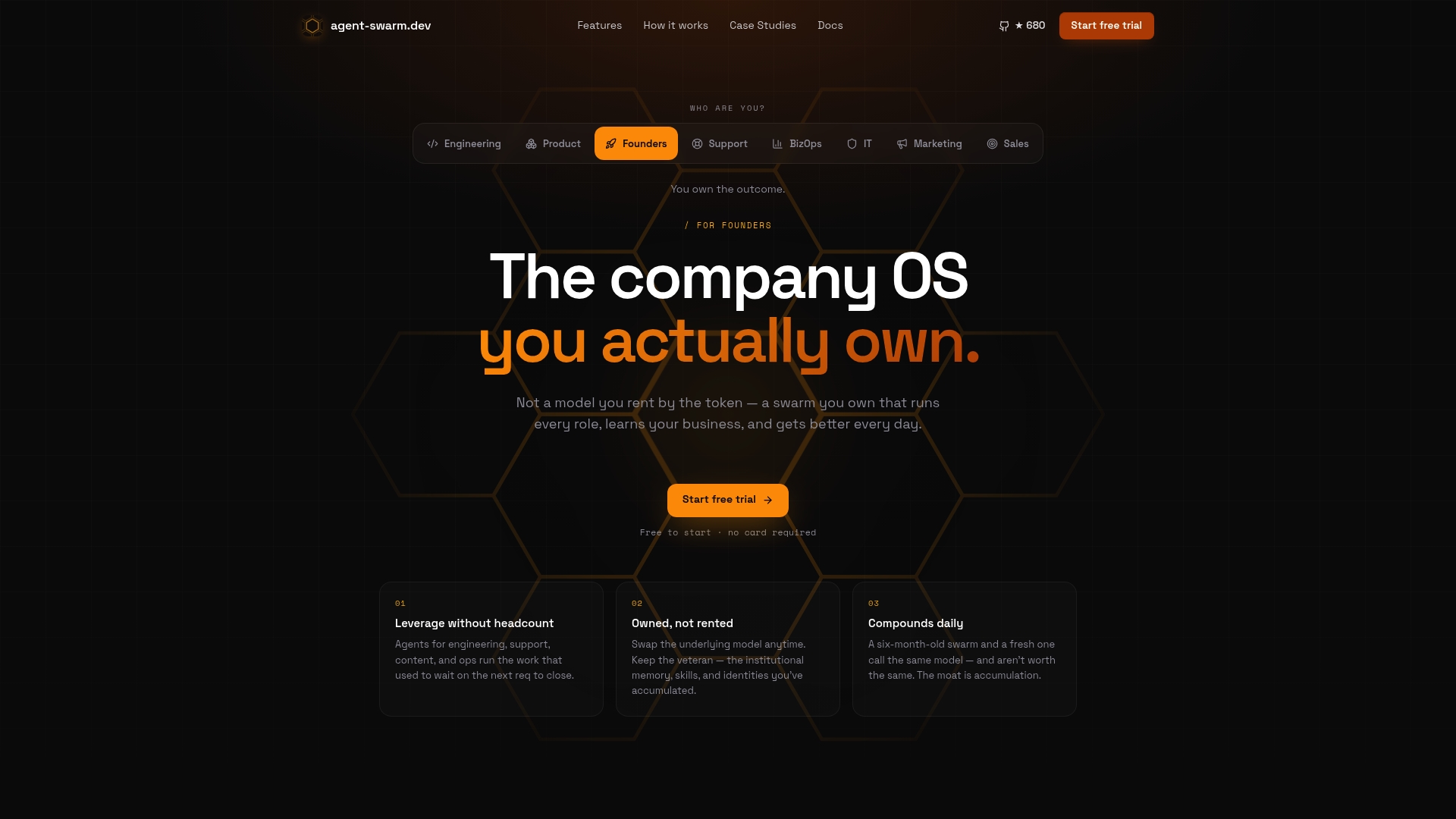
The architecture maps directly to what this guide recommends: a lead agent decomposes objectives and routes tasks to specialized workers (Claude Code, Codex, OpenCode) running in isolated Docker containers, with persistent memory that compounds across sessions. Connectors to Slack, GitHub, Linear, and hundreds of other platforms are built in. RBAC, audit logging, and per-session token accounting are on by default, not bolted on later.
Deployment options: self-hosted MIT open-source (free, no vendor dependency), cloud SaaS billed by active workers with a 7-day free trial, or an enterprise package with dedicated support and custom integrations. For teams evaluating fit before committing, real session examples show exactly how the coordinator/worker pattern runs in production. To start a pilot or explore pricing, visit Agent-swarm.
Sources
Start with the practical docs, then move to patterns, then to formal verification papers.
- multiagentcoordinationprotocol/multiagentcoordinationprotocol
- multi-agent-patterns
- Agent orchestration explained: How enterprises manage ...
- Multi-agent coordination studies survey
FAQ
What is multi-agent orchestration?
Multi-agent orchestration is the coordination layer that routes tasks from a central coordinator to specialized worker agents, manages session boundaries, enforces policy, and aggregates results into a coherent output. It differs from a single-agent loop in that it supports parallelism, role-based access control, and auditable session trails.
When should you use a multi-agent system instead of a single agent?
Use multi-agent orchestration when a task exceeds a single context window, requires parallel execution across domains, or needs audit trails and RBAC that a solo agent cannot provide. For bounded, sequential, low-stakes tasks, a single agent is simpler and cheaper.
How do you prevent deadlocks in multi-agent coordination?
Apply MSC-based projection to generate deadlock-free per-agent programs from a global workflow specification, set explicit session timeouts at the session manager layer, and use typed message schemas that reject malformed payloads before they enter the coordination loop. The ZipperGen implementation demonstrates this approach in Python.
What protocols should enterprise multi-agent systems use?
MCP (Model Context Protocol) for scoped tool and context access, A2A (Agent-to-Agent) for peer coordination and capability negotiation, and MACP for bounded session management and transport bindings. Together they create an interoperable substrate that avoids vendor lock-in.
How does agent-swarm support production multi-agent orchestration?
agent-swarm provides a built-in session manager, task router, RBAC, audit logging, and per-session token accounting, with workers running in isolated Docker containers and connectors to Slack, GitHub, Linear, and other platforms. It is available as MIT open-source for self-hosting or as a cloud SaaS with a 7-day free trial.
Recommended
Related field notes
Multi Agent Patterns Engineers Actually Use in Production
Discover essential multi-agent patterns that optimize AI workflows. Learn how to implement effective strategies for production success.
Multi-Agent Systems Reproduce Every Organizational Anti-Pattern You Already Hate
When autonomous AI agents share resources, they naturally replicate human organizational dysfunction. We catalog 5 production anti-patterns from our swarm of 11+ agents.
Your AI Workflow Has Too Many Agents
Six months ago every node in our content workflow was an agent. It cost $8 a run and produced different output every time. Today it costs $0.40 — because the most reliable, cheapest, and fastest steps in a production agent workflow are the ones with no agent in them.