Agent Reliability Engineering: 30 Day Plan for SREs
Map SRE practices to AI agents: set SLOs, run golden set evals, capture structured traces, and follow a 30 day plan to stabilize agent fleets.

Agent reliability engineering applies SRE principles to AI agents: define intent-driven SLOs, instrument structured tracing and golden-set evals, and use gated self-improvement pipelines so agents improve without surprising users. The immediate moves are simple to name and hard to skip: set SLOs before you scale, trace every reasoning step, run weekly golden-set evals, enforce error budgets that trigger automated throttles, and require human approval on any self-generated change.
TL;DR:
- Setting SLOs based on task success rate and hallucination rates is key, with targets tailored to the agent’s role and real production data.
- Structured reasoning traces and version-controlled golden sets are essential for identifying silent failures and tracking agent improvements over time.
- Automated error response and chaos engineering can safely identify and address failure modes in production agents without risking customer impact.
- Human approval gates and git-backed configurations ensure safe self-improvement pipelines and reliable incident management.
- Implementing these practices with tools like agent-swarm streamlines orchestration, monitoring, and versioning for reliable agent operations.
Table of Contents
- What Does Agent Reliability Engineering Actually Map From SRE?
- How Do You Set SLOs and Error Budgets for Non-Deterministic Agents?
- How Do Golden Sets and Imp@k Metrics Measure Agent Improvement?
- What Should Structured Tracing Capture for Agent Debugging?
- How Should Teams Triage Agent Incidents and Codify Fixes?
- Can Chaos Engineering Work Safely on Production Agents?
- How Do Self-Improvement Pipelines Stay Safe and Auditable?
- What Capacity and Model-Tier Patterns Keep Agent Fleets Reliable?
- What's a Practical 30-Day Plan to Stabilize an Agent Fleet?
- How Does agent-swarm.dev Apply These Practices in Production?
- What Cultural Shift Actually Makes AgentRE Stick?
- Ready to Put These Patterns Into Production?
- Where to Go Deeper on Agent Reliability
- Sources
- FAQ
What Does Agent Reliability Engineering Actually Map From SRE?
If you've spent years running a service reliability program, you already own most of the mental model agent reliability engineering (often shortened to AgentRE) needs. The trick is translation, not reinvention. Agent Reliability Engineering explicitly adapts SRE practices, including SLOs, error budgets, and chaos testing, to the non-deterministic behavior of AI agent workflows, where failures show up as silent hallucinations or runaway cost rather than a 500 error.
The mapping breaks down cleanly once you stop treating "uptime" as the north star:
- SLOs → agent success rate. Instead of "99.9% of requests return in under 200ms," you track "task completed correctly, per intent, X of the time."
- Runbooks → skills. A runbook told a human engineer what to type; a skill tells the agent what tool sequence to run when it recognizes a pattern.
- Error budgets → allowed failure rate per task class. You still burn budget, but the failure mode is a wrong answer, not a stack trace.
- On-call rotation → human-in-the-loop review queue. Someone still gets paged, just for approval decisions instead of pages at 3 a.m.
- APM dashboards → structured reasoning traces. Green infra dashboards mean nothing if the agent quietly invents a customer record.
That last point is the one teams underestimate. Agent Reliability Engineering notes that many "agent" incidents are actually infrastructure noise that never surfaces in standard APM metrics, because the agent kept running, kept returning 200s, and simply did the wrong thing. Your CPU graph looked fine while the agent hallucinated a refund policy.
Start small. Pick one agent type in production today and map five SRE concepts to it on a whiteboard: what's the SLO, what's the runbook equivalent, who approves changes, what's the failure budget, and what telemetry would catch a silent failure. That single exercise usually surfaces at least one blind spot before you write a line of monitoring code.
How Do You Set SLOs and Error Budgets for Non-Deterministic Agents?
Uptime doesn't capture agent risk. An agent can be online, fast, and cheap while confidently producing garbage, which is why Agent SRE pushes teams toward intent-driven boundaries: define what the agent is supposed to accomplish, then measure deviation from that intent, not just system health.
Useful SLIs for agent fleets tend to cluster around five signals:
- Task success rate — did the agent complete the actual job the user asked for, verified against a golden answer or a downstream check.
- Tool-call accuracy — percentage of tool invocations with correct arguments and expected outputs.
- Hallucination rate — fabricated facts, citations, or data per N tasks, sampled and graded.
- Cost-per-task — token spend and API cost per completed unit of work, tracked against a budget ceiling.
- Latency to first useful output — not raw response time, but time to something the human can act on.
SLO targets should vary by role. An operations agent filing tickets or triaging alerts needs a tight success-rate SLO, often north of 98%, because the downstream cost of a wrong action (paging the wrong team, closing a live incident) is immediate. A research agent summarizing documents can tolerate a looser band, maybe 90 to 95%, because a human reviews the output before it ships anywhere consequential.
Pro Tip: Set your first SLO target deliberately low. An agent SLO calibrated against six weeks of real production data is worth more than a target borrowed from a blog post, and a too-strict target just trains your team to ignore alerts.
When a budget burns faster than expected, the response should be automatic, not a Slack thread. Throttle the agent's concurrency, roll back to the last known-good config, or escalate to a human reviewer, depending on how much budget remains. Agent SRE frames this escalation ladder as the mechanism that moves teams from manual, reactive debugging to something closer to automated incident response, where the system defends its own error budget before a human ever gets paged.
How Do Golden Sets and Imp@k Metrics Measure Agent Improvement?
You cannot eval everything an agent might encounter, and trying to is how eval programs die under their own weight. The fix is a golden set: a small, representative sample of tasks that stand in for the whole distribution, refreshed periodically as new failure modes surface. Run it weekly, not continuously. Agent Reliability Engineering (metrics and evals) describes lightweight, representative evals as the practical alternative to exhaustive testing, and a small golden set run consistently beats an ambitious eval suite nobody maintains.
Building one worth trusting means:
- Sampling tasks across difficulty tiers, not just the easy ones that always pass.
- Including known historical failure cases so regressions get caught before customers find them.
- Grading with a mix of automated checks and periodic human spot-review, since automated grading itself can drift.
- Versioning the golden set alongside your agent config, so you know exactly what was tested against what.
The imp@k family of metrics, imp@week, imp@skill, imp@config, measures improvement as a delta over time rather than a static score. Agent Reliability Engineering frames these as improvement-velocity metrics: imp@week tells you whether last week's changes moved the needle, imp@skill isolates whether a specific capability got better or worse, and imp@config ties performance changes directly to a specific configuration version.
The practical alerting pattern is the three-week rule: a single bad week is noise, but three consecutive weeks of negative imp@week deltas on the same skill is a regression worth a dedicated investigation, not a shrug. Our evaluation framework guide covers how to build the golden set itself.
What Should Structured Tracing Capture for Agent Debugging?
An agent trace that only logs the final output is worthless for debugging. You need the reasoning path: every intermediate thought, every tool call with its arguments and return value, every context snapshot the agent had access to at each decision point. Agent Reliability Engineering is direct about why this matters: structured tracing is what separates a genuine agent failure from infrastructure noise, and without step-level traces the two look identical from the outside.
A trace worth keeping records:
- The full input, including system prompt and any injected context, at the moment the agent started the task.
- Every intermediate reasoning step, not just the final answer.
- Each tool call: name, arguments, latency, and raw response.
- A snapshot of memory or retrieved context at each step, since agents often fail because they retrieved the wrong thing, not because they reasoned badly.
- The final output alongside the eval grade it received, if one exists.
Deterministic replay turns this telemetry into a debugging workflow instead of a wall of logs. Capture enough state to rerun the exact same task against the exact same context, then diff the new trace against the old one when you change a prompt or swap a model. That diff usually tells you in minutes what a Slack thread would take an hour to guess at.
Pro Tip: Run a small, idempotent health probe before launching any expensive multi-step agent workflow. Agent Reliability Engineering (runbook) recommends this specifically to avoid burning cost on a run that was doomed from the first tool call.
Tools like Langfuse and LangSmith give you this tracing layer without building it from scratch, and both plug into OpenTelemetry-based pipelines if your team already standardized on that for infrastructure observability. Agent Reliability Engineering (runbook) lists this kind of tight telemetry stack, paired with quick repair automation, as a baseline component of any serious agent operations setup.
How Should Teams Triage Agent Incidents and Codify Fixes?
Agent failures sort into a handful of recurring buckets, and naming them speeds up triage considerably:
- Planning errors — the agent chose the wrong approach to a solvable task, often visible in the trace as a reasonable-looking but wrong first step.
- Execution failures — the plan was fine, but a tool call failed, returned malformed data, or hit a rate limit the agent didn't handle gracefully.
- Hallucinations — the agent fabricated a fact, citation, or data point with full confidence and no supporting trace evidence.
- Infrastructure noise — the underlying model API, database, or network had a transient issue that looked like agent misbehavior but wasn't.
Triage starts by pulling the trace, not the output. Check whether the failure occurred in planning, execution, or generation, then confirm it isn't infra noise by checking the tool-call layer for timeouts or malformed responses. Immediate mitigation is usually one of three moves: roll back to the last stable config, throttle the affected skill's concurrency, or pull the task into a human review queue while you investigate.
The Rule of Three governs when a fix graduates from a one-off patch into a permanent skill: if the same failure pattern shows up three times, it stops being an incident and becomes a gap in the agent's skill library. Codify the fix as a reusable skill, version it, and add the failure case to your golden set so a regression gets caught automatically next time. Our failure taxonomy deep dive breaks these categories down further with real examples.

Can Chaos Engineering Work Safely on Production Agents?
Chaos engineering for agents means injecting realistic faults on purpose, in a controlled setting, so you find the failure mode before a customer does. Agent SRE treats fault injection, corrupted tool outputs, artificial latency, and tool exhaustion, as the mechanism for measuring how badly an SLO degrades under stress and for triggering automated rollback when the error budget gets exceeded.
Fault templates worth running regularly:
- Feed the agent a corrupted or truncated tool response and check whether it notices or confidently proceeds anyway.
- Inject artificial latency into a downstream API and watch whether the agent times out gracefully or hangs the whole workflow.
- Exhaust a rate-limited tool mid-task and see if the agent retries sanely or spirals into repeated failed calls.
- Feed it a slightly out-of-distribution task and watch whether it recognizes the boundary or fabricates an answer anyway.
Shadow mode is where you run this safely: the agent processes real traffic, but its output never reaches a user, only your eval pipeline. Canary gating extends that idea to rollout, a new config or model version only gets a larger traffic share once it clears both the golden-set eval and the live SLO check on a small slice of real tasks. If either gate fails, the rollback should be automatic and immediate, restoring the last git-tracked config that passed, not a manual scramble to remember what changed.
How Do Self-Improvement Pipelines Stay Safe and Auditable?
Letting an agent rewrite its own prompts or skills sounds risky because it is, unless the pipeline is built with a hard gate. Agent Reliability Engineering frames the safe version plainly: the agent proposes, a human approves, and only then does the change ship. Compounding improvement without a human bottleneck is how you end up debugging a config nobody remembers writing.
The pipeline stages that make this work:
- Data collection — capture failure traces, low-scoring eval runs, and near-miss cases as raw material for improvement proposals.
- Proposal generation — the agent (or a dedicated tuning process) drafts a specific change: a new skill, a prompt edit, an updated tool-selection rule.
- Human review — a reviewer sees the proposed diff, the eval delta it's expected to produce, and approves, rejects, or requests changes.
- Gated rollout — approved changes go through the same canary gating as any other config change, not a direct push to production.
Git-backed versioning is what makes this auditable rather than theoretical. Agent Reliability Engineering recommends git-tracked config snapshots for every agent identity, skill, and behavioral file (teams often call this a SOUL.md or equivalent), so any rollback or audit is a git diff away instead of a memory exercise.
Pro Tip: Treat every postmortem as raw material for memory consolidation, not a document that gets filed and forgotten. Distill the fix into a curated note the agent's long-term memory can actually retrieve next time a similar task appears. Our human-in-the-loop guide covers how to structure that review queue without turning it into a bottleneck.
What Capacity and Model-Tier Patterns Keep Agent Fleets Reliable?
Cost and latency control come down to fallback chains: route routine tasks to a cheaper, faster model tier, and escalate only when confidence scores or task complexity demand it. A fallback chain that always defaults to your most expensive model is a budget problem waiting to happen.
Capacity planning heuristics worth adopting early:
- Cap active workers per agent type based on observed cost-per-task, not theoretical throughput.
- Set concurrency limits per skill, since some tool calls (database writes, external APIs) can't scale linearly without breaking something downstream.
- Assign a hard per-task cost budget and kill runs that exceed it rather than letting a stuck agent burn tokens indefinitely.
Transfer experiments test whether an improvement made to one agent generalizes to another performing a similar task. Related work referenced by the HyperAgents research supports the idea that agent-based improvements can transfer systematically when measured with the same golden set across both agents, rather than assumed. Measure before and after transfer with the identical eval suite, or you're just guessing.
What's a Practical 30-Day Plan to Stabilize an Agent Fleet?
Reliability work compounds fastest when it follows a sequence instead of everything at once.
- Days 0 to 7: Instrument a golden set for your highest-traffic agent, define your first SLO and SLI set, wire up structured tracing, and add basic health probes before expensive runs.
- Days 8 to 14: Set error budgets per task class and configure burn-rate alerts so budget depletion triggers a Slack alert, not silence.
- Days 15 to 21: Run your first chaos experiments in shadow mode, corrupted tool outputs and injected latency are the easiest starting templates, and confirm your rollback automation actually fires.
- Days 22 to 30: Hold your first weekly eval review, tie any regression to a specific config version through your imp@config tracking, and codify one recurring incident as a skill under the Rule of Three.
After day 30, the cadence becomes the system: weekly eval reviews, three-week regression investigations when imp@week trends negative, and skill codification every time a failure repeats a third time. None of this requires a large team, but it does require someone accountable for the review queue, or the self-improvement pipeline stalls at the human-approval gate.
How Does agent-swarm.dev Apply These Practices in Production?
agent-swarm.dev runs its own agent fleet against most of the patterns above, not as theory but as the actual operating model. A lead agent breaks objectives into tasks, assigns them to isolated container workers running Claude Code, Codex, or OpenCode, and every worker's output feeds a shared memory layer that compounds across runs instead of resetting each time. Golden-set evals and persistent memory aren't bolted on afterward, they're part of how the orchestration layer decides whether a worker's output is trustworthy enough to hand off.
Integration patterns follow the same philosophy: Slack for human approval gates, GitHub for git-backed config and skill versioning, Linear for turning recurring incidents into tracked work. That combination is what makes the human-in-the-loop gate practical instead of a bottleneck, approvals happen where engineers already work, not in a separate dashboard nobody checks. Real session examples are worth reviewing directly for teams evaluating whether this orchestration model fits their own agent operations.
What Cultural Shift Actually Makes AgentRE Stick?
The technical patterns in this guide are the easy part. What actually determines whether agent reliability engineering survives contact with a real organization is whether reliability gets designed in before the agent ships, not bolted on after the first bad incident. Teams that instrument tracing and golden sets before automating anything catch their worst failure modes in a shadow environment instead of in front of a customer.
The harder discipline is trust calibration. An SLO is a promise you make to your own team about what "good" looks like, and every automated rollback or throttle either reinforces that promise or erodes it. Skip the human approval gate on self-improvement even once, and you've traded a reliability program for a faster way to accumulate undebuggable config drift.
Start with one agent type. Get its SLOs, tracing, and eval loop genuinely solid before expanding, then use transfer experiments to test whether what you learned actually generalizes rather than assuming it does. Reliability that scales sideways beats reliability that only ever worked for the pilot.
— Ez.-
Ready to Put These Patterns Into Production?
agent-swarm is the practical alternative to hand-rolling this entire stack yourself: orchestration, persistent memory, golden-set evals, and git-backed config versioning ship as one open-source operating system instead of five separate tools you have to wire together.
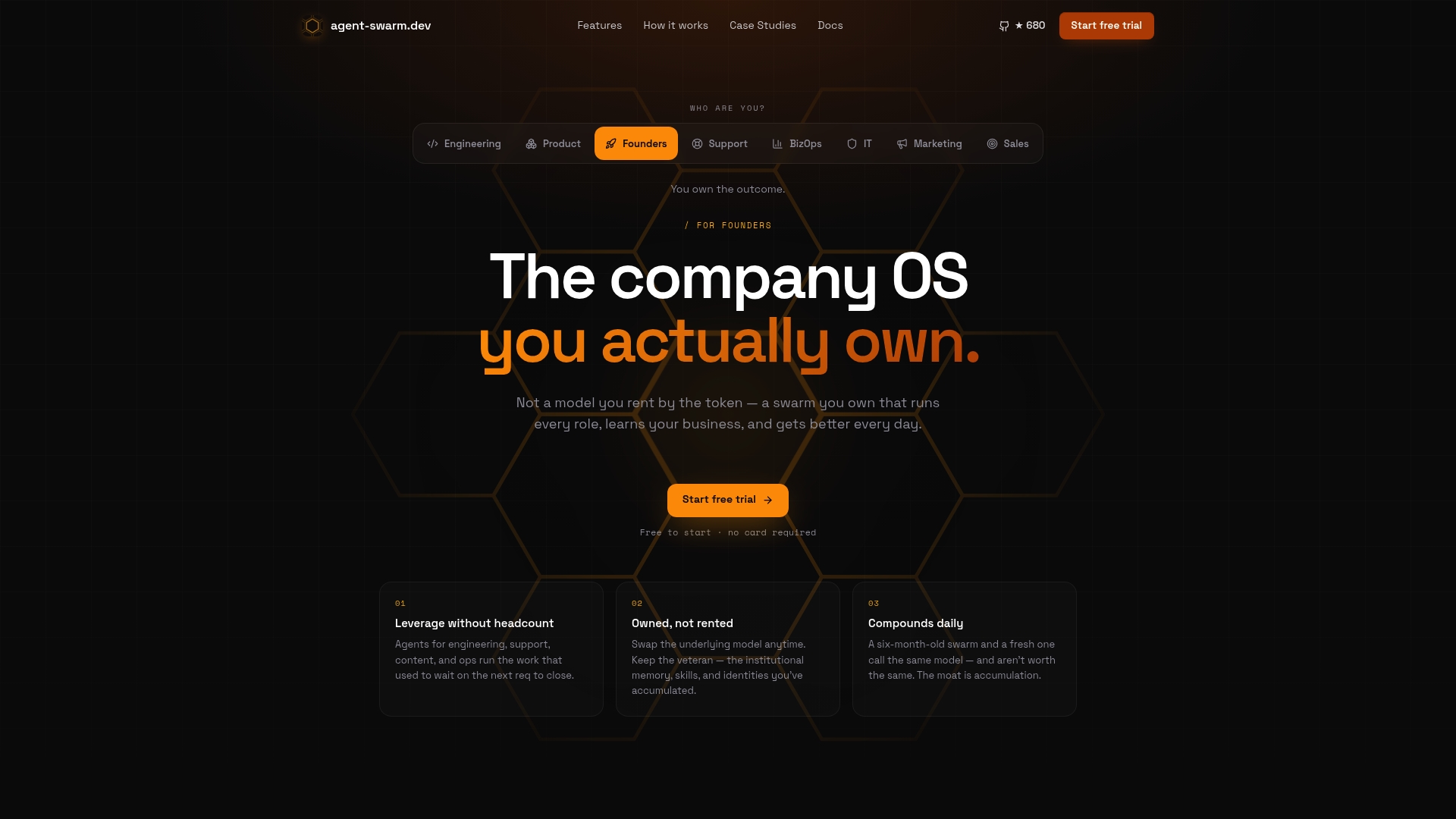
The lead agent breaks objectives into tasks and hands them to isolated container workers running Claude Code, Codex, or OpenCode, while shared memory compounds across every run instead of resetting each session. Integrations with Slack, GitHub, and Linear mean the human-approval gate on self-improvement lives inside tools your team already uses, not a bolted-on review dashboard. If you're weighing an owned, self-hosted swarm against a single AI-employee model, the comparison against Viktor breaks down when each approach fits better. Start by browsing Agent-swarm to see orchestration, evals, and memory consolidation running against actual tasks, then self-host the open-source version for free or spin up a cloud trial to test it against your own agent fleet this week.
Where to Go Deeper on Agent Reliability
For hands-on implementation detail beyond this guide, start with the Agent Reliability Engineering runbook for health checks and telemetry patterns, the Agent SRE toolkit for chaos engineering and SLO tooling, and the metrics and evals repository for imp@k formulas. Langfuse and LangSmith documentation cover the observability integrations referenced throughout, and the HyperAgents research is worth reading for the academic grounding behind transfer experiments.
Sources
- Agent Reliability Engineering: applying SRE principles to AI agent systems
- Agent Reliability Engineering (runbook)
FAQ
How much does an SRE get paid?
Compensation varies widely by region, seniority, and company size, but SRE roles typically command a premium over general software engineering roles because of the on-call and reliability accountability involved. Agent reliability engineering roles, being newer and requiring both ML and infra fluency, tend to price similarly to senior SRE positions at companies running production AI systems.
Is SRE a stressful job?
SRE carries real stress from on-call rotations and incident accountability, but well-instrumented systems reduce that load significantly. Agent reliability engineering can actually lower stress versus traditional SRE once error budgets and automated rollbacks are in place, because the system defends itself before a human gets paged.
What does an agent engineer do?
An agent engineer designs, deploys, and maintains AI agent systems, covering everything from prompt and skill design to the tracing, evals, and SLOs that keep those agents reliable in production. In practice, the role increasingly overlaps with agent reliability engineering, since building an agent and keeping it trustworthy require the same instrumentation.
Is SRE just DevOps?
No. DevOps focuses on the culture and tooling that connects development and operations, while SRE is a specific discipline that applies software engineering to operations problems through SLOs, error budgets, and measured reliability targets. Agent reliability engineering extends that SRE discipline specifically to non-deterministic AI agent behavior, which DevOps tooling alone doesn't address.
What tools support agent reliability engineering today?
Tools like Langfuse and LangSmith provide the structured tracing layer, while frameworks like the open-source AgentRE concepts and Microsoft's Agent SRE toolkit provide the SLO, error-budget, and chaos-engineering patterns. Platforms like agent-swarm combine orchestration, persistent memory, and evals into one operating system rather than requiring teams to integrate each piece separately.
Recommended
Related field notes
Multi Agent Patterns Engineers Actually Use in Production
Discover essential multi-agent patterns that optimize AI workflows. Learn how to implement effective strategies for production success.
Stop Agentic RAG Failures with 5 Evaluation Controls for Engineers
Practical guide for engineers to evaluate agentic RAG: a 5 step checklist, golden set CI gates, traceable execution traces, and role level cost controls.
Prueba en una tarde: aprobaciones en Slack IA con MCP para ingeniería
Guía técnica para responsables de ingeniería. Implementa aprobaciones humanas en Slack con MCP, tarjetas Block Kit, registro append-only y políticas TTL y...