Pass the 3 AM Test: Airflow Alternatives for Engineering Teams
Compare Airflow alternatives by 3 AM operational ergonomics. Run a two-week POC, test backfill and debugging, and trial agent-swarm for persistent,...

For most teams, the right first move is a two-week POC, not a full migration. Prefect suits dynamic Python and ML flows. Dagster wins for dbt-heavy analytics with asset lineage. Kestra fits declarative, event-driven pipelines. And agent-swarm is the pick when the job is multi-agent automation with memory that persists across runs.
TL;DR:
- Agent-swarm excels for automation involving multiple agents with persistent memory, but is not suitable for SQL backfills or lineage-focused tasks like dbt pipelines.
- Prefect and Dagster offer better support for dynamic workflows and asset-based backfills, making them more effective for ML and analytics workloads.
- Managed options like AWS Step Functions or Astronomer reduce operational overhead but limit control and may cost more at scale, especially during incident recovery.
- The true cost of migration hinges on operational effort, with self-hosted tools demanding maintenance, while managed services shift that effort into subscription fees.
- The critical evaluation factor is how quickly a team can diagnose and fix failures during off-hours, favoring tools that allow local reproduction and quick debugging over feature count.
Table of Contents
- Airflow Alternatives Compared: Which One Fits Your Stack?
- What Actually Determines Success in Production?
- How Do You Choose the Right Airflow Substitute?
- Where Does agent-swarm Fit as an Airflow Alternative?
- What Does Switching Actually Cost You in Ops Time?
- How Much Support Can You Actually Expect?
- How Far Can Each Tool Scale Before It Breaks?
- Are These Tools Secure Enough for Regulated Data?
- What Do Real Migrations Actually Look Like?
- What License Terms Apply to Each Tool?
- How Steep Is the Learning Curve for Each Tool?
- The 3 AM Test Beats Every Feature Comparison, and following workflow visibility best practices can improve your debugging and monitoring experience.
- Ready to Trial agent-swarm? Here's What to Test First
- Sources
- FAQ
Airflow Alternatives Compared: Which One Fits Your Stack?
Every orchestrator on this list solves the same base problem Airflow does (schedule work, handle retries, show you what failed) but they diverge hard on how much infrastructure you babysit and how naturally your code maps to their execution model. That divergence is where most migration regret comes from.
We put twelve credible candidates side by side on the dimensions that actually predict satisfaction six months in: how much you're operating, how painful local testing is, whether dynamic runtime behavior is native or bolted on, and who each tool was really built for.
| Tool | Deployment Model | Ops Overhead | Dev Ergonomics | Dynamic Workflows | Best For |
|---|---|---|---|---|---|
| agent-swarm | Self-hosted or cloud | Low to moderate | Container-isolated workers, persistent memory | Native (agent-driven task breakdown) | AI-driven, multi-agent, context-persistent workflows |
| Prefect | Hybrid (cloud + self-hosted agents) | Low | Python decorators, strong local testing | Native dynamic mapping | Dynamic Python and ML pipelines |
| Dagster | Self-hosted or managed (Dagster+) | Moderate | Asset-based, testable in-process | Partition-aware, not runtime-dynamic | dbt-heavy analytics with lineage needs |
| Kestra | Self-hosted or cloud | Low to moderate | YAML declarative, UI editor | Event-driven triggers | Declarative pipelines with real-time triggers |
| Temporal | Self-hosted or managed cloud | Moderate to high | Code-as-workflow, replay-based testing | Native (durable execution) | Long-running stateful business processes |
| Argo Workflows | Self-hosted (Kubernetes-native) | High (requires k8s) | Container-first, YAML specs | Limited, template-driven | Containerized batch jobs on k8s |
| Astronomer (Astro) | Managed cloud | Low (managed) | Same as Airflow, no change | Same as Airflow | Teams staying on Airflow but outsourcing ops |
| AWS Step Functions | Fully managed cloud | Very low | JSON/ASL state machines | Limited branching logic | AWS-native serverless orchestration |
| Azure Data Factory | Fully managed cloud | Very low | Low-code pipeline designer | Limited | Azure-centric ETL |
| Luigi | Self-hosted | Low | Python classes, minimal tooling | None | Simple, filesystem-oriented batch ETL |
| Metaflow | Self-hosted or managed | Low to moderate | Python-native, artifact tracking | Moderate (step-based) | ML experiment orchestration |
| Kedro | Self-hosted | Low | Structured project templates | None | Reproducible, modular data engineering pipelines |
A few notes worth reading before you shortlist anything:
- agent-swarm stands apart because its unit of work is an agent task, not a DAG node. Isolated containers and shared memory matter more than backfill semantics when the "pipeline" is a lead agent delegating to Claude Code, Codex, or OpenCode workers.
- Prefect gives you a hybrid execution model where flows run as ordinary Python functions, which is why local testing feels closer to writing a script than authoring a DAG.
- Dagster treats every table or model as a first-class asset, which is the whole reason partition-aware backfills are less painful here than almost anywhere else on this list.
- Kestra is declarative and event-driven out of the box, with a plugin catalog and UI editor that make it approachable for teams that don't want to write orchestration logic in raw Python.
- Temporal earns its complexity in exchange for durability guarantees that survive process crashes, which none of the batch-oriented tools here even attempt.
- Argo Workflows, AWS Step Functions, and Azure Data Factory all trade flexibility for tight integration with a specific infrastructure layer, which is exactly the point if you're already committed to that layer.
- Luigi, Metaflow, and Kedro stay narrow on purpose. Each covers a smaller job well (simple batch, ML artifacts, reproducible pipelines) rather than trying to be a general orchestrator.
What Actually Determines Success in Production?
Feature comparisons get you a shortlist. What decides whether the tool you pick still feels right a year later is the operational surface area you're signing up to own. A managed offering like AWS Step Functions or Astronomer buys you back the 2 AM pages about scheduler crashes and metadata database bloat, at the cost of control over the runtime.
Developer ergonomics is the second lever, and it's underrated relative to how much it affects velocity. A static DAG model forces you to declare structure before you know the shape of the data. Code-as-flow tools like Prefect let you call a task function directly from a pytest test, which cuts platform engineering load because engineers debug locally instead of round tripping through a scheduler UI. Dagster's asset model sits in between: less dynamic than Prefect, but its asset-aware backfills mean you can rerun a single downstream table without recomputing the whole graph.
Backfill and partition UX matters more than most teams budget for until the first bad batch surfaces. Asset-oriented orchestration materially reduces backfill complexity for dbt-heavy stacks, which can save real engineering time during incidents.
- Map every existing DAG, XCom pattern, and custom operator before you commit; Airflow's own documentation is the cleanest reference for what needs translating.
- Run legacy batch on Airflow while new dynamic or ML workloads go to Prefect or Dagster; phased coexistence beats a big-bang cutover almost every time.
- Don't migrate a pipeline you can't yet test locally in the new tool; that gap always resurfaces at the worst time.
Pro Tip: Time how long it takes to reproduce a failed run locally in each candidate tool. That single number predicts your future incident response time better than any feature checklist.
How Do You Choose the Right Airflow Substitute?
Start with team signals, not tool marketing pages. A five-person platform team without dedicated infra support should weight low ops overhead far higher than a 40-person data org with a Kubernetes team on staff.
- Map your team profile to a shortlist. Small teams with no dedicated infra lean toward managed options (Astronomer, Step Functions, agent-swarm's cloud plan). dbt-centric analytics orgs lean Dagster. ML-heavy teams lean Prefect or Metaflow. Regulated or air-gapped environments lean toward minimal-dependency, self-hosted tools.
- Build a two-week POC around real workloads, not toy examples. Port three actual pipelines, including at least one with a nontrivial dependency chain.
- Test the backfill path explicitly. Break a run on purpose and time how long it takes to recover a single partition or task.
- Inject a failure. Kill a worker mid-run and watch whether the tool recovers state cleanly or leaves you reconciling by hand.
- Check monitoring and alerting parity against what you already have. A downgrade in observability during migration is a hidden cost few teams price in.
- Track two metrics across the POC: developer iteration speed (time from code change to verified run) and simulated incident MTTR.
Stop the migration if a candidate is missing a connector your pipeline can't run without, or if you genuinely cannot test a workflow without deploying it first. Both are structural problems, not friction you'll adapt to.
Where Does agent-swarm Fit as an Airflow Alternative?
agent-swarm isn't a drop-in DAG scheduler, and it doesn't pretend to be. It's built around a lead agent that decomposes an objective into tasks, hands them to workers running specialized agents inside isolated containers, and keeps shared memory that compounds across runs instead of resetting on every execution.
That model fits a specific buyer job well: engineering teams automating recurring, judgment-heavy work (code review triage, recurring reporting, cross-tool operations tasks) where context from last week's run should inform this week's, and where the "pipeline" involves reasoning, not just data transformation. Integrations with common tools mean the workflow can start from a ticket and end with a merged PR or a posted update, with no orchestration DAG in between.
- Choose agent-swarm when the work needs persistent context across runs, not stateless task execution.
- Choose agent-swarm when the automation involves multiple specialized agents rather than a single script.
- Skip it when your priority is dbt model lineage or partitioned SQL backfills. Dagster's asset model is the better fit there.
What Does Switching Actually Cost You in Ops Time?
The sticker price of an orchestrator is almost never the real cost. The real cost is the engineering time spent keeping it alive: patching a metadata database, tuning scheduler parallelism, or debugging a worker pool that silently stopped pulling tasks.
Managed options (AWS Step Functions, Azure Data Factory, Astronomer, agent-swarm's cloud plan) convert that ongoing labor into a subscription line item. That trade only pays off if the managed tier actually covers your workload without constant workaround engineering, so price it against the fully loaded cost of the platform engineer hours a self-hosted stack demands.
Self-hosted tools (Luigi, Kedro, Argo Workflows, a self-hosted agent-swarm deployment) shift the balance the other way: no subscription, but you own uptime, upgrades, and capacity planning. Argo Workflows in particular carries a Kubernetes tax. If you don't already run k8s in production, adopting Argo means adopting Kubernetes operations as a prerequisite, not a side effect.
The dimension teams underprice most is backfill and incident cost. A tool with poor partition support can turn a bad data day into an all-hands afternoon rerunning an entire DAG instead of the three failed tasks. Asset-aware tools avoid that tax structurally.
A useful gut check: total the hours your team spent last quarter on scheduler maintenance, failed-run cleanup, and infra scaling for your current orchestrator. Compare that number against a managed tier's monthly price, and against the setup time a lighter self-hosted tool would take. Most teams are surprised by which side wins.
How Much Support Can You Actually Expect?
Community size and responsiveness vary sharply across this list, and it matters more than most vendor pages let on, because the question isn't "does documentation exist," it's "how fast can I get unstuck at 11 PM."
Airflow still has the broadest provider ecosystem of any tool here, with operators for nearly every system a data team touches. Prefect and Dagster both run active open-source communities with maintainers responsive on GitHub and Slack, plus paid tiers (Prefect Cloud, Dagster+) with SLA-backed support. Kestra's plugin ecosystem has grown quickly, and its GitHub repository shows steady contribution activity alongside its UI-first workflow builder.
Cloud-vendor tools (Step Functions, Azure Data Factory) inherit their parent's support structure: enterprise support contracts exist, but community troubleshooting is thinner since fewer engineers hit the same edge cases outside AWS or Azure's own documentation.
Smaller or narrower tools carry real trade-offs here. Luigi's community has slowed as newer tools absorbed its use cases. Metaflow and Kedro have dedicated but smaller communities tied closely to their maintaining organizations.
agent-swarm, as an open-source project, puts documentation and integration guides directly in its own hands rather than a third-party ecosystem, and enterprise customers get direct support and onboarding rather than a community forum queue. For a team evaluating any orchestrator, the practical test is simple: file a real question in the community channel before you commit, and time the first useful response.
How Far Can Each Tool Scale Before It Breaks?
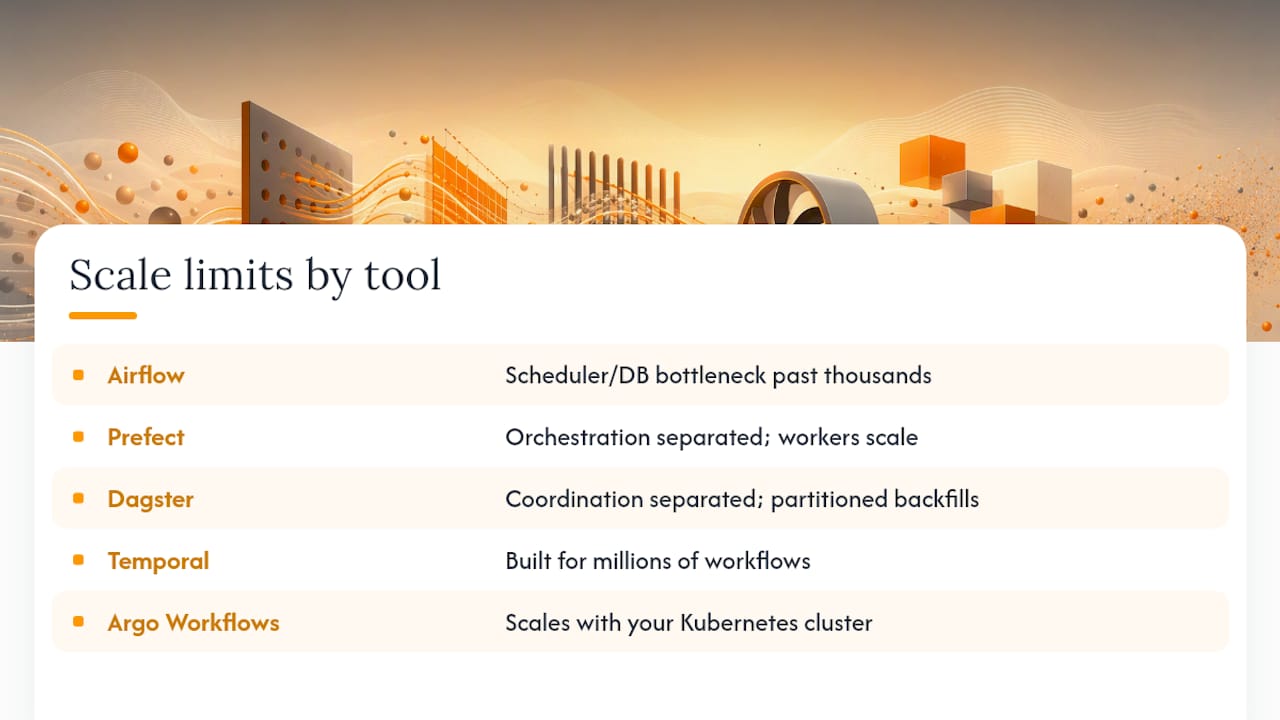
Scale limits show up in different places depending on the tool's architecture, and headline throughput numbers rarely tell you where the actual ceiling is.
Airflow's scheduler and metadata database become the bottleneck first, usually somewhere past a few thousand concurrent task instances, depending on database tuning and executor choice. Prefect's hybrid model separates orchestration state from execution, which lets it scale worker pools independently, a structural advantage for bursty ML workloads. Dagster scales similarly, with run coordination separated from compute, and its partition model keeps large backfills from becoming single monolithic jobs.
Temporal is built for durability at scale by design; its architecture assumes millions of concurrent workflow executions across long time horizons, which is why it's the default choice for stateful business processes rather than batch data jobs. Argo Workflows scales exactly as far as your Kubernetes cluster does, since it delegates scheduling to k8s itself.
Serverless options (Step Functions, Azure Data Factory) scale transparently up to service quotas, which removes capacity planning but introduces hard vendor-set ceilings you need to know before you build against them.
For agent-swarm, the scale question is different in kind: it's not about task throughput but about how many concurrent agent workers a deployment can run in isolated containers, which is a function of your own container infrastructure and the cloud plan's active-worker pricing rather than a scheduler bottleneck.
No public head-to-head benchmark covers all twelve tools under identical load, so treat any raw throughput number a vendor publishes as a starting point for your own POC, not a final answer.
Are These Tools Secure Enough for Regulated Data?
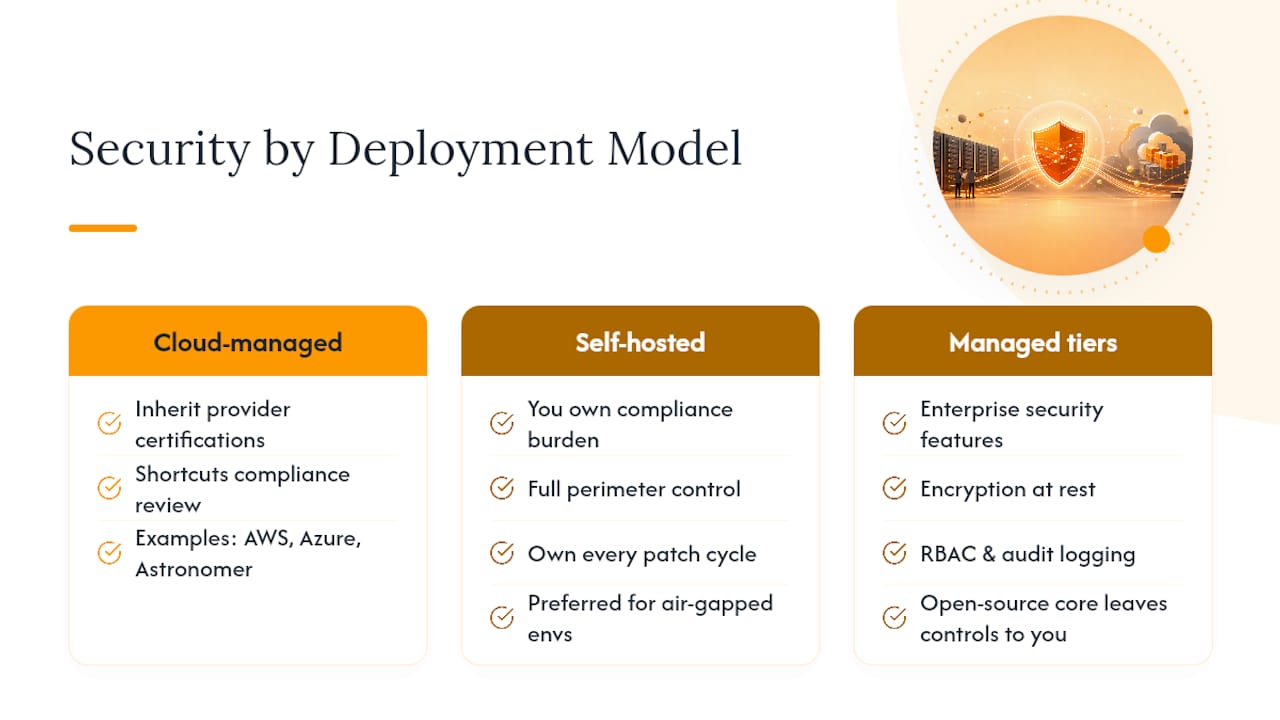
Security posture splits along deployment model more than anything else. Fully managed cloud tools (AWS Step Functions, Azure Data Factory, Astronomer) inherit their cloud provider's compliance certifications (SOC 2, ISO 27001, HIPAA-eligible services in AWS and Azure), which can shortcut a compliance review considerably if your workloads already live in that cloud.
Self-hosted tools push the compliance burden onto you, which is a feature for some teams and a liability for others. Air-gapped or heavily regulated environments often prefer a self-hosted, low-dependency single-binary orchestrator precisely because there's no external service call and no managed control plane to audit. Airflow, Luigi, Kedro, and a self-hosted Argo Workflows deployment all fall into this category: you control the perimeter entirely, but you also own every patch cycle.
Temporal and Dagster+ both offer managed tiers with enterprise security features (encryption at rest, role-based access, audit logging), while their open-source cores leave those controls to your own infrastructure.
agent-swarm's self-hosted deployment keeps agent workers in isolated containers under your own network and access controls, which matters for teams that can't send proprietary code or customer data through a third-party agent runtime. Its cloud tier shifts that boundary to agent-swarm's infrastructure, so the right choice depends on where your compliance line actually sits. Whichever tool you evaluate, ask for its specific compliance documentation rather than assuming "open source" or "cloud-managed" implies a particular certification.
What Do Real Migrations Actually Look Like?
Practitioner writeups converge on a consistent pattern: teams rarely migrate everything at once, and the ones who try usually regret it.
A common real-world sequence looks like this: legacy nightly batch jobs stay on Airflow because rewriting stable, low-change pipelines has a poor cost-to-benefit ratio. New ML training pipelines move to Prefect because data scientists want to iterate locally without redeploying a DAG. Analytics teams migrating dbt-heavy pipelines report the asset model in Dagster cutting backfill incident time from hours to minutes, because a broken model rerun no longer cascades through unrelated tables.
The recurring failure mode in these accounts isn't the new tool underperforming. It's teams underestimating how much custom operator logic and implicit scheduling behavior was baked into their existing Airflow DAGs, which surfaces only once the migration is underway. Airflow's documentation on DAG structure and XCom is worth rereading before migration, specifically to catalog what's implicit versus explicit in your current setup.
Teams adopting agent-swarm for AI-driven workflows describe a different kind of case entirely: not a lift-and-shift from Airflow, but a net-new automation layer for work that was previously manual (recurring triage, cross-tool reporting, code review assistance) because no DAG-based tool was ever going to model agent delegation cleanly.
What License Terms Apply to Each Tool?
Licensing determines both cost and how much you can modify the tool, and the differences here are sharper than they first appear.
Airflow, Luigi, Kedro, and Argo Workflows are Apache-licensed open source with no usage fees, though Argo's practical cost shows up in Kubernetes infrastructure rather than license terms. Prefect and Dagster both run open-core models: the orchestration engine is open source (Apache 2.0), while Prefect Cloud and Dagster+ are commercial managed layers on top, so enterprise features like advanced RBAC or hosted scheduling sit behind a subscription. Kestra follows a similar pattern, with an open-source core and a commercial enterprise edition.
Temporal's server is open source, with Temporal Cloud as the commercial managed option. AWS Step Functions and Azure Data Factory carry no separate license since they're proprietary managed services billed by usage. Astronomer is a commercial wrapper around open-source Airflow, meaning you're paying for managed operations, not a different license on the core engine.
agent-swarm ships as MIT-licensed open source for self-hosted deployment at no cost, with Cloud and Enterprise plans available for teams needing tailored support and integrations. The MIT license means you can modify and redistribute the core freely, which matters if your organization has a policy against copyleft dependencies in production infrastructure.
For enterprise buyers, the practical question is rarely "open source or not." It's whether the commercial tier's price scales predictably with your usage pattern, or whether it punishes growth with per-seat or per-task pricing that outpaces the value delivered.
How Steep Is the Learning Curve for Each Tool?
The learning curve correlates closely with how much the tool asks you to think in its abstractions versus your existing code.
Luigi and Kedro are the fastest onboarding for Python-fluent engineers, since both use plain Python classes and conventional project structure with little new conceptual overhead. Prefect follows closely: if your team already writes Python functions, wrapping them in @flow and @task decorators is a day's work, not a week's. Metaflow asks for a similar level of Python fluency but adds ML-specific concepts (artifacts, steps) that data scientists pick up quickly and generalist engineers take a bit longer to internalize.
Dagster has a steeper ramp because the asset model is a genuine paradigm shift from imperative DAG thinking; teams coming from Airflow often need a week or two to stop writing tasks and start defining assets. Kestra's YAML-first approach lowers the barrier for teams without deep Python investment, though anyone wanting custom logic still needs to write plugins.
Temporal and Argo Workflows carry the steepest curves on this list. Temporal requires understanding durable execution semantics and workflow replay, which is a genuinely different mental model from batch scheduling. Argo requires solid Kubernetes fluency as a prerequisite, not a nice-to-have.
agent-swarm's learning curve depends less on orchestration concepts and more on agent design: defining roles, reviews, and integration points for a lead agent and its workers. Teams already comfortable prompting and reviewing AI coding agents tend to onboard faster than teams new to agentic workflows generally.
The 3 AM Test Beats Every Feature Comparison, and following workflow visibility best practices can improve your debugging and monitoring experience.
Most orchestrator write-ups rank tools by feature checklists: connector counts, UI polish, plugin catalogs. That's the wrong axis. The question that actually predicts satisfaction a year in is narrower: when something breaks at 3 AM, how fast can one engineer, alone, figure out what happened and fix it?
That reframing changes the shortlist. Airflow's operator count stops mattering the moment you're staring at a DAG that half ran, because the debugging path (checking logs across scheduler, worker, and metadata database) is slow by design. Tools that let you reproduce a failure locally, in-process, without redeploying anything, win on this axis regardless of how their marketing page reads.
It also changes how we'd argue for agent-swarm's fit. We wouldn't pitch it as a faster Airflow, because it isn't one. We'd pitch it for the specific failure mode Airflow can't touch: recurring work that needs judgment and memory, not just a schedule. If your 3 AM problem is a broken DAG, look at Prefect or Dagster first. If your recurring problem is manual, judgment-heavy work nobody automated because no scheduler could hold the context, that's the job agent-swarm was built for.
Pick the tool that shortens your worst debugging session, not the one with the longest feature list.
— Ez.-
Ready to Trial agent-swarm? Here's What to Test First
agent-swarm gives engineering teams something none of the DAG-based tools on this list offer: persistent memory that compounds across every agent run, so your automation gets sharper instead of resetting to zero each time. Where Airflow and its scheduler-based competitors ask you to encode logic into static tasks, agent-swarm's lead agent breaks down objectives dynamically and hands them to specialized workers running Claude Code, Codex, or OpenCode, each in its own container.
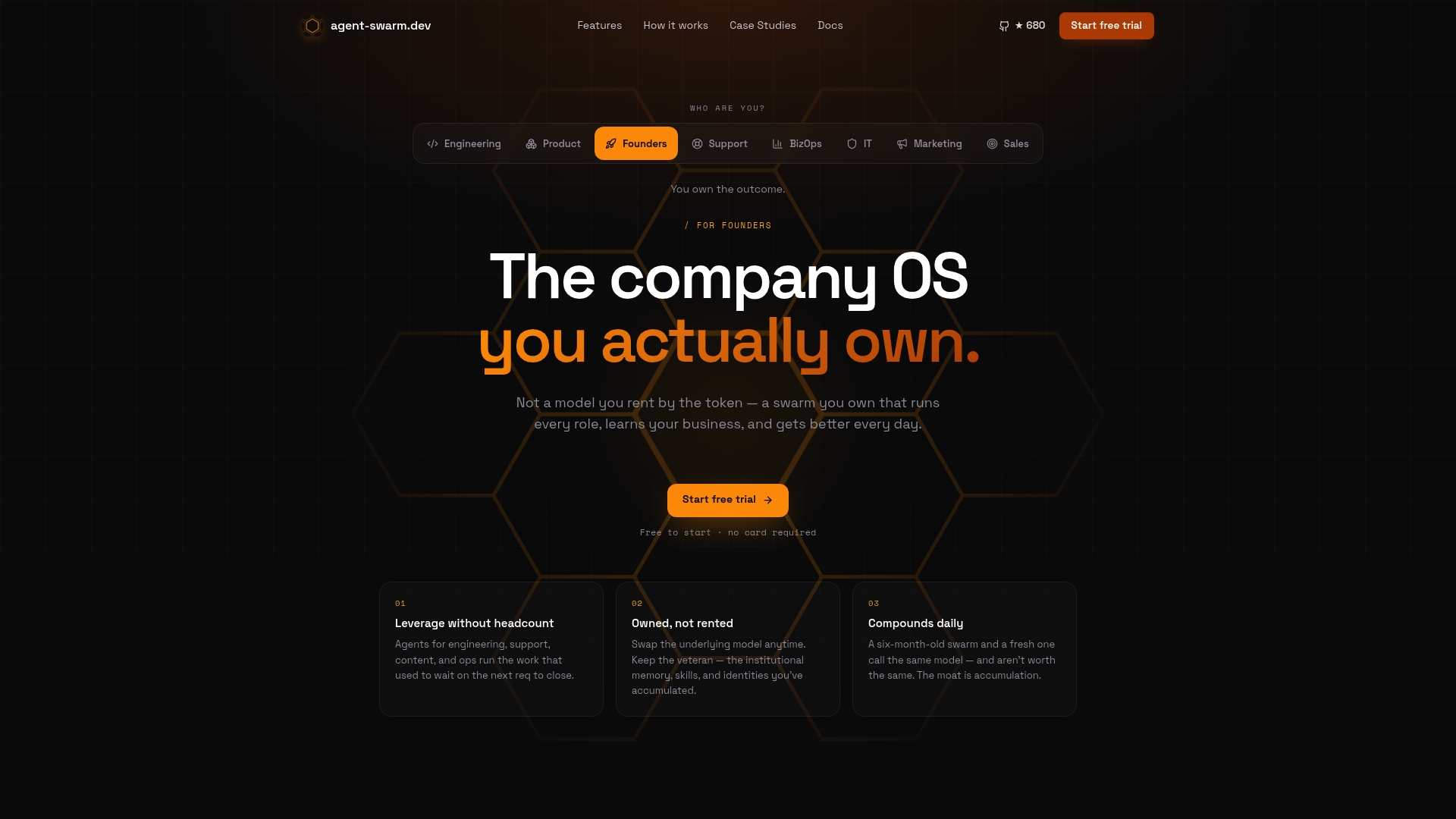
Running a real evaluation takes less effort than most teams expect. Self-host the open-source core for free, or spin up the Cloud plan, priced per month by active worker, and connect it to tools like Slack, GitHub, or Linear. Then run three real recurring workflows for two weeks: one code review or triage task, one cross-tool reporting job, and one multi-step operations task. Measure whether memory retention actually reduces repeated setup time on the second and third runs, and compare that against your current manual process's MTTR.
For teams weighing agent-swarm against a rented AI generalist or a single hired AI engineer, the Manus comparison and Devin comparison lay out the owned-team-versus-rented-tool trade-off directly. See real session outcomes on the examples page, or check current pricing and plans to scope a two-week trial against your own workload.
Sources
Before you commit to a candidate, read the source material directly rather than relying on secondhand summaries.
- Modern Data Orchestrator Platform | Dagster
- Airflow vs Prefect: 2026 Comparison Guide
- kestra GitHub repository
FAQ
What Is Better Than Airflow?
No single tool is universally better. Prefect tends to win for dynamic Python and ML flows, Dagster wins for dbt-heavy analytics needing asset lineage, and agent-swarm is the stronger fit when the job is multi-agent, memory-persistent automation rather than scheduled data pipelines.
Is Airflow Still Relevant?
Yes. Airflow remains the enterprise default with the broadest provider ecosystem, and its managed offerings (MWAA, Cloud Composer) keep it viable for teams that don't want to rewrite stable, low-change pipelines.
Does Airbnb Still Use Airflow?
Airbnb created Airflow internally and open-sourced it, and the platform remains widely deployed across large data organizations that value its mature provider ecosystem, though individual company tool stacks change over time and specific current usage isn't publicly detailed here.
Can dbt Replace Airflow?
Not entirely. dbt handles SQL transformation logic but doesn't schedule, retry, or orchestrate broader pipelines on its own, which is why teams typically pair dbt with an orchestrator like Dagster or Airflow rather than treating it as a standalone replacement.
What Does agent-swarm Cost Compared to These Alternatives?
agent-swarm's self-hosted core is free and open source under MIT, while the Cloud plan runs from $30 to $100 per month based on active workers, listed on the pricing page. Enterprise pricing is available on request.
Recommended
Related field notes
Seguridad en IA autohospedada: guía técnica para equipos
Guía técnica para proteger la IA autohospedada: aplica confianza cero al proxy, verifica pesos y SBOM, aísla ejecución y registra eventos en SIEM.
Self Hosted AI Agents With Auditable, Persistent Memory for Engineers
A practical shortlist for engineering teams needing self-hosted AI agents that keep owned, auditable memory. Includes deployment runbooks, security...
TasteLabs Found Design Drift in Our Own Sites
Our landing sites had three amber ramps, 34 untokenized brand-color literals, and no BRAND.md files. One fix PR has merged; one is still open.