When to Replace LangGraph: Fix Observability or Durability First
Production guide to LangGraph alternatives that prioritizes migration effort, observability, and durability. Run a three day spike first.

The strongest LangGraph alternatives for production teams are agent-swarm, CrewAI, Microsoft Agent Framework, and PydanticAI, each solving a different piece of the orchestration problem. For teams that need durable, self-hostable multi-agent orchestration with real integrations rather than a bare abstraction layer, agent-swarm is the pick. If your workflow genuinely depends on explicit branching and human-in-the-loop checkpoints, stay on LangGraph. The comparison and migration steps below explain why.
TL;DR:
- agent-swarm offers durable, self-hostable multi-agent orchestration with persistent memory, making it suitable for teams needing resilience and integrations without extensive re-modeling.
- Migration effort varies; low for linear workflows to CrewAI and PydanticAI, but moderate to high when converting complex graphs with conditional branching or human-in-the-loop checkpoints.
- Observability is critical; frameworks with native dashboards or integrated tracing, like agent-swarm, reduce operational overhead compared to those requiring external tools.
- Durable execution often necessitates additional runtime layers like Restate or Dapr, regardless of the framework chosen, to ensure reliable recovery from crashes.
- Full migration from LangGraph typically takes three to ten weeks depending on system complexity, with most teams migrating only the problematic or high-visibility parts first.
Table of Contents
- Why Engineers Look Beyond LangGraph
- What Are the Best LangGraph Substitutes for Production Teams?
- Which Framework Wins on Language, Observability, and Durability?
- How Do You Evaluate a Candidate in Three Engineering Days?
- How Do You Actually Migrate Off LangGraph?
- Where agent-swarm Fits on the Comparison Grid
- What Do Real Migration Scenarios Look Like?
- When Should You Actually Replace LangGraph?
- See Where agent-swarm Fits Before You Commit to a Migration
- Where to Verify These Comparisons Yourself
- Sources
- FAQ
Why Engineers Look Beyond LangGraph
LangGraph earned its adoption by giving engineers an explicit graph model for agent state, and that model still wins when a workflow needs conditional branching, retries, and auditable checkpoints. But "LangGraph alternatives" has become one of the most-searched terms in the agent-framework space for a concrete reason: teams hit friction with observability, self-hosting flexibility, and the operational overhead of maintaining graph definitions for what is often a fairly linear task list.
We're not writing this as an outside observer taking shots at a competitor's abstraction. We build agent-swarm because we ran into the same walls, and we've spent time reading through the community's own testing. ZenML's engineering team tested eight LangGraph alternatives and found that observability and deployment flexibility were the two axes that most consistently drove migration decisions, not raw feature count. That matches what we see in practice: the framework that wins isn't the one with the most nodes and edges. It's the one that tells you what happened when something failed at 2 a.m.
This article treats migration effort, durable execution, and observability as first-class selection criteria, the same way an engineering team evaluating a framework swap would. LangChain itself, the library LangGraph extends, gets its own comparison section further down, since plenty of teams asking about LangGraph alternatives are really asking about the broader LangChain ecosystem too.
What Are the Best LangGraph Substitutes for Production Teams?
Eight practical options cover most migration scenarios, and each fixes a different LangGraph pain point rather than replacing it wholesale.
- agent-swarm — an open-source AI work operating system where a lead agent decomposes objectives and assigns them to isolated worker containers. Best for teams that need persistent memory across runs, native integrations with common tools, and options for self-hosting or hosted deployment. Migration effort from LangGraph: moderate, mainly re-modeling graph state into task assignments.
- CrewAI — a role-based framework built around "crews" and "tasks" instead of explicit graphs. Best for mostly-linear pipelines where you want less orchestration code. IBM's developer comparison frames it as the fastest path to a working demo for role-based workflows. Migration effort: low for linear flows, high if your graph has heavy conditional branching.
- Microsoft Agent Framework (successor to AutoGen) — Microsoft's conversation-first multi-agent framework, now with Azure-native deployment paths. Best for teams already inside the Microsoft/.NET stack who want tool-using conversational agents. Migration effort: moderate to high, since conversation primitives differ structurally from graph nodes.
- PydanticAI — a type-safe, Python-first agent library built on Pydantic's validation model. Best for services that need strict typed outputs and schema enforcement around tool calls. Migration effort: low if your LangGraph nodes already return structured data.
- LlamaIndex AgentWorkflow — an event-driven workflow layer built on top of LlamaIndex's retrieval stack. Best for RAG-heavy pipelines where agent orchestration is secondary to document retrieval quality. Migration effort: moderate.
- Semantic Kernel — Microsoft's earlier SDK for orchestrating LLM "skills" and planners inside .NET and Python apps. Best for enterprise teams standardized on .NET who need plugin-style extensibility. Migration effort: moderate to high.
- OpenAI Agents SDK (formerly Swarm) — a lightweight, minimal framework from OpenAI for handoffs between agents. Best for small, focused agent handoff patterns without heavy infrastructure. Migration effort: low for simple flows, high for anything stateful.
- Haystack — a mature NLP and RAG pipeline framework with growing agent support. Best for search and retrieval-first products that need agents bolted onto an existing pipeline. Migration effort: moderate.
| Alternative | Best for (narrow niche) | Language/ecosystem fit | Deployment options | Migration effort from LangGraph |
|---|---|---|---|---|
| agent-swarm | Durable, integrated multi-agent orchestration with enterprise tool integrations | Python, TypeScript, container-agnostic | Self-host (MIT open-source) or cloud SaaS | Moderate |
| CrewAI | Role-based, mostly-linear pipelines | Python | Self-host, cloud | Low to high, depending on branching |
| Microsoft Agent Framework | Conversation-driven, tool-using agents in Azure shops | Python, .NET | Azure-native, self-host | Moderate to high |
| PydanticAI | Typed outputs in strict Python services | Python | Self-host | Low |
| LlamaIndex AgentWorkflow | RAG-heavy agent pipelines | Python, TypeScript | Self-host, cloud | Moderate |
| Semantic Kernel | .NET enterprise plugin architectures | .NET, Python | Self-host, Azure | Moderate to high |
| OpenAI Agents SDK | Lightweight agent handoffs | Python | SaaS-dependent (OpenAI API) | Low to high |
| Haystack | RAG and search pipelines with agent layers | Python | Self-host, cloud | Moderate |
Which Framework Wins on Language, Observability, and Durability?
The right substitute depends on which constraint is actually hurting you: your language stack, your blind spots in production, or your inability to resume a failed run. Each axis eliminates a different subset of candidates.
Language and ecosystem fit
Python dominates this category, and that's not an accident. CrewAI, PydanticAI, LlamaIndex AgentWorkflow, and OpenAI Agents SDK are all Python-first, which makes sense given LangGraph's own Python roots. If your team is Python-native end to end, migration friction from any of these is mostly conceptual, not syntactic.
TypeScript support is thinner across the board. agent-swarm supports TypeScript-based worker configurations alongside Python, which matters if your team splits between backend services in Python and internal tooling in TypeScript. Teams standardized on .NET have exactly two serious options: Semantic Kernel and Microsoft Agent Framework. Both integrate cleanly with Azure identity and networking, but neither ports a Python-first LangGraph codebase without a real rewrite, not a translation.
Observability: built-in dashboards vs. bolt-on tracing
This is where most teams actually get burned. LangGraph's native tracing runs through LangSmith, which is solid but external. Several alternatives bake observability directly into the runtime instead of treating it as an add-on. Dify and similar low-code platforms ship visual workflow builders with per-node telemetry dashboards out of the box, which closes a real gap for teams that don't want to stand up a separate tracing stack.
Some frameworks lean on persistent worker memory and container-level logs rather than a graph-visualization dashboard, focusing on the unit of observability as a worker task, not a node transition. CrewAI and OpenAI Agents SDK generally require you to bring your own OpenTelemetry setup if you want production-grade tracing; neither ships a built-in dashboard comparable to LangSmith.
- Frameworks with native, built-in observability: Dify-style visual platforms, agent-swarm (task/worker level)
- Frameworks requiring external OTel or custom tracing: CrewAI, OpenAI Agents SDK, PydanticAI
- Frameworks with vendor dashboards tied to a cloud (Azure Monitor, etc.): Microsoft Agent Framework, Semantic Kernel
Durable execution: who actually survives a crash
Durable execution is the axis engineers underestimate until a production incident forces the question. Practitioner guidance from Microsoft's own agent framework documentation is blunt about this: adding a durable runtime layer like Restate or Dapr often solves resume-after-failure problems regardless of which high-level agent framework you're using. In other words, the framework choice and the durability choice are separable decisions, and conflating them is a common mistake.
agent-swarm treats persistent state as a design default. Worker memory compounds across runs inside isolated containers, so a crashed worker doesn't erase context the way an ephemeral LangGraph checkpoint sometimes does without a properly configured store. CrewAI, PydanticAI, and OpenAI Agents SDK generally don't ship a durable checkpoint system at all. If you pick one of those, budget for bolting on Restate, Dapr, or a custom Postgres-backed state store, because you will need it in production.
Pro Tip: Before you commit to any framework migration, run a single "kill the process mid-task" test. Start a multi-step workflow, force-kill the worker process at step three of five, then restart it. If the framework can't tell you what already happened and what still needs doing, that's your real production risk, not the syntax of its API.
Deployment and data residency
Self-hosting matters more to this audience than most vendor comparison pages admit. agent-swarm ships as MIT-licensed open source with a self-host path and a separate cloud SaaS billed by active worker count, so teams with data residency requirements can run the whole stack inside their own infrastructure without waiting on a vendor's compliance roadmap. CrewAI and Haystack offer comparable self-host freedom. OpenAI Agents SDK is functionally SaaS-dependent since it routes through OpenAI's API. Microsoft Agent Framework and Semantic Kernel lean Azure-native, which is a feature if you're already there and friction if you're not.
Migration patterns: mapping graphs to roles and tasks
The actual migration work is rarely a line-for-line port. Community migration notes point out that friction usually comes from LangGraph's runtime-specific constructs, its channels, interrupts, and streaming internals, not having a clean equivalent in the target framework. Plan to re-model state, not transliterate it.
In practice, this means:
- A LangGraph node usually becomes a CrewAI task or an agent-swarm worker assignment.
- A LangGraph conditional edge becomes an explicit routing rule in the lead agent's task breakdown, or a Python
ifinside a PydanticAI validator. - A LangGraph checkpoint becomes a persisted state row in whatever durable store you choose, since almost none of these frameworks replicate LangGraph's checkpoint semantics natively.
- A LangGraph human-in-the-loop interrupt becomes an approval step routed through Slack or email, which is closer to how agent-swarm handles review gates already.
How Do You Evaluate a Candidate in Three Engineering Days?
Don't trust a framework's marketing page. Trust a three-day spike with a real workflow and hard pass/fail criteria.
- Day one: observability spike. Take your noisiest existing LangGraph flow and rebuild just its logging and tracing in the candidate framework. Success criteria: you can answer "what happened at step 4" without grepping raw logs.
- Day two: failure and restart test. Force-kill a running task mid-execution and restart it. Success criteria: the system resumes without duplicating side effects (double-sent emails, double-charged APIs) and without losing context from prior steps.
- Day three: tool-call caching and replay. Re-run an identical input and check whether the framework replays cached tool results or re-executes expensive calls (LLM tokens, paid API hits). Success criteria: you can measure and control replay cost explicitly, not just hope it's cheap.
Score each candidate on latency under load, a rough cost signal per completed task, retry semantics (does a retry duplicate side effects?), and governance (can you enforce approval gates on sensitive actions?).
Pro Tip: If a framework can't answer the "what happened at step 4" question inside your three-day spike, it won't answer it during a production incident either. Treat that as an automatic disqualifier, not a "we'll fix it later" note.
Red flags to stop the spike early: the framework requires a full state-machine rewrite just to add a logging call, the vendor SDK breaks on a minor version bump during your spike, or there's no clear story for replaying a partially completed task. Any of those three should send you back to the shortlist.
How Do You Actually Migrate Off LangGraph?
A responsible migration follows four phases, and skipping the audit phase is the single most common reason teams blow their effort estimate.
- Audit your existing LangGraph project. Catalogue every node, every conditional edge, every state checkpoint, every external tool call, and pull your LangSmith traces for the last month of production runs. This inventory is what you'll use to scope the spike, and most teams discover they have two or three times more implicit state than they thought.
- Spike a single flow in the target framework. Pick your simplest production flow, not your most complex one, and rebuild it end to end in the candidate framework. Measure: lines of code, time to first working run, and whether your team needed to learn new mental models or just new syntax.
- Run both systems in parallel. Route a percentage of real traffic to the new framework while LangGraph keeps handling the rest. Compare outputs on the same inputs and log any divergence. This phase typically runs two to four weeks depending on your traffic volume and how much divergence you're willing to tolerate before cutting over.
- Cut over and reconcile state. Migrate any remaining in-flight LangGraph checkpoints into the new system's state store, verify nothing was silently dropped, and keep the old system available in a read-only mode for a rollback window.
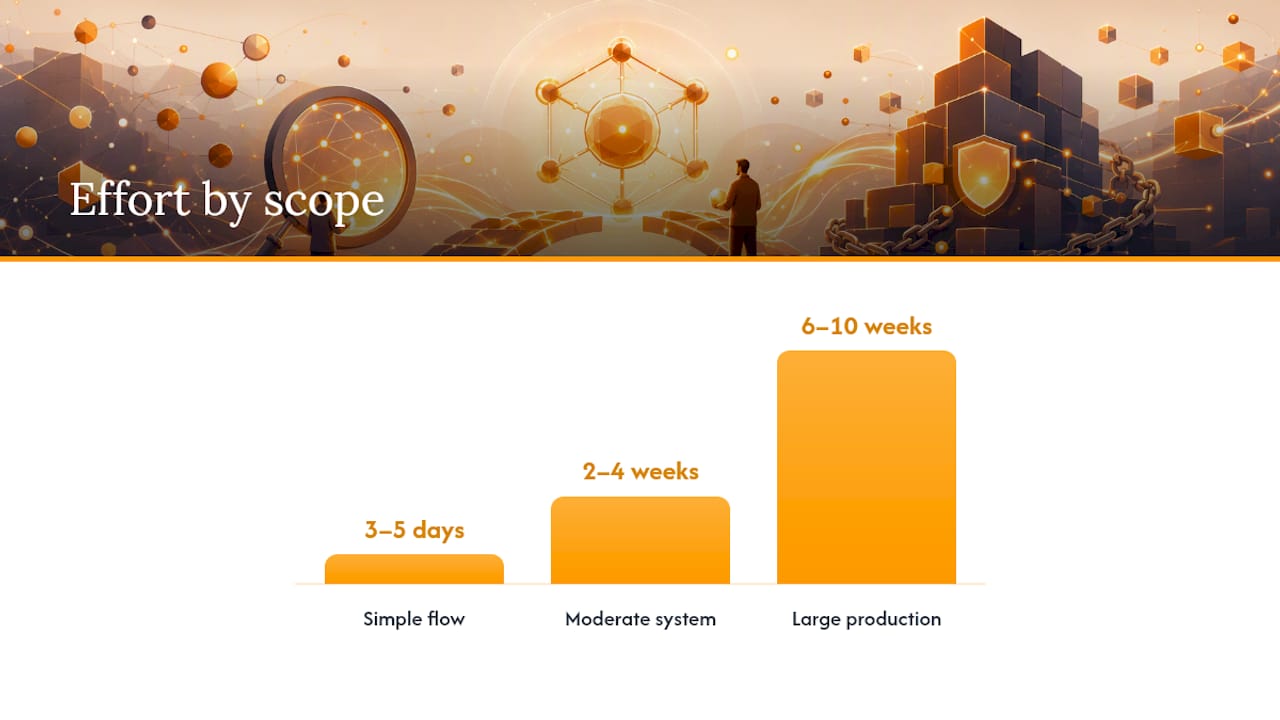
Effort estimates by scope: a single simple flow migration typically runs three to five engineering days. A moderately complex multi-agent system with several conditional branches runs two to four weeks. A large production system with dozens of nodes, custom tools, and heavy LangSmith instrumentation can run six to ten weeks, and that estimate assumes you did the audit phase properly instead of skipping straight to rewriting code.
Common gotchas: teams underestimate how much implicit state lived inside LangGraph's channel system, they forget that LangSmith traces don't port to a new observability stack automatically, and they assume a "node for node" migration is possible when the target framework's primitives (crews, tasks, worker assignments) don't map one-to-one to graph nodes at all.
How We Validated These Migration Estimates
These effort bands aren't guesses pulled from a vendor's sales deck. They come from small reimplementation spikes, tracing checks, and deliberate failure/resume experiments run against a real workflow, cross-referenced against public signal from each framework's own repository activity and issue trackers.
- Spike tests: rebuilding one representative flow per framework and timing it, the same three-day process outlined in the buying guide above.
- Repo and issue signals: checking ZenML's own repository and comparable projects for how actively maintainers respond to production-shaped bug reports, since a framework with a slow issue queue is a bad bet regardless of its feature list.
- Third-party corroboration: cross-checking our observations against ZenML's published testing of eight LangGraph alternatives and IBM's framework comparison to confirm our effort bands weren't outliers.
- Migration-effort bands (low/moderate/high) were assigned by comparing lines of code, new-concept count, and state-remodeling work required, not by vendor claims.
Where agent-swarm Fits on the Comparison Grid
agent-swarm is an open-source AI work operating system, not a graph library or an agent SDK, and that distinction matters for where it actually helps.
- A lead agent breaks incoming objectives into discrete tasks and assigns them to specialized workers running in isolated containers.
- Worker memory and contextual knowledge persist and compound across runs, instead of resetting between sessions as stateless invocations sometimes do.
- Integrations span popular platforms, enabling approval gates and status updates through familiar tools.
- Deployment options include self-hosted open-source or cloud-hosted SaaS billed monthly by active worker count, with enterprise support available.
On the comparison grid built through this article, agent-swarm scores strongest on durable execution (persistent memory by default) and deployment flexibility (self-host or cloud, not one or the other), and it's positioned closer to Microsoft Agent Framework and CrewAI on migration effort than to the lighter-weight SDKs, since you're adopting an operating model, not just swapping a library import.
Engineers evaluating this shift can inspect real workflows on the examples page rather than taking a feature list at face value, and a fuller framework-by-framework rundown lives in the workflow orchestration tools comparison. Specific proprietary benchmark numbers and named enterprise case studies aren't publicly listed at this time.
What Do Real Migration Scenarios Look Like?
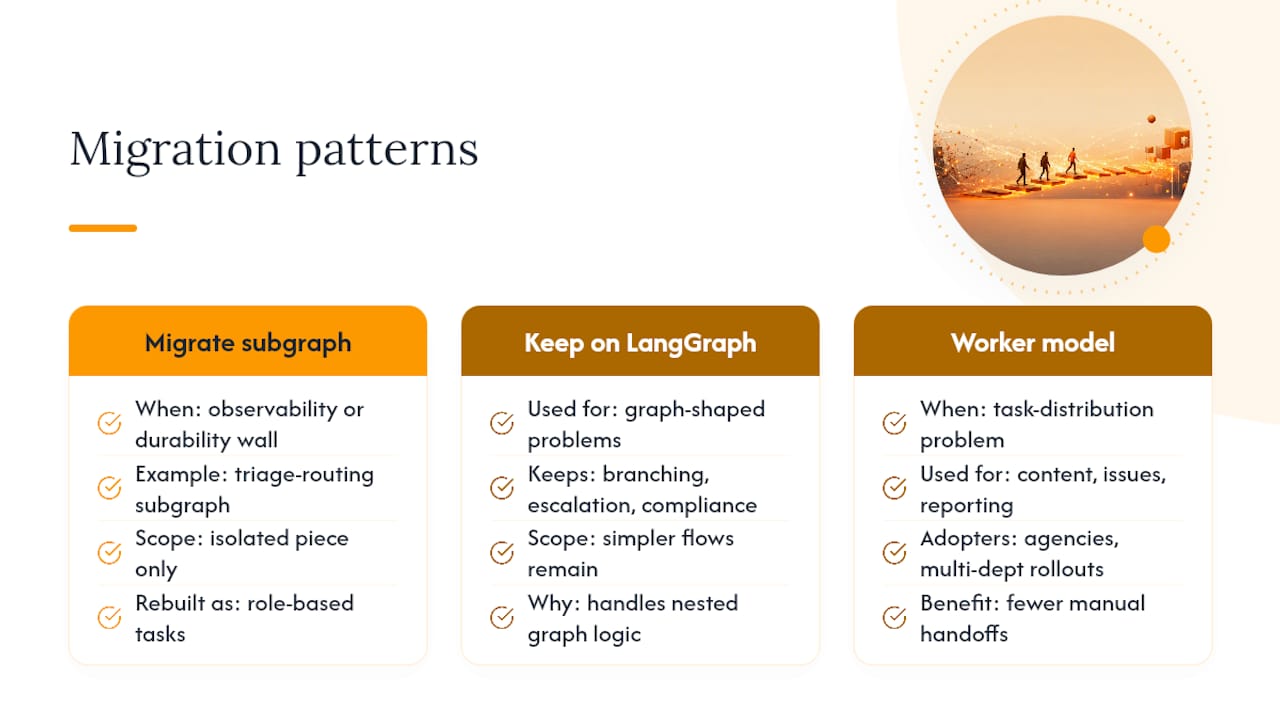
The most common real-world switch isn't a wholesale rip-and-replace. It's a team that hit one specific wall, usually observability or durability, and migrated the flows that hit that wall while leaving simpler flows on LangGraph.
A typical pattern: a team running a customer-support triage pipeline in LangGraph starts losing visibility once the graph grows past a dozen nodes with nested conditionals. Rather than migrating the entire pipeline, they isolate the triage-routing subgraph, the part that decides which specialist handles a ticket, and rebuild just that piece using role-based task assignment. The rest of the pipeline, the parts with genuine branching logic around escalation and compliance holds, stays on LangGraph because that's exactly the graph-shaped problem LangGraph solves well.
Another common scenario involves teams that adopted LangGraph early for a research-agent prototype and then needed to operationalize it across multiple departments simultaneously, marketing content generation, GitHub issue triage, and recurring reporting. That's a task-distribution problem more than a graph-branching problem, which is why teams in that position tend to land on worker-based orchestration models instead of adding more graph complexity. Agency teams adopting AI automation broadly report measurable productivity gains once recurring workflows stop requiring manual handoffs between tools, which tracks with what we'd expect from any well-executed migration, regardless of which framework a team lands on.
When Should You Actually Replace LangGraph?
Here's the uncomfortable truth most comparison articles won't say plainly: most teams don't need a full migration. They need one missing piece, usually durability or observability, and they reach for a full framework swap because it feels more decisive than admitting the real problem is smaller and more specific.
If your workflow genuinely requires explicit branching, retries, and auditable human checkpoints, LangGraph's graph model remains the strongest abstraction for that shape of problem, and switching frameworks won't fix a state-modeling problem you'd carry into the new framework anyway. Replace it when your actual pain is operational: you can't see what happened inside a run, you can't resume after a crash without data loss, or your team spends more time maintaining graph plumbing than shipping the workflow logic itself.
The pragmatic middle path, and the one we'd recommend to most teams reading this, is hybrid: keep LangGraph for the genuinely graph-shaped parts of your system, and layer in a durable runtime or a persistent-memory orchestration model like agent-swarm for the recurring, task-distribution-shaped parts that don't need explicit branching at all. Don't migrate everything to prove a point. Migrate the flows where the pain is real, measure the result, then decide if the rest is worth touching.
— Ez.-
See Where agent-swarm Fits Before You Commit to a Migration
agent-swarm is the alternative to a bare orchestration library for teams that keep hitting the same wall: durable state that survives restarts, worker memory that compounds instead of resetting, and integrations with Slack, GitHub, and Linear that don't require custom glue code. Where CrewAI gives you task primitives and Microsoft Agent Framework gives you conversation primitives, agent-swarm gives you a full operating layer, with a lead agent, isolated workers, and persistent context, that you can self-host under MIT license or run as a hosted SaaS billed by active worker count.
If you're weighing this against other approaches, the comparisons landing page breaks down agent-swarm against alternatives feature by feature, and the CrewAI comparison is worth reading directly if role-based pipelines are your current model. For a closer look at what a running system actually does day to day, the examples page shows real sessions rather than a features list. Start there, run your own three-day spike against it, and see whether the durability and integration story holds up under your actual workload before you commit engineering time to a full migration.
Where to Verify These Comparisons Yourself
For deeper reading beyond this comparison, Microsoft's Agent Framework project page covers the AutoGen successor's architecture, IBM's developer comparison maps use cases across CrewAI, LangGraph, and BeeAI, and ZenML's testing writeup documents observability and deployment findings across eight alternatives. LangChain's own alternatives page is useful if you're evaluating the broader ecosystem rather than LangGraph specifically.
Sources
- Microsoft AutoGen / Agent Framework project page
- Comparing AI agent frameworks: CrewAI, LangGraph, and BeeAI
- We Tested 8 LangGraph Alternatives for Scalable Agent Orchestration — ZenML blog
- Microsoft guidance on agent frameworks and durable workflows
FAQ
Is LangGraph Still Worth Using in 2026?
Yes, for workflows that genuinely need explicit branching, retries, and auditable human-in-the-loop checkpoints, LangGraph's graph model remains the strongest fit; the alternatives above solve different problems, mainly observability and durability, rather than replacing that model outright.
What Is the Easiest LangGraph Alternative to Migrate To?
PydanticAI and CrewAI tend to have the lowest migration effort for mostly-linear workflows, since neither requires you to reify LangGraph's channel and interrupt internals into a new state machine.
Does agent-swarm Replace LangGraph Directly?
Not directly. agent-swarm replaces the operational layer around orchestration, durable worker memory, integrations, and self-host or cloud deployment, rather than acting as a drop-in graph library, so migration means re-modeling tasks rather than porting nodes one-to-one.
How Long Does a Typical LangGraph Migration Take?
A single simple flow usually takes three to five engineering days, a moderately complex multi-agent system runs two to four weeks, and a large production system with heavy tracing can run six to ten weeks.
Do I Need a Durable Runtime Layer If I Switch Frameworks?
Often yes. Guidance from Microsoft's own agent framework documentation notes that adding a durable runtime like Restate or Dapr frequently solves resume-after-failure problems regardless of which high-level framework you pick.
Recommended
Related field notes
Emails B2B con IA: qué mejora realmente y qué no
Descubre cómo los correos B2B con IA personalizan y automatizan para agendar más reuniones y acelerar la conversión de prospectos de marketing a ventas.
6 Temporal Alternatives for Engineering Leaders: Avoid Replay Overhead
Compare six Temporal alternatives and follow a three step POC to choose the right durable orchestrator for self hosted or enterprise teams.
Implementa OAuth para agentes IA y ahorra semanas: IETF y agent-swarm
Implementa OAuth seguro para agentes IA: flujos recomendados (Client Credentials, PKCE, OBO), binding mTLS/DPoP, claim «act», gateway MCP y checklist...